
If you own a home or condo in Toronto, you have to tell the City every year whether it was occupied or vacant, even when you live in it. A home that sat empty for more than six months without an exemption is taxed at 3% of its assessed value. A home that is never declared is treated as vacant. That is the rule behind the Vacant Home Tax (VHT), and it catches more people than you would expect, including owners who simply forgot a form.
I work with Toronto owners who are buying a second home on Lake Simcoe, selling a Toronto condo to move to Innisfil, or holding an investment unit. They ask about the VHT often. This guide covers what the tax is, how it is calculated, what counts as occupied, how to file, and where the traps are.
TL;DR
- The City of Toronto’s VHT is 3% of the property’s Current Value Assessment (CVA) since the 2024 taxation year. It applies to homes in Toronto only.
- Every Toronto residential owner must declare each year, including owners living in the home. No declaration means the City treats the property as vacant.
- A home is safe if it was your principal residence, or a tenant’s or family member’s, for at least six months of the year. Specific exemptions exist for death, care, renovation, sale and more.
- Declarations are normally due April 30 of the year after the one they cover. A false declaration can bring a fine of up to $10,000 plus the tax owing.
- A cottage or condo at Friday Harbour is in Innisfil, so the Toronto tax does not apply to it. Your Toronto home still has to be declared.
What the Toronto Vacant Home Tax is
The VHT is an annual municipal tax on residential properties in Toronto that sat vacant for more than six months of a calendar year. The City’s Vacant Home Tax program page says every owner of a residential property in Toronto must declare each year whether it was occupied or vacant, even if it is their principal residence. The tax was brought in under By-law 97-2022 at a rate of 1% of assessed value. The rate is now three per cent for the 2024 taxation year onward.
The City’s 2024 program announcement puts the number of properties needing an annual declaration at about 820,000. That is why most owners meet the VHT as a yearly chore rather than a tax bill.
Who does not need to declare
The City says declarations are not needed for:
- properties fully assessed as multi-residential, commercial or industrial
- vacant land without a structure
- parking spaces
- condominium lockers
If you own more than one Toronto residential property, you file one declaration per property. Owners who have a Toronto home and a rental condo often file twice and think once is enough.
How the 3% is calculated
The tax is the CVA multiplied by 0.03. The CVA is the value the Municipal Property Assessment Corporation puts on your property, and it is printed on your property tax bill. It is not what the home would sell for today.
Some worked examples at the 3% rate:
| Current Value Assessment | Vacant Home Tax if taxable |
|---|---|
| $700,000 | $21,000 |
| $1,000,000 | $30,000 |
| $1,500,000 | $45,000 |
The $1,000,000 and $1,500,000 figures match the examples in a Toronto tax lawyer’s guide. The amount is not pro-rated by months. If the property is vacant for more than six months and no exemption applies, the full year’s tax applies.
The rate has not always been 3%. It started at 1%, then tripled. Rates can change by City Council decision, so check the City’s page for the year you are filing rather than relying on an older article. Some pages still showing 1% are out of date.
What counts as vacant, and what counts as occupied
The by-law, as set out in Toronto Municipal Code Chapter 778, treats a unit as vacant when, for more than six months of the year, no one uses it as a principal residence and it is not occupied by tenants for at least six months in total. It also says a unit is deemed vacant if the owner does not file the declaration or provide information the City demands.
According to the City’s program page, a property is not taxed if it is:
- Your principal residence for at least six months. Snowbirds and owners who travel or work away still qualify.
- Occupied by a tenant. The tenant needs a written agreement of at least 30 days, and total occupancy must reach at least six months.
- Occupied by a family member or friend who uses it as their principal residence for at least six months.
The 30-day written agreement matters for anyone who rents on a nightly or weekly basis. Stays shorter than 30 days do not meet the tenant test as the City describes it. If you run a furnished or short-term unit in Toronto, plan your occupancy around this rule and your tax reporting. Our guide to short-term rental taxes in Canada covers the income side.
The exemptions, and the paperwork behind each
Exemptions are not automatic. You claim them on the declaration and keep the proof. Taxlawcanada notes that the City audits declarations and expects records to be kept for three years. From the City’s program page, the exemptions and their documents are:
| Situation | What the City looks for |
|---|---|
| Death of a registered owner (up to three consecutive years) | Death certificate |
| Principal resident in care for at least six months (up to two years) | Letter from the facility and proof of prior principal residence |
| Major renovation preventing occupancy for at least six months | Description of the work, invoices and permits, with work actively under way |
| Complete transfer of legal ownership in the year | Land transfer deed |
| Owner or spouse working full-time in Toronto for at least six months, with a principal residence outside the GTA | Proof of residence and an employer letter or contract |
| Court order preventing occupancy for at least six months | Copy of the order |
| Vacant new developer inventory (from 2023) | Sales listing and proof of developer status |
| Medical secondary residence (from 2024) | Proof of an out-of-GTA principal residence and a completed Medical Treatment Certificate Form |
Two details trip people up. A transfer must be a complete change of legal ownership. The City’s page says name changes or adding or removing owners do not qualify. And a renovation exemption needs permits and visible work, not an intention to renovate.
How to file, and when
Declarations cover a calendar year and are due by April 30 of the following year. The City’s news release for the 2026 declaration period states that declarations for 2026 are due April 30, 2027. The portal opens in the fall, so you can file as soon as the year you are declaring is nearly done. Check the City’s page for the current window.
You can file:
- Online, using the assessment roll number and customer number from your property tax bill.
- By phone through 311.
- In person at a Tax and Utility Payment Counter at City Hall or a civic centre.
An authorized representative can file for you. That helps if you are travelling, if you own from abroad, or if a lawyer or accountant manages your affairs.
What I tell my clients: file early, and take a screenshot or save the confirmation. It takes minutes for a home you live in, and it removes the biggest risk, which is that silence means vacancy.
What happens if you miss it or get it wrong
If nothing is filed by April 30, the City assumes the property was vacant and issues a VHT bill. A false declaration, or a failure to provide information the City requests, can result in a fine of up to $10,000 on top of any tax owing, according to the City’s program page.
To dispute a bill, you submit a Notice of Complaint. The City’s Tax and Utilities Answers page says it can be mailed to Revenue Services, Vacant Home Tax Complaints/Appeals, 5100 Yonge St., Toronto, ON M2N 5V7, with your roll number, address, signature and the reason for the complaint. If the complaint is refused, you can appeal to the Appellate Authority within 90 days. The appeal is heard in writing and the City says that decision is final. Disputes have deadlines tied to each year’s bill, so read the notice you receive the day it arrives.
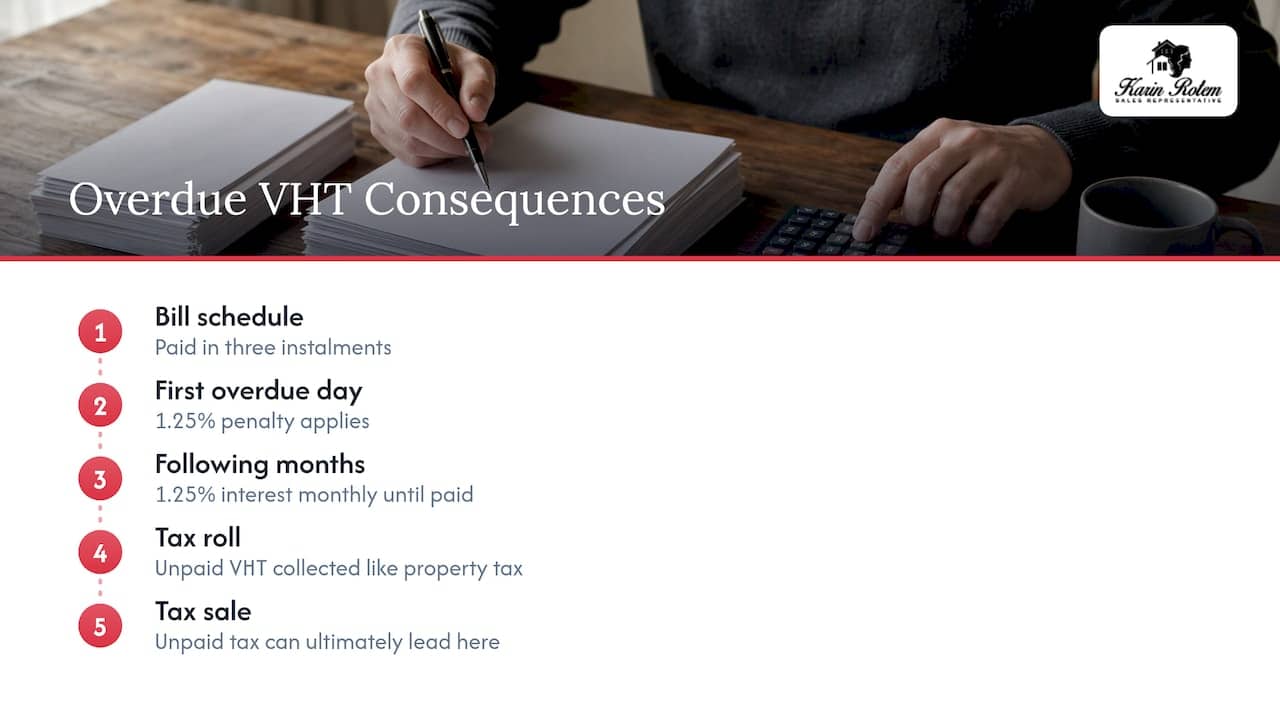
Bills are paid in three instalments. A 1.25% penalty applies on the first day a payment is overdue, then 1.25% interest on the first day of each following month until paid. The City’s 2021 design report explains that unpaid VHT is added to the tax roll and collected like property tax, which can ultimately lead to the tax sale process.
The by-law also lets the City reassess later. Under By-law 97-2022, it can reassess within three years, and where misrepresentation, neglect, carelessness, wilful default or fraud is established, it can reassess at any time. A careless declaration this year can come back.
Renting, renovating, selling and second homes
The City’s rules play out differently depending on what you are doing with the property.
Renting it out. A tenant under a written agreement of at least 30 days, with total occupancy of at least six months, keeps the unit out of the tax. Gaps between tenants count. If you plan to renovate between tenants, track the months. Our look at furnished rental demand in Toronto shows how landlords price when they want occupancy to stay steady.
Renovating. Work needs to prevent occupancy for at least six months, with permits issued and work actively carried out. Keep invoices dated across the period.
Selling. A complete transfer of legal ownership in the year is exempt. If you are selling a Toronto home and moving north, that exemption is one reason to file accurately in the year of closing. Our Toronto to Innisfil move guide walks through the timeline, and the principal residence exemption page explains the separate federal tax side.
A second home. A Toronto second home that sits empty is taxable unless it fits the employment or medical exemptions above. A Toronto pied-à-terre kept for occasional stays is exactly what the tax was aimed at.
If you are buying: the VHT and your lawyer
Unpaid VHT can follow the property. Malicki Sanchez Law advises that in a Toronto purchase, the buyer’s lawyer should obtain the seller’s confirmation that the prior year’s declaration was filed, along with a statutory declaration that no vacant home tax is payable. What most buyers don’t realize is that this is a normal line item for your real estate lawyer, not an extra. Raise it before closing. The same lawyer is the right person for any legal question on your own liability.
Does Friday Harbour or Innisfil have this tax?
This is the question I hear most from Toronto professionals eyeing a waterfront second home. The Vacant Home Tax is a City of Toronto by-law, so it covers residential properties in Toronto. Friday Harbour sits in Innisfil, which has its own property tax system. Buying a condo there does not put it under the Toronto VHT.
What does change is your Toronto home. If you buy a lakeside place and your Toronto house or condo remains your principal residence for more than six months a year, you pass, but you still file the declaration. If you move to Innisfil full time and keep your Toronto property, you need to decide whether it will be rented, sold or declared under an exemption, because a Toronto property no one lives in for more than six months becomes taxable.
For the Innisfil side, our pages on Innisfil property taxes and Innisfil property tax rates show what to budget. If a Toronto property may sit empty at any point, read our note on vacant home insurance in Ontario, because coverage conditions change when a home is unoccupied.
A quick checklist for Toronto owners
- Find your roll number and customer number on your latest property tax bill.
- Count the months your home was a principal residence or tenant-occupied. You need more than six months of occupancy to be safe.
- If you claim an exemption, collect the documents before filing, not after the City asks.
- File online, by 311 or in person, and keep the confirmation.
- Keep records for three years.
- If you own several Toronto properties, file separately for each.
A year of declarations is cheap compared with a $30,000 bill.
Promo: owning in Toronto and Innisfil
If you are weighing a Toronto home against a waterfront place at The Harbour, or planning to sell one and buy the other, we can set out the numbers side by side. Browse Friday Harbour condos for sale or see how Friday Harbour condo prices compare to Toronto. To plan the timing of a sale and a purchase, start at karinrotem.com.
Perspective
We see the Vacant Home Tax as a planning question more than a tax question. For most Toronto owners it costs nothing but a few minutes each year. The owners who get hurt are the ones making a move, whether that is a Toronto condo kept as a pied-à-terre after relocating, a house between tenants, or a sale that closes in the new year.
What I tell my clients is to decide what the Toronto property is for before they buy north: your principal home, a rental, or a sale. Each answer has a clear path under the City’s rules. Our team works across Toronto and Innisfil, with a strong focus on Friday Harbour, so we can plan both ends of the move with you and bring your lawyer in early.
The people who do best treat the declaration as part of the transaction checklist.
Felix
FAQ
Do I need to file if I live in my Toronto home?
Yes. The City requires every residential owner in Toronto to declare each year, including those living in the property as their principal residence. Declaring takes a few minutes and avoids the risk of the City treating the home as vacant.
Does the Vacant Home Tax apply to a Friday Harbour condo?
No. The Toronto VHT is a City of Toronto by-law and covers properties in Toronto. Friday Harbour is in Innisfil. Your Toronto home, if you keep one, still needs its own annual declaration.
What is the Toronto vacant home tax rate?
It is 3% of the property’s Current Value Assessment for the 2024 taxation year onward, according to the City. On a $1,000,000 assessment that is $30,000. The rate can change, so confirm it on the City’s page for the year you are filing.
Can I rent my Toronto condo to avoid the tax?
Yes, if the tenancy meets the City’s test: a written agreement of at least 30 days and total tenant occupancy of at least six months in the year. Nightly stays do not count. Keep your agreements with the declaration records.
What if I missed the April 30 deadline?
The City assumes the property was vacant and issues a bill. You can then dispute it with a Notice of Complaint and your proof of occupancy or exemption. Act as soon as you receive the notice, since each step has its own time limit.
Sources
- Vacant Home Tax, City of Toronto
- 2024 Vacant Home Tax Program, City of Toronto
- City of Toronto opens the 2026 Vacant Home Tax declaration period
- Toronto Municipal Code Chapter 778
- By-law 97-2022
- Final Tax Design and Steps to Implement a Vacant Home Tax, City of Toronto, 2021
- Tax and Utilities Answers, City of Toronto
- A Tax Lawyer’s Guide to the Toronto Vacant Home Tax
- Toronto Vacant Home Tax 2026: Rules, Deadlines and Appeals
- Own a Property in Ontario? Understand the Vacant Home Tax