If you own a home in Toronto, you must declare it to the City every year, whether it is vacant or not. A home that sits empty for six months or more in a year, or that is never declared, is taxed at 3% of its assessed value. For many second-home plans around Toronto, including a waterfront place in Innisfil or Friday Harbour, the main question is simple: which property does Toronto’s tax actually touch, and what do you have to file? This guide answers that.
What I tell my clients is that the tax is rarely a surprise for people who file on time. It becomes expensive when a declaration is missed, because the City then assumes the home was vacant.
TL;DR
- Toronto’s Vacant Home Tax is 3% of a property’s Current Value Assessment for 2024 and later years. On a $1,000,000 assessment, that is $30,000.
- Every residential owner in Toronto must declare each year, including owners who live in the home. The 2026 declaration window opened in November 2026 and, according to Beach Metro’s report, closes April 30, 2027.
- A home is vacant if it is not someone’s principal residence, or rented to tenants, for six months or more in the year. Missing the declaration means the City deems it vacant.
- The tax applies inside Toronto’s boundary. A vacation home in Innisfil or Friday Harbour is not taxed by the City of Toronto, but your Toronto home still needs a declaration.
What the Vacant Home Tax is and why it exists
The Vacant Home Tax (VHT) is an annual municipal tax meant to encourage owners of empty homes to sell or rent them. The City says the revenue goes to affordable housing initiatives. Toronto’s September 2024 announcement estimated the city’s residential vacancy rate at roughly one to 1.2 per cent, and tied the revenue to housing programs under the HousingTO Plan.
The tax was created by By-law 97-2022, which set the original rate at 1% of assessed value. The City’s own design report explained that 1% was picked to be simple and to approximate the commercial tax rate on a vacant unit, with a review after the first year. Council later tripled the rate.
It helps to know that Ontario municipalities do not all have this power. The province’s guidance describes municipal vacant home taxes as applying to residential units under the Assessment Act, and lists the exemptions it recommends, such as principal residences, tenant-occupied homes and homes under major renovation. Toronto’s version is the one that matters for this keyword.
Which properties are covered
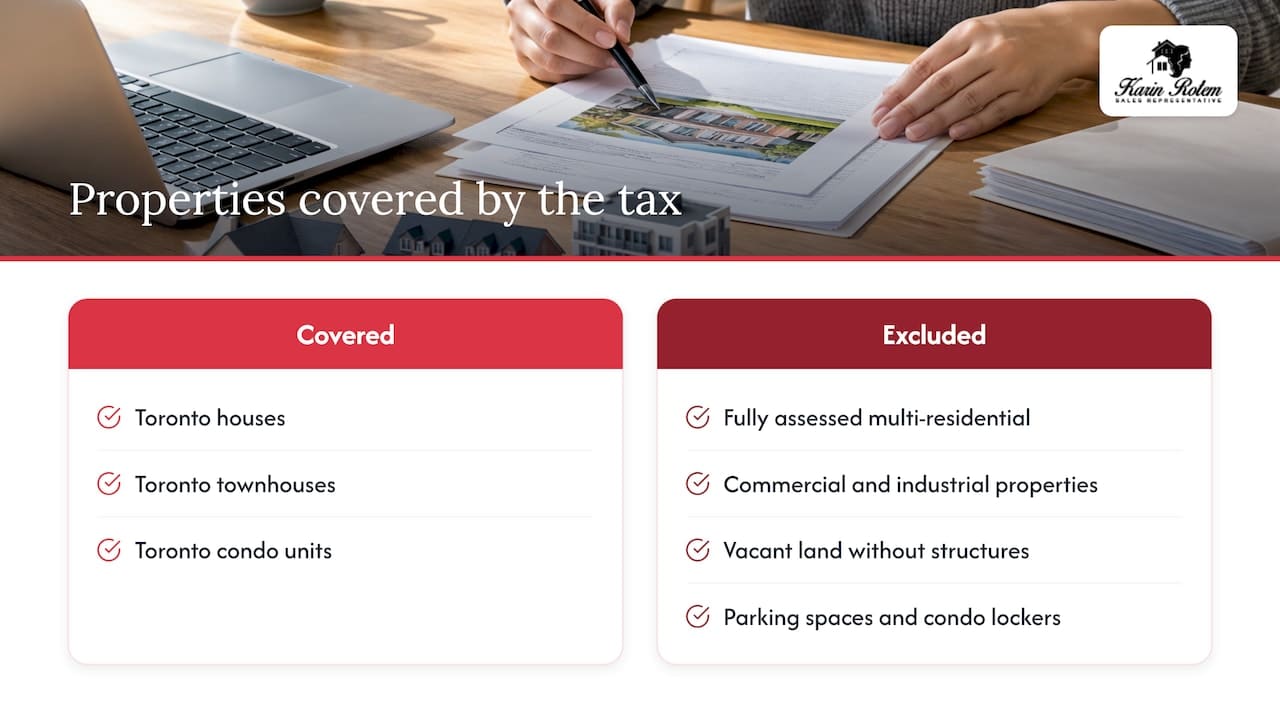
The tax applies to residential properties within the City of Toronto, which includes Scarborough, North York, Etobicoke and East York as well as the downtown core. Houses, townhouses and condo units are all in scope.
The City’s declaration rules exclude fully assessed multi-residential, commercial and industrial properties, vacant land without a structure, parking spaces and condominium lockers.
What most buyers don’t realize is that the tax follows the property’s location, not where you live. A Toronto condo you bought as an investment is covered. A cottage or condo in Innisfil is not covered by the City of Toronto’s tax, because it sits outside the city boundary. Any rules on the Innisfil side are set by that town, so confirm them at the time of purchase. For a budget view of what Innisfil owners pay each year, see our guide to Innisfil property taxes, rates and due dates.
How the City decides a home is vacant
A property is vacant if, for six months or more of the tax year, it was not occupied in a way the by-law recognizes. The City lists what counts as occupied:
- Your principal residence. You live there as your main home for at least six months of the year.
- Tenants. There is a written rental agreement of at least 30 days, and tenants occupy the unit for at least six months in total.
- Family or friends. They use the home as their own principal residence for at least six months.
The six months do not have to be consecutive for tenants, because the test is total occupancy. A home you use only on weekends, or a pied-a-terre you keep for city nights, usually fails this test unless an exemption applies.
A home is also deemed vacant if you do not file a declaration by the deadline. That second route is the one that catches people out. The home may have been lived in all year, yet a missed filing still produces a bill.
The rate and what it costs
Since 2024 the rate is 3% of the property’s Current Value Assessment (CVA), the value the Municipal Property Assessment Corporation puts on your property for tax purposes, and the figure printed on your property tax bill. It was 1% for the 2022 and 2023 tax years. The City’s rate page confirms the 3% figure.
The arithmetic is simple:
| Current Value Assessment | Tax at 3% for a vacant year |
|---|---|
| $700,000 | $21,000 |
| $1,000,000 | $30,000 |
| $1,500,000 | $45,000 |
Your CVA is not the same as market value. Assessments in Ontario have been based on an older valuation date, so check the number on your own bill rather than guessing from a recent sale price.
The tax is billed after the declarations are processed, and the City sets instalment dates each year. The 2025 tax, for example, was payable in three equal instalments in September, October and November 2026. Check the City’s page for the schedule that applies to your bill.
How to declare, step by step
The declaration is quick when you have the right numbers in front of you.
- Gather your identifiers. The City asks for your customer number and either the property address or the 21-digit assessment roll number. Both are on your property tax bill, account statement or VHT notice.
- Choose how to file. The City accepted online filing through its portal, phone filing at 311 or 416-392-2489, and in-person filing at a Tax and Utility Counter at City Hall or a civic centre. The owner or someone authorized to act for the owner can submit.
- State the occupancy status. Say whether the home was occupied as a principal residence, rented, or vacant, and, if vacant, whether an exemption applies.
- Attach proof if you claim an exemption. Keep the documents listed in the next section.
- Keep your confirmation. Save the confirmation in the property file, along with leases and receipts for the year.
The declaration is required even if the home is your main residence. In the City’s March 2026 release, nearly 95 per cent of owners had already filed for the previous year. The declaration period opens each November and runs to April 30, so there is no reason to wait for the last week.
If you own through a spouse, a numbered company or a family arrangement, decide in advance who files. A missed declaration from the “other” owner is still a missed declaration.
Exemptions and the proof they need
You can avoid the tax when your situation matches one of the City’s exemptions. The City’s list includes:
- Death of a registered owner. Up to three consecutive years. You need a death certificate.
- Principal resident in care. The owner lived there as a principal resident and is now in care for six months, for up to two years. You need a letter from the facility and proof of the prior principal residence.
- Major repairs or renovations. The work prevents occupancy for six months, with required permits and active work. Keep a description of the work, invoices or receipts and permits if required.
- Ownership transfer. The home changed owners completely during the year. A land transfer deed is the proof.
- Employment in Toronto. The owner or spouse works full-time in Toronto for six months, needs a secondary residence near work and lives principally outside the GTA. You need proof of the primary residence and a letter from the employer or a contract.
- Court order. An order prevents occupancy for six months. Keep a copy.
- Developer inventory. A never-occupied unit that is actively listed for sale, for up to two years. You need the listing and proof of developer ownership.
- Medical secondary residence. For the owner, a spouse or a dependent whose principal residence is outside the GTA. You need proof of residence and the completed certificate form.
Notice what is not on the list. A general wish to keep a place as a weekend base is not an exemption. If you have a Toronto condo that you rarely use, the practical choices are to occupy it as a principal residence, rent it to tenants under a written agreement for at least six months in total, or sell. That is a decision about how the property earns its keep, not just a tax form.
What happens if you miss the deadline or get it wrong
The penalties are what make this tax worth taking seriously. According to the City’s rules:
- If no declaration is filed by April 30, the City assumes the home was vacant and issues a VHT bill.
- A false declaration, or failing to provide information the City asks for, can bring a fine of up to $10,000 on top of the tax owing.
- Late payments carry a 1.25% penalty on the first overdue day and 1.25% interest on each following month. Unpaid amounts are added to the property tax account and collected like property taxes.
Here is a worked example using the City’s figures. Say your assessed value is $1,000,000 and your declaration is missed. The deemed-vacant bill is $30,000. If it goes unpaid, 1.25% interest per month adds roughly $375 for each month, before any fine.
If you receive a bill for a home you occupied, you can dispute it with a Notice of Complaint. The City lists the deadlines on its VHT page, and they differ between a regular bill and a supplementary bill issued after an audit, so read the notice itself and file within the time shown. Gather your lease, utility bills and proof of residence first. For a high-value assessment, speak with a tax lawyer or accountant before filing the complaint.
Does it affect a Toronto owner buying a vacation home?
This is where the tax and your plans meet. Many Toronto professionals look at waterfront second homes. The tax shapes that decision in three ways.
Your Toronto home is still declared. If you live in your Toronto house or condo, you file and select principal residence. The new vacation home does not change that, as long as you really live in the Toronto property for at least six months.
The vacation home is outside the City’s tax. A condo at Friday Harbour or a home in Innisfil is outside Toronto’s boundary. You will pay that town’s property tax instead, and our Innisfil property tax rates guide shows how to estimate it.
Selling the Toronto home to move north is a different plan. If you sell your Toronto property mid-year, the ownership transfer exemption applies to the year of sale. If you hold it empty while you relocate, the six-month clock keeps running. Our guide to selling in Toronto and buying in Innisfil covers the timing, and the cost of living comparison helps with the wider budget.
If you keep a Toronto unit as a rental, written tenancies of at least 30 days totalling six months keep it out of the vacant category. If you are weighing short-term rental income, read our note on short-term rental taxes in Canada first, because how the unit is occupied affects both the declaration and your income reporting. Ontario’s rent rules matter if tenants move in.
An empty home also raises an insurance question, since many policies treat vacancy differently. Our guide to vacant home insurance in Ontario explains what to confirm with your insurer.
Our perspective
What most buyers don’t realize is that the vacant home tax is not a reason to avoid a second home. It is a reason to be clear, before you buy, about which property is your principal residence and what happens to the other one.
We look at it as a decision about fit. A Toronto owner who wants a waterfront retreat has a clean path: keep the Toronto home as the main residence, file the declaration every November to April, and buy the retreat outside the City’s boundary, in Friday Harbour or elsewhere in Innisfil. A Toronto owner who wants to leave the city has another: sell, and let the sale timing carry the ownership-transfer exemption instead of leaving the house empty.
The costly cases are the ones in the middle, a Toronto unit that is neither lived in nor rented. A 3% charge on the assessed value changes the maths of holding it. We would rather you see that number before you offer on a property than after the bill arrives.
Our team works with buyers, sellers and investors across Toronto, Innisfil and Friday Harbour, so we can map the two properties against each other, including the taxes, the rental plan and the timeline. That is the conversation we want to have with you first.
Felix
Plan the move with us
If you are comparing a Toronto property with a waterfront home, we can help you see both sides of the decision. Start with the Friday Harbour condos for sale, look at homes for rent at The Harbour if you want to try the lifestyle first, or reach us through Karin Rotem’s Toronto and GTA real estate page to talk through your Toronto property and your next one.
FAQ
Do I have to file if I live in my Toronto home?
Yes. The City requires every residential owner to submit a declaration each year, including owners who live in the property. If you do not file by the deadline, the City treats the home as vacant.
Does the Toronto Vacant Home Tax apply to Innisfil or Friday Harbour?
No. The City of Toronto’s tax applies to residential properties within Toronto’s municipal boundary, and Innisfil is a separate municipality. Any local rules for an Innisfil property come from that town, so confirm them with the municipality before you buy.
When is the 2026 declaration due?
The 2026 period opened in November 2026, and Beach Metro reports that the portal accepts declarations until April 30, 2027. The window opens every November and closes April 30, so check the City’s page for the current dates each year.
How long can a Toronto home sit empty before the tax applies?
The tax applies when the home is vacant for six months or more of the tax year. Toronto’s rules count principal-residence use, tenant occupancy of at least six months in total under a written agreement of at least 30 days, and occupancy by family or friends as their principal residence.
Can a second home qualify for an exemption?
Only in specific cases, such as a secondary residence near full-time work in Toronto for an owner who lives principally outside the GTA, or a medical secondary residence. Both need documents, and the City lists the requirements. Convenience alone does not qualify.
Sources
- Vacant Home Tax, City of Toronto
- 2024 Vacant Home Tax Program, City of Toronto
- One month remaining to submit 2025 Vacant Home Tax declaration, City of Toronto
- Municipal Vacant Home Tax, Ontario.ca
- City of Toronto By-law 97-2022
- Recommended Tax Design and Steps to Implement a Vacant Home Tax, City of Toronto
- Toronto’s Vacant Home Tax declaration period for 2026, Beach Metro