
A condo maintenance fee is your monthly share of what it costs to run the building: the common areas, the staff and services, the insurance, and a contribution to a savings account for big future repairs. In Ontario the amount is set by the condo corporation’s budget, it is not optional, and the number on the listing only tells you half the story. What matters is what the fee includes and whether the building is saving enough to avoid a nasty surprise later.
I work with buyers in Toronto, Innisfil and Friday Harbour, and fees are the question that comes up right after price. What I tell my clients is simple: do not compare fees as one number. Compare what each fee covers, how healthy the reserve fund is, and how the fee fits your mortgage approval.
TL;DR
- Condo fees (also called common expenses) pay for the shared parts of the building, its operation and a reserve fund. They are mandatory, whether or not you use the amenities.
- Your fee is your unit’s percentage share of the corporation’s budget, so a building with a pool, concierge and heat included will cost more per square foot.
- The City of Toronto’s study put the average at $0.65 per square foot per month (2018 data). Compare buildings per square foot, and compare what is included.
- A low fee can hide an underfunded reserve fund. Read the status certificate before you commit.
- Lenders count 50% of your condo fee when they calculate whether you qualify for a mortgage.
What condo maintenance fees are
When you buy a condo you own your unit, and you co-own the “common elements” with everyone else in the building: hallways, elevators, roof, lobby, parking structure, gym, grounds. Someone has to pay to clean, heat, insure and repair all of that. The condo corporation does, and it collects the money from owners each month.
The Condominium Authority of Ontario (CAO), the province’s condo regulator, says common expenses fees maintain the common elements, go into the reserve fund, and pay for services such as cleaning, building maintenance and management. “Maintenance fee”, “condo fee” and “common expenses” all mean the same thing. If you have seen the term HOA fee in American listings, this is the Ontario equivalent.
The fee is not a payment to a landlord and it is not profit. The corporation is a not-for-profit body, and fees are practically its only source of revenue, according to the Canadian Condominium Institute’s national primer. That is also why unpaid fees are taken seriously: the same primer notes a corporation can register a lien against a unit for arrears.
What condo fees cover in Ontario
Exactly what you get differs from building to building. CMHC’s condominium buyer’s guide lists the usual items a fee may pay for:
- Snow and garbage removal, landscaping and cleaning
- Heating and cooling maintenance
- Amenities such as pools and party rooms
- Some or all utilities, and sometimes cable and Internet
- Insurance for the common areas
- Security systems
- Staff salaries and property management fees
- A portion toward the reserve fund for major repairs such as roofs, elevators and plumbing
The fee generally does not cover the inside of your own unit. Your contents insurance, your hydro if it is separately metered, your appliances and your renovations are yours.
Why “utilities included” changes the comparison
Two buildings can have very different fees and cost you the same. A building that includes heat, water and hydro will show a higher fee than one where you pay each utility yourself. The only fair comparison is total monthly carrying cost: fee, plus whatever utilities you pay separately, plus property tax.
This matters at a resort-style community like Friday Harbour in Innisfil, where buildings differ in layout, amenities and what is bundled in. I would never quote you a single “Friday Harbour fee”. The fee depends on the building and the unit’s size, and the right move is to get the current budget for the specific building you like. Ask me for it and I will pull it with you before you write an offer. You can browse Friday Harbour condos for sale to see which buildings are on your shortlist.
The fee is not negotiable
CMHC is direct about this: condo fees are neither optional nor negotiable, and owners pay their share even if they never use the pool or disagree with the board. If you are buying a waterfront unit as a weekend retreat and you will be away half the month, the fee is still due every month.
How your fee is calculated
The formula is less mysterious than it looks. The corporation prepares an annual budget. Each unit’s declaration (the building’s founding document) assigns it a percentage of the common expenses, which may vary with unit size. The CAO gives a simple example: a $1,000 monthly budget and a 5% unit share equals $50 a month.
Two pieces make up that budget:
- The operating fund. The everyday costs: cleaning, staff, utilities for common areas, insurance, management, repairs and snow clearing.
- The reserve fund contribution. Money set aside for large, predictable repairs and replacements years from now, such as the roof, elevators, windows or parking garage membrane.
That is why fees go up when building costs go up, when the building ages, or when the reserve fund has been underfunded. A bigger unit has a bigger share, so the fee grows with square footage. This is why per-square-foot comparisons are useful.
What condo fees look like in Toronto
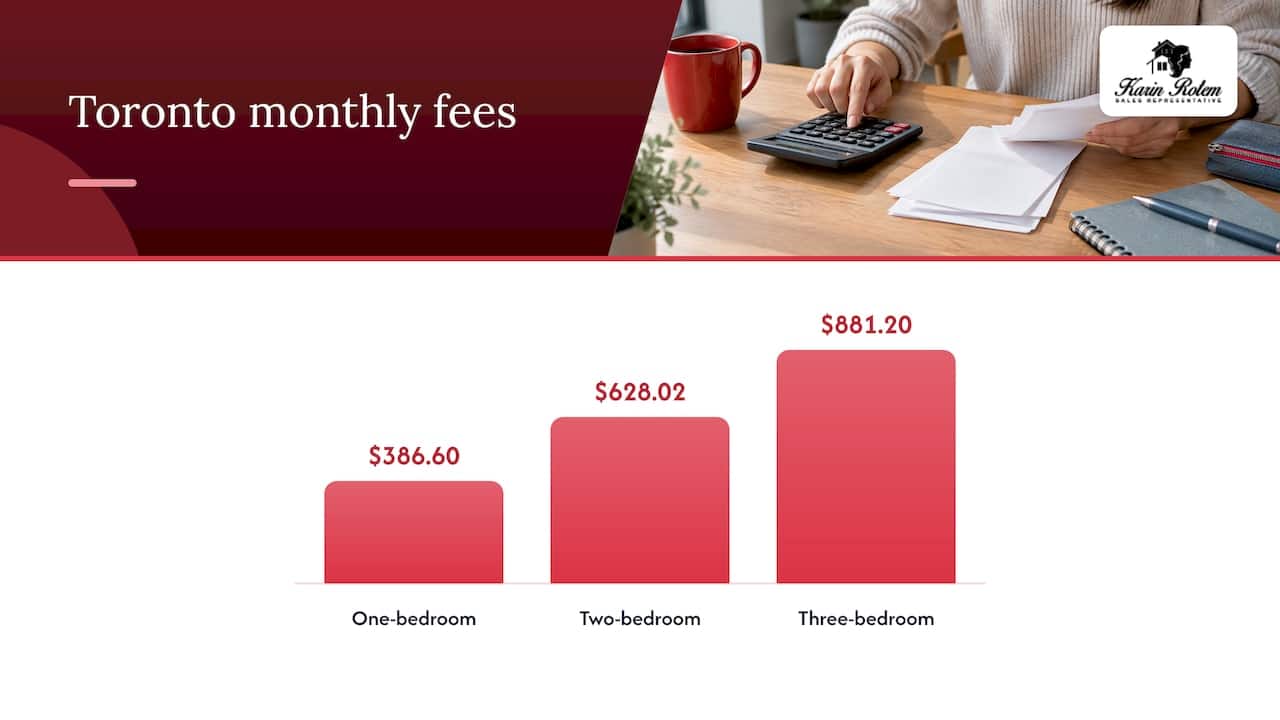
The most solid published benchmark is from the City of Toronto’s planning study, Condominiums: Two Decades of New Housing. Using 2018 data, it reported an average maintenance fee of $0.65 per square foot per month, which works out to:
| Unit type | Average monthly fee (2018 data) |
|---|---|
| One-bedroom | $386.60 |
| Two-bedroom | $628.02 |
| Three-bedroom | $881.20 |
Those figures are several years old, and fees have moved since, so treat them as a reference point for how the math works rather than today’s price. More recent commentary points higher. In a June 2026 piece, MoneySense reported a rule of thumb of 75 to 85 cents per square foot, which is about $595 a month for a 700 square foot condo, with fees above $1 per square foot potentially expensive depending on the amenities.
For a worked example, take a 700 square foot one-bedroom plus den. At $0.65 per square foot the fee is $455 a month. At $0.85 it is $595. At $1.10, which is plausible in an amenity-heavy building, it is $770. Over a year, the gap between the first and the last is $3,780. That is real money, but it only means something if you know what each building includes.
Current Toronto averages move with building age, energy and insurance costs and the mix of new and older buildings. Search listings for the same neighbourhood and building type, then compare per square foot.
Is a low fee always good news?
No. MoneySense also reports a warning from industry experts that a fee of 50 cents per square foot in a 20-year-old building may be too low and could signal an underfunded reserve fund. A suspiciously low fee often means the corporation has been deferring the cost of major repairs. Those costs do not disappear. They come back as fee increases or special assessments.
How fees change, and why new buildings are different
Fees can go up each year when the budget rises. The more important question is whether the starting number was realistic.
Ontario’s Auditor General reviewed condo oversight and found that initial developer-set fees are typically understated. Most surveyed boards had to raise reserve fund contributions afterward by an average of 50%, and developers sometimes understate or defer maintenance costs to make fees appear lower. If you are buying a new or recent building, whether in Toronto or at a newer community, ask what the budget assumes and when the first reserve fund study is due.
The CAO’s own guidance is blunt in the other direction: delaying major repairs can be dangerous and costly, and a fee increase may be necessary to avoid special assessments. A fee that rises moderately to keep the building properly funded is usually a sign of good management, not bad news.
Reserve funds and special assessments
The reserve fund is the building’s savings account for major repairs. In Ontario, a qualified professional such as an engineer or architect must complete a reserve fund study every three years, according to the CAO’s Condo Owners’ Guide. The study estimates what the building will need and recommends how much to contribute.
A special assessment is an extra charge to owners when the budget or reserve fund falls short or an unexpected expense hits. If you want the full picture, I have written about what buyers need to know about special assessments in Ontario.
Board-side rules are also evolving. A Dec 2025 legal summary of Ontario’s Bill 72 notes that some Condominium Act changes, including expanded status certificate disclosures, had their deadline extended by a year, so the disclosure you receive may become more detailed. Ask your lawyer what applies when you buy.
What to check before you make an offer
This is where fees stop being a monthly number and become a decision. Here is the routine I walk buyers through.
- Get the status certificate. For a resale, it is the key document. The CAO says it can include the current budget, the last audited financial statements, the most recent reserve fund study and the state of the fund, the unit’s common expenses and arrears, any increase in common expenses and its reason, and special assessments charged since the current year’s budget. The corporation must provide it within 10 days of a request, and the fee is capped at $100. Have your lawyer review it. Our guide explains what a status certificate is and why it matters.
- Read the reserve fund study. Is it current? Is the fund close to what the study recommends? A fund far below the recommendation is a flag for future fee increases or assessments.
- Check the fee history. One increase with a clear reason is normal. A pattern of large jumps is something to understand before you sign.
- Confirm what is included, in writing. CMHC advises checking the disclosure statement for new builds, the status certificate for resales and the operating budget, and getting written confirmation of what the fee covers.
- Look for arrears and lawsuits. The certificate discloses unpaid fees and, in Ontario, outstanding legal action involving the corporation.
- Add up the real monthly cost. Fee, utilities not included, property tax, insurance and mortgage payment.
MoneySense quotes an industry expert making the same point: the monthly payment alone doesn’t show a property’s financial health. It depends on how well the reserve fund is funded and whether the property has been maintained.
If you want a condition built into your offer so you have time to do this review, see whether to include a financing condition in Ontario. And remember that fees sit alongside other purchase costs, covered in what closing costs include in Ontario.
How fees affect your mortgage approval
Lenders do not ignore your condo fee. CMHC guidance says 50% of condominium fees are included in both the gross debt service (GDS) and total debt service (TDS) ratios, with maximums of 39% and 44% for insured mortgages. The Financial Consumer Agency of Canada describes the same measures: GDS covers housing costs (mortgage, property tax, heat and half the condo fee) against gross income, and TDS adds all your other debts.
What that means in practice: a $600 fee counts as $300 toward your ratios. Between two otherwise identical condos, the one with the higher fee can reduce the mortgage you qualify for. The FCAC also notes that federally regulated lenders apply a stress test at the higher of 5.25% or your contract rate plus 2%. Your lender or broker will run the exact numbers for your income and debts.
If you are comparing a Toronto unit with a waterfront one, the purchase price gap and the fee gap both matter. I have laid out how Friday Harbour condo prices compare to Toronto.
Fees for second homes and investment units
If you are buying a vacation home or a rental, the fee is part of your holding cost whether the unit is occupied or not. Work out the break-even: rent or rental income, minus fee, property tax, insurance and utilities you pay. A building with generous amenities can support a stronger lifestyle or rental appeal, and its higher fee should be weighed against that. In resort-style communities, ask how the building handles short-term rentals, because the corporation’s rules and your insurance both matter. For the amenity side, see our guide to luxury condo amenities in Ontario.
Our perspective
What most buyers don’t realize is that the fee is a symptom, not the cost. Two units with the same fee can be completely different purchases, one in a building that has funded its future and one that has been putting it off.
When we sit down with a buyer in Friday Harbour or Toronto, we start with what the fee includes, then the reserve fund, then the mortgage math. A well-run building with a fair fee is the lifestyle purchase people imagine when they picture stepping onto the dock with a coffee.
Our team is the number one team at The Harbour, and we use that local depth to read the budget for the specific building you are considering, so the fee is something you understand before you offer, not after you close.
Felix
Reading the numbers with us
If you are weighing a Friday Harbour or Innisfil condo, or comparing it with a Toronto unit, we can pull the building’s budget and walk you through the fee, the reserve fund and what it means for your monthly cost. Start with Friday Harbour condos for sale, or reach out through our site and tell us what you are looking for.
FAQ
What do condo fees cover in Ontario?
They cover the shared parts of the building: cleaning, maintenance, insurance for the common areas, staff and management, and often some utilities and amenities. A portion also goes into the reserve fund for major repairs. The inside of your unit is your responsibility.
What is the average condo fee in Toronto?
The City of Toronto’s study reported an average of $0.65 per square foot per month using 2018 data, and more recent commentary points to roughly 75 to 85 cents per square foot. Your building’s fee depends on its age, amenities and what is included, so compare per square foot and compare what each building covers.
Can condo fees increase?
Yes. The corporation’s budget is reviewed each year, and fees may rise with costs or to fund the reserve properly. The status certificate discloses any increase and its reason, so check it before you buy.
What are Friday Harbour condo fees?
They vary by building and unit size, and what is included differs from one building to the next. The most reliable figure is the current budget and status certificate for the unit you are considering. We can help you get and read them.
Do condo fees affect my mortgage?
Yes. Lenders count 50% of your condo fee in the debt ratios used to qualify you, so a higher fee can reduce the amount you are approved for. Your lender or broker will run the figures for your situation.
Sources
- Common Expenses, Condominium Authority of Ontario
- Condominium Buyer’s Guide: FAQs, CMHC
- CCI-N Primer: Canadian Condominium Legislation
- Condominiums: Two Decades of New Housing, City of Toronto
- Condo maintenance fees: How much is too much? MoneySense
- Value-for-Money Audit: Condominium Oversight in Ontario
- CAO Condo Owners’ Guide
- Status Certificates, Condominium Authority of Ontario
- Bill 72: A Buy for Some Condominium Act Changes, Shibley Righton
- Calculating GDS / TDS, CMHC
- Preparing to get a mortgage, Canada.ca