
Pre-emptive offers, commonly called bully offers, are legal in Ontario. What makes them complicated is not the law itself but the duties that come with them. Under the Trust in Real Estate Services Act (TRESA) and RECO’s published bulletins, agents and sellers must follow specific steps the moment a pre-emptive offer enters the picture, or they risk complaints, disputes, and a deal that unravels.
Here is the short version of what that means in practice:
- A bully (pre-emptive) offer is a purchase offer submitted before a seller’s scheduled offer-review date, designed to pressure a fast decision.
- Sellers choose whether to accept, reject, or ignore it, but their agent must have written direction in place before acting.
- Agent obligations are triggered immediately: RECO requires notification to all interested parties and documentation of every decision.
- Buyers carry real risk: waiving conditions and compressing timelines to win can create costly problems after the fact.
Three bodies govern how this plays out in Ontario: RECO (Real Estate Council of Ontario), which enforces agent conduct; TRESA, the legislation that replaced REBBA and sets the current rules for offer handling; and OREA (Ontario Real Estate Association), which has publicly called for restrictions on the practice.
Key takeaways
A bully offer in Ontario is legal but only as clean as the written direction and agent process behind it.
| Point | Details |
|---|---|
| Written direction is mandatory | Sellers must give their agent explicit written instructions before a pre-emptive offer is presented or reviewed. |
| Four seller options exist | RECO recognises four choices: do not notify, notify only, notify and review if threshold met, or review all. |
| Buyers carry condition risk | Waiving financing or inspection without proper preparation can result in deposit loss or post-closing liability. |
| TRESA controls offer sharing | Sellers can direct in writing whether offer content is shared with other buyers under TRESA rules. |
| Karinrotem guides both sides | The team drafts written direction, advises on offer structure, and negotiates pre-emptive offers in Toronto, Innisfil, and Friday Harbour. |
What is a bully offer in Ontario real estate?
A bully offer, or pre-emptive offer, arrives before the seller has opened the door to offers. Sellers often list with a delayed-offer date, a strategy designed to build interest and generate competing bids on a set date. A bully offer tries to short-circuit that process entirely.
The anatomy of a typical bully offer follows a recognisable pattern:
- No conditions: financing, inspection, and status certificate conditions are removed to signal certainty.
- Strong deposit: a certified cheque or bank draft, often well above the standard amount, demonstrates commitment.
- Short irrevocable period: sometimes as little as a few hours, forcing the seller to decide before other buyers can mobilise.
- Clean closing date: flexible or seller-preferred closing terms reduce friction.
What most buyers do not realise is that a bully offer is as much a test of certainty as it is of price. A seller who has set an offer date is betting on competition. A bully offer has to make the risk of waiting feel greater than the certainty of accepting now.
A quick example: A home in Toronto lists on a Tuesday with offers reviewed the following Monday. By Thursday, a buyer submits a firm offer at $80,000 over asking with a $100,000 deposit and a six-hour irrevocable period. The seller’s agent must immediately consult the seller’s written direction to know whether to even present it, and must notify all registered interested parties before the seller can respond.
Ontario regulatory framework: what RECO, TRESA, and OREA require
RECO’s written-direction requirement
The RECO Bulletin No. 4.2 on delayed offer presentation is clear: a seller must give their agent specific, written direction before a delayed-offer strategy is used. That direction must state the offer presentation date and time, and the agent must communicate that information to all interested parties. If the seller later changes course, the agent must update listing notes and notify those same parties in writing.

RECO Bulletin No. 4.3 on managing pre-emptive offers goes further. It requires the seller’s agent to have explicit written instructions covering exactly how a pre-emptive offer will be handled before one ever arrives. The bulletin outlines four options a seller can choose from: do not notify interested parties; notify but do not review the offer; notify and review only if the offer meets a price threshold; or notify and review all pre-emptive offers.
The practical consequence: an agent who presents a bully offer to a seller without documented written direction is exposed to a RECO complaint. Practitioner guides confirm that the integrity of the process, not the price, is what determines whether a transaction survives regulatory scrutiny.
TRESA and offer-content sharing
Under TRESA, sellers have a new layer of control. With written direction in place, a seller can decide whether offer content, or specific parts of it, is shared with other buyers who have also submitted offers. This matters in a bully-offer scenario because it affects whether competing buyers know what they are bidding against.
OREA’s public position and the policy debate
OREA has publicly urged the Ford government to restrict bully offers, arguing the practice creates unfair pressure on sellers and undermines the integrity of a planned offer process. CBC News covered the push extensively, reflecting genuine public concern. The government has not enacted a ban, so bully offers remain legal. What OREA’s campaign did accomplish was sharpen RECO’s guidance and raise awareness among agents about their documentation obligations.
Practical seller guidance: written direction and your options
What I tell my seller clients before we list is simple: decide how you want to handle a pre-emptive offer before one lands on your doorstep. Once a bully offer arrives, you have very little time to think clearly. Written direction drafted in advance is what gives you control.
Written-direction checklist
Work through these items with your listing agent before the property goes live:
- Offer presentation date and time: state it precisely so all interested parties receive the same information.
- Pre-emptive offer policy: choose one of the four RECO-recognised options (see table below).
- Price threshold (if applicable): if you will only review offers above a certain amount, state that figure.
- Communication method: specify how your agent will notify interested parties (email, phone, MLS update).
- Listing note updates: confirm your agent will update the MLS and all platforms if your direction changes.
- Irrevocable period treatment: decide in advance whether you will accept offers with very short irrevocable windows.
- Multiple representation disclosure: confirm how designated representation will be handled if your agent also represents a buyer.
For a deeper look at what belongs in your listing agreement, the seller representation agreement guide covers the key terms to include.
Seller options for handling pre-emptive offers
| Option | What it means | Regulatory steps required |
|---|---|---|
| Do not notify | Agent does not tell interested parties a pre-emptive offer exists | Document direction in writing; no further notification needed |
| Notify, do not review | Interested parties are told an offer arrived, but seller will not look at it | Written direction; agent notifies all registered interested parties |
| Notify and review if threshold met | Seller reviews only if the offer meets a stated price or condition | Written direction with threshold specified; agent notifies all parties and confirms threshold |
| Notify and review all | Seller will consider any pre-emptive offer presented | Written direction; agent notifies all parties promptly; update listing notes |
Sample written-direction wording
Here is plain-language text you can adapt with your agent:
“I, [Seller Name], direct my agent to [notify / not notify] all registered interested parties if a pre-emptive offer is received. I will [review / not review] any pre-emptive offer [unless it meets or exceeds $X]. My agent is authorised to update listing notes and MLS platforms to reflect any change to this direction.”
Pro Tip: Review your written direction with your agent every time market activity changes. A direction that made sense on Day 1 of your listing may not serve you on Day 7 if interest has been stronger or weaker than expected.
Pro Tip: If you change your direction mid-listing, ask your agent to confirm in writing that all interested parties have been notified and that the MLS listing notes have been updated. That paper trail is your protection if a complaint is ever filed.
To avoid the most common pitfalls sellers face in competitive markets, the common home seller mistakes guide is worth reading before you list.
Practical buyer guidance: structuring a bully offer that works
The core trade-off
Speed and certainty are what a bully offer buys you. The price you pay for them is real: you are typically waiving conditions, compressing your due-diligence window, and paying a premium to pre-empt competition that may never have materialised. That trade-off is sometimes worth it. Often it is not.
Dos and don’ts for buyers
Do:
- Secure firm mortgage pre-approval, not just a pre-qualification, before submitting.
- Commission a pre-offer home inspection if the seller allows access. A few hundred dollars now can prevent a five-figure surprise after closing.
- Set an irrevocable period long enough to give the seller’s agent time to notify interested parties, typically a minimum of a few business hours.
- Include a certified deposit cheque, ready to be delivered immediately on acceptance.
- Review closing costs in Ontario so your budget accounts for land transfer tax, legal fees, and adjustments on a fast close.
Don’t:
- Waive financing without a firm lender commitment in writing.
- Use a two-hour irrevocable period. It signals desperation, not strength, and may prevent the seller’s agent from meeting their notification obligations.
- Include hidden clauses or unusual conditions that create closing risk. Clean and simple wins.
- Assume the seller will counter. Many sellers either accept or let the irrevocable period expire.
That combination addresses every concern a seller has about certainty without creating compliance problems for their agent.
Common legal questions about offers in Ontario
These are the questions I hear most often from clients on both sides of a bully-offer situation.
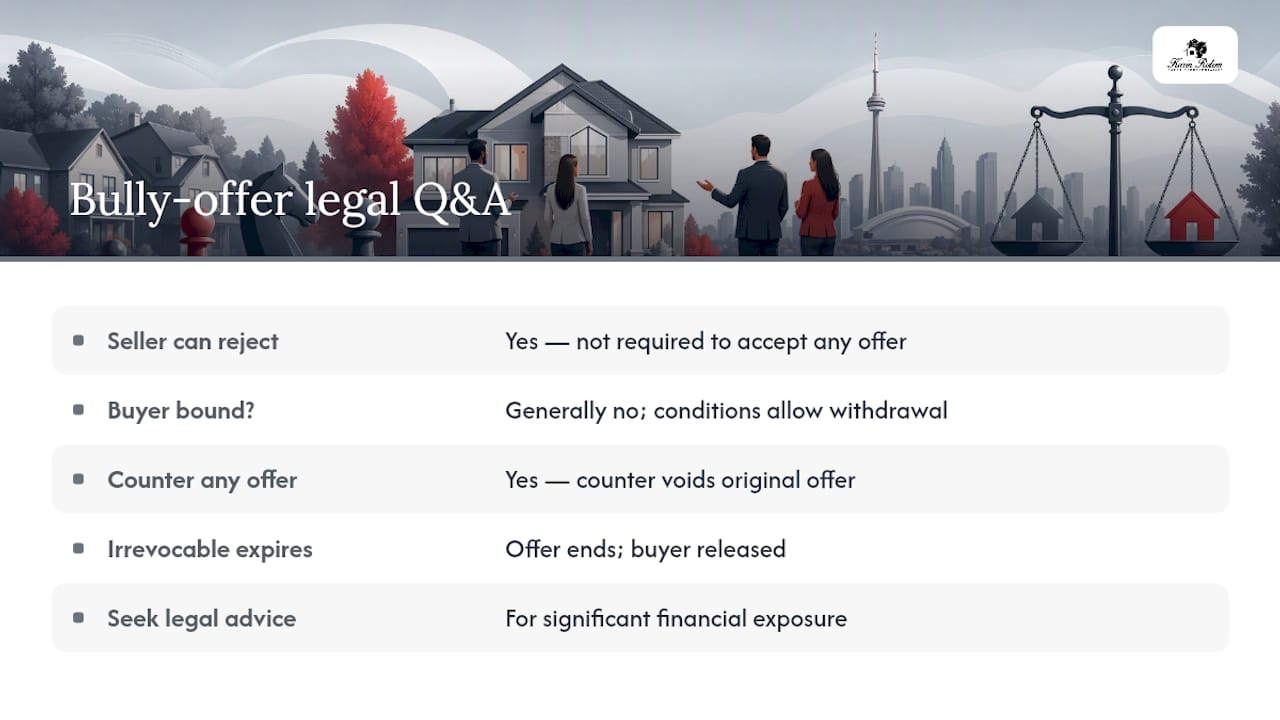
Can a seller reject a full-price offer in Ontario?
Yes. Ontario law does not require a seller to accept any offer, including one at full asking price. A seller can reject, counter, or ignore an offer for any reason that does not violate human rights legislation. The listing price is an invitation to offer, not a binding commitment.
Can a buyer back out of an accepted offer in Ontario?
Generally, no. Once both parties have signed and the offer is firm, it is a binding contract. A buyer who walks away risks losing their deposit and may face legal action for damages. If the offer includes conditions (financing, inspection), the buyer can withdraw during the condition period without penalty. A firm bully offer carries no such safety net.
Can you counter a full-price offer?
Yes. A seller can counter any offer, regardless of price. A counter-offer voids the original offer, so the buyer is no longer bound by it. Both parties are free to walk away once a counter is issued.
What happens when an irrevocable period expires?
The offer dies. The seller cannot accept it after the irrevocable period passes, and the buyer is released from any obligation. This is why very short irrevocable windows are risky for buyers: if the seller’s agent cannot reach the seller in time, the offer simply lapses.
When questions move beyond contract mechanics into territory involving significant financial exposure, consulting a real estate lawyer is the right call. Agent guidance covers process; legal advice covers liability.
What I tell my clients: red flags and tactics that work
Two scenarios I have seen play out
A seller I worked with set a delayed-offer date but gave vague written direction: “handle pre-emptive offers as appropriate.” When a bully offer arrived, her agent was unsure whether to notify other interested parties. The ambiguity caused a delay, the buyer withdrew the offer, and the seller lost a strong bid. Vague direction protects no one.
On the buyer side, I have seen buyers waive financing conditions on a bully offer without a firm lender commitment, only to discover the property did not appraise at the purchase price. The buyer was left scrambling to cover the gap or risk losing their deposit. Pre-approval is not optional in this scenario.
Red flags to watch for
- An irrevocable period so short the seller’s agent cannot realistically notify all interested parties.
- A listing agent who cannot confirm written direction exists before presenting your offer.
- Undisclosed multiple representation, where the same agent represents both buyer and seller without proper designation and disclosure.
- Ambiguous listing notes that do not reflect the seller’s actual direction on pre-emptive offers.
Tactics that consistently work
- For sellers: draft written direction before listing, review it with your agent, and keep a copy. If you change it, confirm the update in writing.
- For buyers: treat the deposit as a signal. A certified cheque for a meaningful amount tells the seller you are serious and financially ready.
- For both: clear, documented communication between agents reduces the risk of a RECO complaint and keeps the transaction on track.
For sellers managing multiple competing offers, the multiple offers guide for Innisfil home sales covers the compliance and strategy side in detail.
Pro Tip: Ask your agent to walk you through their written-direction template before you list. If they do not have one, that is a signal worth taking seriously.
Why documentation is the only real protection
Here is my honest view after working through competitive markets in Toronto and Innisfil: the buyers and sellers who get hurt by bully offers are almost never hurt by the offer itself. They are hurt by the absence of a documented plan.
A seller who has clear written direction in place can respond to a bully offer calmly and strategically. A buyer who has done their financial homework can submit a firm offer without panic. The process works when both sides have done the preparation. When they have not, the compressed timeline of a bully offer turns every gap in planning into a problem.
The sample wording and checklists in this article are starting points. Adapt them with your agent, put them in writing, and keep copies. If you are unsure how your situation fits the RECO framework, a conversation with a local agent who knows the current market is worth more than any template.
Working with Karin Rotem’s team on pre-emptive offers
Navigating a bully offer in Toronto, Innisfil, or Friday Harbour requires more than knowing the rules. It requires an agent who has drafted written direction under pressure, negotiated firm offers in tight timelines, and kept transactions clean when the market moves fast.
Karinrotem’s team handles the full process: drafting written direction before listing, advising on staged marketing strategies that reduce unfair pressure, and negotiating on both sides of pre-emptive offer situations. For buyers in competitive waterfront markets, the team’s local knowledge of how to negotiate the best offer translates directly into better-structured bids and fewer costly surprises.
If you want a second set of eyes on your written direction, or you are a buyer considering a pre-emptive offer and want to know whether the terms make sense for your situation, reach out to the team for a short consultation.
Sources
- RECO bulletin 4.2 managing a delayed offer presentation process
- Bully offer / pre-emptive offer | Mortgage terms (Nesto)
- Pre-Emptive (Bully) Offers in Ontario Real Estate | Disciplined Transaction Control | Barry & Tracy Cordingley
This article is general information, not a substitute for advice from a qualified lawyer. Consult a qualified legal professional about your own circumstances before acting on anything here.
FAQ
Can a seller reject a full-price offer in Ontario?
Yes. A seller in Ontario is not obligated to accept any offer, including one at the full asking price. The listing price is an invitation to offer, not a binding commitment, and a seller may reject or counter for any lawful reason.
Can a buyer back out of an accepted offer in Ontario?
Generally, no. A firm, accepted offer is a binding contract in Ontario. Walking away risks deposit forfeiture and potential legal action for damages. Buyers retain the right to withdraw only during any active condition period stated in the offer.
Can you counter a full-price bully offer?
Yes. A seller can counter any offer regardless of price. Issuing a counter-offer voids the original, releasing both parties from their prior obligations and opening a new negotiation.
What happens if a bully offer’s irrevocable period expires?
The offer lapses automatically. The seller cannot accept it after the deadline passes, and the buyer is released from any obligation. Very short irrevocable periods can also prevent a seller’s agent from meeting RECO’s notification requirements for interested parties.
What is a seller’s written direction and why does it matter?
Written direction is a documented instruction from the seller to their agent specifying how pre-emptive offers will be handled. RECO requires it before an agent can present or act on a bully offer. Without it, the agent has no clear authority to proceed and is exposed to a regulatory complaint.