Buying in a resort community is not the same as buying an ordinary house or condo. You are buying a home and a share of a lifestyle: the marina, the pool, the restaurants, the rules and the monthly costs that keep it all running. Before you make an offer, check four things: the documents (especially the financial health of the condo corporation), the ongoing costs, what the rules say about renting your unit, and how easily you could sell later. What I tell my clients is simple: the view sells the property, but the paperwork decides whether it suits you.
I’m Karin Rotem, and my team works every day in Toronto, Innisfil and especially Friday Harbour. This guide is the checklist I walk buyers through, including the parts that aren’t glamorous.
TL;DR
- A resort-community home is usually a condo or a townhouse inside a managed community, so you buy into fees, rules and shared amenities as well as the unit itself.
- Read the status certificate, the reserve fund information and the rental rules before you waive any condition. They tell you more than the listing photos.
- Rental income can help carry the costs, but condo rules, municipal rules and GST/HST all affect what you actually keep.
- Decide first how you will use the place: weekends, full-time, or income. That choice shapes which property type fits.
- Plan your exit on day one. Resale depends on the rules and the buyer pool as much as on the view.
What a resort community actually is (and what it isn’t)
A resort-style community is a residential neighbourhood built around shared amenities: a marina or beach, a pool, a golf course, trails, dining and often a village-style main street. Ownership is usually one of three things:
- A condominium unit, where you own the unit and share ownership of the common elements with other owners.
- A freehold or townhouse home within a community that charges fees for shared services.
- A hotel-style or rental-program unit, where the building is run commercially and rentals may go through a management company.
That last category is where buyers get confused, so a quick distinction helps. A timeshare is a different product altogether. Timeshare contracts fall under provincial jurisdiction in Canada, so the legal nature of what you own depends on the province. A condo you own outright, with a title in your name, is a different thing from a right to use a unit for a few weeks a year. If you want to understand the hotel-style version, I’ve written a buyer’s guide to condo hotel units.
What most buyers don’t realize is that two units in the same community can have very different ownership terms. One may be a regular residential condo with no rental restrictions. The one next door may sit in a building with a commercial rental structure. Always ask which one you are looking at.
Start with how you will use it
Before comparing properties, I ask clients to answer one question honestly: how many nights a year will you personally be there?
| Your plan | What usually fits | The trade-off |
|---|---|---|
| Weekends and summers, no rental | A well-located condo or townhouse with strong amenities | You pay fees all year for a place you use part of the year |
| Primary home, relocating from Toronto | A unit or home with year-round access and services | Check winter maintenance and what is open off-season |
| Part-time use plus rental income | A unit in a building that permits short-term rental | Wear, rules and tax paperwork rise with every rental night |
| Pure investment | A property type built for rental, with clear rules | You depend on rental demand and on the rules staying the same |
If the honest answer is “twelve weekends and a week in August,” I will often tell a client that a smaller unit with lower fees is the smarter buy than the biggest one they can afford. If you are weighing a move out of the city, our guide to selling a Toronto home and buying in Innisfil walks through the sequencing, and why a vacation home near Toronto makes sense covers the lifestyle case.
The documents to read before you make an offer
In a resort community, you are buying into a corporation’s finances. These are the documents and questions that matter most.
The status certificate
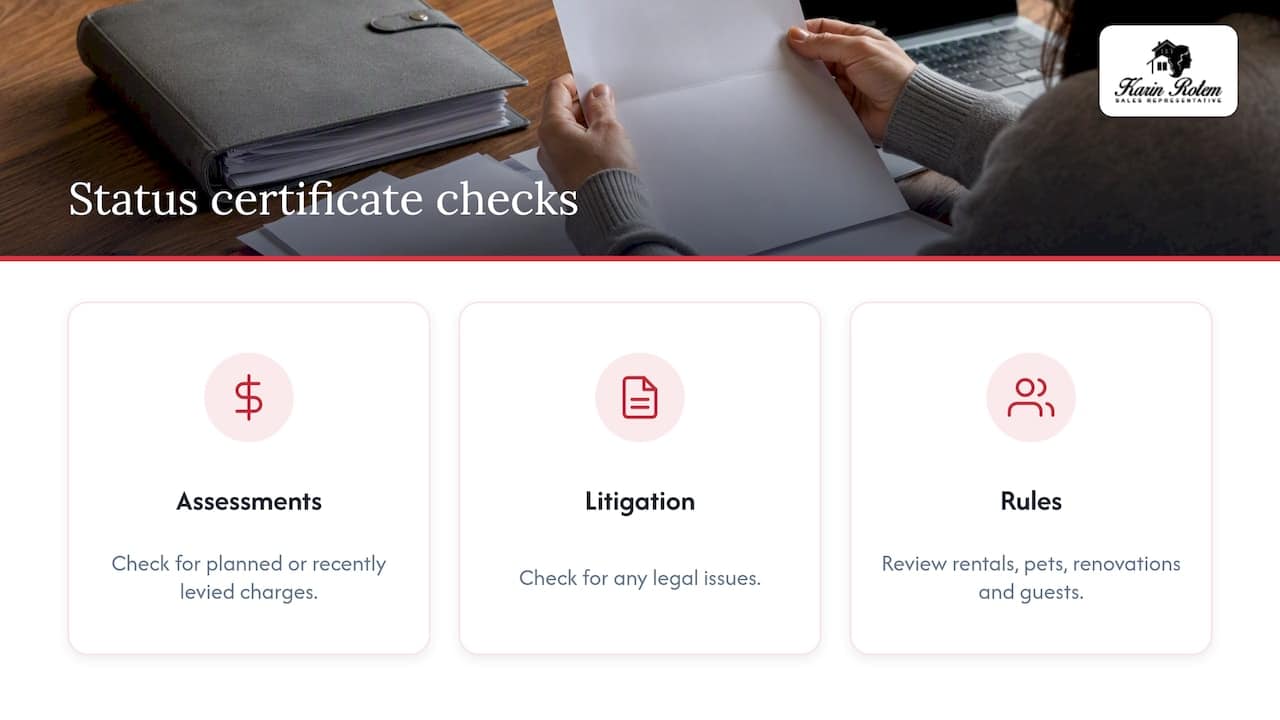
For a resale condo in Ontario, the status certificate summarises the corporation’s finances, rules and any legal issues. Have your lawyer review it, and read it yourself with specific questions in mind: Is there a special assessment planned or recently levied? Is there any litigation? What do the rules say about rentals, pets, renovations and guests?
The reserve fund
The reserve fund pays for major repairs and replacements, such as roofs, elevators, docks and mechanical systems. Ontario requires condo corporations to keep one, and the province notes that many older properties have low reserves, which can lead to significant extra contributions from owners. In a waterfront community, shoreline, boardwalks and marina structures can be expensive to maintain, so ask what the most recent reserve fund study says about them. We’ve put together a plain-language look at the reserve fund study process and a guide to condo special assessments in Ontario, both useful before you sign.
New-build paperwork
If you are buying a newly built unit from a developer, Ontario’s reforms were designed so that buyers receive a condo guide at the time of sale and can read it during the 10-day cooling-off period. Use that window. Reading a property’s inspection and disclosure history before you commit is a habit worth building, and this piece on how to read a property’s inspection history shows why the paper trail matters.
Waterfront-specific checks
If the property touches the water, ask about shoreline condition and who is responsible for it. Our guide to erosion control on the Ontario waterfront explains what buyers should ask before they commit.
The real cost of owning in a resort community
The purchase price is only the start. Here is how I break down annual costs with clients.
Condo or maintenance fees
Condominium fees are mandatory and cover the upkeep of common elements. CMHC notes that fees can be adjusted periodically to reflect changing service costs and the state of the reserve fund. In a resort community the fee often pays for amenities you may not use every day: pools, fitness spaces, security, landscaping and shared infrastructure. That is not a reason to avoid it. It is a reason to ask what is included, what is billed separately, and how the fee has moved over the past few years. Our guide to luxury condo amenities in Ontario helps you judge which amenities are worth paying for.

Property tax, insurance and utilities
Property tax depends on the municipality and the assessed value, and insurance depends on how the unit is used. A unit that is rented out part of the year may need different coverage from one you occupy yourself, so talk to your insurance broker before you close, not after. Utilities for a seasonal unit are lower, but heating a second home through winter still costs money.
Closing costs
Budget for legal fees, title insurance and land transfer tax. The tax is set by the province, and in Toronto there is an additional municipal tax, which makes the closing bill for a Toronto purchase noticeably different from one in Innisfil. Your lawyer can give you an exact figure for your price. I’d rather you hear this before an offer than at the lawyer’s office.
GST/HST on new and some resale units
This surprises people. Under the Canada Revenue Agency’s guidance, a previously occupied vacation property is taxable if it was not used primarily as the vendor’s residence and at least 90% of its rentals were for periods under 60 days, such as units that sat in a rental pool. If you buy a new unit for rental, you may also be eligible for input tax credits on the GST/HST paid, depending on how much of the use is commercial. Ask your accountant about this before you sign, because the answer depends on your facts.
Renting your resort home: what you can and can’t do
Many buyers in Friday Harbour and similar communities want the property to earn something when they aren’t there. It can, but three layers of rules apply, and the strictest one wins.
- The condo’s own rules. In Ontario, condominium declarations, bylaws or rules can prohibit or restrict short-term rentals, and owners must follow those restrictions even if municipal bylaws permit rentals.
- The municipality. Local licensing and registration rules may apply to short-term rentals.
- Any rental program. Some resorts offer or require a management program. At one resort in B.C., for example, owners may choose whether to join, but any rentals must go through the hotel’s management company, with revenue pooled and expenses deducted before the remainder is split between owners and management. Programs differ by community, so read the agreement closely.
For Friday Harbour specifically, see our explainer on rental rules for owners, and for the set-up steps in the province, how to set up a short-term rental in Ontario legally.
What rental income does to your taxes
A GST/HST registrant making short-term rentals of a vacation property generally has to charge and collect GST/HST if the rent is more than $20 per day. On the income tax side, expenses such as property taxes during the period the property is available for rent are generally deductible, but personal-use days change the calculation. Our guide to protecting your deductions with the T776 shows how owners track this. Hosts also need tools to handle bookings and guest records, and it helps to understand what short-term rental software costs before you build it into your return estimate.
What most buyers don’t realize is that renting adds wear. More guests means faster replacement of furniture and finishes, and sometimes friction with year-round neighbours. Build that into the numbers instead of treating rent as pure profit.
Property types for income
Not every unit is built for rental. Our guide to income property types at Ontario resorts compares them, and what a short-term rental income property is explains the basics. If you’d like to see what rental-ready looks like, read about furnished rental property features investors need.
Financing: what to ask your lender
Lenders treat vacation properties differently from principal residences, and the rules can shift, so speak to your mortgage professional early. Three questions I tell clients to ask:
- What down payment do you require for a second home or a rental property?
- Will you count any projected rental income toward qualifying, and how much?
- Does the building type, such as a hotel-style unit, change the terms?
Bring the status certificate and the rental rules to that conversation. A lender may be comfortable with a straightforward condo and cautious about a unit in a commercial rental structure. Don’t assume rental income will qualify you. Treat it as a bonus until your lender confirms otherwise.
Perspective: how we look at resort buying
We have spent years in Friday Harbour and Innisfil, and our team is the top-performing team at The Harbour and among the Top 100 worldwide at REMAX. What that experience taught us is that buyers regret the same three things: skipping a deep document review because the market felt competitive, underestimating total carrying costs, and assuming rental rules would work in their favour without reading them.
So we do something that doesn’t always make a sale quicker. We ask buyers how they will use the place, and sometimes we tell them a property is not the right fit. A buyer who wants daily rental income does not belong in a building with restrictions, and a buyer who wants quiet should know which buildings are rental-heavy. We would rather lose one deal than have a client sit on a unit that doesn’t work for them.
Our approach is to pair market insight with strong negotiation, but also to lay out the trade-offs plainly: fees against amenities, rental flexibility against quiet, price against location in the community. The right unit is the one that matches your goals, not the one with the best photo.
— Felix
Resale and exit: plan it before you buy
I’ve seen buyers spend months choosing a unit and ten minutes thinking about selling it. Reverse that.
- Rental restrictions shrink or widen your buyer pool. A unit where short-term rental is allowed appeals to investors. A unit where it is banned appeals to owner-occupiers. Neither is wrong, but know which group you will be selling to.
- Fee history matters to the next buyer. Their lawyer will read the same status certificate you did.
- Seasonality affects timing. Waterfront and lifestyle properties often draw the most attention when the weather is good, so listing timing can influence your result. Ask your agent for local sales patterns, not generic ones.
- Hotel-style structures narrow the market. If a lender is cautious about a building type, your future buyer’s lender may be too.
If you’re curious how costs compare with the city, read how Friday Harbour condo prices compare to Toronto and the waterfront property types near Toronto. For investors, our waterfront condo investment playbook goes deeper on market data.
A short checklist before you write an offer
- Decide your use: personal, rental or both, and how many nights.
- Have your lawyer review the status certificate, reserve fund study and rules.
- Ask for fee history and any planned or recent special assessments.
- Confirm in writing what the rules say about short-term rentals.
- Speak to your lender about second-home or rental financing.
- Ask your accountant about GST/HST and income tax on rental use.
- Walk the community off-season, not just on a sunny Saturday.
- Price your exit: who will buy this, and why?
Looking in Friday Harbour or Innisfil?
If you want to see what is available, you can browse current Friday Harbour condos for sale, look at The Harbour for sale or for rent, or ask about our exclusive Friday Harbour listings. Prefer to talk it through first? Reach out through karinrotem.com and tell me how you plan to use the property. I’ll give you an honest view of whether it fits, including when the answer is no.
FAQ
Is buying in a resort community a good investment?
It can be, but it depends on the property type, the rules and the fees. Rental income can offset ownership costs, yet wear, fees, taxes and restrictions all reduce what you keep. Run the numbers with realistic occupancy and confirm the rental rules in writing first.
Is a condo in a resort community the same as a timeshare?
No. With a condo you hold title to a unit, while a timeshare gives you a right to use a property for set periods. Timeshare contracts fall under provincial rules, so read any contract carefully and get legal advice before signing.
Can I rent out my unit whenever I want?
Not necessarily. Your condo’s declaration, bylaws and rules can restrict or prohibit short-term rentals even where the municipality allows them. Some communities also have rental programs with their own terms. Check both before you buy.
What fees should I expect beyond the purchase price?
Expect condo or maintenance fees, property tax, insurance, utilities, legal fees and land transfer tax at closing. Fees can also change over time depending on costs and the reserve fund. Ask for the fee history so you can see the trend.
Sources
- Timeshares, Office of Consumer Affairs (ISED Canada)
- Condominium law changes (ontario.ca)
- Condominium Buyer’s Guide: Condo Basics (CMHC)
- The GST/HST and the Purchase, Use and Sale of Vacation Properties by Individuals (CRA)
- Rental Income (CRA)
- Home-Sharing Guide for Ontario Municipalities
- Own at Watermark Beach Resort
Recommended
- What Should I Look for in a Friday Harbour Condo? | Expert Buyer Tips
- What Should You Ask Your Real Estate Agent When Buying at Friday Harbour? – Key Questions for Your Purchase
- How Does Friday Harbour Compare to Other Ontario Resort Communities? – A Condo-Buying Comparison
- Discover the Ultimate Lifestyle: The Benefits of Living in a Friday Harbour Condo Community