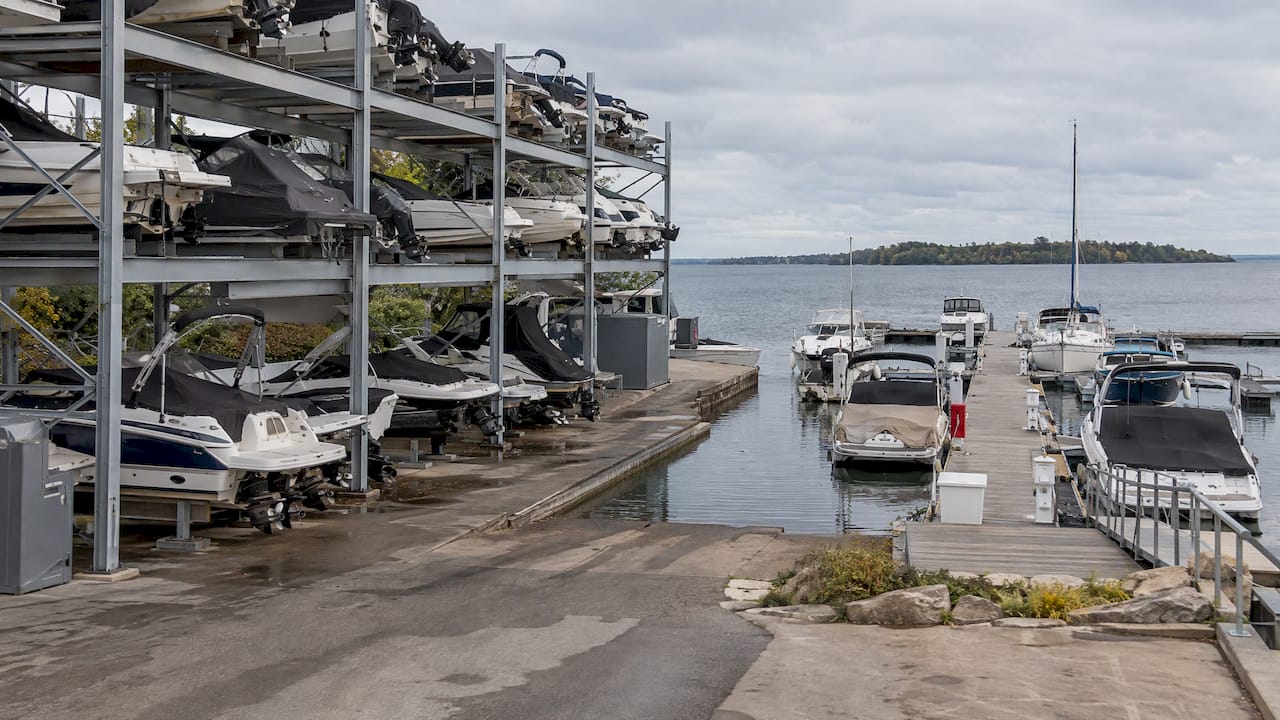
A wet slip keeps your boat in the water, ready to untie and go. Dry stack keeps it on a rack, out of the water, and the marina launches it when you call. If you boat most days or sleep aboard, the slip usually wins. If you get out on weekends and want less upkeep, dry stack often does. Either way, the choice matters more than it seems when you are buying a home or condo near the water, because it can decide which property actually works for your boat. I’m Karin Rotem, and I work with buyers around Friday Harbour and Innisfil. Below is how the two options compare, what they cost in Ontario, and what to settle before you make an offer.
TL;DR
- Wet slip: the boat stays in the water. You get 24/7 access and fit any size, but you take on bottom paint, anode changes and exposure to weather and ice.
- Dry stack: the boat sits on a rack and is launched on request. Upkeep is lower and the hull stays dry, but you book launches ahead and size limits apply.
- Cost: Ontario seasonal wet berths run from about $126 to $210 per foot depending on the marina and services. Dry stack is typically quoted per foot for the season.
- Buying near the water: confirm slip dimensions, insurance and boat-size limits in writing before you commit to a property.
The core difference: spontaneity or protection
In a wet slip, your boat floats at a dock. Boating BC Association describes the appeal plainly: you untie and head off whenever you want. The price of that freedom is upkeep. Boats kept in the water need anti-fouling bottom paint and a yearly haul-out to change sacrificial anodes, which are small metal blocks (zincs) that corrode so your hull and drive do not.
Dry stack, also called rack storage or dry rack, stores the boat on an enclosed rack at a marina. Staff bring it down with a forklift and put it in the water for you. The same association notes the boat is protected from weather, the finish is preserved, corrosion is avoided and maintenance costs drop. The trade-offs are that you must arrange the launch before you arrive, a busy day can mean a wait, the boat is not accessible around the clock, and the battery is not maintained because there is no shore power.
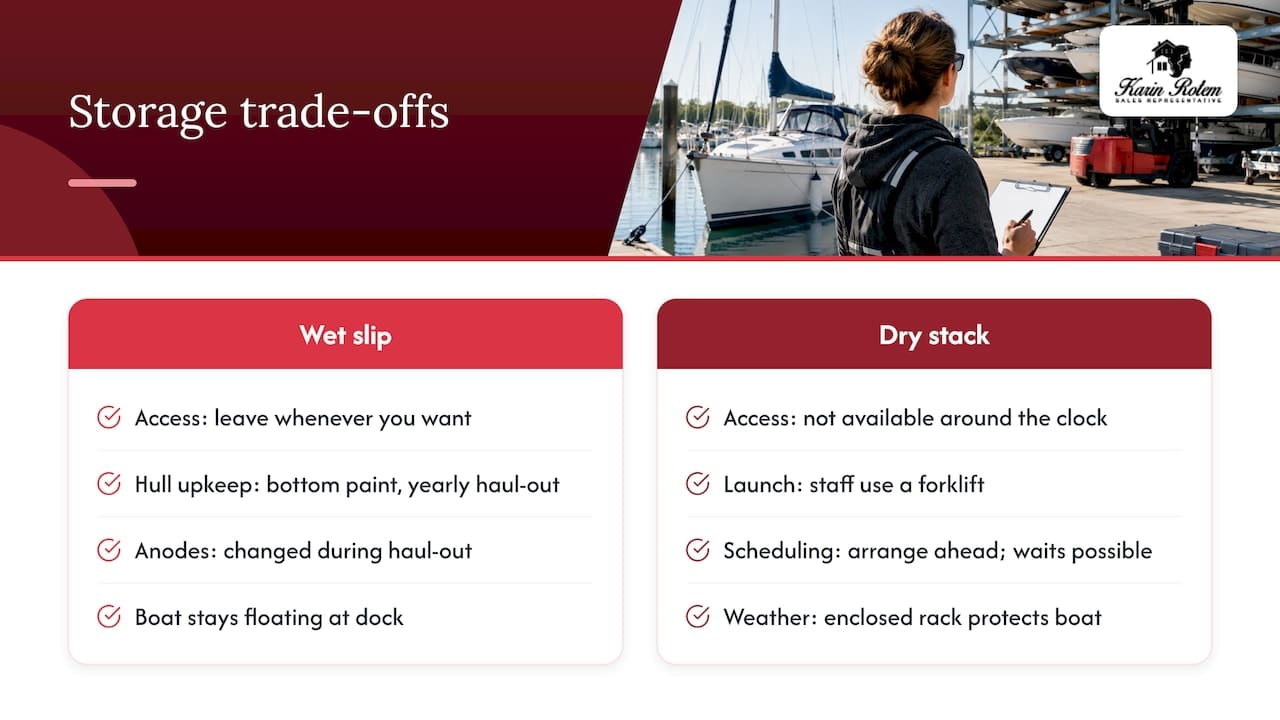
What I tell my clients: ask yourself how many days you will actually be on the water. Most people overestimate. A boat that is used eight to twelve weekends a summer has very different needs from one that is the centre of your daily routine.
Side by side
| Wet slip | Dry stack | |
|---|---|---|
| Access | Untie and go, day or night | Call ahead; launch on request during operating hours |
| Hull upkeep | Bottom paint, cleaning, anode changes | Hull stays dry; no bottom paint |
| Weather and ice | Exposed to sun, wind, growth and winter ice if left in | Stored on a rack, often indoors |
| Shore power | Usually available at the dock | Not plugged in, so batteries are not maintained |
| Boat size | Largest boats and sailboats | Mostly powerboats, with rack limits |
| Work on board | Possible when you like | Needs advance arrangement |
Access: how spontaneous are you?
Access is where most owners feel the difference. A wet slip means you can step aboard at 7 a.m. for a quick run or stay out until dark. With dry stack, you plan. On Lake Simcoe, for example, one Orillia operator offers dry stack in-and-out service with two marine forklifts for boats up to 25 feet, monthly from May to October, with 60 minutes’ notice during regular hours. A Canadian storage guide says launches typically need a call or app booking a few hours ahead, and that dry stack is less common in Canada than in the United States.
That matters if you are a Toronto professional heading north on a Friday evening. If the marina closes before you arrive, a rack boat waits until morning. A slip boat is ready when you are.
Maintenance and protection
A hull sitting in water collects growth. A Toronto-area marine dealer notes that dry stack minimizes maintenance because the hull stays dry, while wet slips need more frequent hull care and carry a high risk of ice damage in Ontario winters. Another source adds that dry-stack owners skip bottom paint and avoid zebra mussel growth because the hull is out of the water between trips.
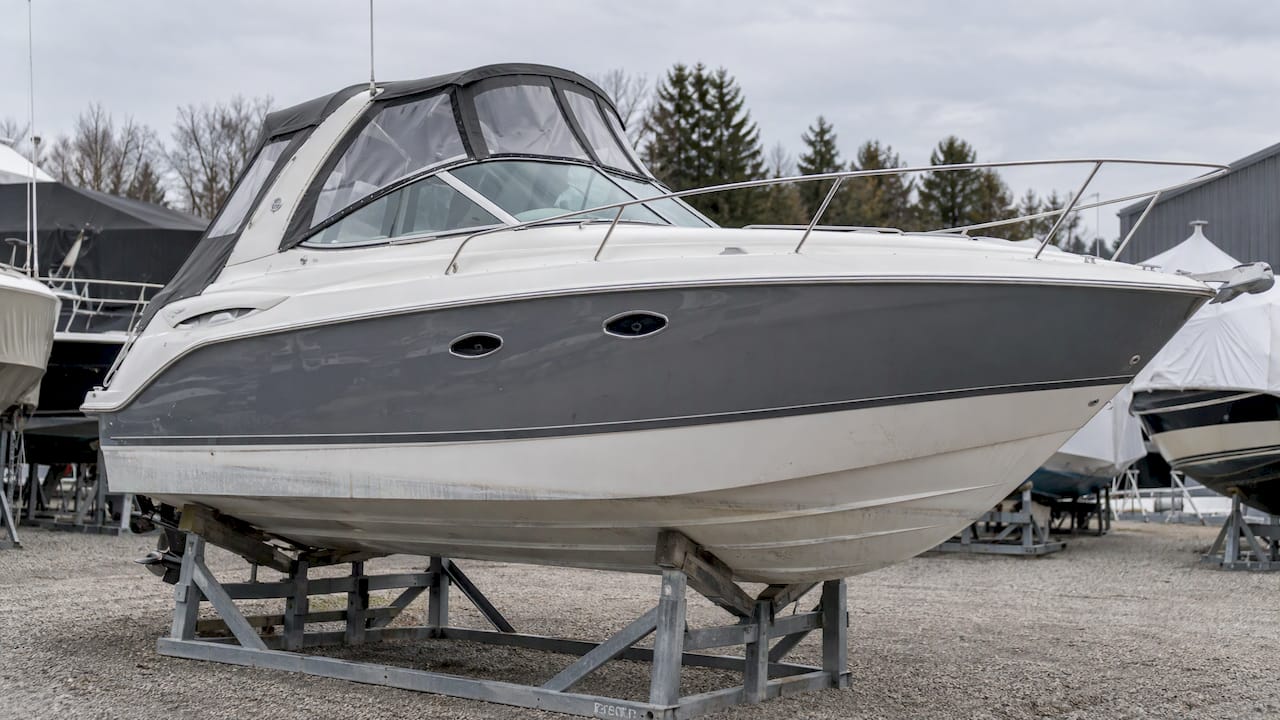
Security is the other piece. An island marine shop in BC points out that open docks are more exposed to theft and vandalism, especially for larger boats with valuable electronics, while gated, surveilled dry facilities reduce that risk. Ask any marina about security, depth, marine growth and power services, whichever option you choose.
If your boat will be stored indoors, the same logic applies as with any stored belongings: a stable environment matters. This overview of climate controlled versus regular storage explains how temperature and humidity control protect what you keep inside.
What fits on a rack, and what needs a slip
Size is the first filter. Rack limits are set by the forklift, the building and the boat’s weight, beam and height.
- Length: Canadian dry stack facilities commonly handle powerboats up to roughly 28 to 40 feet. One Vancouver marina’s rack accepts power boats from 18 to 32 feet, up to 11 feet high, a 9-foot beam and 11,000 lbs dry weight, and cannot take sailboats. Marinas in other regions set their own limits.
- Boat type: Bowriders, centre consoles, deck boats and wake boats suit racks. Sailboats and many inboard cruisers generally need a slip. The Canadian storage guide says inboard V-drives and sailboats usually do not fit.
- Air draft: Towers, T-tops and antennas can disqualify a boat from covered racks. One US comparison calls this the common pitfall. Measure to the highest point before you commit.
- Marina rules: Facilities also set conditions. A Port Credit marina’s rules require boats to be registered, licensed and insured, and exclude PWCs and wooden boats.
What each option costs in Ontario
Prices vary by marina, length and what is included, so treat these as published examples and not a quote. Always compare the total for a full year, not just the slip rate. Discover Boating makes the point that a year-round dry stack can replace both winter storage and a summer slip, while a permanent wet slip still carries yearly haul-out fees.
| Marina and option | Published rate | Period |
|---|---|---|
| Toronto Island Marina, summer docking | $132/ft (Class A) or $126/ft (Class B), plus HST | 2026 season, May 1 to Oct 31 |
| Toronto Outer Harbour, seasonal berth | $162/ft (30 amp) or $210/ft (50 amp) | Price list of February 1, 2025 |
| Harbour West, Penetanguishene, seasonal dockage | $1,402 (up to 20 ft) to $4,840 (up to 50 ft) | 2026 rates |
| Dry stack, Toronto area | $50 to $100/ft for a six-month season | Published April 2026 |
| Dry stack, national guide | From $100/ft per season | October 2026 CAD rates |
Three things move the real number. First, winter: in Ontario, slips close in the fall and a wet-slip boat must be hauled, winterized and stored, so add that cost. Harbour West’s 2026 add-ons include outside winter storage at $42.35/ft and haul-out and launch at $12.25/ft each way. Second, deposits and booking deadlines: marinas often require non-refundable deposits in the fall for the following season. Third, insurance: a Toronto harbour marina requires proof of $2 million liability insurance per vessel. Boat insurance is not legally required in Canada, but it is highly recommended, and a marine insurance broker can quote for your specific boat.
Prices are republished each season, so use the marina’s own page for current rates.
Which one suits which owner
- Weekend boater with a runabout or bowrider: dry stack. You avoid towing, launching, bottom paint and winter prep, and the boat is clean and ready when you arrive.
- Daily boater, live-aboard or anyone who values a 7 a.m. spontaneous run: wet slip.
- Larger cruiser or sailboat: wet slip, because it is the only option when a boat exceeds rack limits.
- Investor with a short-term rental property: think about what guests will use. A property that comes with a private slip is a different product from one that depends on guests arranging rack launches.
- Smaller trailerable boat on a tight budget: home trailer storage is the most economical, as long as you have the space, a tow vehicle and a secure area. Trips are less spontaneous because you hook up and drive to a launch.
Buying a home or condo with a boat in mind
This is the part most boat-storage articles skip, and where I can help. If you are looking at Friday Harbour or Lake Simcoe waterfront, the boat plan should shape which property you buy.
What most buyers don’t realize is that a slip is not an unlimited right. At Friday Harbour, the marina rules set private homeowner slip limits of 26’6" x 9’ x 7,500 lbs for a 5-metre dock, or 36’6" x 14’ x 13,500 lbs for an 8-metre dock, with one vessel and one PWC up to 11’. Sailboats have a 4’6" draft limit. Homeowners provide proof of registration and insurance each year, and boaters must carry $2 million in liability coverage including hull and machinery and wreck removal. Check your boat’s length, beam and weight against those numbers before you write an offer.
A few practical checks:
- Does the unit come with a slip, or only access? Our guides on boat docking for condo owners and what marina access means at Friday Harbour explain the difference, and our page on Friday Harbour marina fees shows what ownership adds to your annual costs.
- Does your boat fit the dock? Compare length, beam, weight and draft to the written limits above.
- Is a boathouse part of the plan? On Lake Simcoe lots, Innisfil’s zoning by-law caps boathouses at 5.0 metres high and 10.0 metres long, with a width of the lesser of 25% of the frontage or 12.0 metres, and no human habitation. See our private boathouse permit guide before you plan one.
- Will you use it year-round? If the cottage will close for winter, our cottage winterizing guide covers the decision, and your boat’s winter storage should be planned alongside it.
- Lake Simcoe versus the harbour: for shoreline, permits and insurance on private waterfront, see our Lake Simcoe waterfront guide.
Our perspective
We tell buyers to decide the boat plan before the property plan. The question is not wet slip or dry stack in the abstract. It is how often you will really be on the water, what your boat measures, and whether the property you love supports that pattern.
For a Toronto professional with a weekend boat, convenience is the whole point of a second home. A slip close to the unit means you arrive, walk down and go. If your boat is on a rack, the plan has to include launch calls and operating hours, and that needs to fit how you travel north.
Our team has built its reputation at The Harbour and in Innisfil, and we put the slip limits, marina rules and costs on the table early, so you know what the home gives you before you fall in love with it. When a property or a boat does not fit, we say so plainly and look for the one that does.
Felix
Looking at Friday Harbour or Innisfil?
If a boat is part of why you want to be on the water, start with the homes and condos that suit it. Browse Friday Harbour condos for sale or contact us through karinrotem.com and we will help you match the property to your boat, your schedule and your budget.
FAQ
Is dry stack cheaper than a wet slip?
It depends on the marina and your boat, and on what else you pay for. Dry stack avoids bottom paint and often replaces separate winter storage, which is why weekend boaters can come out ahead on total annual cost. Compare the full year, including haul-out, winterizing and prep, not only the seasonal rate.
Can I use my boat any time with dry stack?
Not on the spot. You arrange the launch ahead, usually by phone or app, and it happens during operating hours. A busy day may mean a wait, and a late return may mean the boat stays in the water overnight, depending on the marina’s policy.
What size boat fits in dry stack storage?
Most Canadian racks are built for powerboats up to about 28 to 40 feet, within set limits on height, beam and weight. Sailboats and many inboard cruisers generally need a slip. Always confirm the specific marina’s limits, including tower and antenna height.
What should I check about boat storage before buying near Friday Harbour?
Confirm in writing whether the property includes a slip or only marina access, and compare your boat’s length, beam, weight and draft to the marina’s published limits. Also confirm the insurance the marina requires and the annual fees. We can walk you through all of it for a specific unit.
Sources
- Owning A Boat, Boating BC Association
- Dry Rack Storage, Crate’s Lake Country Boats
- Dry Stack Boat Storage, Boat Parking
- Wet Slip vs. Dry Stack vs. Lift Slip, SeasonalSlips
- How does Dry Stack Boat Storage Compare, Boat Toronto
- Wet or Dry Boat Storage in BC, Alberni Power Marine
- Drystack, Milltown Marina
- Rules and Regulations, Port Credit Harbour Marina
- Boat Storage Guide, Discover Boating
- Spring and Summer Rate Schedule, Toronto Island Marina
- Price List, Outer Harbour Marina
- Rates, Harbour West Marina
- Marina Rules and Regulations, Friday Harbour
- Comprehensive Zoning By-law 080-13, Town of Innisfil