
A listing price strategy is the calculated method a seller uses to set the initial marketing price of their property to attract qualified buyers and drive competitive offers. The listing price is not the same as the selling price. The listing price is what you advertise; the selling price is what you actually agree to at closing. Understanding what does listing price strategy mean gives you real control over who walks through your door, how many offers you receive, and how much you ultimately take home.
What does listing price strategy mean in real estate?
A listing price is primarily a marketing anchor and negotiation tool, not a fixed valuation guarantee. It shapes how buyers perceive your property before they ever step inside. Set it too high and buyers scroll past. Set it thoughtfully and you create the conditions for a strong, competitive sale.
Several factors shape your listing price:
- Comparable sales (comps): Recent sales of similar homes in your neighbourhood set the baseline. A three-bedroom detached home in Innisfil that sold for $850,000 last month tells you where the market sits right now.
- Days on market: How long similar homes are sitting before selling signals whether buyers have leverage or sellers do.
- Property features: Upgrades, lot size, waterfront access, and condition all shift your price above or below the comp average.
- Local market conditions: Inventory levels and buyer demand in your specific area matter far more than national headlines.
- Seller timeline: A seller who needs to close in 45 days prices differently than one who can wait three months.
The gap between listing price and selling price varies by market. In a hot Toronto neighbourhood, homes routinely sell $50,000 to $150,000 above list. In a slower market, the final price often lands below the listing number. Karinrotem’s sold listings show this range clearly across different property types and communities. The listing price sets the stage; the market writes the final number.
Buyer engagement also responds directly to price positioning. A property priced at market value draws serious, pre-qualified buyers. A property priced above market attracts fewer showings, weaker offers, and eventually a price reduction that signals trouble to the market.

How do market conditions affect listing price strategies?
Market temperature is the single biggest factor in choosing your pricing approach. Agents measure it using inventory levels, days on market, and the sale-to-list-price ratio.
The sale-to-list-price ratio tells you exactly where the market stands. A ratio above 1.00 means homes are selling above asking price. That signals a hot market where demand outpaces supply. A ratio below 1.00 means buyers are negotiating sellers down, which signals a cooler market with more inventory than demand.
| Market type | Inventory level | Recommended pricing approach | Expected outcome |
|---|---|---|---|
| Hot market | Low (under 2 months) | Price at or slightly above comps | Multiple offers, sale above list |
| Balanced market | Moderate (2–4 months) | Price at market value or slightly below | Steady showings, one to two offers |
| Cool market | High (over 4 months) | Price below comps to stand out | Attracts buyers who might otherwise skip |
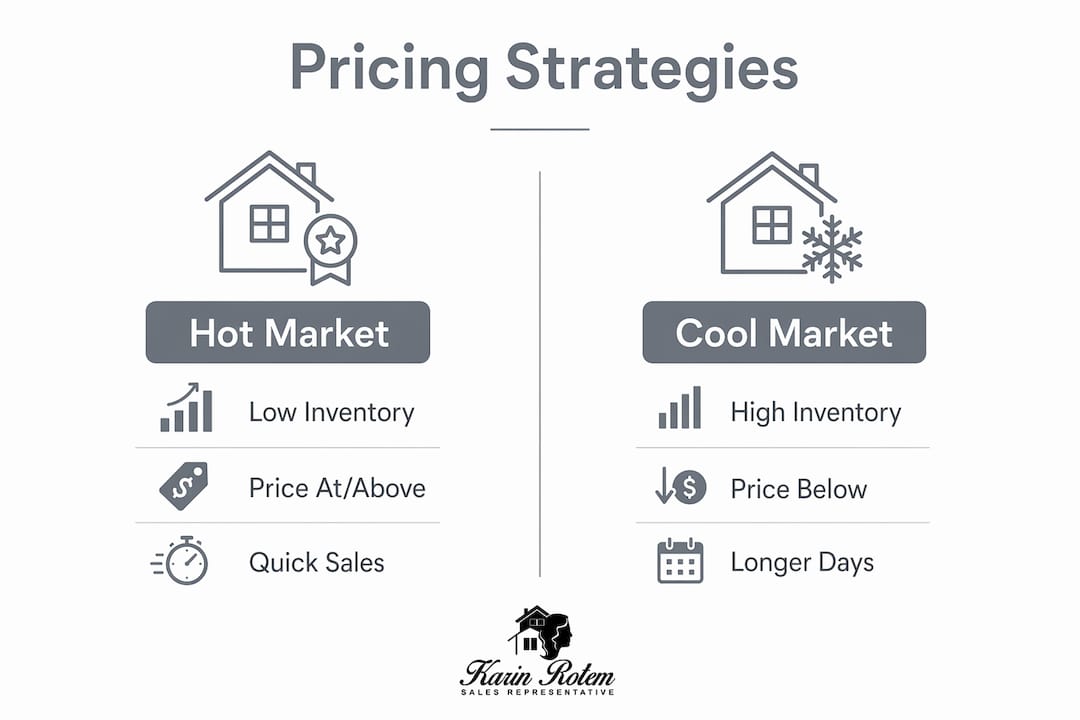
In a hot market like parts of Toronto or Friday Harbour during peak season, pricing at comps or slightly above captures the demand already in the market. In a balanced market, underpricing to spark competition combined with an offer date can generate multiple bids and push the final price above list. In a cool market, aggressive underpricing is often the only way to generate meaningful buyer interest.
Pro Tip: Track the sale-to-list-price ratio alongside days on market every week during your listing period. If the ratio in your area is consistently above 1.02, you may be leaving money on the table by pricing at exact market value.
The right pricing approach shifts as the market shifts. What worked in february may not work in september. Karinrotem monitors these indicators continuously for clients in Toronto and Innisfil to keep pricing decisions grounded in current data, not assumptions.
What real estate pricing tactics influence buyer behaviour and search exposure?
Pricing is not just about value. It is about visibility. Most buyers search for homes online using price filters with round-number brackets. A listing priced at $400,000 appears only in searches up to $400,000. A listing priced at $399,990 appears in two search brackets: the one ending at $400,000 and the one starting at $350,000. That small difference can effectively double your listing’s audience.
Here are the core tactics that shape buyer behaviour and search exposure:
-
Price at category edges. Setting your price just below a round-number threshold (e.g., $699,900 instead of $700,000) captures buyers searching in the bracket below while still appearing to those searching above. This is one of the most underused tools in residential real estate.
-
Use offer dates in low-inventory markets. Listing below market value and setting a specific offer date creates urgency. Buyers know they are competing, which pushes offers higher. This tactic works best when inventory is tight and demand is strong.
-
Avoid small, incremental price drops. A $900 reduction signals a nervous seller. The market reads it as hesitation and buyers wait for more drops. A larger price adjustment that crosses into a new search category signals a deliberate repositioning and attracts a fresh pool of buyers.
-
Align your price with your target buyer’s search habits. A waterfront property at Friday Harbour attracts a different buyer than a suburban semi-detached in Barrie. Understanding where those buyers search and what filters they use is part of maximising your MLS exposure.
-
Educate yourself before listing. Sellers who understand how buyer search filters work make better pricing decisions. Agents who explain this clearly help close the gap between homeowner expectations and market reality.
Pro Tip: Before you list, ask your agent to show you exactly how your property appears in buyer search results at your proposed price. Then ask what changes if you drop by $10,000. The difference in audience size often surprises sellers.
How to set the right listing price: practical steps
Setting the right price is part analysis, part timing, and part honest self-assessment. The most important pre-listing decision a seller makes is the listing price. Get it right and the market rewards you quickly. Get it wrong and you spend weeks chasing the market down.
- Run a comparative market analysis (CMA). Pull the last 90 days of sales for comparable homes within one kilometre. Look at price per square foot, days on market, and the sale-to-list ratio. This is your pricing baseline.
- Factor in your timeline. If you need to sell within 30 days, price at or slightly below market. If you have flexibility, you can test the top of the range. Aligning price with your timeline removes a lot of stress from the process.
- Watch the first weekend closely. The first weekend on market is your clearest signal. Strong showing requests and early offers confirm your price is right. Silence or low engagement tells you the price needs attention before the listing goes stale.
- Adjust decisively, not timidly. If the first two weeks produce no serious interest, a meaningful price adjustment crossing into a new search category will attract buyers who previously filtered you out. A token reduction of a few hundred dollars does nothing.
- Work with an agent who knows your micro-market. Pricing in Friday Harbour is different from pricing in midtown Toronto. Local knowledge about buyer profiles, seasonal demand, and waterfront premiums is not something a national algorithm captures. Karinrotem’s team brings that depth to every listing. Understanding when to use a real estate agent is itself a strategic decision.
The right listing price is a moving target. It responds to new sales data, shifting inventory, and buyer feedback in real time. Sellers who treat it as a fixed number from day one often leave money on the table or sit on the market far longer than necessary.
Key takeaways
A well-executed listing price strategy is the single most powerful tool a seller controls before the property hits the market.
| Point | Details |
|---|---|
| Listing price vs. selling price | The listing price is your marketing number; the selling price is what closes. They are rarely the same. |
| Sale-to-list ratio as your compass | A ratio above 1.00 signals a hot market; below 1.00 means buyers have the upper hand. |
| Price category positioning | Pricing just below a round-number threshold can double your listing’s online audience. |
| First weekend is your feedback | Low engagement in the first weekend is a clear signal to adjust price before the listing loses momentum. |
| Local expertise matters | Micro-market knowledge in areas like Friday Harbour or Toronto shapes pricing decisions that national data cannot replicate. |
What I’ve learned about pricing that most sellers overlook
What I tell my clients consistently is this: the listing price is not about what you think your home is worth. It is about what the market will pay right now, given current inventory, buyer demand, and search behaviour. Those are three different things, and confusing them is the most common and costly mistake I see.
The first weekend on market is something I watch very carefully with every listing. Most sellers think they have weeks to gauge interest. They do not. Buyer attention is highest in the first 72 hours. If the showing requests are not coming in by saturday afternoon, the price is the problem. Not the photos, not the staging. The price.
I also see sellers resist meaningful price adjustments because a small drop feels like a concession. The reality is the opposite. A $900 drop on a $750,000 listing tells the market you are not serious. A $25,000 drop that moves you into a new search bracket tells buyers you are ready to deal. That distinction matters enormously in how the market responds.
In Friday Harbour specifically, waterfront and lifestyle premiums are real but they are seasonal and buyer-profile dependent. Pricing a Friday Harbour property in january requires a different approach than pricing the same unit in june. I have seen sellers overprice in the off-season and then chase the market all spring. Getting the timing and the price right together is where the real advantage lives.
— Felix
Pricing your property with Karinrotem’s local expertise
Karinrotem’s team brings deep market knowledge to every listing in Toronto, Innisfil, and the Friday Harbour community. Whether you are selling a waterfront condo, a family home, or an investment property, the team conducts a thorough comparative market analysis and builds a pricing approach grounded in current local data. You can browse current listings to see how strategic pricing translates into real results across different property types and price points. For sellers who want a clear, honest assessment of where their property sits in today’s market, Karinrotem offers the local insight and negotiation experience to get you there with confidence.
FAQ
What is a listing price strategy in real estate?
A listing price strategy is the deliberate method a seller uses to set the initial asking price of a property to attract buyers and maximise sale outcomes. It combines market data, buyer search behaviour, and local conditions to determine the most effective starting price.
How does listing price differ from selling price?
The listing price is the initial marketing price set before the property goes to market; the selling price is the final amount agreed upon at closing. In hot markets, the selling price often exceeds the listing price.
Why does the first weekend on market matter so much?
Buyer attention is highest in the first 72 hours after a listing goes live. Weak engagement in that window is a direct signal that the price is too high, and waiting too long to adjust allows the listing to go stale.
What is the sale-to-list-price ratio and why does it matter?
The sale-to-list-price ratio measures whether homes in your area are selling above or below their asking price. A ratio above 1.00 confirms strong demand and supports aggressive pricing tactics like underpricing with an offer date.
How do price category thresholds affect listing visibility?
Pricing just below a round-number threshold, such as $399,990 instead of $400,000, places your listing in two buyer search brackets instead of one. This can significantly expand the number of buyers who see your property online.