Yes. If your property meets the CRA’s ownership and occupancy tests, the principal residence exemption can eliminate capital gains tax entirely on the sale. But it is not automatic anymore. You must report the sale on Schedule 3 of your tax return, and if the property was not your principal residence for every year you owned it, you also need Form T2091(IND) to calculate the taxable slice. Miss the reporting step and you risk penalties even when the gain itself would have been fully exempt.
TL;DR:
- The principal residence exemption requires proper reporting on Schedule 3 and possibly Form T2091(IND) if ownership years vary, or penalties can apply.
- Only one property per family unit can be designated as the principal residence annually after 1981, complicating multi-property ownership with potential taxable gains.
- The exemption calculation uses a formula that counts designated years plus one, divided by total ownership years, with special rules if the owner was non-resident or the property was not inhabited every year.
- Converting part of a home to rental or business use triggers deemed dispositions, but elections can often extend the exemption period if filed correctly.
- Accurate record-keeping, including receipts for improvements and legal documents, is essential for substantiating claims during audits years after the sale.
What qualifies as a principal residence exemption Canada claim
The CRA doesn’t just take your word for it. A property has to pass three tests before it counts as a principal residence, and I’ve seen sellers lose part of their exemption because they assumed a property automatically qualified when it didn’t.
First, it has to be a housing unit. That includes a detached house, a condo, a semi, a mobile home, even a trailer or houseboat in some cases. The land underneath and around it counts too, but only up to half a hectare (roughly 1.24 acres) unless you can show CRA that more land was necessary to use and enjoy the home. That threshold trips up a lot of rural and cottage-country sellers whose lots run larger than a standard city parcel.
Second, you or your spouse, common-law partner, or child must have owned it. Joint ownership works fine here. Two spouses on title, or a parent and adult child co-owning a property, can both claim the exemption on the same designated home for the years they owned it together.
Third, and this is where most disputes happen: the property has to be ordinarily inhabited in the year. CRA doesn’t require full-time occupancy. A seasonal cottage you live in every summer can qualify. What CRA will push back on is a property used purely for storage or held strictly as an investment with no personal use. Utility bills, a driver’s licence address, or mail records are often enough to demonstrate residency if you’re ever asked.
Here’s the part that surprises people the most:
- One family unit can designate only one property as a principal residence for each year after 1981, according to Income Tax Folio S1-F3-C2.
- A family unit means you, your spouse or common-law partner, and any unmarried children under 18.
- Spouses cannot each claim a different property as their principal residence for the same tax year after 1981.
- Once a child turns 18 or marries, they can potentially designate a separate property, which matters for multi-generational households.
This family unit rule is the single biggest trap for households that own both a city home and a cottage. You cannot fully shelter gains on both properties for overlapping years. Designation of one property excludes the other for those years, leading to taxable gain on the non-designated property regardless of personal use.
How the principal residence exemption is calculated
The exemption formula looks intimidating on paper, but it boils down to a fraction: how many years the property was designated as your principal residence, divided by how many years you owned it.
Here’s the CRA formula in plain terms:
- Take the number of years the property was designated as your principal residence, plus one (the “plus-one” rule).
- Divide that number by the total number of years you owned the property.
- Multiply that fraction by the total capital gain to get the exempt portion.
- Subtract the exempt portion from the total gain to find the taxable amount.
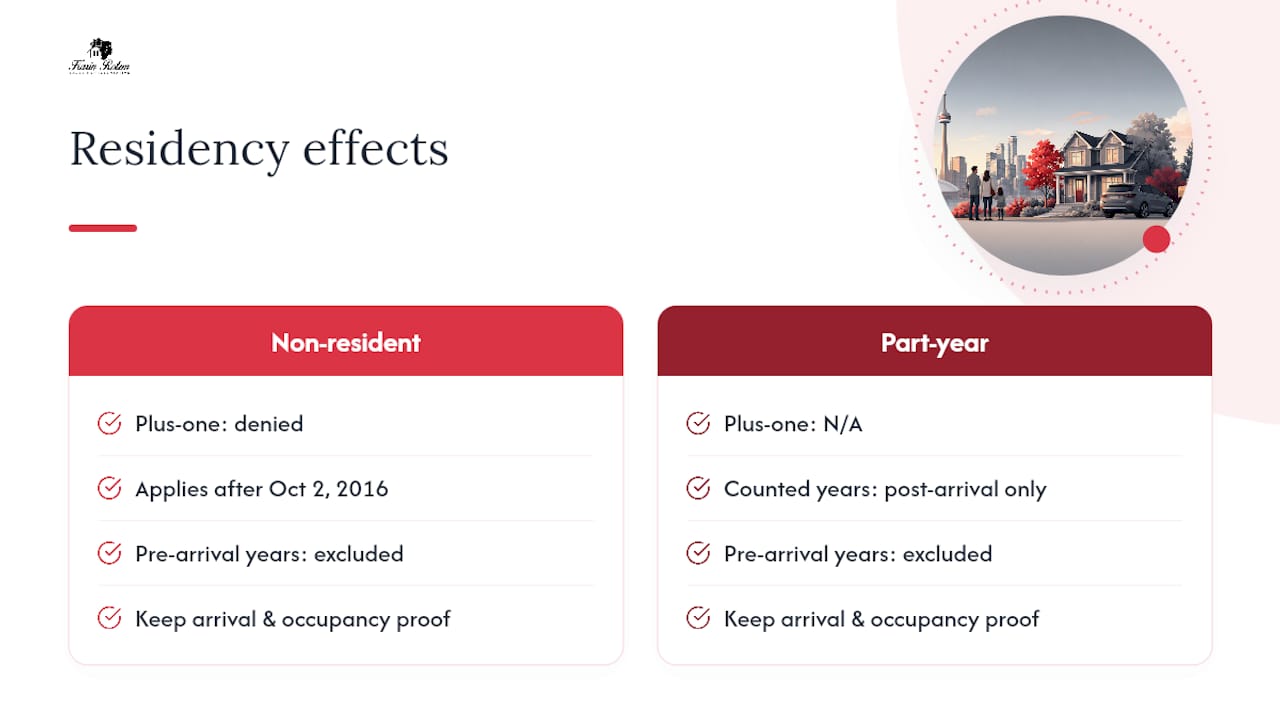
The plus-one rule exists so that if you sell one home and buy another in the same calendar year, you don’t lose a year of exemption on either property, since you technically can’t have two principal residences designated in the same tax year without it. There’s a wrinkle worth knowing: for dispositions after October 2, 2016, the plus-one may be denied if you were a non-resident of Canada for the entire year you acquired the property. That change specifically targeted non-resident speculation in the housing market, and it catches people by surprise if they bought while living abroad and moved to Canada later.
Counting years matters more than people expect. You count from the calendar year of acquisition to the calendar year of disposition, and each partial year still counts as a full year in the formula. Properties acquired before 1982 have their own transitional treatment, since the “one property per family unit” rule didn’t apply before that year, and CRA’s T4037 capital gains guide walks through those older scenarios with worked examples.
Quick math example: Say you owned a home for 12 years and it was your principal residence for 10 of those years (the other 2, you rented it out entirely). Your exempt fraction is (10 + 1) ÷ 12, or 11/12. If the total capital gain on sale was $120,000, the exempt portion is $110,000, leaving $10,000 as a capital gain, half of which (the standard capital gains inclusion) gets added to your taxable income.
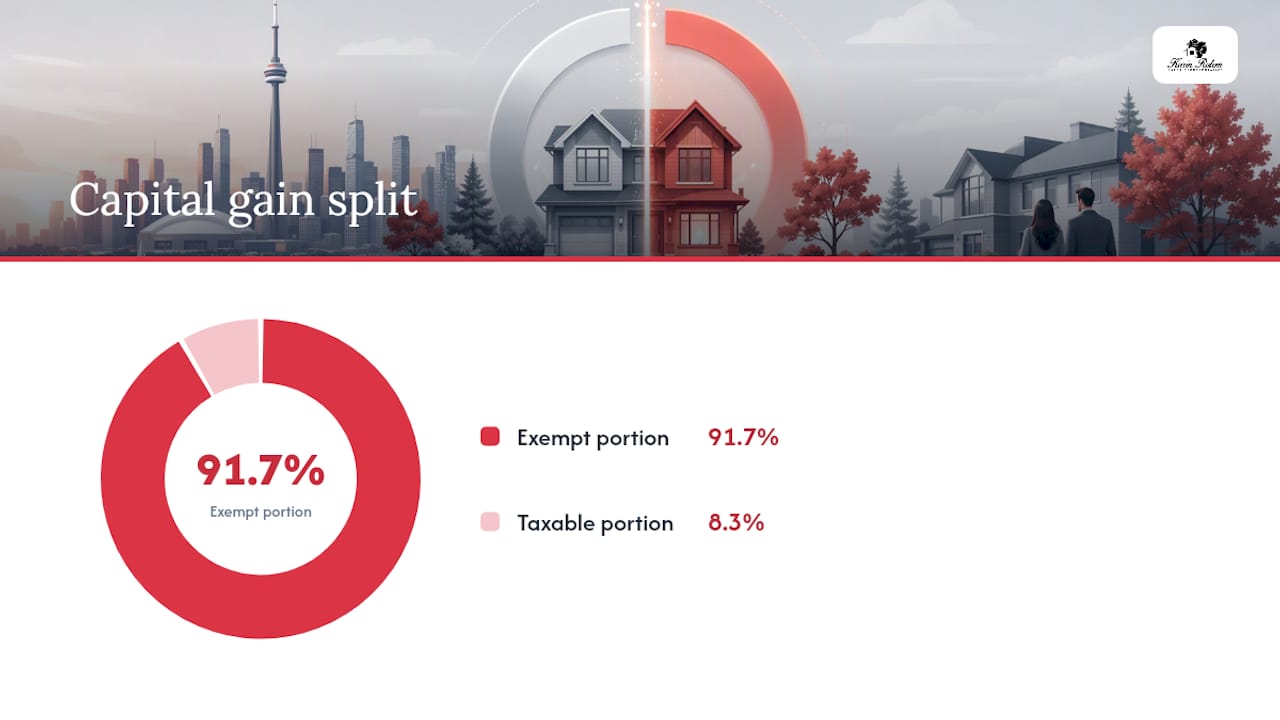
That last two years of full rental use is exactly the kind of detail that shows up on the T2091(IND) worksheet, and it’s why the form exists in the first place. Skipping it because “the house was mostly my home” is how sellers end up under-reporting.
Designating and reporting the sale since 2016
Since the 2016 tax year, every sale of a principal residence has to be reported on Schedule 3 of your T1 return, full stop. Before that change, CRA didn’t require reporting if the entire gain was exempt, which meant a lot of sales simply never showed up on a return. That loophole is closed now.
Whether you need Form T2091(IND) on top of Schedule 3 depends on one question: was the property your principal residence for every single year you owned it? If yes, Schedule 3 alone is usually sufficient. If no, even for one year, you need to complete Form T2091(IND) to calculate the taxable portion.
The form asks for specifics you should have on hand before you sit down to file:
- The property’s address and legal description
- The year you acquired it
- Proceeds of disposition (what you actually sold it for)
- Adjusted cost base (purchase price plus eligible capital improvements)
- The years you’re designating it as your principal residence
Pro Tip: Pull your Statement of Adjustments from closing before you file. It has your exact proceeds figure and often the legal description, saving you a call to your lawyer’s office mid tax season.
If you sold a property years ago and never reported it, you’re not without options. CRA allows late designations in some circumstances, though a penalty may apply, generally the lesser of $8,000 or $100 per month of lateness. For more serious omissions, the Voluntary Disclosures Program can reduce penalties if you come forward before CRA contacts you first.
A short filing checklist before you send your return:
- Confirm the property meets the ownership and ordinarily-inhabited tests for the years you’re claiming.
- Check whether every year of ownership was covered by the designation, or whether T2091(IND) is required.
- Gather your Statement of Adjustments from both purchase and sale.
- Total your capital improvements with receipts, not estimates.
- Complete Schedule 3, and T2091(IND) if applicable, before the filing deadline.
Change of use, partial dispositions, and rental conversions
Converting even part of your home to a rental or business use can trigger a deemed disposition, meaning CRA treats you as having sold the property at fair market value and immediately reacquired it, even though no actual sale happened. This resets your cost base and starts a new ownership period for capital gains purposes.
You can often avoid that deemed disposition using the subsection 45(2) election, which lets you designate the property as your principal residence for up to four additional years after the change in use, provided you don’t claim capital cost allowance on it and you file the election with your return for the year of the change.
A few practical points worth flagging:
- The four-year extension can be indefinite if you’re required to move for work and meet specific residency conditions.
- When only part of a property changes use, such as converting a basement into a long-term rental suite, CRA accepts reasonable allocation methods, square metres or number of rooms are both common, to split the gain between residential and rental portions.
- Whatever method you use, document it. CRA wants to see the calculation, not just the conclusion.
- If you later convert the rental portion back to personal use, a parallel election under subsection 45(3) can apply in reverse.
Get the timing wrong here and you can trigger tax on a gain you never intended to realize. If you’re weighing a rental conversion, our guide on capital gains for rental property in Canada breaks down the reporting side in more detail.
Common mistakes that shrink or erase the exemption
I’ve watched sellers lose thousands of dollars on mistakes that had nothing to do with the property itself and everything to do with paperwork.
- Assuming the sale doesn’t need reporting. Since 2016, every principal residence sale goes on Schedule 3, even when the entire gain is exempt. Forgetting this step invites a penalty notice, not because tax is owed, but because the sale wasn’t disclosed.
- Double-designating within a family unit. A couple who each claim a different property as their principal residence for overlapping years after 1981 will have one designation disallowed by CRA, usually the smaller gain, which defeats the purpose entirely.
- Misallocating gains on partial rentals. Sellers who rented out a portion of their home sometimes report the whole gain as exempt, or the whole gain as taxable, instead of splitting it by square footage or room count as CRA expects.
- Losing renovation receipts. Capital improvements raise your adjusted cost base and shrink your taxable gain. Without receipts, CRA can disallow the claimed cost, inflating the gain you owe tax on.
Pro Tip: If you renovated a kitchen or added a bathroom in the last decade, dig up those invoices now, even if you’re not selling this year. Contractors don’t keep records forever, and neither does your memory.
To make the stakes concrete: a Toronto seller who owned a home for 15 years, designated it as their principal residence the whole time, and reported the sale on Schedule 3 pays zero capital gains tax on a $400,000 gain. A seller in an identical situation who simply forgot to file Schedule 3 faces a penalty exposure and a much longer conversation with CRA, even though the underlying tax owed is the same: zero. The paperwork is the difference between a clean file and a headache.
Record-keeping: what to save and for how long
CRA can ask you to substantiate a principal residence claim years after the sale, so treat your documents like an insurance file, not a folder you clear out every spring.
Keep these on hand:
- Purchase and sale agreements, plus Statements of Adjustments from both transactions
- Receipts and invoices for capital improvements (renovations, additions, major system replacements)
- Rental agreements or lease documents if any portion of the property was ever rented
- Your completed T2091(IND) worksheet and Schedule 3 filing
- Utility bills or other proof of occupancy if the “ordinarily inhabited” test could be questioned
CRA generally expects you to keep tax records for six years from the end of the relevant tax year, but for a principal residence, I’d argue you keep the sale documents indefinitely, since the designation years can matter decades later if you’re audited on a different property. Scan everything and store copies both digitally and in a physical file; a cloud folder plus a paper copy at home covers you if one system fails.
If documents are missing, don’t panic. CRA will often accept a reasonable reconstruction, old bank statements showing mortgage payments, land registry records, or a call to your original lawyer’s office can fill gaps. Contact CRA directly if you’re unsure what’s salvageable before you file.
Non-resident status and part-year residency effects
Your residency status in the year of acquisition and the year of sale both affect what you can claim, and this is one of the more misunderstood corners of the exemption.
If you were a non-resident of Canada for the entire year in which you acquired the property, the plus-one bridging year is denied for dispositions after October 2, 2016. That single rule change was aimed squarely at reducing the exemption’s benefit for foreign buyers who parked money in Canadian real estate without ever living here full-time.
Part-year residents face a different wrinkle. If you moved to Canada partway through a year and the home became your principal residence only after you arrived, only the years of actual Canadian residency and ordinary inhabitation count toward the designated period. The pre-arrival period doesn’t qualify, even if you owned the property.
This matters a lot for international buyers eyeing Toronto or the Friday Harbour area as a future home base. If you’re buying now with plans to relocate permanently later, the residency timeline you establish affects both your exemption eligibility and potentially your exposure to non-resident withholding tax on a future sale. Get the sequence of events, arrival date, occupancy start, and any prior non-resident periods, documented clearly, because CRA will ask for it if the file gets reviewed.
Foreign properties and Canadian tax residents
Canadian tax residents who own a home outside Canada — a Florida condo, a villa in Portugal — can still designate that foreign property as their principal residence, provided it meets the same ownership and ordinarily-inhabited tests as a Canadian property, as explained in this real estate apostille Canada guide for international transactions. The exemption isn’t restricted to domestic real estate.
The catch is the family unit rule still applies across borders. If you own a home in Toronto and a condo in Florida, you and your family unit can only designate one of them per year. Many snowbirds assume the foreign property is automatically excluded from Canadian tax rules because it’s not on Canadian soil; it isn’t. If you sell either property, the same Schedule 3 and potential T2091(IND) filing requirements apply.
There’s also a reporting layer separate from the PRE itself: foreign property with a cost over $100,000 CAD may trigger Form T1135 (Foreign Income Verification Statement) filing obligations, regardless of whether you ever sell it. That’s a distinct requirement from the principal residence designation, and conflating the two is a common error among Canadians who split time between two countries.
Designating your home the right way
Designation isn’t a separate application you submit to CRA in advance. It happens at the point of filing, through the same forms already covered: Schedule 3 for the basic sale report, and Form T2091(IND) when the property wasn’t your principal residence for every year of ownership.
The designation itself is really just a statement, on the T2091(IND) form, of which years you’re claiming the property as your principal residence. You’re not asking CRA for pre-approval; you’re calculating the exemption yourself and reporting the result, subject to CRA’s right to review it later.
One detail that trips people up: if you’re the legal representative of someone who died owning a principal residence, a different form, T1255, handles that designation on behalf of the estate rather than T2091(IND). Executors settling an estate should flag this early, since the deadlines and required information differ from a standard sale.
What I tell my clients about timing a sale to protect the exemption
What I tell my clients selling in Innisfil or looking at a Friday Harbour purchase: your closing date isn’t just a moving day, it’s a tax date. Selling in December versus January can shift a full year in your ownership count, and that changes the exemption fraction. If you’re keeping a cottage while buying a Friday Harbour property short-term, the family unit rule means only one gets the designation for overlapping years, so decide which property matters more for your long-term tax picture before you list either one.
— Felix
How a real estate team can support sellers who want to protect their exemption
A knowledgeable local team can help you sequence the listing and closing dates so your ownership years and family unit designation work in your favour, something a generic online calculator can’t do because it doesn’t know your specific timeline or your other properties. Some teams offer seller consultations that walk through timing, provide document checklists tailored to your situation, and referrals to trusted tax professionals for the calculations themselves. They are not tax preparers, and anything involving T2091(IND) math or a Voluntary Disclosures Program application belongs with an accountant or tax lawyer. What such teams handle is the real estate side, getting your sale structured and timed so the tax outcome is clean rather than accidental. If you’re planning a sale and want that guidance, browse current listings or reach out to book a seller consultation.
This article is general information, not a substitute for advice from a qualified financial advisor. Consult a qualified financial professional about your own circumstances before acting on anything here.
FAQ
How long do you have to live in a house to avoid capital gains tax in Canada?
There’s no minimum time requirement; what matters is that the property was ordinarily inhabited and designated as your principal residence for the years you’re claiming, even a single year of ownership can be fully exempt if properly designated.
What qualifies as a principal residence?
A housing unit you or your family unit owns and ordinarily inhabits, including up to half a hectare of surrounding land, and it can be a house, condo, cottage, or even a houseboat.
How does CRA determine primary residence?
CRA looks at ownership and whether the property was ordinarily inhabited in the year, a factual test that considers occupancy evidence like utility bills or a driver’s licence address rather than requiring full-time residency.
Do I have to pay capital gains when I sell my principal residence?
If the property was your principal residence for every year you owned it and you report the sale on Schedule 3, the entire gain is typically exempt; if it wasn’t your principal residence for all those years, Form T2091(IND) calculates the taxable portion.
Do I need to file Form T2091(IND) every time I sell my home?
No, only when the property wasn’t your principal residence for every year you owned it; if it was, Schedule 3 alone generally covers the reporting requirement.