
Yes, you can use rental income to qualify for a mortgage in Canada, but not dollar for dollar. Lenders count only a portion of the rent, or the rent after expenses, and the formula depends on the lender, the property type and whether you will live in the building. What I tell my clients is simple: work out the lender’s number before you fall in love with a property, not after.
I work with buyers and investors in Toronto, Innisfil and Friday Harbour, so I see these calculations on real deals every week. This guide explains how the numbers work, what changed with OSFI in 2026 (and what did not), and how to prepare a file that gets approved.
TL;DR
- Lenders rarely count 100% of your rent. Expect a share of gross rent or a net-income calculation, which can add far less to your borrowing power than you hoped.
- CMHC’s rules for insured mortgages are more generous on owner-occupied 2-unit homes (up to 100% of gross rent) than on 3 to 4 unit properties (up to 50% of gross rent, or a net rental income approach).
- OSFI’s 2026 capital rules change how banks classify rental-heavy loans, not the underwriting standards used to qualify you personally.
- Your tax return, leases and a clean paper trail matter as much as the rent itself.
How lenders turn rent into qualifying income
Every Canadian mortgage approval starts with two ratios. The Financial Consumer Agency of Canada explains that lenders look at your Gross Debt Service (GDS) ratio and Total Debt Service (TDS) ratio. Housing costs (mortgage payment, property taxes, heat and 50% of condo fees) should typically stay under 39% of gross income, and total debts under 44%. On top of that, you must pass the stress test, at the greater of 5.25% or your contract rate plus 2%.
Rental income enters the picture in one of two ways:
- Add-back (or gross-up) method. The lender adds a percentage of the rent to your income. Brokers and lenders commonly quote 50% to 80%, and the percentage varies by lender.
- Offset method. The lender subtracts the rent, or a percentage of it, from the property’s carrying costs, so it reduces your debt side instead of raising your income side.
The same $2,000 of monthly rent can produce quite different results under each method. That is why two lenders can look at one file and approve different amounts.
A worked example
Say you earn $120,000 a year and want to buy a two-unit property in which you will live in one unit and rent the other for $2,000 a month ($24,000 a year).
| Treatment | Rent counted | Income used for GDS and TDS |
|---|---|---|
| No rental income | $0 | $120,000 |
| 50% of gross rent | $12,000 | $132,000 |
| 80% of gross rent | $19,200 | $139,200 |
| 100% of gross rent (where permitted) | $24,000 | $144,000 |
Those are illustrative figures, not a lender quote. At a 39% GDS limit, the gap between $132,000 and $144,000 of income is worth roughly $4,700 more in annual housing costs. That is real, but it is not the doubling of buying power many first-time landlords picture.
What most buyers don’t realize is that the stress test applies to the whole mortgage payment, not only to the rent-supported part. A property that “pays for itself” at today’s rate may look much weaker at the qualifying rate.
What CMHC allows on insured mortgages
If your down payment is under 20%, your mortgage is insured and CMHC’s guidelines apply. CMHC’s rental income guidance sets different approaches by property type:
- Owner-occupied 2-unit property: up to 100% of gross rental income can be used for qualification.
- Owner-occupied 3 to 4 unit property: lenders use either up to 50% of gross rental income or a net rental income approach.
The key phrase is “up to”. CMHC sets the ceiling, and the lender still decides how much it will use. Many lenders sit well below the maximum, particularly for projected rent on a unit with no tenant yet.
Secondary suites
If you already own a home and want to add a basement apartment, in-law suite or laneway home, the federal government changed the insured mortgage rules so that homeowners can refinance to help cover the cost of building a secondary suite. Ask your lender how that works for your situation, because eligibility depends on the specific insured product and the municipal rules for your lot.
Price cap and amortization
Since December 15, 2024, the insured mortgage price cap is $1.5 million instead of $1 million. The same reforms opened 30-year amortizations to all first-time buyers and to buyers of any new build. A longer amortization lowers the monthly payment used in your GDS and TDS, which can matter more than the rental percentage itself.
What OSFI’s 2026 changes mean for you
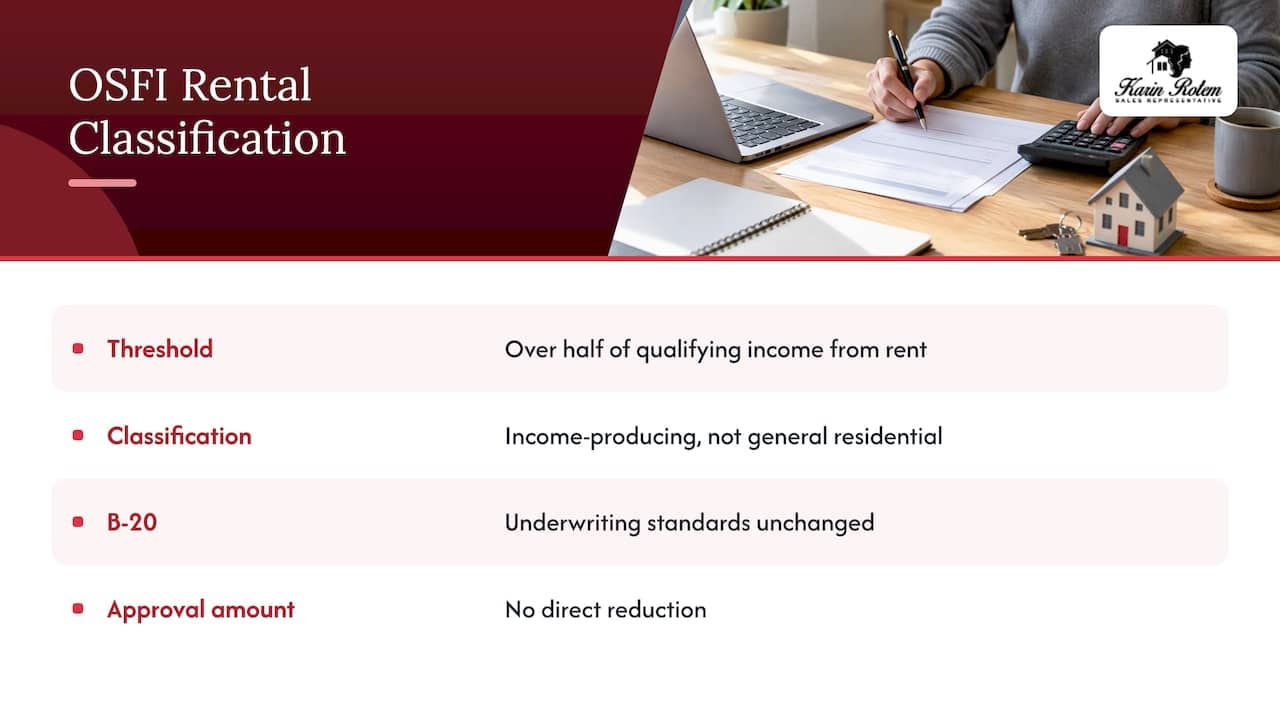
You may have seen headlines saying that new OSFI rules will crack down on rental mortgages in 2026. The reality is narrower. OSFI’s updated Capital Adequacy Requirements guideline clarifies how institutions classify real estate exposures for capital purposes, and does not alter the established Guideline B-20 underwriting standards. Borrowers can keep using rental income to qualify as they have since 2023.
The practical test is the 50% line. As OSFI’s backgrounder and commentary describe, a loan is treated as income-producing, rather than general residential, when more than half of the income used to qualify comes from the property’s rent. That is a bank-level classification. It does not reduce your approval amount directly.
Where you may feel it is pricing and appetite. A bank that holds more capital against rental-heavy loans may be more conservative, or charge differently, on files that lean heavily on rent. That is an inference from how the capital rules work, not a published rate change, so ask your lender or mortgage broker how your file would be classified.
OSFI is also working on consolidating its residential mortgage underwriting guidance, including B-20, into a single chapter of a new Credit Risk Management guideline, with income verification for rental and self-employed borrowers called out as a persistent concern. Expect lenders to keep asking for solid documentation.
Proving the rent: what lenders want to see
Lenders do not take your word for the rent. The requirements differ by situation:
- Existing landlords: signed leases, plus tax returns showing the rental income on Form T776 and your Notices of Assessment.
- Buyers of a tenanted property: the current lease, proof of rent payments and often an estoppel-style confirmation from the seller.
- Buyers planning to rent a unit: a market rent opinion, often from an appraiser, and sometimes a conservative percentage applied because no rent has been collected yet.
The CRA’s industry consultation found that lenders need a breakdown of income sources, including line 15000 detail, because a simple total income figure does not show whether multiple income streams are sustainable.
This is where unreported rent hurts. If you collected rent in cash and never declared it, a lender cannot count it. If you claimed heavy deductions that bring your net rental income close to zero, a net-income lender will count close to zero too. Talk to your accountant before you apply, not after a decline.
If part of your rent comes from roommates or co-tenants, documentation is even more important. This walkthrough on how to verify roommate income in Canada shows the kind of checks that make shared-housing income easier to evidence.
Short-term rentals are a different conversation
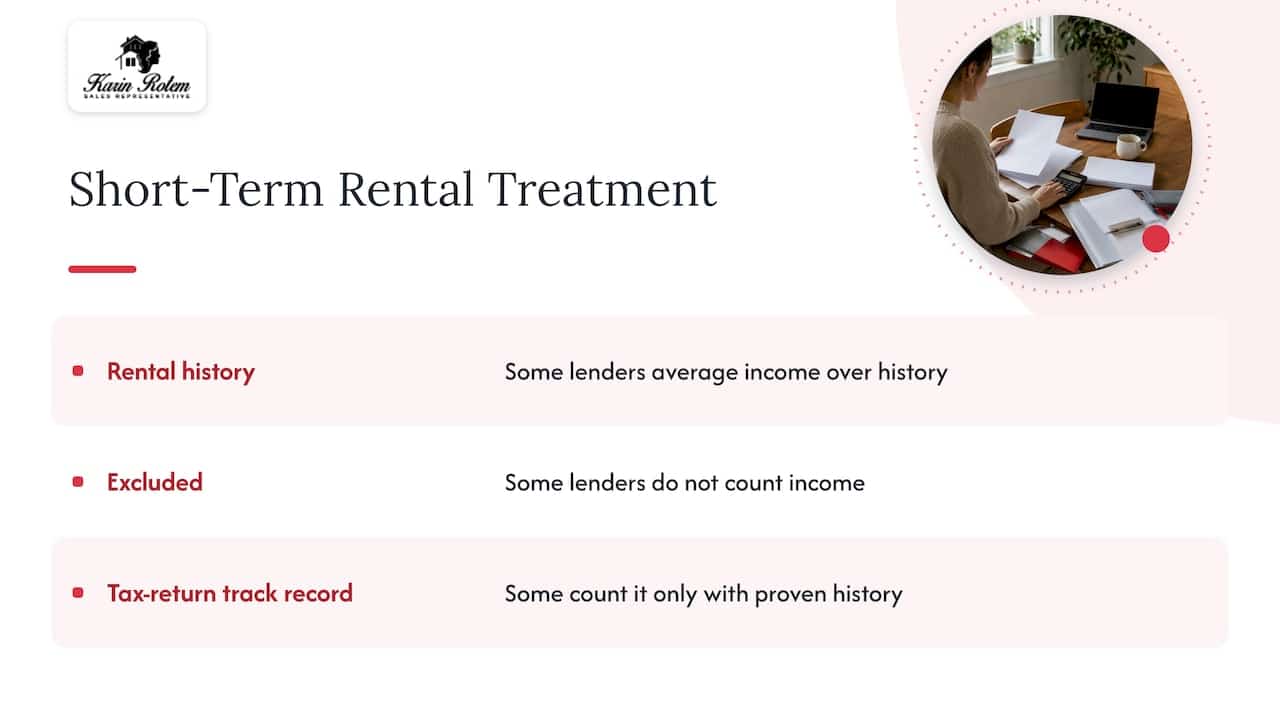
Many of my clients ask about Airbnb-style income, especially for resort-style properties. Lenders are generally more cautious with short-term rental income because it is seasonal and less predictable than a 12-month lease. Some will average it over a history, some will not count it at all, and some will only count it with a proven track record on your tax return.
If that is your plan, start with our guides on what a short-term rental income property is, the short-term rental income property checklist and how to protect your deductions with T776 for short-term rentals. For Friday Harbour specifically, read the rental rules for owners before you build any numbers on rental assumptions.
Our perspective: qualify first, then fall for the property
We see the same pattern again and again. A buyer finds a waterfront condo or an Innisfil home, assumes the rental income will carry the mortgage, and then discovers that the lender counts a fraction of it. So we reverse the order.
What we tell our clients:
- Get a pre-approval that states exactly how rental income is treated, in writing, from the lender that will fund you.
- Build two budgets: one the lender will accept, and one you can live with if the unit sits empty for two months.
- Look at condo fees, property taxes and reserve fund health, because they reduce net rent and, with 50% of condo fees counted in GDS, they affect your qualifying ratios.
- Decide whether the property is an investment, a vacation home you will rent occasionally, or a home you will live in. Lenders treat these differently, and so should you.
Our honest view: a rental-supported mortgage is a good fit when you have strong income outside the property and the rent is a cushion. It is a poor fit when the numbers only work at 100% of projected rent with no vacancy. If a deal needs everything to go right, we will say so, even if it means you buy something else or wait.
For investors weighing waterfront options, our waterfront condo investment playbook and income property due diligence guide walk through the checks we run before an offer.
— Felix
Steps to prepare your application
- Pull your last two years of tax returns and Notices of Assessment. Check that rental income is reported where it should be.
- Collect leases and proof of payment. Bank records showing rent deposits help.
- Run your own numbers. Our mortgage and affordability calculators let you test payments and affordability before you speak to a lender.
- Ask lenders the right questions. What percentage of rent do you use? Gross or net? Do you count projected rent? How do you treat short-term rentals?
- Compare an A lender and an alternative lender. Alternative lenders can be more flexible on rent but typically at a higher cost, so compare the full cost, not just the approval.
- Plan your down payment. Rental properties that are not owner-occupied usually need a larger down payment than a primary residence, so confirm the requirement with your lender.
If you live outside Canada or are new to the country, your options differ again. See our guide to non-resident mortgage options in Ontario and the notes on currency exchange for a Canadian real estate purchase.
Common mistakes that cost buyers approvals
- Counting on projected rent as if it were proven. Many lenders discount it or ask for an appraiser’s rent opinion.
- Ignoring the stress test. The qualifying rate is higher than your actual rate.
- Forgetting future tax. If you later sell, capital gains rules apply. Read our piece on capital gains on rental property in Canada so the exit does not surprise you.
- Under-estimating costs on furnished or seasonal rentals. Our list of furnished rental property features investors need helps you budget.
- Applying to several lenders at once without a plan. Too many credit checks can hurt. Have a broker or your agent’s mortgage contact narrow the field first.
Looking at Friday Harbour or Innisfil?
If you are weighing a resort-style purchase with rental potential, we can help you match the property to what a lender will actually finance. Browse Friday Harbour condos for sale, see what is currently for sale at The Harbour, or look at rental options at The Harbour to see how rents compare. When you are ready to talk numbers, contact our team and we will go through your situation with you. We are not mortgage lenders, so we will point you to the right professional for the financing itself.
FAQ
How much of my rental income will a lender count in Canada?
It varies. Lenders commonly use somewhere between 50% and 80% of gross rent, or a net rental income figure after expenses. CMHC allows up to 100% of gross rent on an owner-occupied 2-unit property, but the lender decides what it will actually use.
Can I qualify for a mortgage using rent from a property I haven’t rented yet?
Often yes, but with conditions. Lenders usually want a market rent opinion from an appraiser, and some apply a lower percentage to projected rent than to rent already shown on a lease and your tax return.
Do OSFI’s 2026 rules make it harder to use rental income?
Not directly. The 2026 Capital Adequacy changes affect how banks classify loans for capital purposes and do not change the B-20 underwriting standards used to qualify you. You may notice different appetite or pricing on rental-heavy files, so ask your lender how it classifies yours.
What documents do I need to prove rental income?
Expect signed leases, your tax returns with the rental income reported (Form T776), Notices of Assessment and proof of rent deposits. Lenders use these to confirm the income is real and sustainable.
Sources
- Preparing to get a mortgage, Financial Consumer Agency of Canada
- Rental income, CMHC
- Mortgage reforms announcement, Department of Finance Canada (October 2024)
- Mortgage reforms in force, Department of Finance Canada (December 2024)
- Clarifying OSFI’s guidance on rental income and mortgage classification
- Backgrounder: Final Capital Adequacy Requirements Guideline (2026), OSFI
- Consultative document on Credit Risk Management, OSFI
- Mortgage industry consultation on a potential income verification tool, CRA