
Most agents I speak with think a real estate marketing plan is a list of channels they post to. Instagram, MLS, maybe a few flyers. What it actually is, is something quite different. A real estate marketing plan is a concise strategic document that connects your annual business goals to your audience, channels, budget, and measurable outcomes. Without that connection, you end up busy but not productive. This guide breaks down every component so you can build a plan that actually drives listings, appointments, and closed deals, whether you serve downtown Toronto condos or waterfront properties at Friday Harbour.
Key takeaways
| Point | Details |
|---|---|
| Strategy over tactics | A marketing plan is a structured framework linking goals, audience, channels, budget, and KPIs, not a task list. |
| KPIs make it measurable | Track metrics like cost per lead and lead-to-appointment rate to make performance visible and decisions data-driven. |
| Budget benchmarks matter | Allocate roughly 10% of your GCI to marketing, scaling to 15-20% in competitive or luxury markets. |
| Rolling plans outperform static ones | A 90-day rolling calendar keeps your plan adaptable and your execution focused. |
| Channel focus beats channel sprawl | Anchoring on 3-4 platforms with strong content outperforms spreading thin across many channels. |
What is a real estate marketing plan, really?
A real estate marketing plan is a living document that ties your business goals to the specific actions, channels, and metrics that will get you there. It is not a brainstorm. It is not a content calendar. Those are tools that live inside the plan, not the plan itself.

Think of it this way. Your business goal might be to close 18 transactions this year and reach $250,000 in gross commission income (GCI). Your marketing plan answers the questions: Who am I trying to reach? Where do I find them? What will I say? How much will I spend? And how will I know if it is working?
A well-built plan typically addresses six components:
- Annual business goals: Specific targets like number of listings, transactions, or GCI for the year.
- Audience definition: Who your ideal client is, including where they live, what they are buying, and what motivates them. Are you targeting first-time buyers in Innisfil or cottage investors at Friday Harbour?
- Channel strategy: The 3-4 platforms and marketing vehicles you will commit to, chosen because your clients actually use them.
- Budget allocation: How much you will spend across channels and on what basis.
- KPIs: The metrics you will track monthly to know whether your marketing is producing results.
- Review cadence: When and how you will update the plan based on performance data.
Most agent marketing plans fail because they list many channels without a defensible budget or clear connection to commercial outcomes. A plan that has all six components prevents that waste.
Pro Tip: Keep your plan to one page or a tight 8-10 pages maximum. If you cannot summarise your strategy concisely, you will not follow it.
Measuring success with the right KPIs
The most important element in any real estate marketing strategy is a measurement system with clear, time-bound KPIs. Without it, you cannot tell whether a slow quarter is a lead generation problem or a conversion problem. Those require completely different fixes.
Six key KPIs with time windows make performance measurement realistic and diagnostic:
- Cost per lead by channel: What you spend to generate one lead from each source (e.g., Instagram ads vs. referrals vs. MLS exposure).
- Lead-to-appointment rate within 30 days: What percentage of new leads book an appointment within a month. This reveals whether your follow-up process is working.
- Appointment-to-listing rate: How many appointments convert to signed listings. Low numbers here point to a presentation or pricing conversation problem.
- GCI per dollar spent: Your overall return on marketing investment. For every dollar spent, what do you generate in gross commission?
- Days on market vs. market average: For sellers, this is a proxy for how well your listing marketing is working.
- Lead source attribution: Where your closed deals actually came from, not where you assumed they came from.
Time-windowed KPIs are particularly useful because they reveal exactly where the breakdown is happening. If your cost per lead is low but your lead-to-appointment rate is poor, the problem is your follow-up system, not your advertising. That is a very different problem to solve than low lead volume.
Here is a simple way to think about the three stages of your funnel:
| Funnel stage | KPI to track | What low numbers mean |
|---|---|---|
| Awareness | Cost per lead by channel | Ads or content are not reaching the right audience |
| Engagement | Lead-to-appointment rate (30 days) | Follow-up speed or messaging needs work |
| Conversion | Appointment-to-listing rate | Pricing conversations or presentation needs strengthening |
Pro Tip: Set a fixed monthly date, say the first Monday of each month, to review your KPIs. Consistency turns data into a habit rather than a scramble.
Budget allocation and realistic benchmarks
Knowing what to spend is one of the most common sources of uncertainty for agents. The benchmark most widely cited is 10% of GCI for marketing, with 15-20% in competitive or high-priced markets like Toronto’s luxury condo segment or waterfront communities like Friday Harbour.
Here is what that looks like in practice:
| Annual GCI | 10% benchmark | Monthly budget | Notes |
|---|---|---|---|
| $150,000 | $15,000 | $1,250 | Suitable for newer agents building pipeline |
| $300,000 | $30,000 | $2,500 | Mid-tier; allows multi-channel presence |
| $500,000+ | $50,000-$100,000 | $4,200-$8,300 | Luxury or competitive markets warrant 15-20% |
The most important thing I tell agents about budget is this: use your own data first, industry averages second. If Instagram has produced 60% of your closed deals in the past 18 months, that channel deserves a proportionally larger share of your budget. An industry average cannot tell you that.
A few budget discipline principles worth following:
- Assign a specific dollar amount to each channel before the quarter begins.
- Track actual spend versus planned spend monthly, not just at year end.
- Cut underperforming channels after 90 days of data, not after two weeks of impatience.
- Reserve 10-15% of your marketing budget for testing new channels or seasonal campaigns.
One mistake I see regularly is agents spending heavily on a channel because a colleague swears by it, without checking whether their own audience is actually there. A referral-heavy business in Friday Harbour may need very different investment than a buyer-focused agent working pre-construction in Innisfil.
You can explore realtor commission structures to better understand how to frame your GCI targets when building your budget plan.
How to create and maintain a living marketing plan
The phrase “living document” gets used a lot, but what it actually means is that your plan has a scheduled review process built into it from day one. Ongoing revision rather than a “write once and forget” approach is what separates agents whose marketing compounds over time from those who restart from scratch every January.
Here is a practical process for building and maintaining your plan:
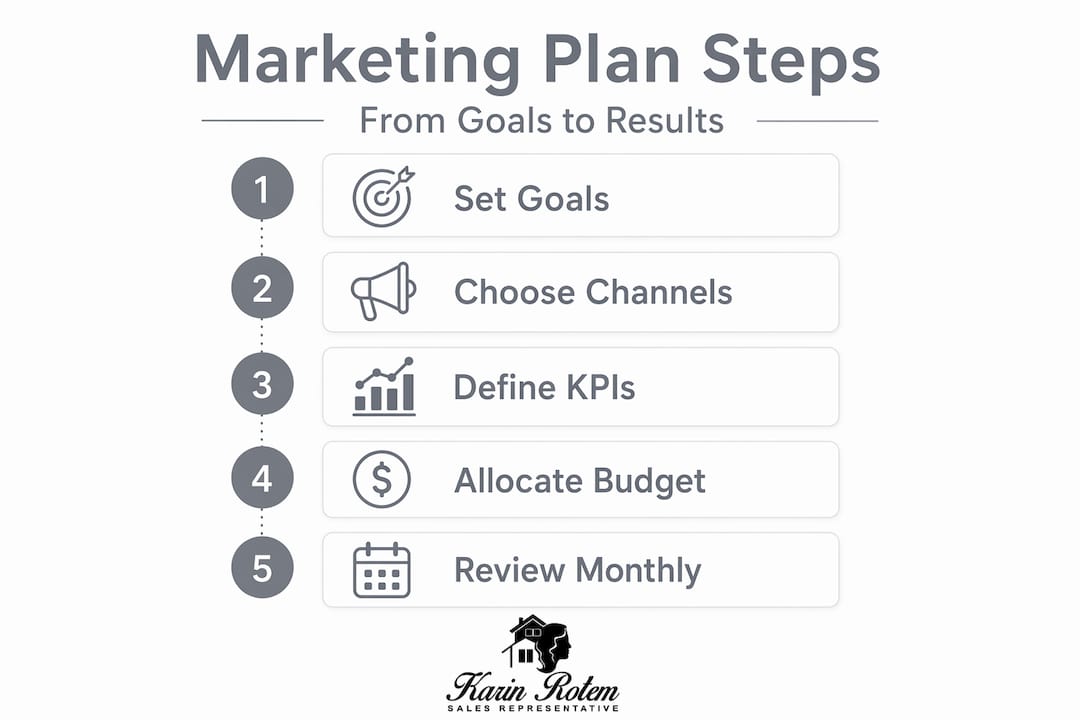
- Start with your annual goals, then work backwards to what quarterly milestones would put you on track. If you want 18 transactions, you likely need 6 listings per quarter and a specific number of appointments per month to reach that.
- Build a rolling 90-day content and activity calendar. Short-term planning keeps actions tied to accountability. Each quarter, you know exactly what you are publishing, where, and why.
- Schedule a monthly KPI review. Look at what the numbers are telling you and make one or two adjustments, not ten. Chasing every signal leads to chaos.
- Do a quarterly strategic reset. Review whether your goals still make sense, whether local market conditions have shifted, and whether your channel mix needs adjusting.
- Gather client feedback. Ask buyers and sellers how they found you and what made them reach out. This qualitative input often reveals things the data does not.
Aligning your plan with local market signals matters enormously in markets like Toronto and Friday Harbour, where seasonal buying patterns, interest rate changes, and new development announcements can shift demand quickly.
Pro Tip: Write your 90-day plan on a single page with three columns: goals, actions, and KPIs. Pin it somewhere visible. What you see daily is what you execute on.
Channel strategies for Toronto and Friday Harbour markets
Choosing the right channels is one of the most consequential decisions in your real estate digital marketing plan. The goal is focus, not coverage. Anchoring on 3-4 platforms with strong content and consistent presence outperforms scattered activity across eight channels every time.
For agents working in the Toronto and Friday Harbour markets, the channels that consistently perform include:
- MLS with professional photography and video tours. The listing itself is your most viewed marketing asset. Maximising your MLS listing exposure through quality photography, detailed descriptions, and strategic pricing position is non-negotiable, especially for waterfront properties where visual presentation drives emotional buying decisions.
- Instagram and short-form video. Lifestyle-driven markets like Friday Harbour respond strongly to video content showing the property in context, the dock, the sunset, the resort amenities. Buyers are not just buying square footage; they are buying a way of life.
- Email marketing to your database. Your existing contacts, past clients, and referral sources are your most cost-effective marketing channel. A monthly market update or new listing alert keeps you front of mind.
- Local area marketing and community content. Blog posts and social content specific to Friday Harbour, Innisfil, or particular Toronto neighbourhoods build search visibility and position you as the area expert rather than a generalist.
- Referral and past client outreach. Structured follow-up with past clients, including anniversary calls and market updates, is one of the highest-returning real estate promotion techniques available to any agent.
Integrating digital and offline channels matters for luxury and waterfront properties. A well-produced property brochure left at a Friday Harbour marina or resort concierge desk reaches an audience that no Instagram ad can target with the same precision.
My perspective on why most plans never get used
What I have observed over years of working in the Toronto and Innisfil markets is that most agents do not fail at creating marketing plans. They fail at keeping them simple enough to actually follow.
I have seen agents build elaborate, colour-coded strategy documents that sit untouched after February. What I have found works is the opposite: a one-page plan with three annual goals, four channels, a monthly budget number, and three KPIs. That is it. Everything else is detail you add as you grow.
The agents I have seen build real consistency are the ones who treat their plan the same way a good listing presentation treats pricing. You show the data, you make a clear recommendation, and you commit to it with accountability checkpoints built in.
Treating the marketing plan as a living document is what gives it longevity. Markets shift. Friday Harbour saw significant changes in buyer profile over the past two years. The agents who adapted their channel strategy and messaging quarterly outperformed those who stuck with the same plan regardless of what the data showed.
The uncomfortable truth is that measurement is what most agents avoid because it makes underperformance visible. But visible problems are solvable. The agents who commit to monthly KPI reviews are the ones who course-correct early rather than realising in November that the year did not go as planned.
— Felix
Work with a team that markets properties with purpose
At Karinrotem, our real estate marketing strategy is built on exactly the principles in this article: clear goals, the right channels for each property, disciplined budget allocation, and measurement that drives real decisions. Whether you are preparing to sell a Friday Harbour waterfront condo or exploring investment opportunities in Innisfil, we bring the same structured approach to every listing.
You can browse our current property listings to see how strategic marketing translates into real results, or view my active listings for properties currently on the market. If you are considering selling and want to understand how a well-built marketing plan can shorten your days on market and protect your sale price, our team is ready to walk you through the process. You can also read more about selling your Friday Harbour condo for property-specific guidance.
FAQ
What is a real estate marketing plan?
A real estate marketing plan is a strategic document that connects your annual business goals to your audience, channels, budget, and KPIs in a focused framework. It differs from a task list by linking every activity to a measurable commercial outcome.
How much should a real estate agent spend on marketing?
A common benchmark is 10% of GCI annually, rising to 15-20% in competitive or luxury markets. An agent with $300,000 GCI would budget approximately $2,500 per month.
What KPIs should be in a real estate marketing plan?
Key metrics include cost per lead by channel, lead-to-appointment rate within 30 days, appointment-to-listing rate, and GCI per dollar spent. Tracking these with clear time windows reveals where your funnel is breaking down.
How often should a real estate marketing plan be updated?
Your plan should be reviewed monthly for KPI performance and reset quarterly for strategy. Ongoing revision keeps the plan relevant to market conditions rather than becoming a document you reference once a year.
What channels work best for real estate marketing in Canada?
MLS with professional photography and video, Instagram, email marketing to your database, and community-specific content consistently perform well. For lifestyle markets like Friday Harbour, video tours and local area content carry significant weight in buyer decision-making.
Recommended
- Maximise your MLS listing exposure for waterfront homes
- How Canadian realtors guide international buyers in Ontario
- Should I Use a Real Estate Agent to Sell My Friday Harbour Property? – Karin Rotem Real Estate Agent
- How to Buy a Friday Harbour Condo in 2025 | A Step-by-Step Buyer’s Guide – Karin Rotem Real Estate Agent