
If you own or rent at Friday Harbour and you’ve been trying to make sense of what’s actually allowed, you’re not alone. Friday Harbour rental rules explained clearly and completely is something most owners desperately need, yet rarely find in one place. Between a recent moratorium, overlapping condo bylaws, county occupancy codes, and complaint-driven enforcement, the rules feel like a moving target. This guide walks you through exactly where things stand today, what compliance looks like in practice, and how to protect your investment or tenancy without getting caught off guard.
Key takeaways
| Point | Details |
|---|---|
| Moratorium is active | Friday Harbour imposed a six-month transient rental moratorium to address parking, housing, and commercial displacement. |
| Occupancy limits apply | County code caps overnight guests at 2 per bedroom plus 3 additional children, with one parking space required per bedroom. |
| HOA rules add restrictions | Many Friday Harbour condos prohibit room-by-room rentals and require whole-unit leases only. |
| Enforcement is complaint-driven | Investigations begin after verified complaints, but once opened, owners must demonstrate full compliance quickly. |
| Nearby permit deadlines matter | Pre-existing vacation rentals in San Juan County communities face provisional permit deadlines that can end operations if missed. |
The current regulatory framework
The first thing I tell my clients is this: Friday Harbour’s rental environment is not a free-for-all, and it hasn’t been for some time. The six-month transient rental moratorium imposed by the Town of Friday Harbour came directly out of community pressure around three issues: parking strain, the displacement of commercial uses, and a documented shortage of employee and long-term housing.
What the moratorium means practically is that new short-term rental licences and permits are paused during the review period. Existing permitted operations may continue under specific conditions, but new applications face delays. If you were hoping to list a recently purchased unit on a vacation rental platform right away, that plan needs to be revisited with current local approval status in mind.
Underneath the moratorium sits San Juan County code, specifically SJCC 18.40.275, which sets the baseline occupancy and parking standards. Under this code, maximum overnight occupancy is 2 guests per bedroom plus 3 additional children. Parking requirements sit at a minimum of one space per bedroom. These numbers matter because violations of either can be grounds for an enforcement complaint.
Code enforcement actions in Friday Harbour are complaint-driven rather than proactively inspected. That means the department does not routinely audit listings. Instead, a neighbour, fellow owner, or platform user files a complaint, the department authenticates it, and then works with the property owner to reach compliance. The tone is remediation-focused, not punitive at first, but the requirement to become compliant quickly is firm.
The distinction between short-term and long-term rentals also matters here. Short-term rentals, typically those under 30 days, face the most regulatory scrutiny and are the direct target of the moratorium. Long-term leases of one month or more operate under a different set of obligations and are generally not subject to the same moratorium restrictions, though they must still satisfy building, safety, and land-use standards.
Pro Tip: Before assuming your property qualifies as a long-term rental outside the moratorium’s reach, confirm the classification with the Town directly. A lease structured as 30 days can sometimes still be treated as transient depending on how it’s listed and marketed.
Short-term and vacation rental specifics
Understanding Friday Harbour rental guidelines at the property level means looking at three layers: the county code, any municipal licensing requirement, and the condo or HOA rules that govern your specific building or community.
Here is a practical breakdown of the specific rules that affect short-term and vacation rental operations at Friday Harbour:
-
Minimum rental periods. Friday Harbour condos and resort-style communities commonly impose minimum rental periods in their governing documents. Some allow stays as short as one week; others require a minimum of 30 days. Review the declaration and bylaws for your specific building before listing anywhere.
-
Whole-unit restrictions. Some Friday Harbour condos restrict room rentals to whole-unit leases only, meaning you cannot rent out individual bedrooms to separate guests. This is a meaningful restriction for owners who expected to use room-by-room platforms to generate supplementary income.
-
Registration and licensing obligations. Even where the moratorium does not immediately block a rental, hosts must verify local licensing requirements, tax remittance obligations, safety compliance, and HOA rules before listing. Low registration activity in Friday Harbour is not a green light. It more likely reflects owners who have not yet gone through the proper channels.
-
Parking compliance. The parking requirements tied to rental properties are often an afterthought until a complaint is filed. Under county code, one parking space per bedroom is the minimum. If your unit does not have the required number of dedicated spaces, that alone can make the rental non-compliant.
-
Tax and fee obligations. Vacation rental owners also carry supplementary obligations around tax and fee compliance that go beyond the rental permit itself. Confirm short-term rental tax remittance requirements are met before your first guest checks in.
Understanding the rental contract at Friday Harbour is equally important for renters. You need to know whether your agreement respects minimum period rules and whether the owner holds the appropriate permissions before you commit to a booking.
Navigating compliance: a practical approach
The question I hear most often from investors and owners is: “How do I make sure I’m on the right side of all this?” The honest answer is that compliance at Friday Harbour requires a holistic assessment, not just a quick check of one rule.

Owners should assess the full picture across several categories before operating any rental. That includes structural safety, heating and plumbing systems, waste disposal arrangements, occupancy limits, and parking. Complaints that trigger enforcement frequently involve structural deficiencies, unsafe heating or plumbing, or the use of trailers and RVs as dwelling spaces beyond the six-month threshold. Addressing these proactively keeps you out of the enforcement queue.
When it comes to documentation, this is where many owners fall short. Documenting communications and all remediation efforts during an enforcement investigation significantly improves your ability to resolve issues efficiently. Keep records of every permit application, inspection, approval letter, and correspondence with the Town or county. If a complaint is filed against you, this paper trail is your best protection.
Pro Tip: Set a calendar reminder for any permit renewal dates and any new regulatory deadlines that emerge from the moratorium review process. Missing a deadline, even an administrative one, can result in losing your rental operating status.
A few practical steps to build your compliance framework:
- Confirm your building’s specific minimum rental period and whole-unit requirements with your property manager or strata council.
- Verify your parking allocation against the one-space-per-bedroom rule and document that it is dedicated and accessible.
- Register with any required municipal licensing authority before listing on any platform.
- Consult with a local real estate professional familiar with Friday Harbour rental policies explained at the building level, since rules vary by complex.
- During the moratorium period, use the time to prepare your compliance documentation rather than waiting for the pause to lift.
Rental rules and their effect on the market
The regulatory environment at Friday Harbour directly shapes what you can earn and what your property is worth on resale. The moratorium on transient rentals reduces supply at a time when demand for waterfront vacation accommodation remains strong. That tension between fewer available listings and steady visitor interest has implications for both active operators and prospective buyers.
| Factor | Current situation | Owner impact |
|---|---|---|
| Rental availability | Reduced by moratorium and HOA restrictions | Fewer competing listings, but tighter compliance pressure |
| Booking lead times | Average 66 days overall; summer avg 84 days | Strong advance demand during peak season |
| Resale confidence | Compliance risk adds uncertainty for buyers | Well-documented compliant rentals command stronger pricing |
| Long-term housing pressure | Moratorium reflects shortage of long-term rentals | Policy likely to tighten further, not loosen |
What this table tells you is that the best-positioned owners are the ones operating within the rules with clean documentation. Properties with a verified, compliant rental history are genuinely easier to sell and tend to attract better offers. The resale value dynamics at Friday Harbour are increasingly tied to how transparent and clean a property’s rental record is.
For investors weighing income potential against compliance risk, the honest trade-off is this: operating outside the rules might appear to generate income in the short term, but it introduces enforcement liability and resale complications that can easily outweigh any short-term gain.
What nearby communities tell us about what’s coming
Friday Harbour does not sit in isolation. It operates within San Juan County, and what happens in nearby communities gives a clear signal of where local vacation rental regulation is heading.
| Community | Regulation type | Key deadline | Fee waiver available? |
|---|---|---|---|
| Eastsound | Provisional use permit required | June 25, 2026 | Yes, for pre-existing rentals |
| Lopez Village | Provisional use permit required | June 25, 2026 | Yes, for pre-existing rentals |
| Friday Harbour | Transient rental moratorium active | Under review | Not yet announced |
In both Eastsound and Lopez Village, existing vacation rentals must obtain a provisional use permit by June 25, 2026, or face the loss of their ability to operate. A fee waiver is available for operations that pre-date the new rules, which is a meaningful incentive to act early rather than wait. Missing that deadline is not a recoverable situation through a simple late application. It can end a rental’s operational status entirely.
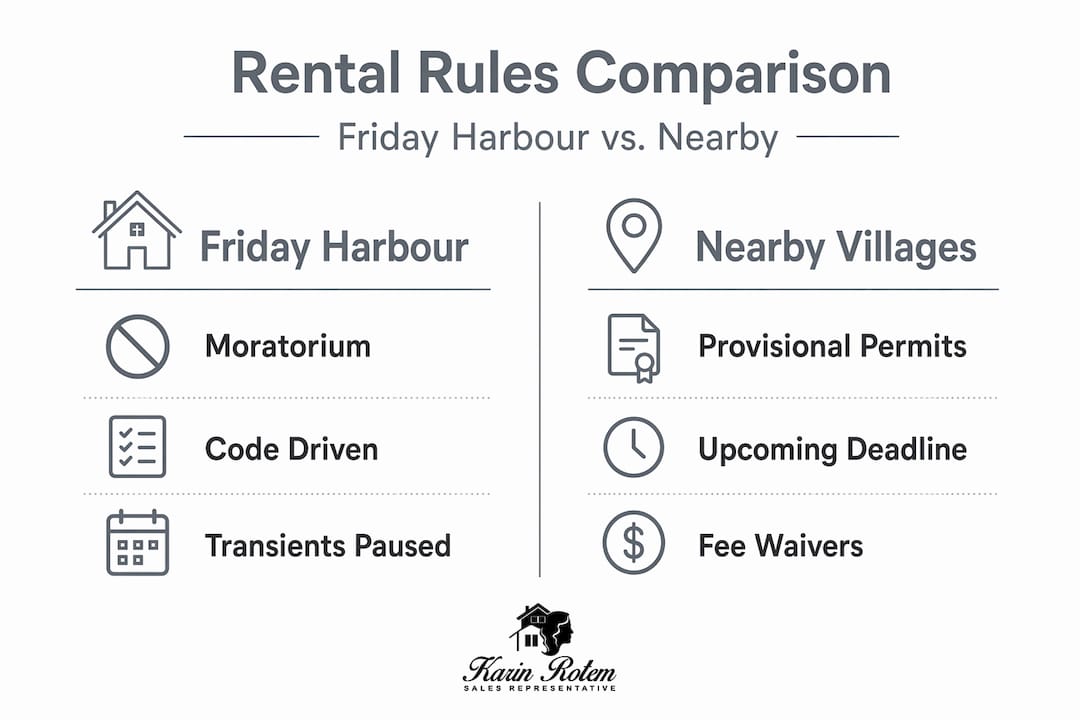
Friday Harbour’s moratorium fits squarely into this county-wide pattern. Regulators are moving toward formalised permit structures, hard deadlines, and proactive documentation requirements. Owners who treat provisional permit deadlines as optional are the ones who find themselves scrambling when enforcement catches up. Anticipating a similar permit framework emerging for Friday Harbour is not speculation at this point. It is the logical next step based on what the county is already doing.
My honest take on these rules
What I’ve seen working with buyers and renters in Friday Harbour over the years is a consistent pattern: people underestimate how layered these rules actually are. They see a listing on a vacation rental platform, they see a property advertised as rental-eligible, and they assume someone else has already done the compliance work. That assumption is frequently wrong.
The moratorium caught a number of owners off guard because they were operating under the understanding that low enforcement activity meant low risk. That is not how complaint-driven enforcement works. One motivated neighbour or one competing owner can file a complaint and trigger a full review of your operation. The complaint-driven nature of enforcement means silence is not approval.
My advice to anyone considering a rental at Friday Harbour, whether as an owner listing the property or as an investor assessing income potential, is to treat compliance as a foundation, not an afterthought. Know your building’s bylaws. Know the county occupancy rules. Know what permits you hold and when they need renewal. The community’s needs are driving these rules, and that community sentiment is not going away. The owners who do well here long-term are the ones who respect that reality and build their rental operations accordingly.
— Karin Rotem
Work with someone who knows Friday Harbour deeply
If you’re assessing a Friday Harbour property as a rental investment or trying to make sense of your current obligations as an owner, working with an advisor who genuinely knows this market makes a real difference. Karinrotem’s team has guided buyers, sellers, and investors through the specifics of Friday Harbour rental policies explained at the building and community level, including current moratorium considerations and HOA requirements. Explore Friday Harbour luxury properties or learn more about waterfront rental options to understand what’s available under today’s rules. Reach out directly for a conversation tailored to your specific property or investment goals.
FAQ
Can I rent at Friday Harbour right now?
It depends on your property’s status and building rules. The current moratorium restricts new short-term transient rental permits, but properties with existing approvals and compliant long-term lease arrangements may still operate. Always confirm with the Town directly.
What are the occupancy limits for Friday Harbour rentals?
San Juan County code allows a maximum of 2 overnight guests per bedroom plus 3 additional children, with a minimum of one parking space required per bedroom. Exceeding these limits is a common enforcement trigger.
Do Friday Harbour condos allow Airbnb-style rentals?
Many do not. Several buildings restrict rentals to whole-unit leases only and impose minimum rental periods. Reviewing your specific building’s declaration and bylaws is the only reliable way to confirm what is permitted.
How does code enforcement work in Friday Harbour?
Enforcement is complaint-driven. Once a complaint is authenticated, the department works with the owner to achieve compliance. Documented remediation efforts and proactive communication significantly improve resolution outcomes.
What happens if I miss a provisional use permit deadline?
Based on the county-wide pattern seen in Eastsound and Lopez Village, missing the permit deadline can result in losing the legal right to operate a vacation rental entirely. Fee waivers are available for pre-existing operations that apply on time, making early action critical.
Recommended
- Friday Harbour buyer rules: What you must know first
- Can You Airbnb or Short-Term Rent Your Friday Harbour Condo? – Know the Rules Before Listing – Karin Rotem Real Estate Agent
- Can I Airbnb My Friday Harbour Condo? | Short-Term Rental Rules Explained – Karin Rotem Real Estate Agent
- Friday Harbour Exclusive List – Karin Rotem Real Estate Agent