
Many GTA homebuyers walk into their first property search with a common assumption: any real estate agent they speak with is automatically working for them. That assumption can cost you. Without a signed buyer representation agreement, the agent showing you homes may actually have legal obligations to the seller, not to you. Understanding this distinction is one of the most important steps you can take before making one of the largest financial decisions of your life. This guide breaks down exactly what a buyer representation agreement is, what it protects, and how to use it to your advantage in the Greater Toronto Area market.
Key Takeaways
| Point | Details |
|---|---|
| Defines agent loyalty | A buyer representation agreement makes your chosen agent legally responsible to act in your best interests. |
| Protects your rights | Having this agreement clarifies obligations and limits misunderstandings in your home purchase process. |
| Flexible and negotiable | Terms, commissions, and duration can almost always be discussed and adjusted before signing. |
| Know how to exit | If your needs change, exit clauses and open communication let you end an agreement safely. |
What is a buyer representation agreement?
A buyer representation agreement is a legally binding contract between you, the homebuyer, and a real estate brokerage. It formally establishes that the brokerage and its agent are working on your behalf, not the seller’s. Think of it as the document that transforms a helpful agent into your dedicated advocate.

The agreement outlines the specific duties and services the agent will provide throughout your home search. This includes conducting property searches, arranging viewings, presenting offers, and negotiating on your behalf. Without it, an agent may be operating as a “customer service” provider rather than a true representative, which carries very different legal obligations under Ontario’s Trust in Real Estate Services Act (TRESA).
Here is what a standard buyer representation agreement typically covers:
- Duration: The time period during which the agent exclusively represents you, often 30 to 90 days but negotiable
- Geographic area: The specific region or property types covered by the agreement
- Commission structure: How the agent is compensated, usually through the seller’s proceeds, but clearly stated upfront
- Duties of the brokerage: What services you can expect, including market analysis, offer preparation, and negotiation
- Exclusivity clause: Confirmation that you agree to work with this agent during the contract period
- Termination conditions: The process for ending the agreement if needed
Pro Tip: You are never obligated to sign a buyer representation agreement at your very first meeting with an agent. Take the document home, read it carefully, and ask questions before committing. A trustworthy agent will welcome that conversation.
It is worth noting that the agreement protects both parties. You receive dedicated representation, and the agent has assurance that their time and effort will be recognised if a transaction completes. This mutual accountability often leads to a more productive working relationship.
Key benefits of signing a buyer representation agreement
Understanding the basics is important, but why should you consider signing a representation agreement as a homebuyer? The practical advantages go well beyond simply having a signed piece of paper.
The most significant benefit is fiduciary duty. Once you have a signed agreement in place, your agent is legally required to act in your best interests at all times. This means full disclosure of any information that could affect your decision, honest advice even when it is not what you want to hear, and confidentiality around your financial situation and motivations. As noted in guidance around how a buyers agent protects you, dedicated buyer representation ensures your agent acts solely in your best interests.
Here are the key benefits you gain with a signed agreement:
- Negotiation power: Your agent can negotiate price, conditions, and closing terms entirely on your behalf, without divided loyalties
- Conflict of interest protection: If the property you want is listed by the same brokerage, your agent must disclose this and navigate the situation transparently
- Tailored property searches: Your agent can set up customised alerts and access listings beyond what is publicly visible on consumer portals
- Market expertise: You receive informed guidance on local pricing trends, neighbourhood conditions, and comparable sales specific to the GTA
- Legal and contractual guidance: Your agent helps you understand offer conditions, deposit requirements, and key dates in the transaction
When you consider using a real estate agent for any property transaction, the value of formal representation becomes clear. An agent without a signed agreement is not legally bound to prioritise your interests, even if they are courteous and helpful.
Pro Tip: Ask your agent directly, “Are you representing me or providing customer service?” before any property viewings. The answer tells you a great deal about the relationship you are entering.
Without a buyer representation agreement, you may inadvertently share information with an agent who is obligated to pass it to the seller. Your budget ceiling, your timeline pressure, your emotional attachment to a property: all of this can be used against you in negotiations if your agent is not formally on your side.
Comparing buyer and seller representation agreements
To deepen your understanding, let’s see how buyer agreements differ from seller side contracts in real estate. Both types of agreements share a common purpose: they establish a formal, legally binding relationship between a client and a brokerage. But the focus and obligations differ significantly.
| Feature | Buyer representation agreement | Seller representation agreement |
|---|---|---|
| Primary obligation | Finding and securing a suitable property | Marketing and selling the listed property |
| Negotiation focus | Negotiating the lowest price and best terms for the buyer | Negotiating the highest price and best terms for the seller |
| Duration | Typically 30 to 90 days, tied to search period | Typically 60 to 120 days, tied to listing period |
| Commission | Usually paid from seller’s proceeds at closing | Paid from sale proceeds at closing |
| Exclusivity | Buyer agrees to work with one brokerage | Seller agrees to list with one brokerage |
| Key deliverables | Property searches, offer preparation, negotiation | Staging advice, marketing, showings, offer review |
| Termination clause | Written notice, subject to agreement terms | Written notice, subject to listing agreement terms |
Both agreements share important common provisions. Exclusivity protects the agent’s investment of time and resources. Dispute resolution clauses outline what happens if disagreements arise. Commission structures are clearly defined to avoid misunderstandings at closing.
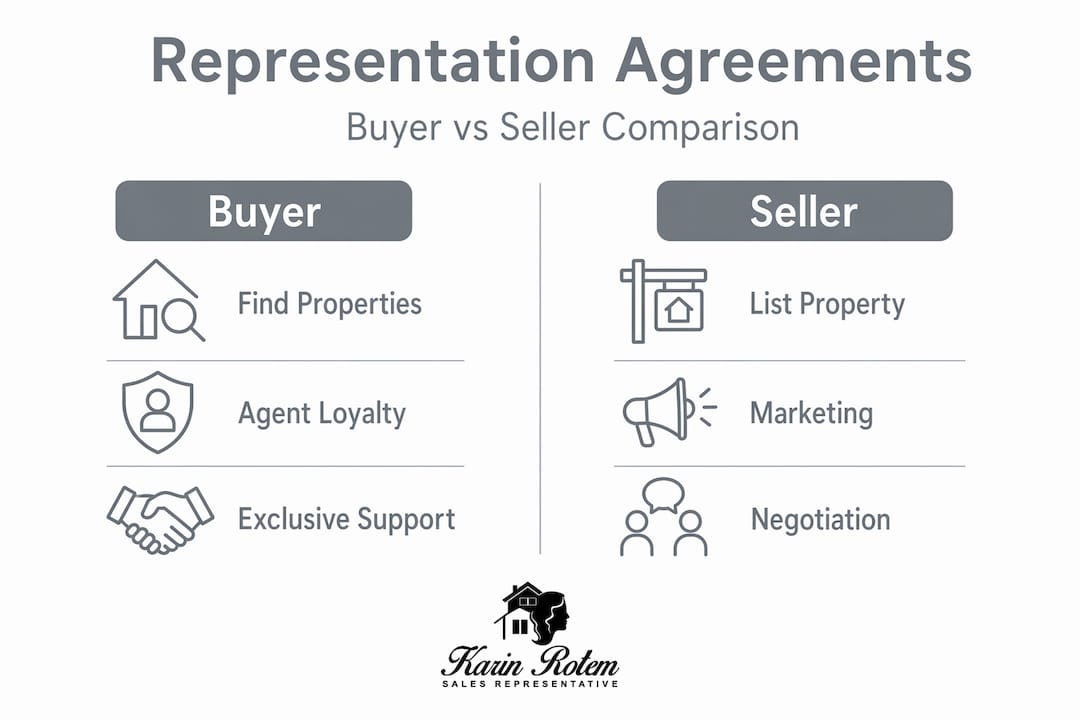
When reviewing exclusive listings agreements or browsing sold listings agreements, you can see how these formal arrangements shape real transactions. The key takeaway is that both agreements exist to create clarity and accountability, which benefits everyone involved.
A few additional points worth noting:
- Seller agreements focus heavily on marketing timelines and pricing strategy
- Buyer agreements are more fluid, adapting to your evolving property search
- Both agreements can be renegotiated with mutual consent before they expire
- Reviewing listing agreements and favourite listing agreements can help you understand how properties are positioned in the market
When and how to sign a buyer representation agreement
Now that you know what’s in a buyer agreement, let’s cover when and how to make it official. Timing matters. Signing too early, before you have assessed the agent’s communication style, market knowledge, and availability, can leave you locked into a relationship that does not serve you well. Signing too late means you may be receiving guidance without the full protection you deserve.
Here is a practical step-by-step approach:
- Meet with your prospective agent. Have an initial consultation to discuss your goals, budget, preferred neighbourhoods, and timeline. This is your opportunity to assess their knowledge of the GTA market and their communication approach.
- Request the agreement in advance. Ask for a copy of the buyer representation agreement before your first official property viewing. Read it thoroughly and note any terms you do not understand.
- Ask clarifying questions. Specifically ask about the duration, the geographic scope, the commission structure, and the termination process. A good agent will answer every question without hesitation.
- Negotiate terms if needed. Commission rates and contract lengths are not always fixed. If you feel the duration is too long or the area too broad, discuss adjustments. Many agents are flexible, particularly for well-prepared buyers.
- Sign only when you are comfortable. There is no deadline pressure. The right agent will never rush you into signing. When you feel confident in the relationship and the terms, proceed.
Knowing how to choose the right agent before signing any agreement is just as important as understanding the agreement itself. Equally, having a list of questions to ask your agent ensures you walk into that first meeting prepared and confident.
Pro Tip: If an agent insists you sign a buyer representation agreement before answering your questions or before you have had a chance to assess their expertise, treat that as a warning sign. The best agents earn your trust first.
How to end a buyer representation agreement
But what if things change or your needs are no longer being met? Here’s how to exit an agreement. This is a topic many agents avoid discussing upfront, but it is an important part of understanding what you are signing.
Most buyer representation agreements in Ontario include provisions for termination. Here are your main options:
- Expiry: The simplest exit is allowing the agreement to expire naturally at the end of its term without renewal
- Mutual release: Both you and the brokerage agree in writing to terminate the agreement early, which is often the cleanest resolution
- Written notice: Some agreements allow you to terminate with written notice, subject to specific conditions outlined in the contract
- Brokerage complaint process: If you are dissatisfied with your agent’s service, you can escalate concerns to the managing broker at the brokerage
- Regulatory body: In Ontario, the Real Estate Council of Ontario (RECO) handles complaints against agents who breach their professional obligations
“If you are ever unsure about your rights within a buyer representation agreement, speaking with a real estate lawyer is always a sound step. Ontario law provides clear protections for buyers, and a qualified legal professional can help you navigate any disputes efficiently.”
Your first step should always be an honest conversation with your agent. Many issues arise from miscommunication rather than genuine misconduct. If that conversation does not resolve the matter, escalate to the brokerage level.
Understanding what your legal advice for homebuyers looks like at closing also helps you appreciate why having a lawyer review your representation agreement is a smart move. The lawyer’s role at closing extends beyond the transaction itself and includes ensuring your interests were protected throughout the process.
The truth about real estate representation few agents will share
Here is something I have observed consistently working with buyers across the GTA: most people do not realise how much their negotiating position depends on who their agent is actually working for. Not in theory. In practice, in the room, when the offer is on the table.
Many agents are skilled, ethical professionals. But the system itself creates ambiguity. Without a signed buyer representation agreement, an agent can technically provide services to a buyer while maintaining obligations to a seller. This is not a scandal. It is simply how unrepresented buyer relationships have historically worked. The problem is that most buyers never know this is happening.
I have also seen buyers pressured into signing agreements that are far too long in duration or far too broad in geographic scope. A 12-month agreement covering all of Ontario is not standard practice. It is restrictive. If you see terms like that, ask why they are there and push back.
The other reality is that a signed agreement alone does not guarantee great representation. Ongoing communication, proactive updates, and genuine investment in your outcome are what separate a good agent from a great one. The paperwork creates the legal framework. The relationship fills it with meaning.
My honest advice: treat the buyer representation agreement as the beginning of a working relationship, not the end of a negotiation. Ask hard questions. Expect clear answers. And never sign anything that makes you feel trapped rather than protected.
Ready to start your GTA home search with expert representation?
With a clear understanding of buyer representation agreements, you’re ready for your next move. At Karin Rotem Real Estate, we believe every buyer deserves dedicated, transparent representation from the very first conversation. Whether you are searching for a primary residence in Toronto, a waterfront retreat at Friday Harbour, or an investment property in Innisfil, our team is here to guide you with honesty and expertise. Explore our properties to see what is currently available, or browse my listings for a closer look at what our team represents. Let’s find your next home together, with the full protection you deserve.
Frequently asked questions
Can I work with multiple agents without a buyer representation agreement?
Yes, until you sign an exclusive buyer agreement, you can generally work with multiple agents, but this typically limits the depth of service and commitment each agent will provide.
Are buyer representation agreements required in Ontario?
They are not legally mandatory, but most real estate agents will require a signed agreement before formally representing your interests and investing significant time in your search.
What should I look for before signing a buyer representation agreement?
Review the commission terms, contract duration, geographic area covered, and the termination process carefully to ensure the agreement aligns with your needs and timeline.
How do I terminate a buyer representation agreement if I’m unhappy?
Start by speaking directly with your agent about your concerns, then provide written notice if the agreement permits, and seek legal advice if the situation remains unresolved.