
Most sellers assume that once a property is listed on the MLS (Multiple Listing Service), the hard work is done and buyers will come flooding in. This is one of the most costly misconceptions in real estate. In the competitive Toronto and Innisfil waterfront markets, a listing that is technically “live” can still be nearly invisible to the very buyers you are trying to reach. Small gaps in listing data, missing keywords, and incomplete feature fields can quietly bury even the most beautiful waterfront property. This article walks you through how MLS exposure truly works and what it takes to genuinely maximise it.
Key Takeaways
| Point | Details |
|---|---|
| Listing completeness matters | Thorough photos, filled fields, and specific keywords are required for MLS search visibility. |
| Engineered demand increases results | Pre-listing strategy and agent outreach can boost buyer interest before your MLS launch. |
| MLS is not always enough | In crowded markets, combine public exposure with targeted tactics for best results. |
| Waterfront properties need nuance | Standing out in luxury or lifestyle segments requires tailored MLS and marketing approaches. |
| Policy changes shape strategy | Ongoing rule updates can shift the effectiveness of off-market and pocket listing strategies. |
What does MLS exposure really mean?
MLS exposure is not simply the act of uploading a property to the system. It refers to how broadly and effectively a listing is shared with brokers, consumers, and syndication partners across every connected platform. Think of it as the difference between placing a sign on a side street versus a well-lit main road. The sign exists in both cases, but only one gets noticed.
“MLS exposure is not just about ‘being on MLS’; it depends on how complete the listing data is, including photos, required searchable fields, and the exact terms and keywords populated.”
For waterfront and luxury lifestyle properties in Innisfil and Toronto, this distinction is especially important. Buyers searching for lakefront access, a private dock, or resort-style amenities use very specific filters. If those features are not properly entered as searchable terms in the listing, the property simply will not appear in their results, regardless of how stunning the home actually is.
Here is what MLS exposure genuinely depends on:
- Complete data fields: Every checkbox, dropdown, and free-text field in the MLS system matters. Leaving any blank removes your listing from filtered searches.
- Quality photography: Listings with professional, high-resolution photos attract more clicks and hold buyer attention longer.
- Accurate and thorough keywords: Waterfront, dock, lake access, marina, resort community, these are the terms that qualified buyers type into search filters.
- Proper categorisation: Misclassifying a condo as a townhouse, or leaving out the waterfront designation, redirects your listing to the wrong audience entirely.
Understanding these mechanics is the first step. The next is recognising how much the quality of your listing data actually affects buyer behaviour in real, measurable ways. It also helps to work with an agent experienced in using a real estate agent who knows these nuances intimately. Agents who understand MLS pre-listing strategies can help you position your property for maximum impact before it even goes live.
How listing data completeness drives real buyer engagement
With this foundation on what MLS exposure truly means, it is important to see the real effect of listing completeness on buyer engagement. The quality of your listing data is directly linked to how many buyers find it, how long they spend reviewing it, and whether they book a showing.
Incomplete MLS listings may be legally live but still underperform significantly, resulting in fewer qualified clicks, fewer showings, and greater reliance on an agent’s manual outreach to drum up interest.

| Listing quality factor | Impact on incomplete listings | Impact on complete listings |
|---|---|---|
| Photos (under 5 images) | Low click-through, poor first impression | High engagement, more saves |
| Missing waterfront keyword | Excluded from filtered searches entirely | Visible to all relevant buyers |
| No parking or pet details | Filtered out by key buyer segments | Reaches families and investors |
| Vague description | Buyer uncertainty, fewer showings | Buyer confidence, more inquiries |
| No virtual tour | Higher drop-off rate | Longer time spent, more serious leads |
The table above illustrates just how much damage a few missing details can do. For high-value listings in communities like Friday Harbour, where waterfront condo visibility can mean the difference between a competitive offer and a stale listing, every field must be treated as essential.
Understanding key buyer preferences in these communities reveals that buyers are highly specific. They filter by dock access, building amenities, water views, and even the direction a balcony faces. An agent who does not populate these fields is essentially hiding your property from its most motivated buyers.
Here are the most commonly missed fields in waterfront listings:
- Waterfront designation and water type (lake, river, bay)
- Dock or boat slip availability
- Distance to water or beach access
- Resort or community amenity details (marina, clubhouse, gym, pool)
- View type (open water, marina, park, or garden)
Pro Tip: Before your listing goes live, ask your agent to run a test search using the exact filters a motivated buyer would use. If your property does not appear in those results, something critical is missing from the listing data.
You can also use MLS search filters to verify which terms and criteria are most commonly used by active buyers in your target segment, then ensure every one of those fields is filled in accurately.
MLS, pocket listings, and engineered demand: what really works?
With so many options for marketing a home, especially in competitive segments like waterfront properties, the risks and rewards of MLS exposure versus alternative strategies matter more than ever. MLS is not always the first tool a skilled agent reaches for.
Before a property goes live on MLS, reputable brokers may engineer demand, quietly generating buyer interest through their professional networks, social media, and direct outreach. This pre-listing phase can create genuine competition and even trigger multiple offers before a listing is publicly visible.
However, the strategy of withholding a listing from MLS entirely, often called a “pocket listing” or “off-market listing,” carries real trade-offs. Research has shown that pocket listings can carry a premium in certain markets, but that premium has been shrinking as “clear cooperation” policies become more widely enforced in Canada and the United States.
Here is a clear comparison of the three main approaches:
| Strategy | Best for | Key advantage | Key risk |
|---|---|---|---|
| Full MLS exposure | Most sellers | Maximum visibility, competitive offers | Similar listings compete directly |
| Pre-listing / engineered demand | High-demand properties | Creates urgency before competitors see it | Limited if network is small |
| Pocket/off-market listing | Privacy-sensitive sellers | Controls who sees the property | Lower exposure, potentially lower price |
The numbered breakdown below captures the sequence most effective for Friday Harbour and Toronto waterfront properties:
- Pre-listing preparation: Professional staging, photography, and an agent network buzz campaign before going live.
- Strategic MLS launch timing: Monday or Tuesday listings often see higher traffic than Friday launches, as buyers plan weekend showings mid-week.
- Full MLS activation with complete data: All fields, photos, keywords, and amenity details in place from day one.
- Active promotion post-launch: Social media, targeted email outreach to registered buyer databases, and digital advertising.
- Performance review and adjustment: If showing traffic is low after the first two weeks, revisit and update the listing data.
Sellers interested in how Friday Harbour compares to other waterfront communities will find that the community’s resort-style amenities often justify a full MLS launch combined with targeted network pre-marketing, because the lifestyle appeal is broad enough to attract buyers from across the Greater Toronto Area and beyond.
Unique challenges of maximising MLS exposure for waterfront and lifestyle homes
With these complexities in mind, let us look at the specific hurdles that make waterfront listings different from standard residential properties. These challenges require a more nuanced approach than a typical suburban home.
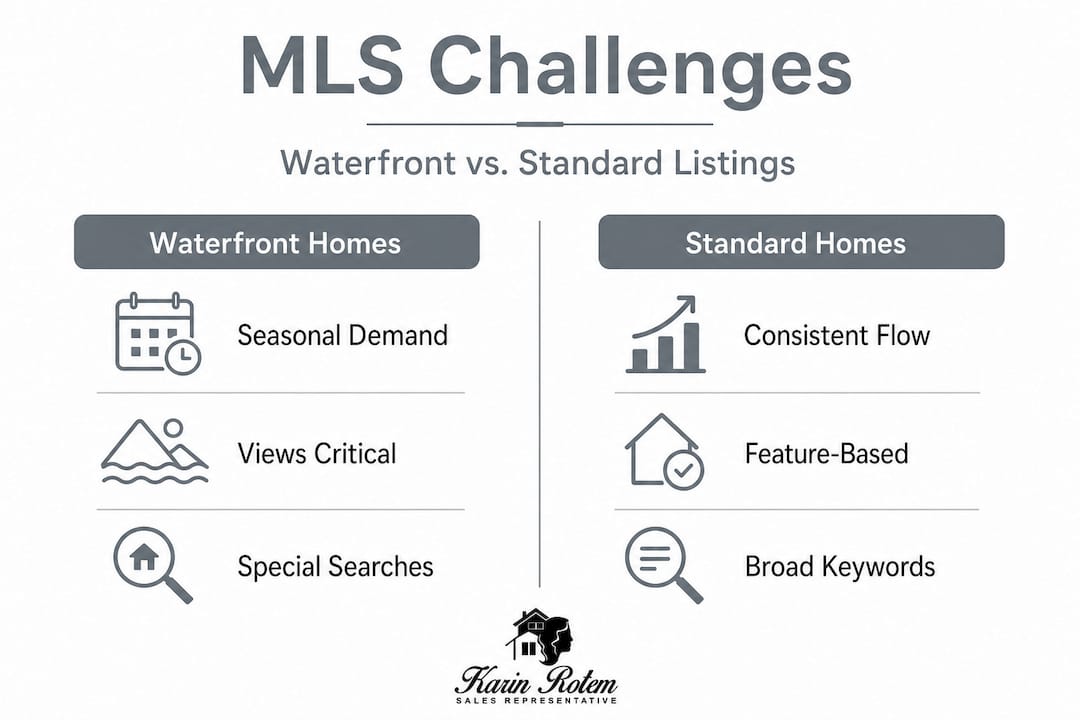
Waterfront inventory can create a herd mentality, where too many similar listings with comparable views, price points, and amenities compete for the same small pool of discerning buyers. When this happens, even well-priced and attractive listings can stagnate. Buyers become overwhelmed by similar choices and delay decisions.
Here are the most pressing challenges specific to this segment:
- Seasonal buyer cycles: Waterfront interest peaks in spring and early summer. Listings that miss this window face slower autumn and winter traffic.
- Luxury buyer selectivity: High-net-worth buyers are patient. They will wait for the right property rather than compromise. Generic listings do not hold their attention.
- Stagnation risk: Days on market are visible to every buyer on MLS. A listing that sits too long triggers suspicion, even when the reason is simply seasonal timing.
- Lifestyle features that are hard to categorise: A property’s proximity to a marina, ski hill, or golf course may not fit neatly into MLS dropdown menus. These must be described precisely in the free-text sections.
- Competition from new development: In communities like Friday Harbour, pre-construction units often compete directly with resale listings on MLS, creating additional pressure on pricing and presentation.
Pro Tip: For waterfront homes that have been on the market for 30 days or more without an offer, consider pulling the listing briefly, refreshing the photos and description with new seasonal imagery, and relaunching. This resets the “days on market” clock and gives the listing fresh visibility in buyer search results.
Pairing MLS exposure with targeted digital outreach, direct agent-to-agent marketing, and community-specific platforms is particularly effective for top waterfront condo listings where visual appeal and lifestyle storytelling are critical to generating genuine buyer interest.
Best practices to maximise MLS impact in today’s market
To wrap this up, here is our straightforward checklist. While market shifts mean tailored strategy wins over any single formula, these steps consistently deliver stronger results for sellers in the Toronto and Innisfil lifestyle segments.
- Research comparable listings thoroughly. Know what competing waterfront properties look like on MLS, what their photos show, what language they use, and how they are priced. This is your benchmark.
- Populate every MLS field without exception. This includes parking, locker, pet policy, water access type, dock availability, amenity details, and any unique features specific to the property.
- Invest in professional photography and a virtual tour. For properties above $800,000, this is non-negotiable. Buyers often decide whether to book a showing based solely on the first three photos.
- Coordinate a network push on launch day. Your agent should notify their buyer database, fellow agents, and relevant buyer groups simultaneously with the MLS launch. Momentum in the first 48 to 72 hours matters enormously.
- Monitor and adjust. Track how many clicks, saves, and showing requests the listing generates each week. If those numbers drop, the listing data or pricing may need to be revisited.
Pro Tip: Work with your agent to craft a listing description that tells a story about the lifestyle, not just the features. Buyers of waterfront and resort properties are purchasing a way of life, and the description should help them picture it clearly.
For more personalised guidance on preparing a lifestyle property for sale, explore our expert buyer tips resource, which outlines what the most discerning buyers are prioritising in today’s market.
The uncomfortable truth about MLS exposure: why nuance matters most
Here is what most listing guides will not tell you. MLS exposure is necessary, but it has never been sufficient on its own. I have seen beautifully finished Friday Harbour properties sit on the market for weeks while a comparable unit nearby received multiple offers within days. The difference was not price. It was strategy.
In Toronto and Innisfil’s high-value waterfront segments, the agents who consistently achieve the best results are not simply those who list properties fastest. They are the ones who understand buyer psychology deeply, time their launches carefully, and treat every single field in the MLS system as a critical piece of communication with the buyer.
Most sellers still think of MLS as a switch. Flip it on, and buyers appear. The reality is that it is more like a precision instrument. Used well, it amplifies every advantage your property has. Used carelessly, it can make even a stunning waterfront home effectively invisible to the buyers who would love it most.
The market in 2026 is moving quickly. Inventory fluctuates, buyer expectations are rising, and the competition for attention across digital platforms is more intense than ever. Only those who treat their luxury real estate strategy with the same seriousness as their listing price will consistently achieve outstanding results.
How we help you win with smart MLS exposure
At Karin Rotem’s team, we do not treat MLS as a checkbox. We build a tailored marketing plan for every property, combining full MLS optimisation with strategic pre-listing outreach, professional staging guidance, and community-specific digital marketing. Whether you are selling a Friday Harbour resort property or exploring investment potential through waterfront rental options, we bring the local expertise and buyer network to position your listing for maximum visibility and competitive offers. Reach out to us today to learn how a properly engineered MLS strategy can make a real difference for your property.
Frequently asked questions
What happens if my MLS listing is missing key features or photos?
Incomplete listings are less visible in filtered MLS searches, resulting directly in fewer buyer clicks and a significant reduction in showing requests.
Is it better to use only MLS exposure or try off-market strategies as well?
MLS maximises exposure and price competition, but off-market strategies can carry a premium in certain conditions; combining both approaches typically produces the strongest outcomes.
How do agents create buyer demand before an MLS listing goes live?
Through strategic network outreach and careful timing, skilled brokers engineer demand by generating genuine buyer interest and even bidding competition before a property officially appears on MLS.
What MLS exposure challenges are unique to waterfront or lifestyle homes?
Crowded waterfront markets can trigger herd mentality among buyers, leading to listing stagnation even for well-priced properties, making precise and differentiated MLS strategy essential.
Do MLS policy changes affect pocket listing advantages?
Yes. Clear cooperation policies have measurably reduced or eliminated the price premiums that pocket listings once offered, shifting the balance back toward full public MLS exposure for most sellers.
Recommended
- Discover the Ultimate Lifestyle: The Benefits of Living in a Friday Harbour Condo Community – Karin Rotem Real Estate Agent
- The Best Waterfront Condos in Friday Harbour: A Buyer’s Guide – Karin Rotem Real Estate Agent
- What Are Buyers Looking for in Friday Harbour Homes? – Karin Rotem Real Estate Agent
- By the water’s edge: Are there waterfront rental options at Friday Harbour? – Karin Rotem Real Estate Agent