
Tourism demand is the primary driver of rental income growth in vacation and resort-style properties. When visitor numbers rise, short-term rental occupancy climbs, nightly rates increase, and long-term residential demand strengthens through job creation and local economic growth. The role of tourism demand in rental income is not a single effect but a layered one, touching everything from your nightly rate to your property’s resale value. Understanding both the direct and indirect effects helps you make sharper investment decisions, whether you own a waterfront condo at Friday Harbour or are evaluating your first resort-area property.
How does tourism demand directly influence short-term vacation rental income?
Tourism demand is the most immediate lever on short-term rental income. When tourist arrivals increase, occupancy rates rise and property owners can charge premium nightly rates, particularly during peak seasons and around major local events. Research confirms that tourism growth boosts both short-term rental occupancy and long-term residential demand by driving job creation and investor confidence. That dual effect is what makes resort-area properties so attractive to income-focused investors.
Seasonality is the defining challenge of short-term vacation rental revenue. A property near a ski hill earns the bulk of its income in winter. A lakeside cottage peaks in july and august. Event-driven demand, such as festivals, regattas, or long weekends, can spike nightly rates well above the seasonal average, but those windows are short. Investors who plan around these cycles capture the upside. Those who ignore them often find their annual income projections fall short.

The gross revenue picture, however, does not tell the full story. Short-stay rentals carry high operational costs, including cleaning, platform fees, and management, that often reduce net income despite higher gross revenue. A property earning $4,000 per month in peak season may net considerably less after those costs are accounted for. Long-term rentals, by contrast, have lower operational demands and yield steadier cash flow.
Competition in the short-term rental market has also intensified. Short-term rental markets are increasingly dominated by professional operators, making it tougher for individual investors without revenue management strategies. Professional hosts use dynamic pricing tools and occupancy analytics to fill gaps between peak periods. Individual owners who rely on flat-rate pricing leave money on the table during high-demand windows and struggle to fill slower periods.
- Higher occupancy and rates during peak tourist seasons reward well-located, well-managed properties.
- Event-driven demand creates short windows of premium pricing that require active calendar management.
- Operational costs including cleaning, platform fees, and turnover reduce net yield significantly.
- Professional competition raises the bar for individual investors without management support.
Pro Tip: Use a revenue management approach to adjust your nightly rate dynamically across seasons and events. Flat-rate pricing is the single biggest missed opportunity in short-term vacation rentals.
What indirect effects does tourism demand have on long-term rental income?
Tourism demand does not only benefit short-term rentals. Its influence on long-term rental income is slower but equally real. When a resort community grows, it creates jobs in hospitality, retail, food service, and construction. Those workers need housing. That workforce housing demand supports stable, mid-market long-term rental income that persists even in the off-season.
Research from Japan illustrates this mechanism clearly. A one-standard-deviation increase in foreign overnight stays correlates with a 0.5 percentage point rise in per capita taxable income over five years, accounting for about 20% of income growth in regional economies. Higher local incomes translate into stronger rental demand and reduced vacancy risk for long-term landlords. The effect is most pronounced in leisure and seasonal destinations, which describes most Canadian resort markets.
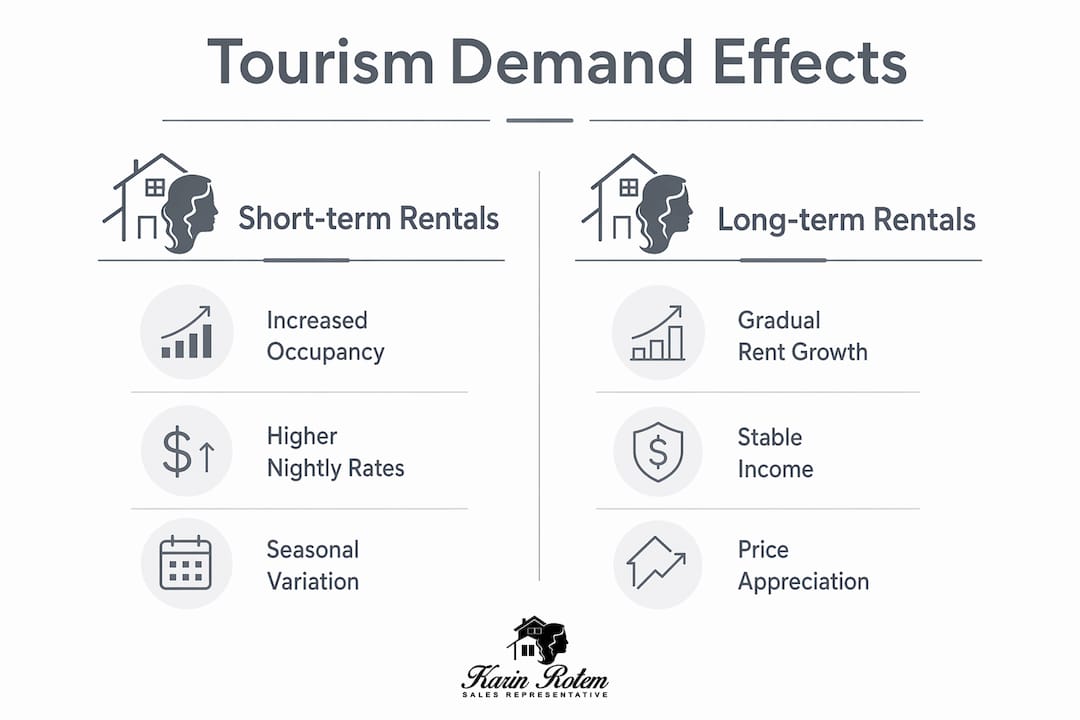
Infrastructure improvements follow sustained tourism growth. Better roads, expanded transit, upgraded utilities, and new commercial amenities all make a community more liveable. That improved liveability attracts residents who are not tourists, deepening the pool of potential long-term tenants. This is a pattern Karinrotem has observed directly in Innisfil and the Friday Harbour area, where resort-driven investment has raised the quality of the surrounding community.
The indirect benefits differ meaningfully between highly seasonal resort towns and diversified urban centres. In a town where tourism is the dominant industry, a bad season can ripple through the entire local economy. In a market like Innisfil, proximity to Toronto provides an economic floor that pure resort towns lack. That diversification reduces the risk that a slow tourist season will hollow out long-term rental demand.
- Workforce housing demand from tourism employment supports stable long-term rental income year-round.
- Rising local incomes tied to tourism growth reduce vacancy risk and support rental price appreciation.
- Infrastructure investment makes resort communities more attractive to permanent residents, not just visitors.
- Market diversification matters: resort towns near major urban centres carry lower economic risk than isolated seasonal destinations.
How does tourism demand affect property prices and investment returns?
Tourism demand pushes property purchase prices upward, which directly affects your return on investment. Spanish research found that a 12.8% increase in tourists arriving by air is linked to a €3,800 increase in home purchase prices and a 1.7% rise in local rental prices. That relationship between visitor volume and property values is not unique to Europe. It shows up in any market where tourism demand outpaces housing supply.
The density of short-term rentals compounds this effect. A 1% increase in short-term rental density leads to an 11% average rise in local housing prices, mainly in supply-constrained areas. The mechanism is straightforward: when investors convert residential stock to tourist rentals, the supply of homes available for purchase or long-term lease shrinks. Prices rise for everyone. This creates a profitability differential for early investors but raises entry costs for those who follow.
Regulatory risk is the counterweight to these gains. The conversion of residential stock into tourist rentals creates profitability differentials, but also regulatory risk as governments impose restrictions to protect housing supply. Canadian municipalities, including several in Ontario, have introduced short-term rental licensing requirements and caps on the number of nights a property can be rented. These rules can materially change the income profile of a property you buy today.
| Investment consideration | What it means for your return |
|---|---|
| Rising purchase prices | Higher entry cost compresses initial yield; appreciation potential remains strong |
| Short-term rental density | Concentrated tourist rentals push up local prices but also invite regulatory scrutiny |
| Regulatory restrictions | Licensing caps and night limits can reduce gross revenue and require strategy adjustment |
| Net yield vs. gross revenue | High gross income means little if operational costs and vacancy eat the margin |
Pro Tip: Always calculate net rental income projection before purchasing. Gross revenue figures from listing platforms do not account for platform fees, cleaning, maintenance, or vacancy. Net yield is the number that actually matters.
What should investors consider when evaluating tourism-influenced rental markets?
Location is the most consistent predictor of sustained rental income in tourism markets. Proximity to tourism hubs and event venues significantly enhances a property’s ability to maintain premium rental rates despite market fluctuations. Not all properties in a resort community benefit equally. A unit with marina access or a ski-in ski-out position commands a different income profile than one two kilometres from the main attraction.
-
Assess location quality first. Proximity to the primary tourist draw, whether a waterfront, ski hill, or golf course, determines your occupancy ceiling. Review the types of income properties available at Ontario resorts to understand which configurations attract the strongest demand.
-
Compare short-term and long-term rental strategies. Short-term rentals generate higher gross revenue but carry higher costs and operational intensity. Long-term rentals offer steadier cash flow with less management burden. The right choice depends on your time, risk tolerance, and the specific property.
-
Factor in professional revenue management. Professional management can optimise occupancy and rates in ways that individual owners rarely achieve alone. Dynamic pricing, channel management, and guest experience standards all affect your net income.
-
Research local regulations before you buy. Short-term rental licensing rules vary by municipality. Confirm what is permitted in your target market before assuming a property can operate as a vacation rental.
-
Integrate tourism data with broader market indicators. Visitor arrival trends, hotel occupancy rates, and local employment data all signal the health of the tourism economy. A property in a growing tourism market with rising employment is a fundamentally different investment than one in a market where visitor numbers are flat.
Pro Tip: Use the short-term rental property checklist to evaluate any resort-area property before making an offer. It covers the operational, regulatory, and income factors that most buyers miss.
Key takeaways
Tourism demand directly increases short-term rental occupancy and nightly rates while indirectly strengthening long-term rental markets through job creation, rising local incomes, and infrastructure growth.
| Point | Details |
|---|---|
| Tourism drives occupancy and rates | Higher visitor arrivals push up short-term rental occupancy and permit premium nightly pricing. |
| Operational costs reduce net yield | Cleaning, platform fees, and management costs significantly reduce net income from short-stay rentals. |
| Indirect effects support long-term demand | Tourism-driven employment creates workforce housing demand that sustains long-term rental income. |
| Rising property prices compress entry yields | Tourism pressure on housing supply raises purchase prices, requiring careful net yield analysis before buying. |
| Location determines income ceiling | Proximity to the primary tourist attraction is the strongest predictor of sustained rental performance. |
What I tell every investor considering a resort-area property
What I tell my clients is this: tourism numbers are a tailwind, not a guarantee. I have seen investors buy in strong tourism markets and still underperform because the property was poorly located, the cost structure was ignored, or regulations changed after purchase. The research on tourism’s influence on rental income is compelling, but it describes averages across markets. Your specific property either captures that demand or it does not.
What most buyers do not realise is that the gap between a well-located resort property and a mediocre one in the same community can be enormous. At Friday Harbour, for example, a unit with direct marina views and resort amenity access attracts a completely different calibre of tenant and a meaningfully higher nightly rate than a comparable unit without those features. The tourist numbers for the whole community are the same. The income is not.
My honest advice is to weigh regulatory risk heavily. Ontario municipalities are actively reviewing short-term rental policies. A property that pencils out beautifully as a vacation rental today may face licensing restrictions within two to three years. I always encourage clients to stress-test their numbers under a long-term rental scenario as well. If the property still makes sense with a long-term tenant, you have a resilient investment. If it only works as a short-term rental, you are carrying more risk than you may realise.
The investors I have seen succeed in tourism-influenced markets share one trait: they treat the property as a business from day one. They understand their cost structure, they use professional management or revenue tools, and they choose location with discipline rather than emotion.
— Felix
Karinrotem’s expertise in tourism-driven real estate
Karinrotem specialises in vacation and resort-style properties across Toronto and Innisfil, with particular depth in the Friday Harbour community. If you are evaluating a property for its rental income potential in a tourism-influenced market, the team brings local knowledge that goes well beyond listing data. From understanding which Friday Harbour properties attract the strongest short-term rental demand to assessing the regulatory environment in Innisfil, Karinrotem provides the context that turns research into confident decisions. Browse the current available properties or reach out directly for a conversation about your investment goals.
FAQ
What is the role of tourism demand in rental income?
Tourism demand increases short-term rental occupancy and nightly rates while supporting long-term rental markets through local job creation and income growth. The effect is strongest in supply-constrained resort areas near major tourist attractions.
Does tourism demand raise property purchase prices?
Research links a 12.8% rise in tourist arrivals to a €3,800 increase in home purchase prices. Higher short-term rental density also pushes local housing prices upward, compressing initial yields for new investors.
Are short-term rentals more profitable than long-term rentals in tourist areas?
Short-term rentals generate higher gross revenue in strong tourism markets, but high operational costs including cleaning, platform fees, and management often reduce net income. Long-term rentals offer lower returns but steadier, lower-maintenance cash flow.
How does location affect vacation rental revenue in resort markets?
Proximity to the primary tourist attraction is the strongest predictor of sustained rental income. Properties near marinas, ski hills, or event venues consistently command premium rates and higher occupancy than comparable properties further away.
What regulatory risks should investors consider in tourism-driven rental markets?
Governments in many Canadian municipalities are introducing short-term rental licensing requirements and nightly caps to protect housing supply. Investors should confirm local rules before purchasing and stress-test their income projections under a long-term rental scenario as well.