
Scaling a rental portfolio in resort communities is defined as the deliberate process of acquiring, integrating, and managing multiple vacation properties within amenity-rich destinations to grow income and spread investment risk. Resort markets behave differently from urban rental markets. Demand is seasonal, guests expect lifestyle experiences, and the gap between a well-run property and a poorly managed one shows up fast in your revenue. Large real estate investment trusts like Sun Communities raise annual rental rates about 4% in resort and RV communities, which signals steady, compounding income growth for investors who get the fundamentals right. The strategies that work here are specific to this market, and that is exactly what this guide covers.
What do you need before scaling a resort rental portfolio?
The single biggest mistake investors make is acquiring more properties before they have the right systems in place. Portfolio size, technology, and property type knowledge are the three foundations you need before expanding rental holdings in any resort market.
Portfolio size and management thresholds
Your portfolio size directly determines your management approach. Owners with 1–5 properties can self-manage effectively using AI-powered messaging and channel management tools. At five or more properties, operational complexity grows faster than most investors expect, and professional management becomes the more profitable choice.
| Portfolio size | Recommended approach | Key tools |
|---|---|---|
| 1–5 properties | Self-management with AI tools | Channel manager, dynamic pricing software |
| 5–10 properties | Hybrid or professional management | Property management system (PMS), revenue manager |
| 10+ properties | Full professional management | Integrated PMS, dedicated operations team |
Technology stack for resort rental investors

A working tech stack for vacation home management has three layers. The first is a property management system that centralises bookings across platforms. The second is a dynamic pricing tool that adjusts rates based on demand, seasonality, and local events. The third is automated guest messaging, which handles check-in instructions, upsell offers, and review requests without manual effort.
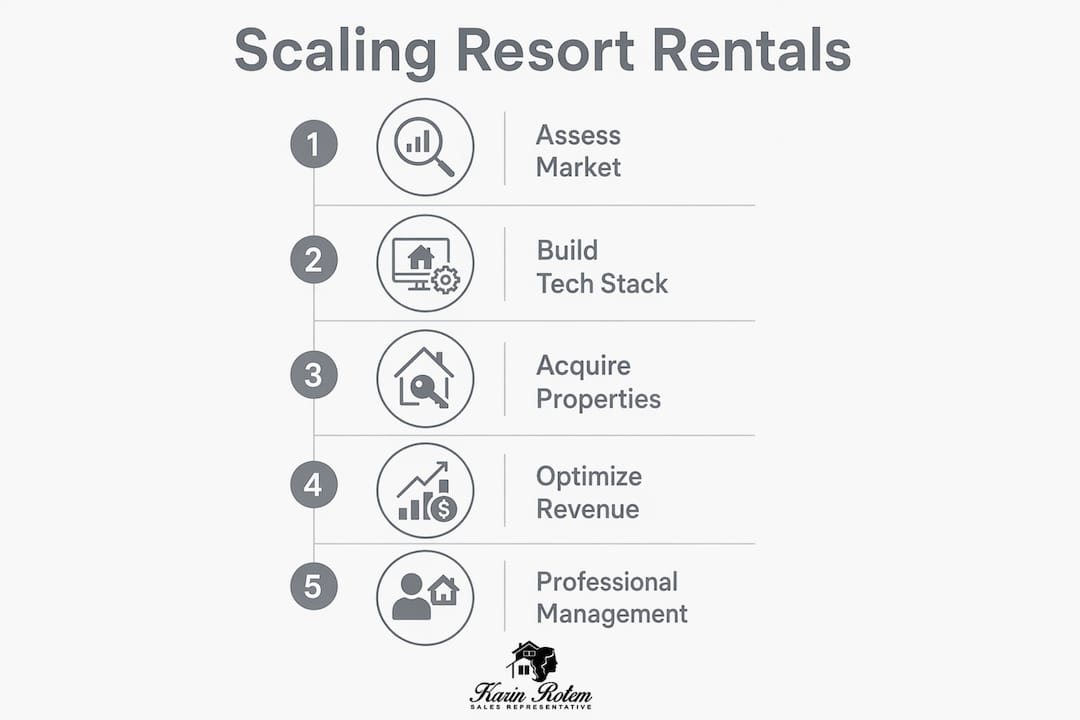
Pro Tip: Set up your tech stack before you acquire your second property, not after. Retrofitting systems across multiple listings is far more disruptive than building the foundation early.
Understanding resort property types
Not all resort properties perform equally. Branded short-term rental communities offer amenity infrastructure like water parks, dining, and concierge services that individual homeowners cannot replicate. That infrastructure commands higher nightly rates and attracts guests with shorter booking windows, which improves revenue predictability. Understanding which property types exist in your target resort market, from condo hotels to managed rental programmes, shapes every acquisition decision you make. Karinrotem’s Ontario resort income property guide breaks down the specific property types available in markets like Friday Harbour and Innisfil.
How do you acquire and integrate properties in resort markets?
Acquisition in resort communities is not just about finding a good price. It is about choosing property types and structures that support portfolio growth without requiring disproportionate capital or management overhead.
-
Prioritise branded resort communities. Branded developments provide built-in amenity infrastructure, consistent brand standards, and a guest base that already trusts the product. This reduces your marketing cost and supports premium pricing from day one.
-
Mix accommodation types within a single resort footprint. Condo hotels and mixed-use resort compounds that blend hospitality and residential units reduce upfront capital requirements while maintaining a consistent guest experience. You share infrastructure costs across the development rather than bearing them alone.
-
Use managed rental programmes where available. Many resort developments offer on-site management programmes that handle bookings, cleaning, and maintenance. Joining these programmes lowers your operational burden while keeping your property active in the rental pool.
-
Evaluate each acquisition against your existing portfolio’s geographic concentration. Spreading properties across two or three resort destinations reduces your exposure to a single market’s seasonal fluctuations.
- Confirm short-term rental bylaws and resort association rules before signing any purchase agreement.
- Review the resort’s occupancy history, not just the developer’s projected returns.
- Assess whether the resort’s amenity programme is funded through a reserve fund or ongoing fees, since underfunded amenities deteriorate quickly and hurt your nightly rates.
- Factor in capital expenditure cycles. Resort properties face higher wear from guest turnover than long-term rentals.
How do you maximise revenue across a resort rental portfolio?
Revenue management in resort rental portfolios is a system, not a one-time pricing decision. Pricing, minimum stays, and guest experience must be treated as a continuous loop, monitored monthly against market benchmarks rather than just your own historical data.
Dynamic pricing and minimum stay strategy
Dynamic pricing software adjusts your nightly rate based on real-time demand signals: local events, competitor availability, and booking pace. Set minimum stay requirements strategically. A three-night minimum over a long weekend captures higher-value guests, while a one-night minimum during shoulder season fills gaps that would otherwise sit empty.
Managing gap nights
Gap nights are the single, two, or three-night gaps between existing bookings. Left unmanaged, they represent pure revenue loss. Automated gap-night management through dynamic minimum-night adjustments and targeted discounts can recover 5–15% of lost annual revenue. That is a material improvement that requires no additional properties and no additional guests beyond what your calendar already attracts.
Pro Tip: Review your gap-night report every two weeks during peak season. A single unbooked weekend in july or august in a resort market costs more than a month of shoulder-season vacancy.
Upselling without adding occupancy
Upsells like equipment rentals and grocery stocking increase revenue without adding wear, turnover costs, or additional bookings. In resort markets, guests arrive expecting a complete experience. Offering kayak rentals, firewood delivery, or pre-stocked fridges at checkout converts that expectation into direct revenue. This approach grows your revenue per available room (RevPAR) without touching your occupancy rate.
| Revenue lever | Impact on RevPAR | Operational complexity |
|---|---|---|
| Dynamic pricing | High | Low (automated) |
| Gap-night management | Medium to high | Low (automated) |
| Upsell services | Medium | Medium (vendor coordination) |
| Professional management | High | Low (outsourced) |
Professional management as a revenue tool
Professional management services charge 10–15% in fees and can increase revenue by up to 18% versus self-management. The fee pays for itself when a professional manager’s pricing expertise, guest communication, and maintenance response times outperform what you can deliver across five or more properties. Choosing the right manager is its own decision. Karinrotem’s guide on choosing a property manager walks through the key criteria specific to vacation rental markets.
What challenges should you expect when scaling resort rentals?
Scaling in resort markets creates predictable problems. Knowing them in advance lets you build solutions before they cost you money.
- Unbooked gap nights compound quickly. A portfolio of ten properties with an average of three unmanaged gap nights per month loses significant revenue annually. Automation is the only practical solution at scale.
- Burnout from manual operations. Investors who self-manage beyond five properties without automation report that guest communication alone consumes more time than the income justifies. Build your tech stack before you hit that threshold.
- Regulatory changes in resort municipalities. Short-term rental bylaws in resort communities across Ontario have tightened in recent years. Licencing requirements, occupancy limits, and noise bylaws vary by municipality and can change with little notice. Monitor local council decisions as part of your regular portfolio review.
- Seasonal revenue concentration. Resort markets concentrate revenue into peak periods. A wet summer or a poor ski season can compress your annual income into fewer bookings than projected. Diversifying across two resort types, such as a waterfront property and a ski-adjacent property, reduces this exposure.
- Maintenance costs at scale. Guest turnover in resort properties is higher than in long-term rentals. Budget for a higher maintenance reserve than you would for a comparable urban investment property. Underfunding maintenance leads to declining reviews, which directly reduces your nightly rate.
The STR Comply portfolio management guide offers a practical framework for tracking compliance and operational performance across multiple short-term rental properties.
Key takeaways
Scaling a resort rental portfolio requires matching your management approach to your portfolio size, automating revenue recovery, and prioritising branded communities that command premium pricing.
| Point | Details |
|---|---|
| Match management to portfolio size | Self-manage up to five properties with AI tools; hire professionals beyond that threshold. |
| Automate gap-night recovery | Dynamic minimum-night adjustments can recover 5–15% of lost annual revenue. |
| Choose branded communities | Branded resort developments command higher rates and reduce your marketing burden. |
| Treat revenue management as a system | Monitor pricing, minimum stays, and guest experience monthly against market benchmarks. |
| Upsell without adding occupancy | Equipment rentals and stocking services grow RevPAR with minimal operational cost. |
What I have learned about scaling resort rentals from working in Friday Harbour
Most investors I work with come to resort markets with an urban investment mindset. They focus on purchase price and projected cap rate, then discover that resort properties have a completely different operating rhythm. The income is real, but it requires active management in a way that a long-term rental simply does not.
What I tell my clients is this: your first resort property teaches you the market. Your second and third properties are where you actually start building a portfolio. The jump from one to three properties is where most investors either build the right systems or get buried in operational detail.
The trend I find most interesting right now is the growth of integrated resort developments that combine residential ownership with hotel-grade amenity programmes. Friday Harbour is a strong local example. Owners there benefit from a managed community with marina access, dining, and retail, which supports nightly rates that a stand-alone cottage in the same region cannot match. That amenity premium is not just a lifestyle feature. It is a structural advantage that holds up even in softer booking seasons.
The investors who scale successfully in resort markets are not necessarily the ones with the most capital. They are the ones who treat revenue management as a discipline, automate the recoverable losses early, and choose properties where the community itself does part of the marketing work for them.
— Felix
How Karinrotem helps investors grow resort rental portfolios
Karinrotem works with investors across Toronto and Innisfil who are building income-generating portfolios in resort communities. Friday Harbour is one of the most active markets we serve, with a range of waterfront and resort properties suited to short-term rental strategies. Whether you are evaluating your first resort acquisition or looking to add properties to an existing portfolio, our team brings local market knowledge, transaction experience, and honest guidance on what the numbers actually look like in practice. If you want to understand which property types in Ontario resort markets generate the strongest rental income, our Ontario resort income property guide is a practical starting point.
FAQ
What is the minimum portfolio size to scale resort rentals profitably?
Most investors find that three to five properties is the threshold where resort rental income becomes meaningful relative to management time. Beyond five properties, professional management typically improves both revenue and owner quality of life.
How much do professional vacation rental managers charge?
Professional vacation rental management fees typically range from 10–15% of rental revenue. Performance-based plans at the higher end of that range often include more active pricing management and can increase total revenue by up to 18% versus self-management.
What are gap nights and why do they matter?
Gap nights are short unbooked periods between existing reservations. Automated pricing tools that adjust minimum stay requirements to fill these gaps can recover 5–15% of annual revenue that would otherwise be lost.
Are branded resort communities better investments than stand-alone vacation homes?
Branded resort communities provide amenity infrastructure that individual owners cannot replicate, which supports higher nightly rates and more consistent bookings. They are generally the stronger choice for investors focused on income stability rather than capital appreciation alone.
How do I manage short-term rental regulations in Ontario resort markets?
Licencing requirements and occupancy rules vary by municipality and change regularly. Review local bylaws before purchasing, build compliance checks into your quarterly portfolio review, and consult a local real estate advisor with direct experience in your target resort community.