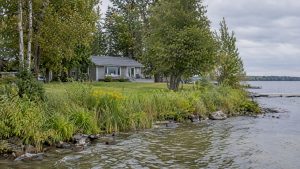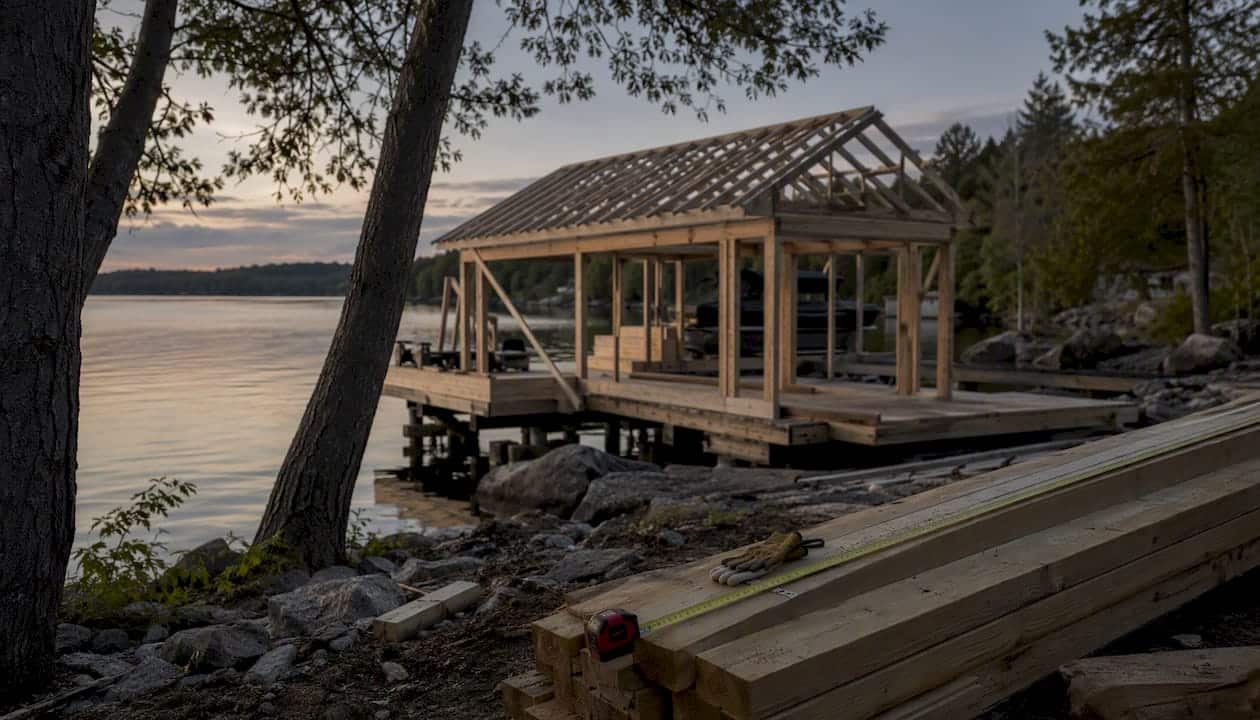
A private boathouse permit is a municipal building permit required to construct or substantially alter a boathouse, boat port, or covered dock structure at or near the ordinary high-water mark of a shoreline property. Your first step is straightforward: confirm whether your shoreline strip falls within an Original Shore Road Allowance (OSRA) and check your municipal zoning before drawing a single plan.
Three layers of authority typically apply:
- Municipal building department — issues the building permit, enforces local zoning setbacks, and schedules inspections
- Provincial regulations — O. Reg. 160/17 and O. Reg. 239/13 govern work permits and exemptions on shore lands and Crown land
- Federal and other agencies — Parks Canada (Trent–Severn Waterway), Fisheries and Oceans Canada (DFO), and local conservation authorities where wetlands or navigation are involved
Key takeaways
A private boathouse permit in Ontario requires municipal approval, OSRA resolution, and often agency letters from Parks Canada, DFO, or conservation authorities before construction can begin.
| Point | Details |
|---|---|
| Municipal permit is mandatory | Nearly all boathouse and boat port structures require a building permit regardless of provincial exemptions. |
| OSRA status is a prerequisite | Confirm shore road allowance ownership or licence before submitting any permit application. |
| Sealed drawings often required | Steel structures and complex framing require a Professional Engineer’s seal under the Ontario Building Code. |
| Timeline is longer than expected | Full process from pre-consultation to permit issuance typically runs 4–12+ months depending on complexity. |
| Karinrotem guides buyers through it | The team provides pre-offer OSRA checks, permit history reviews, and engineer referrals for waterfront purchases. |
What does a boathouse permit actually cover?
Ontario municipalities regulate a range of shoreline structures under their building permit frameworks. The structures most commonly caught are:
- Boathouses (enclosed or partially enclosed, with or without a second storey)
- Boat ports (roofed, open-sided structures over water)
- Docks with any upper structure or enclosed storage
- Shoreline decks attached to or near the water’s edge
- Seasonal or permanent storage buildings on the shoreline
Size thresholds matter. FOCA notes that Ontario Regulation 239/13 generally exempts structures occupying less than a small area of shore lands from provincial work permits. What most property owners miss is that this exemption does not remove the municipality’s authority to require a local building permit. The Township of Severn documents a narrow exception for small floating or pole docks under specific size and seasonal conditions, but a full boathouse almost never qualifies. The City of Kenora sets a permit threshold for smaller structures, with boathouses subject to local maximum size and projection limits.
Pro Tip: Always confirm both the provincial exemption threshold and your specific municipal bylaw. A structure that clears the provincial 15 m² exemption can still require a municipal permit — and often does.
Which authorities need to approve your project?
Getting the right approvals in the right order saves weeks. Here is who does what:
- Municipal building department — primary permit issuer; sets local zoning, setbacks, lot coverage limits, and inspection requirements. Start here.
- MNRF (Ministry of Natural Resources and Forestry) — issues provincial work permits for activities on Crown land or shore lands under O. Reg. 160/17; relevant when the shoreline involves public lands.
- Parks Canada / Trent–Severn Waterway — if your property sits on the Trent–Severn system, a Parks Canada permit is required before you submit your municipal application. This sequencing is non-negotiable and adds lead time.
- DFO (Fisheries and Oceans Canada) — review is triggered when construction could affect fish habitat or navigation; a Fisheries Act authorization may be required.
- Conservation authorities — local CAs regulate development near wetlands and within regulated shoreline areas; their approval or letter of no objection is often a prerequisite for the municipal permit.
Practical note: On Trent–Severn Waterway properties, the Parks Canada permit must be in hand before the municipal building department will accept a complete application. Budget an additional 4–8 weeks for that step alone.
What documents does a permit application require?
Municipal boathouse applications require a consistent core package, with additions depending on complexity. The Township of Muskoka Lakes and Township of Severn both list the following as required:
- Completed Building Permit Application form
- Schedule 1 (designer responsibility statement, signed by the designer or homeowner)
- Site plan showing lot dimensions, water frontage, setbacks, and structure location
- Digital construction drawings (PDF format) with dimensions, materials, and structural details
- Proof of OSRA ownership or licence (see Section 5)
- Letters of approval from Parks Canada, DFO, MNRF, or conservation authority where applicable
When does a Professional Engineer’s seal become mandatory? Steel dock structures, any structural framing exceeding standard residential thresholds, and complex foundations typically require drawings sealed by a licensed Professional Engineer under the Ontario Building Code. Welding validation and certified-welder confirmation are also required for steel-work submissions. If you are using a homeowner-prepared design, Schedule 1 shifts responsibility to you as the designer — a significant liability if the structure fails.
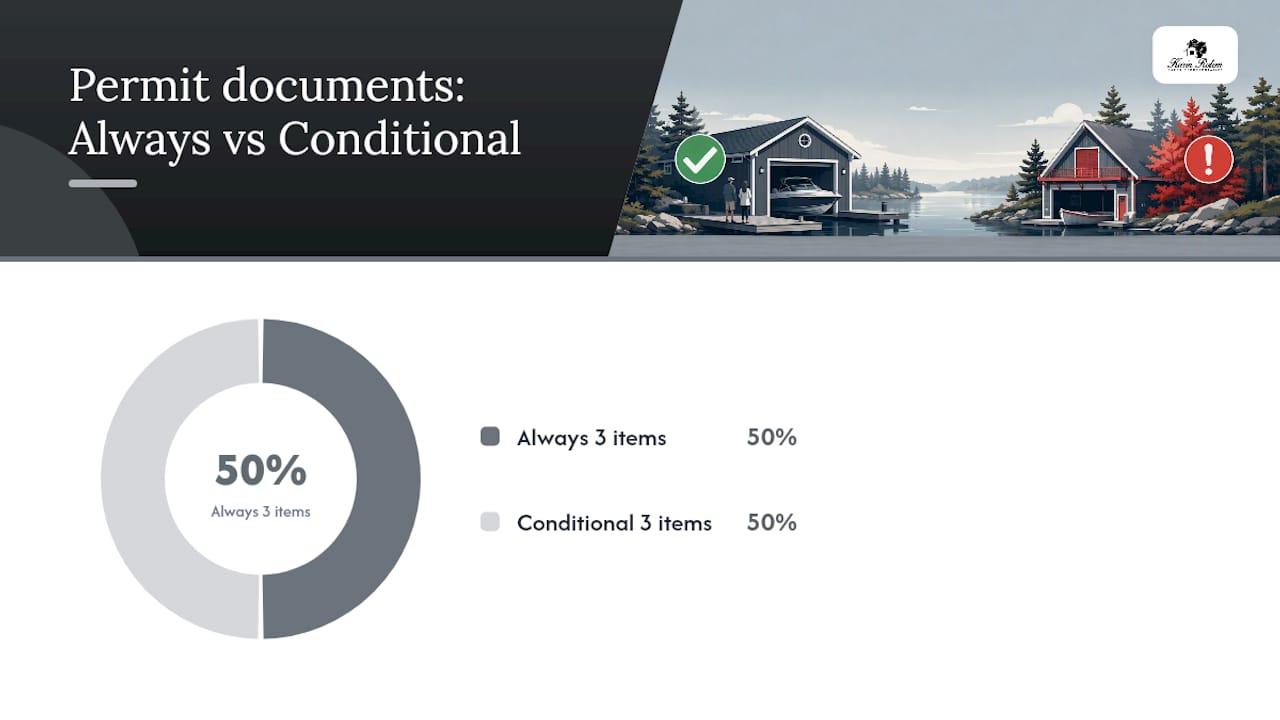
| Document | Who prepares it | When required |
|---|---|---|
| Building Permit Application | Owner or agent | Always |
| Schedule 1 | Designer or owner | Always |
| Site plan | Surveyor or designer | Always |
| Sealed structural drawings | Professional Engineer | Steel, complex framing, OBC thresholds |
| Agency approval letters | Parks Canada / DFO / CA | When applicable |
| OSRA proof of ownership or licence | Owner / municipality | When shoreline strip is public land |
Does the Original Shore Road Allowance affect your permit?
Yes, and this is the issue that catches the most buyers off guard. An OSRA is a strip of Crown-owned land, typically a historically surveyed area along Ontario shorelines in the 19th century. Many waterfront properties do not include this strip in their title, meaning the land between the property boundary and the water’s edge is technically public.
The Township of Muskoka Lakes requires proof of OSRA ownership before issuing a boathouse building permit; a Conditional Building Permit Agreement may be available to help eligible projects move forward during the OSRA purchase process. The City of Kawartha Lakes enforces encroachment licences for structures on City-owned shoreline land. Your options are:
- Purchase the OSRA from the municipality (most common in Muskoka; adds months and fees)
- Obtain a licence or encroachment agreement (annual or long-term; does not transfer ownership)
- Redesign the project to avoid encroaching on the allowance entirely
Pro Tip: OSRA purchase applications and licence agreements can add several months to your timeline and additional fees. Confirm OSRA status before making an unconditional offer on any waterfront property.
How to apply for a boathouse permit, step by step
- Pre-consultation — contact the municipal building department to confirm zoning, setbacks, and OSRA status (allow 2–6 weeks for a response)
- OSRA resolution — apply to purchase or licence the shore road allowance if required
- Site survey and drawings — commission a surveyor and, where needed, a Professional Engineer for sealed structural drawings (4–12 weeks)
- Agency approvals — submit to Parks Canada, DFO, conservation authority, or MNRF as applicable; obtain letters of approval
- Formal municipal submission — submit the complete package (application, Schedule 1, site plan, drawings, agency letters, OSRA proof) and pay the permit fee
- Municipal review and processing — 4–12+ weeks depending on complexity and season
- Staged inspections — dock inspection must typically be closed before the boathouse permit is issued; follow the inspection sequence your permit specifies
- Permit issuance and construction — post the permit on site and build to the approved drawings
Fee note: Budget for the municipal permit fee, Professional Engineer fees, OSRA purchase or licence costs, and any conservation authority or Parks Canada application fees. These costs vary significantly by municipality and project scope; engineering fees alone for a complex boathouse can run into the thousands of dollars.
Common mistakes that delay or kill a permit
Knowing what to avoid is as valuable as knowing the steps. The most frequent problems I see:
- Assuming neighbour precedent applies — zoning bylaws are highly localised; what was approved next door may not be permitted on your lot
- Skipping the OSRA check — discovering a public road allowance after an offer is accepted is expensive and sometimes deal-ending
- Submitting incomplete structural drawings — missing dimensions, no engineer seal where required, or absent welding documentation triggers automatic rejection
- Under-budgeting professional fees — engineering, surveying, and agency application costs are often larger than the municipal permit fee itself
- Missing conservation authority input — many buyers assume the building department covers everything; it does not
For a broader look at luxury property buyer pitfalls, the same principle applies: due diligence before the offer protects you far better than conditions after.
Trent–Severn Waterway and environmental permits
Properties on the Trent–Severn Waterway face an additional layer of federal oversight that changes the application sequence entirely.
When Parks Canada is involved:
- A Parks Canada permit is required for any structure, dredging, or filling within the Waterway corridor
- This permit must be obtained before submitting the municipal building permit application
- Contact Parks Canada’s Trent–Severn Waterway office directly to confirm whether your property falls within the regulated corridor
Dredging, filling, and Crown land work permits:
- Confirm whether the work involves dredging or filling of shore lands
- Check whether a provincial work permit is required under O. Reg. 160/17 via the Ontario Crown land and shore land work permits page
- Assess whether the Fisheries Act applies; contact DFO if fish habitat may be affected
- Obtain all agency approvals before the municipal submission
For Trent–Severn properties specifically:
- Confirm Waterway corridor status with Parks Canada
- Obtain Parks Canada permit
- Secure DFO and conservation authority letters
- Then submit the complete municipal package
What happens after the permit is issued?
Receiving the permit is not the finish line. Post-permit obligations are real and enforced.
- Post the permit on site in a visible location before construction begins
- Follow the approved drawings exactly; any deviation requires a permit amendment
- Complete staged inspections in the sequence your permit specifies (dock inspection before boathouse framing, framing before enclosure, and so on)
- Notify the building department of any changes before making them
A word on grandfathered structures. Many buyers assume an older boathouse is protected by its age. Municipal trends are toward tighter shoreline controls, and projects previously grandfathered may be subject to current rules when renovated or replaced. Replacing a roof, adding a wall, or changing the footprint can trigger a full permit review under today’s bylaws. Non-compliance consequences include stop-work orders, fines, and in serious cases, forced removal at the owner’s expense. For context on how renovation rules interact with evolving bylaws, the Friday Harbour condo renovation rules guide illustrates how current standards can override prior approvals.
What I tell my clients about buying waterfront with a boathouse permit
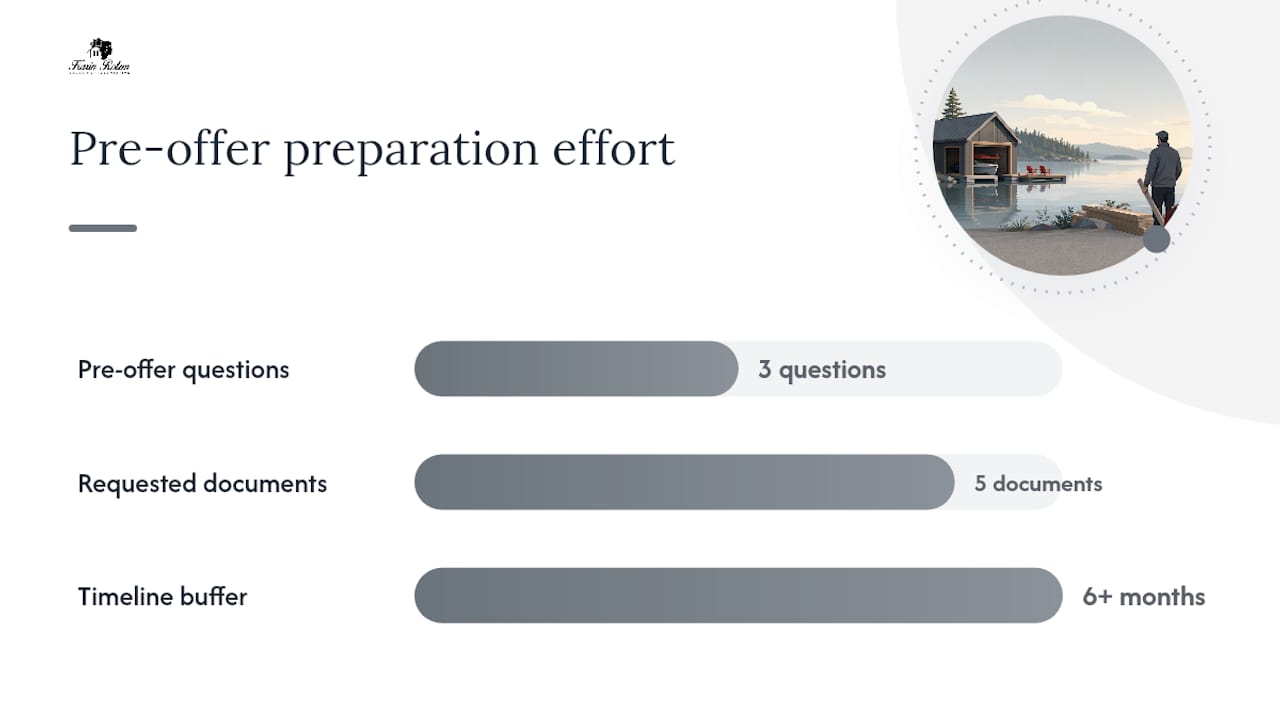
What most buyers don’t realise is that the boathouse is often the most legally complex part of a waterfront purchase, not the house itself. Before any offer, I walk my clients through three questions: Does the OSRA belong to the seller? Does an existing permit match the structure that’s actually there? And has the dock ever had a closed inspection?
I always ask sellers for a specific document package:
- Current survey showing OSRA status
- All previous building permits and inspection records for the boathouse and dock
- OSRA purchase or licence records
- Any engineering reports or structural assessments
- Conservation authority or agency correspondence
The trade-off is real. A property with a fully permitted, engineer-sealed boathouse on a purchased OSRA is worth more and carries far less risk than one with an unpermitted structure and an unresolved shore road allowance. When the OSRA is unresolved and the structure is unpermitted, I recommend a conditional offer tied to permit pre-approval or OSRA resolution, with a realistic timeline buffer of six months or more. Sometimes the numbers still work. Sometimes they don’t, and walking away is the right call.
Local expertise matters here. Understanding why local agents make waterfront buying smarter comes down to exactly this kind of pre-offer intelligence, not just the listing price.
Karinrotem’s team helps you navigate waterfront permits with confidence
Waterfront permitting is where deals get complicated, and where having the right guidance makes a measurable difference. Karinrotem’s team brings hands-on knowledge of Ontario’s shoreline approval process, from OSRA checks and pre-consultation meetings to coordinating with engineers, permit agents, and municipal contacts on your behalf.
Before you make an offer, we can help you assess OSRA status, review existing permit histories, and identify red flags that affect value or timeline. For buyers ready to explore Ontario waterfront properties with full awareness of what the permitting process involves, we offer property-specific consultations that go well beyond the listing sheet. Browse current waterfront listings or reach out directly to book a pre-offer due diligence conversation.
Sources
Check the specific municipal page for your property address, as rules vary by township. When contacting permit coordinators, have your site plan, proof of ownership, and a written project description ready.
- Building, Demolition and Construction | Township of Muskoka Lakes
- Docks & boathouses | Federation of Ontario Cottagers’ Associations (FOCA)
- Docks and Boat Ports | Township of Severn
- Docks and shorelines | City of Kenora
- O. Reg. 160/17: Activities on public lands and shore lands – work permits and exemptions
For general guidance on permit timelines and fee structures in construction projects, the GlassRailingStore permit process guide offers a useful parallel on what to expect from staged municipal approvals.
This article is general information, not a substitute for advice from a qualified lawyer. Consult a qualified legal professional about your own circumstances before acting on anything here.
FAQ
What is a private boathouse permit in Ontario?
A private boathouse permit is a municipal building permit required to construct or significantly alter a boathouse, boat port, or covered dock structure on a shoreline property. It is separate from any provincial work permit that may also be required under O. Reg. 160/17.
Do I need a permit for a floating dock?
Most floating docks still require a building permit, though some municipalities such as the Township of Severn document a narrow exception for small floating or pole docks under specific size and seasonal conditions. Always confirm with your local building department before assuming an exemption applies.
How long does the boathouse permit process take?
The full process often takes several months depending on complexity and approvals required from pre-consultation to permit issuance, depending on OSRA status, agency approvals required, and municipal review times. Properties on the Trent–Severn Waterway require a Parks Canada permit first, which adds further lead time.
What is an OSRA and why does it matter for my permit?
An Original Shore Road Allowance is a strip of Crown-owned land surveyed along Ontario shorelines; many waterfront properties do not own this strip. The Township of Muskoka Lakes, for example, requires proof of OSRA ownership before issuing a boathouse building permit.
Can I renovate a grandfathered boathouse without a new permit?
Renovations, replacements, or significant alterations to an older boathouse commonly trigger a full permit review under current bylaws, potentially removing any previously grandfathered status. Confirm with your municipal building department before starting any work.