
Effective guest screening for a short-term rental property is a systematic process that combines identity verification, objective background checks, and documented criteria to protect your investment and stay on the right side of the law. The industry term for this process is “guest vetting,” and it covers everything from the moment a booking request arrives to the moment a guest receives their access code. What I tell my clients who own vacation properties in Friday Harbour and across Innisfil is this: a single bad guest can cost you more than a month’s rental income. A structured vetting process prevents that. This article walks you through the tools, the legal framework, and the step-by-step process to do it right.
How to screen guests for your short-term rental property in 2026
The most effective guest vetting combines automated technology with a clear set of written criteria. Neither works well alone. Automated tools catch fraud and flag risk signals at scale. Written criteria keep your decisions consistent, defensible, and free from discrimination complaints.
The short-term rental industry has moved well past manual inbox reviews. Hosts who set up a short-term rental legally in Ontario now have access to verification platforms that run ID checks, liveness selfie comparisons, and background risk scores in minutes. The key is knowing which tools to use and how to layer them.

What technologies and tools are essential for guest verification?
Modern ID verification technology performs checks in under 60 seconds without inconveniencing guests. That speed matters because friction at the booking stage costs you reservations.
The core technologies worth knowing are:
- ID document scanning: Optical character recognition reads passport or driver’s licence data and cross-references it against government databases.
- Liveness selfie checks: The guest takes a real-time selfie that the system matches to their ID photo. Liveness verification is the most effective tactic to prevent identity theft and fraudulent bookings.
- Automated background risk scoring: The system checks criminal databases, sex offender registries, and global sanction lists, then returns a risk score rather than a raw report.
- Phone and email validation: Automated validation screens out burner phone numbers and temporary email addresses without adding steps for legitimate guests.
- Property Management System (PMS) integration: Hosts who integrate screening with a PMS save time and maintain consistent procedures across every booking channel.
Pro Tip: Look for a verification platform that integrates directly with your booking calendar. Manual copy-paste workflows break down during high-volume periods and create gaps in your audit trail.
A blended approach of automated checks and human review offers the best tradeoff between efficiency and judgement. Automated scores handle volume. Manual review handles edge cases, such as a guest with a common name that triggers a false positive on a criminal database.
| Feature category | What it does | Why it matters |
|---|---|---|
| ID document scan | Reads and validates government ID | Confirms identity is real |
| Liveness selfie | Matches live photo to ID | Prevents fake ID use |
| Background risk score | Flags criminal or sanction matches | Surfaces high-risk profiles |
| Phone/email validation | Screens out temporary accounts | Reduces fraudulent inquiries |
| PMS integration | Automates workflows | Keeps screening consistent |
What are the lawful criteria for rejecting a guest without discrimination?
Screening is not about gut feelings. Consistent, objective criteria reduce discrimination risks and legal exposure. Canadian hosts must align their screening criteria with the Ontario Human Rights Code, which prohibits denial based on race, sex, age, disability, family status, and several other protected grounds.
The good news is that objective, property-related risk factors are fully lawful grounds for denial. Acceptable non-discriminatory reasons for rejecting a guest include:
- A criminal history directly related to property damage or violence
- Verified negative reviews from previous hosts documenting rule violations
- Refusal to provide government-issued photo ID
- Failure to complete verification within the required timeframe
- A background risk score that exceeds your documented threshold
Every denial must rest on at least one of these documented factors. When you use a third-party screening service to inform a denial, issuing an adverse action notice is strongly recommended. This notice informs the guest that a consumer report influenced the decision and gives them the right to dispute inaccurate information.
Objective, written house rules reduce discrimination risks when applied consistently to every applicant. Write your rules before you list the property, not after a problem arises.
Pro Tip: Keep a discretionary log. For every booking you approve or decline, record the date, the guest’s verification status, and the specific rule or risk factor that drove your decision. A discretionary log creates a non-discriminatory, defensible record if a complaint is ever filed.
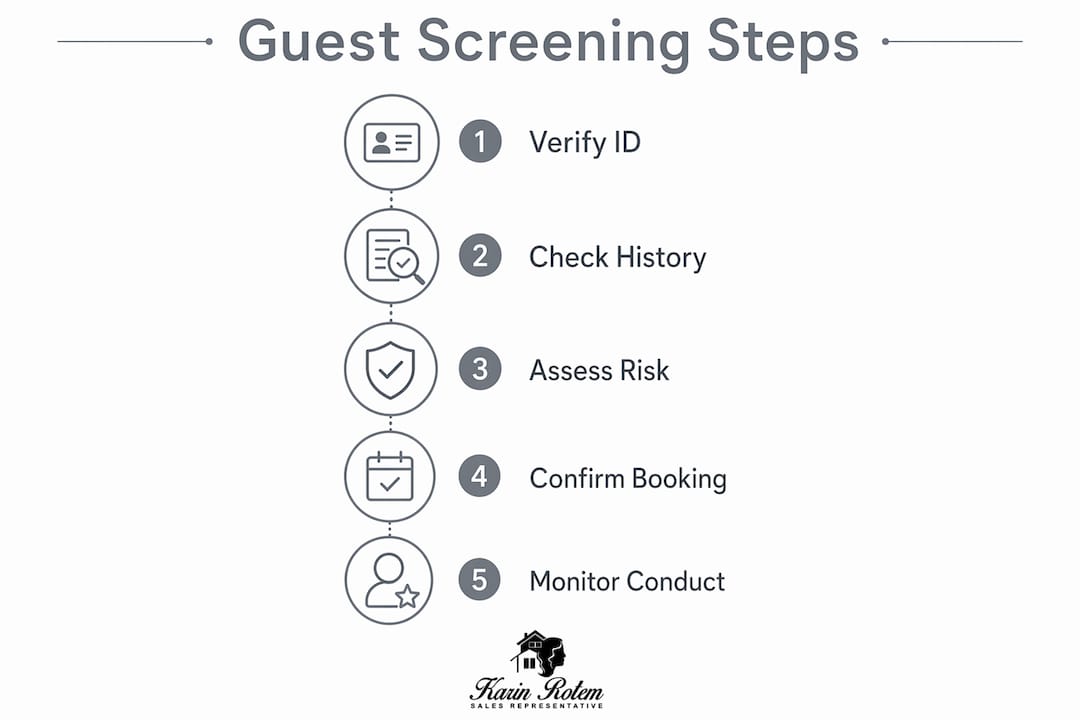
How to implement a guest screening process step by step
A reliable tenant screening process follows the same sequence every time, regardless of the booking channel.
-
Activate instant booking with conditions. Set your platform to require verified ID and a complete profile before a booking request is accepted. This filters out anonymous inquiries before they reach your inbox.
-
Send pre-booking questions within two hours. Pre-booking communication helps clarify intentions and supports risk assessment. Ask about the purpose of the trip, the number of guests staying, and whether any events are planned. Keep the tone warm and welcoming.
-
Request government ID and a liveness selfie. Send a verification link through your chosen platform. Give guests a 24-hour window to complete it. If they do not complete it, send one reminder, then cancel the request.
-
Review the background risk score. Most platforms return a pass, review, or decline recommendation. A “review” flag means you read the detail manually before deciding. A “decline” flag means you document the reason and issue an adverse action notice if required.
-
Confirm the booking in writing. Send a confirmation that includes your house rules, the signed rental agreement, and the check-in instructions. This creates a paper trail that supports any future dispute.
-
Handle incomplete verification promptly. If a guest cannot produce valid ID, treat it as an automatic decline. Do not make exceptions based on the guest’s explanation alone.
“What most hosts don’t realise is that the screening process is also a communication process. A guest who responds promptly, answers questions clearly, and completes verification without complaint is already demonstrating the behaviour you want inside your property.”
For hosts managing Friday Harbour rental rules and community-specific conduct requirements, this step-by-step process integrates naturally with the community’s own guest conduct standards.
What are the most common guest screening mistakes?
The most damaging screening mistake is relying on instinct rather than criteria. A host who declines a booking because something “felt off” without a documented reason is exposed to a discrimination complaint with no defence.
Other frequent mistakes include:
- Skipping the adverse action notice. When a third-party report informs a denial, failing to notify the guest creates legal exposure.
- Applying rules inconsistently. If you waive the ID requirement for one guest, you weaken your position when you enforce it for another.
- Ignoring local municipal rules. Ontario municipalities have their own short-term rental registration and conduct requirements. Hosts who overlook these face fines that screening alone cannot prevent.
- Forgetting the psychological filter. Explicit house rules requiring government ID and a signed rental agreement within 24 hours cause high-risk guests to self-select out before you spend time reviewing them.
- Treating screening as a one-time setup. Regulations change, platforms update their tools, and your property’s risk profile shifts with the market. Review your criteria at least once a year.
Pro Tip: Add a line to your listing description that states all guests must complete identity verification before check-in. This single sentence deters fraudulent inquiries and sets expectations before the booking conversation begins.
Active guest screening reduces damage, noise complaints, and protects your income and reputation over time. The hosts who treat screening as an operational standard, not a reaction to a bad experience, are the ones who build sustainable rental businesses.
For a broader look at how screening fits into your overall investment approach, the PEAR framework offers useful thinking on combining automated and manual methods for rental property management.
Key takeaways
A structured, multi-layered screening process is the single most effective way to protect a short-term rental property from damage, legal risk, and lost income.
| Point | Details |
|---|---|
| Use layered verification | Combine ID scanning, liveness selfies, and risk scoring for the strongest protection. |
| Document every decision | A discretionary log and adverse action notices protect you from discrimination complaints. |
| Apply criteria consistently | Written house rules applied equally to every guest reduce legal exposure significantly. |
| Integrate with your PMS | Automated screening workflows save time and prevent gaps during high-volume booking periods. |
| Review criteria annually | Regulations and platform tools change; update your screening standards at least once a year. |
What I’ve learned from watching hosts get this wrong
I’ve worked with a lot of short-term rental investors across Friday Harbour and Innisfil, and the pattern I see most often is this: hosts invest heavily in the property itself and almost nothing in the process of choosing who stays in it. They buy beautiful waterfront units, furnish them well, and then accept bookings from whoever clicks first.
The hosts who build profitable, low-drama rental businesses do the opposite. They treat guest vetting as part of the property’s operating infrastructure, the same way they treat maintenance schedules and insurance. They write their criteria before they list. They use verification tools from day one. They keep records.
What I find most interesting is that thorough screening actually improves the guest experience for good guests. When someone completes verification quickly and receives a clear, professional confirmation, they arrive with confidence. The property feels managed. That perception drives better reviews, which drives better future bookings. The security and the hospitality are not in tension. They reinforce each other.
The one thing I’d push back on is the idea that screening is only for large operators. A single-unit host in Friday Harbour has just as much to lose from one bad stay as a multi-property manager. The tools are accessible, the process is learnable, and the cost of not doing it is real.
— Felix
How Karinrotem supports short-term rental owners
Karinrotem works with investors and property owners across Toronto, Innisfil, and the Friday Harbour community to find, acquire, and manage income-generating properties. If you are evaluating a vacation property as a rental investment, understanding the full operational picture, including guest vetting, local regulations, and property management, is part of making a sound decision. Karinrotem’s team brings that full picture to every client conversation. Browse available rental investment properties to see current opportunities, or review the short-term rental income checklist to assess whether a property fits your goals.
FAQ
What does it mean to screen guests for a short-term rental?
Guest screening is the process of verifying a guest’s identity, reviewing their rental history, and assessing risk before confirming a booking. It typically includes ID verification, a liveness selfie check, and a background risk score.
Is it legal to reject a guest based on a background check in Canada?
Yes, provided the denial is based on objective, property-related risk factors such as criminal history related to damage or violence, not on protected characteristics under the Ontario Human Rights Code. Issuing an adverse action notice when a third-party report informs the decision is strongly recommended.
How long does modern guest verification take?
Modern ID and liveness verification completes in under 60 seconds. The process adds minimal friction for legitimate guests while effectively filtering out fraudulent bookings.
What is an adverse action notice and when do I need one?
An adverse action notice informs a guest that a consumer screening report influenced a booking denial and gives them the right to dispute inaccurate information. Hosts should send one whenever a third-party background service contributes to a rejection decision.
How often should I update my guest screening criteria?
Review your screening criteria at least once a year. Municipal regulations, platform policies, and available verification tools all change, and your criteria need to reflect current legal requirements and risk standards.