Airbnb zoning compliance in Ontario means your short-term rental meets every municipal requirement that applies to your specific property: the right zoning designation, an active operator registration, building and fire code standards, and proper tax remittance. There is no single provincial rule that governs all of this. Ontario has delegated short-term rental (STR) regulation to individual municipalities under the Municipal Act, 2001 and the City of Toronto Act, 2006, so what is perfectly legal in one neighbourhood can be a bylaw offence two streets away.
The core compliance elements every Ontario host needs to understand:
- Principal residence rule: Most regulated municipalities permit STRs only in the property where you actually live, verified through government ID, tax filings, and utility bills.
- Zoning bylaws: Your property must sit in a zone that permits short-term rental use under your municipality’s official plan.
- Operator registration or licence: You must register with your municipality before listing or advertising your property.
- Building and Fire Code compliance: Your unit must meet Ontario Building Code and Ontario Fire Code standards, including carbon monoxide alarms on every floor as of January 1, 2026.
- Municipal Accommodation Tax (MAT): Most regulated cities require you to collect and remit MAT quarterly, even in periods with no bookings.
- Advertisement rules: Your municipal registration number must appear prominently on every listing.
Short-term rental is defined under Toronto Municipal Code Chapter 547 as all or part of a dwelling unit rented for fewer than 28 consecutive days in exchange for payment. Principal residence means the single dwelling unit where the operator ordinarily resides — not an investment property, not a cottage, and not more than one unit per property.
The Ontario Land Tribunal handles appeals when operators dispute municipal zoning decisions or bylaw interpretations. The Municipality of Lakeshore and the City of Toronto represent two ends of the regulatory spectrum: Toronto operates one of Ontario’s most detailed licensing frameworks, while many smaller municipalities are still drafting their first bylaws. Knowing exactly where your property falls on that spectrum is the first step to operating legally.
How zoning bylaws determine whether you can host at all
Zoning bylaws are the foundation of STR eligibility in Ontario, and they vary more than most prospective hosts expect. A municipality’s zoning bylaw assigns each parcel of land a use category, and short-term rentals are only permitted where that category explicitly allows them. Even if your city has an STR licensing programme, your individual property still needs to sit in a compliant zone.
The principal residence requirement is the single most common restriction across regulated Ontario municipalities. Toronto, Mississauga, Brampton, Vaughan, Oakville, Burlington, Milton, Caledon, and Oshawa all require the STR to be the operator’s actual principal residence, which rules out investment properties and secondary homes entirely. Three GTA municipalities go further and prohibit STRs outright: Markham, Halton Hills, and Scugog. If your property is in any of those three, mid-term rentals of 30 nights or more are your only legal option.

The distinction between entire-unit and partial-unit rentals also matters enormously under zoning rules. In Toronto, renting individual rooms or a basement suite while you live in the property carries no annual night cap. Renting the entire unit is capped at 180 nights per calendar year. That single rule makes room rentals viable year-round in Toronto while whole-home rentals face a hard ceiling.
Secondary suites, laneway suites, and garden suites can qualify as STRs under Toronto’s framework, but only if the suite is your principal residence and the unit complies with zoning bylaws, the Ontario Building Code, and the Ontario Fire Code. A basement apartment you rent out while living upstairs is a different legal situation from a basement apartment you own but do not occupy.
Key eligibility criteria that apply across most regulated Ontario municipalities:
- The property must be the operator’s principal residence at the time of each rental.
- The operator can hold only one STR registration per property.
- The dwelling unit must be in a zone that permits residential short-term rental use.
- Secondary suites must be self-contained, with exclusive food preparation and sanitary facilities.
- Condo corporations may prohibit STRs independently of municipal rules; always review your declaration and status certificate before listing.
- East Gwillimbury permits STRs only in Mixed-Use zones; residential-only zoned properties cannot legally operate.
Ottawa takes a slightly different approach. Its framework under By-law 2021-104 allows one STR in a principal residence and, uniquely among major Ontario cities, one cottage rental permit for rural properties that are not a principal residence. That cottage exception does not exist in Toronto or most GTA municipalities.

How to register, get licensed, and stay compliant as an Ontario host
Registration is not optional, and the process is more involved than most first-time hosts anticipate. What I tell my clients who are considering an Airbnb in Toronto is this: start the application at least two months before you plan to list, because documentation requirements are thorough and processing times vary.
Step-by-step registration process
- Confirm zoning eligibility by checking your municipality’s zoning map and verifying your property type is permitted for STR use.
- Gather required documents: government-issued photo ID, proof of principal residence (utility bills, tax documents, mail), and proof of property insurance with explicit STR coverage.
- Submit your registration application through your municipality’s online portal, declaring that your property meets the Ontario Fire Code and Ontario Building Code.
- Indicate rental type: under Toronto’s By-law 503-2024, you must specify at application whether you intend to operate an entire-unit or partial-unit rental. That designation stays fixed for the entire registration term.
- Pay the applicable fee. Toronto’s registration fees include a renewal and an initial registration fee. Ottawa charges a two-year permit fee. Niagara Falls and Oshawa charge initial and annual renewal fees respectively.
- Display your registration number prominently on every advertisement. Under By-law 503-2024, platforms must verify your registration number before your listing goes live, and non-compliant ads must be removed within 24 hours.
- Attend your annual compliance inspection. As of january 2025, all approved Toronto STR registrations are subject to annual inspections, and the operator must be present. Bring documentation proving principal residence status.
- File quarterly MAT reports regardless of whether you had any bookings during the period.
Compliance comparison across major Ontario cities
| City | Licence required | Principal residence | Annual night cap | MAT rate | Liability insurance |
|---|---|---|---|---|---|
| Toronto | Yes (renewal fee) | Yes | 180 nights (entire unit) | 8.5% | $2,000,000 liability insurance |
| Ottawa | Yes (two-year permit fee) | Yes (cottage exception) | — | 4% | Required |
| Niagara Falls | Yes (renewal fee) | No (zone-based) | 3 bedrooms max | $2/night | Required |
| Mississauga | Yes (annual fee) | Yes | 180 days | 4% | $2,000,000 liability insurance |
| Oshawa | Yes (annual fee) | Yes | 180 days | 5% | $2,000,000 liability insurance |
| Oakville | Yes (annual fee) | Yes | 28 days per stay | 4% | $2,000,000 liability insurance |
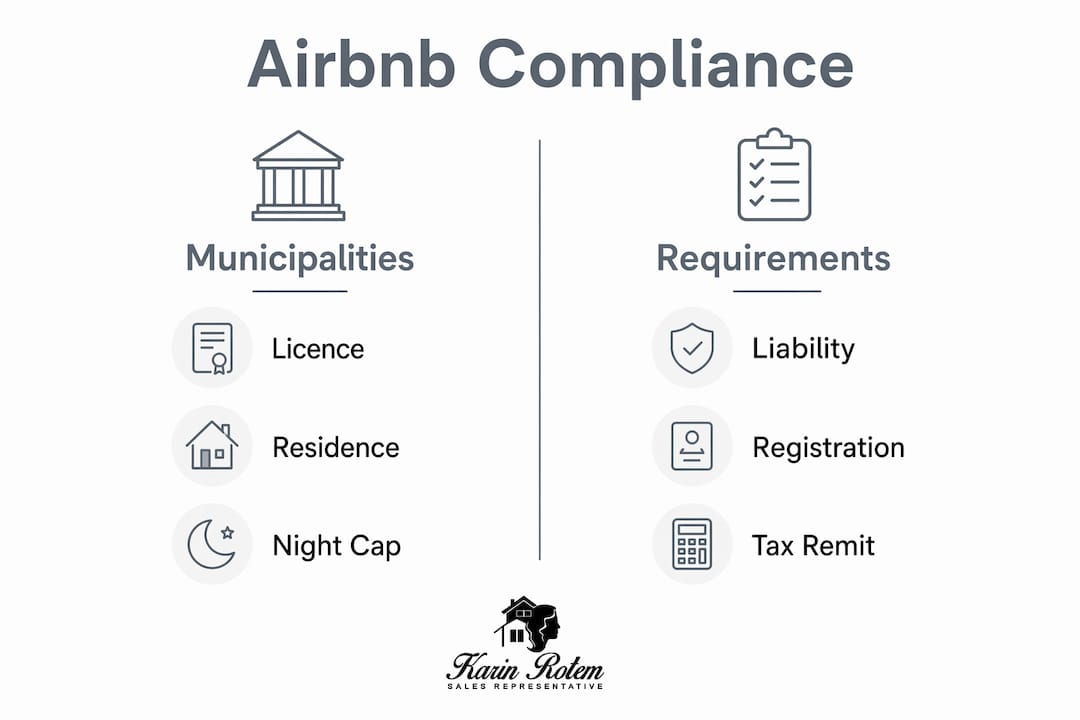
Pro Tip: Most regulated Ontario municipalities require a minimum of $2,000,000 liability insurance in liability insurance that explicitly covers short-term rental use. Standard homeowner policies almost never include this coverage, so contact your insurer before you list.
Operators must also post a physical copy of their registration information in a visible location inside the rental property for the duration of each guest’s stay. Failure to maintain any of these requirements can result in licence revocation, not just a fine.
What building and fire codes require from Ontario Airbnb hosts
Meeting the Ontario Building Code and Ontario Fire Code is not a one-time checkbox. These are ongoing obligations that inspectors verify during annual compliance reviews, and gaps can cost you your registration.
The most significant province-wide change in 2026 is the Ontario Fire Code requirement for carbon monoxide alarms in all homes, including short-term rentals. Hosts must install CO alarms near every sleeping area and on every floor of the property, even floors without bedrooms. This applies regardless of municipality.
Secondary suites have specific requirements worth understanding clearly. A secondary suite qualifies as a legal STR unit only when it is self-contained, with food preparation and sanitary facilities for the exclusive use of its occupants. A basement room that shares a kitchen with the main unit does not meet this standard. The suite must also have been constructed under a valid building permit.
Essential building and fire safety compliance points for Ontario STR hosts:
- Smoke alarms must be installed on every storey and outside every sleeping area.
- Carbon monoxide alarms are required near sleeping areas and on every floor, effective January 1, 2026.
- All bedrooms must have been built as part of the original construction or under a lawful building permit.
- Exits must be clear and accessible; emergency egress windows in basement bedrooms must meet minimum size requirements under the Building Code.
- The property must comply with the municipality’s property standards bylaw, including Chapter 629 in Toronto.
- Hosts must declare Building Code and Fire Code compliance at the time of registration and maintain it throughout the licence term.
During an annual inspection, city inspectors can require you to produce records proving principal residence status, review the physical condition of the unit, and take photographs. Obstructing an inspection is itself a bylaw offence. Brampton’s By-law 165-2021, as amended by By-law 47-2026, explicitly authorises inspectors to enter at any reasonable time to confirm compliance with the Building Code, Fire Code, and zoning bylaw.
Municipal accommodation tax: what Ontario hosts owe and when
The Municipal Accommodation Tax is a mandatory charge on top of your rental revenue, and the filing obligation exists even when you earn nothing. What most hosts do not realise is that Airbnb collecting and remitting MAT on your behalf does not eliminate your own reporting duty.
Toronto’s MAT rate is 8.5% from June 1, 2025 through July 31, 2026, temporarily increased from the standard 6%. After July 31, 2026, the rate reverts to 6%. Toronto’s rate is the highest in the GTA; most other regulated municipalities charge 4%, and Oshawa sits at 5%.
MAT filing is quarterly. Payment is due within 30 days of the end of each quarter. You must file a report for every period, including nil reports when you had no rentals.
Airbnb has signed a Voluntary Collection Agreement with the City of Toronto, which means the platform collects and remits MAT directly on your behalf for bookings made through its system. However, the legal responsibility to file a quarterly MAT report remains with you, the operator. If you had bookings through Airbnb, you still file a report but exclude the Airbnb revenue from your remittance calculation, since Airbnb reports those nights directly to the City. Bookings through other channels remain your responsibility to remit.
Failure to file or remit MAT can result in the City revoking your STR registration or denying renewal. Beyond MAT, Ontario hosts are generally responsible for 13% Harmonized Sales Tax (HST) on rental income. If you are not registered for HST, platforms like Airbnb typically collect and remit it on your behalf, but confirm this with your accountant because your specific revenue level and situation affect your obligations.
Recent legislative changes reshaping Ontario’s STR rules
Ontario’s short-term rental regulatory environment has shifted considerably since 2023, and the pace of change is accelerating. Hosts who built their plans around yesterday’s rules are finding those plans need updating.
Toronto’s By-law 503-2024, passed by City Council on May 23, 2024, introduced the most significant amendments to Chapter 547 in several years. The key changes:
- One dwelling unit per property: An operator’s principal residence is now explicitly restricted to a single dwelling unit, preventing multi-unit STR operations on one property.
- Entire-unit vs. partial-unit designation: Operators must choose one rental type at registration, and that designation is locked for the full term. An entire-unit registrant cannot pivot to partial-unit rentals mid-term.
- Platform verification: Rental platforms must verify operator registration numbers before listings go live, and must remove non-compliant listings within 24 hours of a request from Municipal Licensing and Standards.
- Conversion prevention: The bylaw explicitly targets the conversion of long-term rental units to STRs, reinforcing the housing availability goals behind the original Chapter 547 framework.
Across the broader GTA, the trend is moving rapidly toward licensing-based regulation. Burlington introduced its STR framework in May 2025. Caledon’s programme is expected to launch in spring 2026 with a $500 annual fee and a 180-night cap. Whitby is actively developing its bylaw. Ajax, Pickering, Clarington, Brock, Richmond Hill, and King Township currently have no STR-specific bylaw, but most are drafting one, and the window for unregulated operation in those municipalities is closing.
Municipalities with active prohibitions or pending frameworks to watch:
- Markham: Outright prohibition on rentals under 30 days in virtually all zones; enforcement uses fines and zoning orders.
- Halton Hills and Scugog: STRs treated as prohibited land use; mid-term rentals of 30+ nights are the only legal path.
- Whitby: Bylaw under development; status is TBD as of 2026.
- East Gwillimbury: STRs permitted only in Mixed-Use zones; residential-only properties are excluded.
On the enforcement side, municipalities are increasingly using automated listing monitoring to identify unregistered operators. Municipal fines for non-compliant STRs typically range from $500 to $5,000 per day. Niagara Falls imposes penalties of up to $50,000 for a first offence and up to $100,000 for repeat violations. Federally, the government now denies all income tax deductions for non-compliant rentals, meaning you cannot claim mortgage interest or maintenance costs if your STR is operating outside municipal rules.
What Karin Rotem’s team tells clients about navigating STR compliance
What I see most often with clients who are excited about Airbnb income is a misunderstanding of the principal residence requirement. They assume ownership is enough. It is not. Municipalities verify principal residence through a combination of government-issued ID, tax filings, utility bills, and mail records. Owning a property and renting it short-term while living elsewhere is not permitted in Toronto, Mississauga, Brampton, or most other regulated GTA cities. The verification process at annual inspections is thorough, and inspectors are specifically trained to identify gaps.
The second thing clients often miss is the condo restriction layer. Even when the municipality permits STRs, your condo corporation may prohibit them under its declaration or rules. Under Ontario’s Condominium Act, condo boards have the authority to restrict or ban short-term rentals entirely, regardless of what the city allows. Violation fines from condo corporations typically run $1,000–$5,000 per incident. Before you list a condo unit, review the status certificate, declaration, and rules carefully.
For clients considering short-term rental investment properties in Ontario, my practical advice comes down to a few core principles:
- Verify zoning before you buy. If you are purchasing a property with STR income in mind, confirm the zoning designation and principal residence requirements in that municipality before you make an offer.
- Register before you list. Operating without a registration exposes you to fines, listing removal, and loss of tax deductions. The registration process takes time; build that into your timeline.
- Keep meticulous records. Annual inspections require documentation proving principal residence status. Keep utility bills, tax documents, and government ID organised and accessible.
- Review your insurance policy. Standard homeowner policies exclude STR activity. You need a policy that explicitly covers short-term rental use, with at least $2,000,000 liability insurance in liability coverage in most regulated municipalities.
- File MAT reports every quarter. Even nil reports are mandatory. Missing a filing period is one of the fastest ways to lose your registration.
Pro Tip: If you are considering a property in an unregulated municipality like Ajax or Pickering, factor in the likelihood of regulation within the next 12–18 months. What is permissible today may require a licence and principal residence compliance by the time you are ready to list.
For clients interested in setting up an STR legally in Ontario, the municipalities with the clearest frameworks and most predictable compliance paths are Toronto, Ottawa, and Oshawa. They have detailed bylaws, established inspection processes, and clear fee structures. Smaller municipalities with no current bylaw offer more flexibility today but carry regulatory uncertainty that can affect your investment’s long-term viability.
If you are exploring waterfront properties near Toronto with STR potential, the compliance picture varies significantly by location. Innisfil, for example, operates under a different framework than Toronto, and Friday Harbour properties come with their own community rules on top of municipal requirements. Getting that local detail right before you buy is exactly the kind of guidance our team provides.
If you are ready to explore properties that align with your STR goals, browse our current listings to see what is available in Ontario’s most active markets.
Key takeaways
Ontario’s short-term rental compliance requires meeting municipal zoning, licensing, building safety, and tax obligations specific to your property’s location, with no single provincial rule covering all hosts.
| Point | Details |
|---|---|
| Principal residence is the core rule | Most regulated Ontario municipalities permit STRs only in the property where you actually live, verified through tax documents and government ID. |
| Registration must come before listing | You must register with your municipality and display your registration number on all ads before accepting any bookings. |
| Toronto’s MAT rate is 8.5% until july 31, 2026 | After that date, Toronto’s rate reverts to 6%; most other GTA cities charge 4%, and quarterly filing is mandatory even with no revenue. |
| Entire-unit rentals are capped at 180 nights | Toronto, Mississauga, Brampton, Milton, Caledon, and Oshawa all apply a 180-night annual cap on whole-home rentals. |
| Three GTA municipalities prohibit STRs outright | Markham, Halton Hills, and Scugog ban short-term rentals; mid-term rentals of 30+ nights are the only legal option in those cities. |
FAQ
What are the rules for Airbnb in Ontario?
Ontario has no single provincial Airbnb rule. Each municipality sets its own requirements under the Municipal Act, 2001 or the City of Toronto Act, 2006, covering zoning eligibility, operator registration, building and fire code compliance, and Municipal Accommodation Tax remittance.
Do you need a licence to run an Airbnb in Ontario?
Yes, in most major Ontario cities. Toronto, Ottawa, Mississauga, Brampton, Vaughan, Oakville, Burlington, Oshawa, and Niagara Falls all require a municipal licence or registration before you can legally list or operate a short-term rental.
How do I know if Airbnb is allowed in my area?
Check your municipality’s zoning bylaw to confirm your property’s zone permits short-term rental use, then review whether your city has an STR licensing programme. Markham, Halton Hills, and Scugog currently prohibit STRs outright, while several Durham Region municipalities have no STR-specific bylaw yet.
What is the 80/20 rule for Airbnb?
The 80/20 rule is not a recognised standard in Ontario’s STR regulatory framework. Ontario municipalities regulate short-term rentals through principal residence requirements, night caps, and licensing bylaws rather than any 80/20 formula.
What happens if I operate an Airbnb without registering in Ontario?
Municipal fines for unregistered STR operation typically range from $500 to $5,000 per day, with some cities like Niagara Falls imposing penalties up to $100,000 for repeat violations. Platforms must also remove listings that lack a valid registration number within 24 hours of a municipal request, and the federal government denies income tax deductions for non-compliant rentals.