
What is an international wire transfer in Canadian real estate?
An international wire transfer is an electronic instruction that moves funds across borders between financial institutions, and for Canadian real estate, it is the standard method for completing large cross-border payments. When a buyer in Hong Kong purchases a condo at Friday Harbour, or a family in the UK sends a down payment for a Toronto property, the money travels through a structured chain of banks before landing in a Canadian trust account.
The process relies on the SWIFT network (Society for Worldwide Interbank Financial Telecommunication), which acts as the global messaging backbone connecting thousands of banks. SWIFT MT-103 messages are the specific format used for single customer credit transfers, and they carry all the payment instructions from the sending bank to the receiving institution.
Three pillars shape every international wire in a Canadian real estate context:
- Canadian banks act as either the receiving institution or an intermediary, and they are bound by federal anti-money laundering rules.
- The SWIFT network routes the payment instructions securely between institutions across different countries.
- FINTRAC (the Financial Transactions and Reports Analysis Centre of Canada) monitors these flows under the Proceeds of Crime (Money Laundering) and Terrorist Financing Act (PCMLTFA).
What I tell my clients is that the wire itself is not complicated. What trips people up is the compliance layer sitting around it.
Who does what, and how does the money actually move?
Understanding the real estate wire transfer process means knowing who touches the funds at each stage. There are more hands involved than most buyers expect.
Key parties:
- Sender (buyer or their bank abroad): Initiates the transfer by providing payment instructions to their home bank.
- Sending bank: Executes the SWIFT message and debits the sender’s account.
- Intermediary (correspondent) bank: Routes the funds when the sending and receiving banks have no direct relationship. There can be more than one.
- Receiving Canadian bank or trust account: The buyer’s lawyer or notary typically holds funds in a trust account until closing conditions are met.
- FINTRAC: Receives mandatory reports from Canadian financial institutions on qualifying transfers.
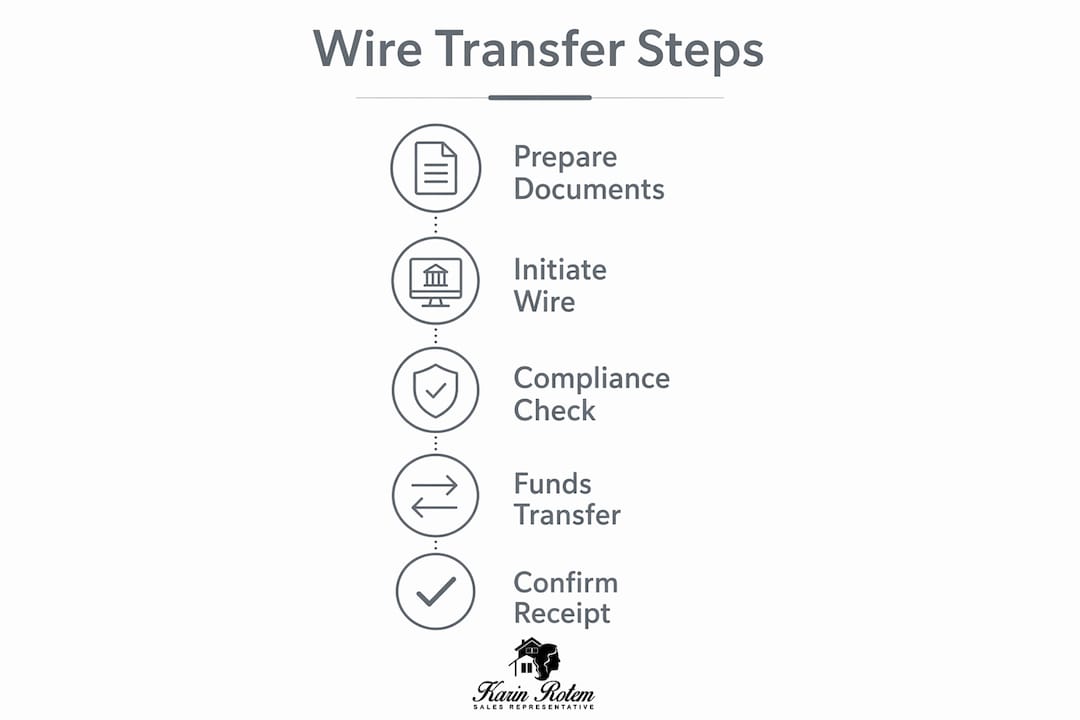
Step-by-step flow:
- The buyer instructs their bank to initiate an international electronic funds transfer, providing the recipient’s full banking details.
- The sending bank transmits a SWIFT MT-103 message, debiting the sender’s account.
- One or more correspondent banks relay the funds, each potentially deducting a handling fee.
- The Canadian receiving bank accepts the final transfer and notifies the recipient, usually the buyer’s real estate lawyer.
- The lawyer verifies the funds, confirms source-of-funds documentation, and holds the money in trust until the closing date.
- On closing day, the lawyer releases funds to the seller’s lawyer, and title transfers.
Real estate wires differ from ordinary international transfers in one critical way: the receiving party is almost always a lawyer’s trust account, not a personal bank account. That adds a verification step that general consumer transfers skip entirely.

How long does it take, and what will it cost you?
Traditional bank wire transfers take 3–5 business days or longer for international real estate funds. Delays happen when correspondent banks require additional compliance checks, when documentation is incomplete, or when the transfer crosses multiple time zones and banking holidays.
Typical fee structure:
- Sending bank fee: A flat charge from the originating institution, which varies by bank and country.
- Correspondent bank fees: Each intermediary bank in the chain may deduct a handling fee before passing the funds along.
- Receiving bank fee: The Canadian bank accepting the wire may charge an incoming wire fee.
- Currency exchange markup: This is often the largest hidden cost. Banks rarely offer the mid-market rate; the spread between the rate they quote and the true market rate can represent a meaningful percentage of the total transfer on large sums.
What most buyers don’t realise: Currency exchange markups can significantly increase the cost of transferring large amounts for real estate purchases. Specialised transfer platforms that offer mid-market rates and transparent fees can reduce that cost substantially compared to traditional banks. Understanding hidden real estate fees before you wire is worth the time.
Currency fluctuations add another layer of uncertainty. If you lock in a rate on the day you sign a purchase agreement but the wire takes five business days to arrive, the exchange rate may have shifted. For large transactions, forward contracts through a licensed foreign exchange provider can lock in a rate in advance, protecting you from adverse moves. For a full breakdown of managing currency costs alongside your purchase, the currency exchange guide for Canadian real estate covers the practical steps.

What information and documents do you need to send a wire?
Getting the paperwork right before you initiate the transfer saves weeks of frustration. Canadian banks review source-of-funds documentation extensively for large real estate deposits, and funds may be frozen or returned if documentation is insufficient, causing delays of 30 days or more.
Banking details required for the wire:
- Full legal name of the recipient (lawyer or notary trust account)
- Recipient bank name, address, and SWIFT/BIC code
- Account number or IBAN
- Routing or transit number for the Canadian bank
- Purpose of payment (real estate purchase, deposit, etc.)
Source-of-funds documents your Canadian bank or lawyer will request:
- Signed purchase and sale agreement
- Bank statements showing the funds in your account (typically 3–6 months)
- Foreign sale contracts if proceeds come from selling property abroad
- Salary records or proof of income if funds accumulated over time
- Gift letters with supporting bank statements if any portion is a gift from a family member
Documents must be in English or French. If your originals are in another language, you will need certified translations. The amounts, names, and dates across all documents must match the wire exactly. A mismatch between the wire receipt and the bank statement is one of the most common reasons funds get held.
Canadian regulatory requirements: FINTRAC, AML, and what they mean for your closing
Canada imposes no legal cap on incoming legitimate funds for real estate purchases, but the compliance framework around those funds is detailed. Financial institutions must report international electronic funds transfers of CAD $10,000 or more to FINTRAC, including aggregated related transfers within a static 24-hour window.
What the regulatory framework covers:
- FINTRAC reporting: Automatic, mandatory, and handled by the bank. It is a crime-monitoring tool, not a tax trigger. Receiving a large wire does not mean you owe more tax; it means the transfer is logged.
- AML verification: Canadian banks must verify the source of funds for large real estate deposits. They are not doing this to inconvenience you; they are legally required to under the PCMLTFA.
- Anti-structuring rules: Splitting a transfer into amounts under $10,000 to avoid reporting is illegal. FINTRAC aggregates transactions within 24 hours, and structuring is a criminal offence carrying severe penalties.
- Legal professionals as compliance gatekeepers: Real estate lawyers and notaries conduct their own anti-money laundering due diligence and must verify proof of funds before releasing money at closing. Their role is not optional; it is mandated under FINTRAC’s rules for legal professionals.
- T1135 filing: If you hold specified foreign property valued over CAD $100,000, you must file Form T1135 with the CRA. This is separate from FINTRAC reporting and applies to income-producing foreign properties, not personal-use homes.
Pro Tip: Prepare your source-of-funds package at least 60 days before your closing date. Gathering foreign bank statements, certified translations, and sale contracts takes longer than most buyers anticipate, and a missing document can freeze funds at the worst possible moment.
For a deeper look at how AML obligations affect your transaction, the anti-money laundering guide for Canadian real estate walks through each requirement in plain language.
Practical tips that actually make a difference
The mechanics of a wire transfer are straightforward. The execution is where things go wrong. Here is what I tell every international buyer before they send a dollar.
- Plan for capital controls in your home country. Canada imposes no outbound limit on incoming funds, but your home country may. China, for example, has annual individual quotas on outbound capital. Planning transfers in batches over multiple calendar years, or using multiple family members’ allowances, is standard practice for buyers from jurisdictions with these restrictions.
- Verify beneficiary details through a second channel. Before wiring any amount, call your lawyer’s office directly using a phone number from their official website to confirm the trust account details. Wire fraud in real estate often involves intercepted emails with altered account numbers.
- Use regulated, traceable channels only. Underground or informal remittance systems (sometimes called “fei-ch’ien” or hawala networks) leave no paper trail. Informal remittance channels risk irreversible fund loss, denied mortgage approval, and regulatory investigation.
- Keep all documents consistent. The name on the wire must match the name on the purchase agreement, which must match the name on your bank statements. Any discrepancy triggers a hold.
- Engage your lawyer early. Your real estate lawyer needs to know funds are coming from abroad well before closing. They will give you the trust account details and advise on what documentation they need.
- Handle gifted down payments with extra lead time. Lenders enforce a 90-day seasoning rule on gifted down payments. Arranging gift documentation 95–100 days before closing reduces the risk of a last-minute funding delay.
Pro Tip: Send a small test wire of a nominal amount first if your bank allows it, then confirm receipt with your lawyer before sending the full balance. This confirms the account details are correct and the routing path is working.
Buying vs. selling: how the wire transfer process differs
The direction of the transfer changes your responsibilities significantly, and most guides treat buying and selling as the same process. They are not.
When you are buying:
You are the sender. Your job is to initiate the wire with accurate beneficiary details, provide source-of-funds documentation to your bank and your lawyer, and time the arrival so funds clear before the closing date. The risk of delay sits with you. If the wire arrives late, you may be in breach of the purchase agreement.
When you are selling:
You are the recipient. Your lawyer receives the funds in trust and, after confirming all closing conditions are met, releases the net proceeds to you. If you are a non-resident seller, the Canadian government requires your lawyer to withhold a portion of the sale price under the Income Tax Act until you obtain a clearance certificate from the CRA. That withholding can be 25% of the gross sale price for non-residents, which is a significant cash-flow consideration if you are planning to repatriate funds immediately after closing.
Sellers also need to plan for the outbound wire from Canada to their home country, which triggers its own FINTRAC reporting on the Canadian side and may trigger reporting obligations in the destination country as well. For non-residents navigating the full purchase and sale cycle, the non-resident property purchase guide for Ontario covers the tax and compliance steps in detail.
Risks and common issues in international real estate wire transfers
Wire fraud is the most serious risk, and it is more common in real estate than in almost any other transaction type. Criminals intercept email communications between buyers and their lawyers, substitute fraudulent account numbers, and disappear with the funds before anyone notices. The money is rarely recovered.
Beyond fraud, the most frequent issues are:
- Frozen funds: Incomplete or mismatched source-of-funds documentation causes banks to place holds. A 30-day freeze on a $400,000 wire days before closing is a genuine crisis.
- Correspondent bank deductions: Funds arrive short because an intermediary bank deducted its fee mid-chain. Always wire slightly more than the required amount, or confirm with your lawyer how to handle a shortfall.
- Exchange rate losses: Sending funds without a locked rate exposes you to market movement between initiation and receipt.
- Missed closing deadlines: A wire that takes longer than expected due to compliance checks or banking holidays can push a closing date, triggering penalties under the purchase agreement.
- Structuring investigations: Buyers who split transfers to stay under the $10,000 reporting threshold face criminal investigation, not just a fine.
What most buyers don’t realise is that the biggest risks are administrative, not technical. The SWIFT network is reliable. The documentation process is where transactions fall apart. Working with a lawyer who handles international transactions regularly, and a realtor who understands the full funding picture, makes a material difference. If you are considering Friday Harbour real estate or another waterfront property in Ontario, connecting with a team that has guided international buyers through this process is the clearest path to a smooth closing.
Key takeaways
International wire transfers for Canadian real estate require FINTRAC-compliant documentation, accurate banking details, and early planning to avoid frozen funds or missed closing deadlines.
| Point | Details |
|---|---|
| FINTRAC reporting threshold | Transfers of CAD $10,000 or more are automatically reported by Canadian financial institutions to FINTRAC; this is compliance monitoring, not a tax assessment. |
| Transfer timeline | Traditional bank wires take 3–5 business days or longer; incomplete documentation can extend delays to 30 days or more. |
| Source-of-funds documents | Sale contracts, bank statements, salary records, and gift letters must match wire amounts, names, and dates exactly. |
| Anti-structuring rule | Splitting transfers to stay under $10,000 is a criminal offence; FINTRAC aggregates related transactions within a 24-hour window. |
| Gifted down payments | Lenders apply a 90-day seasoning rule; arrange gift documentation 95–100 days before closing to avoid funding delays. |
FAQ
What happens if you wire transfer more than $10,000 to Canada?
Canadian financial institutions automatically report wire transfers of CAD $10,000 or more to FINTRAC as required under the PCMLTFA. This is a routine compliance procedure for crime monitoring and does not affect your ability to complete the real estate purchase, provided your source-of-funds documentation is in order.
Are wire transfers over $10,000 reported to the CRA?
FINTRAC reporting and CRA tax reporting are separate obligations. A wire transfer report goes to FINTRAC for crime-monitoring purposes; it does not automatically trigger a CRA assessment, though you remain responsible for reporting any taxable income or gains from the transaction on your tax return.
How long does a large international wire transfer take for a real estate closing?
Traditional bank wires typically take 3–5 business days for international transfers. If documentation is incomplete or compliance checks are triggered, delays of 30 days or more are possible, which is why sending funds well ahead of the closing date is standard practice.
What are the rules for international wire transfers in Canadian real estate?
Transfers must go through regulated financial institutions, source-of-funds documentation must be provided in English or French with certified translations if needed, and splitting transfers to avoid the $10,000 reporting threshold is illegal. Non-resident sellers also face a withholding requirement under the Income Tax Act until a CRA clearance certificate is obtained.