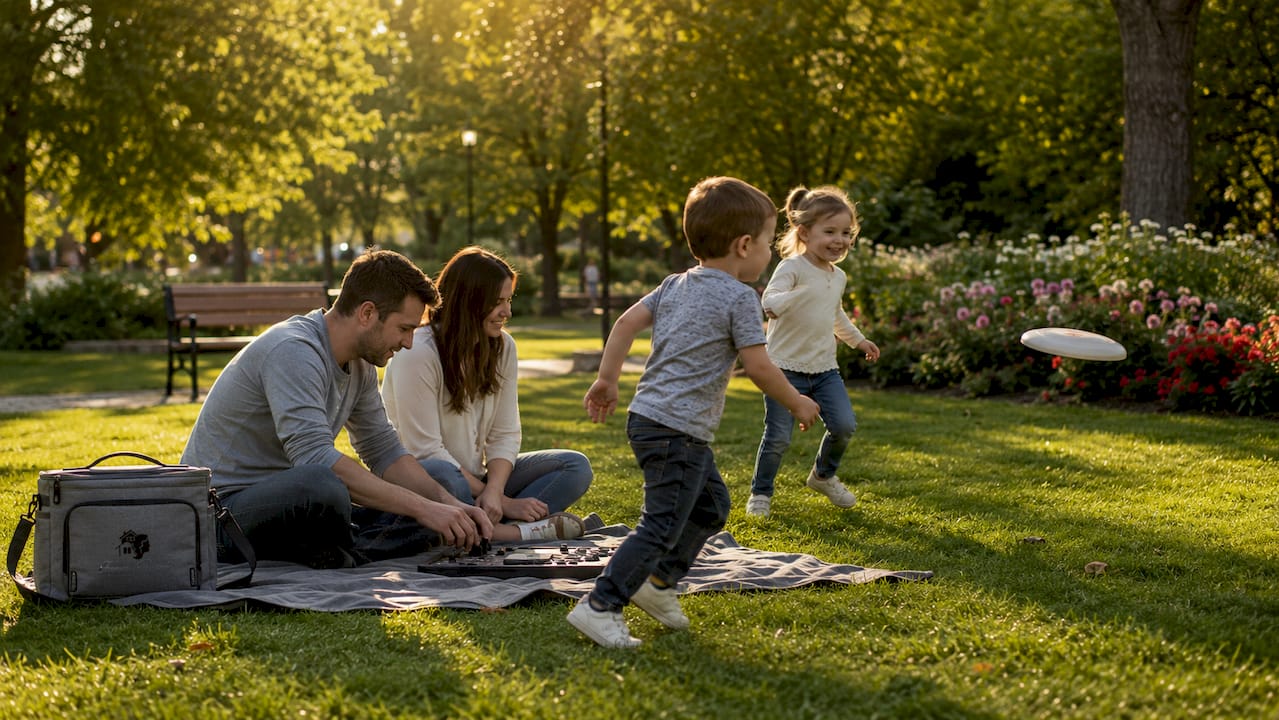
Green space is one of the most consistent predictors of where families choose to move and how satisfied they remain after the move. Peer-reviewed research, Statistics Canada analysis, and transaction experience across the Toronto–Innisfil corridor all point to the same conclusion: proximity to functional, visible green space influences relocation intentions, and private or semi-private outdoor areas reduce the likelihood that families will want to move again. The role of green space in family relocation is not a soft lifestyle preference. It is a measurable driver of long-term housing satisfaction.
Here is what that means for a family deciding where to move right now:
- Private yards and semi-private courtyards reduce early-stage moving intentions more reliably than proximity to large public parks alone.
- Proximity and daily access matter more than a neighbourhood’s overall greenness score. A park you walk past every day outweighs a conservation area you visit twice a year.
- Life stage shapes the equation. Families with young children weight private yards and walkable play areas heavily; teens and multigenerational households prioritise different features.
- Shared communal courtyards in condos and townhouses can substitute for private yards, but only when governance, maintenance, and access rules support regular family use.
Pro Tip: When you’re shortlisting properties, prioritise daily-use access — a small private yard or a park within a five-minute walk — over a large conservation area that requires a drive. Families who use green space daily report higher satisfaction than those who live near impressive but inconvenient parks.
What research and national data say about green space and family relocations
The evidence connecting green space to relocation behaviour is stronger than most buyers realise, and it holds across Canadian urban and suburban contexts.
| Finding | Key detail | Source |
|---|---|---|
| Life satisfaction and green access | Statistics Canada finds green access is positively and significantly associated with life satisfaction, with the effect strongest among higher-income households who can prioritise private outdoor spaces | Statistics Canada |
| Proximity outranks overall greenness | Urban Natures Lab research in Vancouver and Calgary shows proximity to green space ranked as the most important location factor for many respondents, outranking overall neighbourhood greenness | Urban Natures Lab |
| Private and semi-private spaces reduce relocation intent | Longitudinal research presented at EPC 2024 shows private gardens and semi-private joint yards reduce the probability that families will consider moving, with the effect strongest at the earliest decision stages | EPC 2024 |
| Eye-level tree visibility predicts satisfaction | Research linking the Viewshed Greenness Visibility Index (VGVI) to resident satisfaction found VGVI had a stronger association with satisfaction than top-down greenness metrics like NDVI | npj Urban Sustainability |
| Toronto-specific confirmation | A conjoint survey experiment in Toronto’s inner suburbs found parks and green space are reliably attractive location attributes across income groups | ResearchGate |
A few important caveats apply. Most of these studies are observational, meaning they identify associations rather than proven cause-and-effect. Results also vary by urban versus suburban context, income level, and local amenity mix. The Statistics Canada finding, for instance, shows a stronger green-space-to-satisfaction link among higher-income families, partly because those households can afford properties with private outdoor space as a substitute for public parks.
For a Canadian family choosing a home, the practical interpretation is this: focus your search on proximate, functional green space rather than broad neighbourhood greenness. Test your actual walking routes to nearby parks during a viewing, not just the map distance. And treat private or semi-private outdoor space as a long-term stability asset, not just a lifestyle bonus.
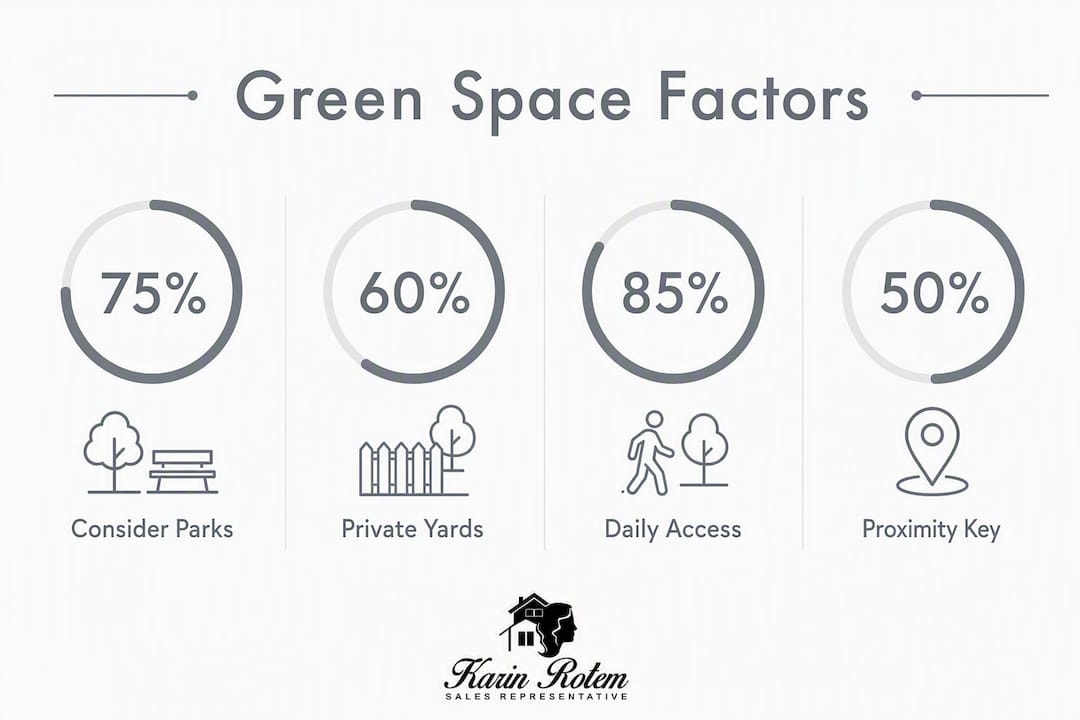
Statistic callout: Survey work in Calgary and Vancouver found proximity to green space was an important location factor for many respondents, with private green space rated particularly important in suburban contexts.
How green space actually shapes family choices and wellbeing
Understanding the mechanisms behind the evidence helps you evaluate properties more precisely. Green space does not improve family wellbeing through one single pathway. It works through several overlapping channels, and each one points to a different feature you should check during a viewing.
The main pathways:
- Daily play and exercise access. Children with a private yard or a park within walking distance accumulate more unstructured outdoor time. That matters for physical development, attention, and sleep quality.
- Psychological restoration. Research on VGVI shows that visual contact with trees from inside the home, not just proximity to a park, correlates with resident satisfaction. What you see from your kitchen window matters.
- Child socialisation. Shared green spaces, whether a cul-de-sac, a communal courtyard, or a neighbourhood park, create informal play opportunities that build friendships and social confidence in children.
- Social cohesion for parents. Adults who use shared outdoor spaces regularly report stronger neighbour relationships. For a family new to a community, this is one of the fastest routes to feeling settled.
- Environmental benefits. Tree canopy reduces local temperatures, improves air quality, and reduces stormwater runoff. These are not abstract benefits; they affect how comfortable your outdoor space is in July and how much your heating and cooling costs.
The type of green space determines which of these pathways is active. Private yards support regular, unsupervised play for young children and give parents the flexibility to be outside without coordinating with neighbours. Public parks support organised activity, larger social networks, and seasonal programming. Semi-private courtyards sit in between: they offer social contact without the maintenance burden of a private yard, but their value depends entirely on how well they are managed and whether the governance rules actually allow children to use them freely.
Life-stage differences are real. A family with a preschooler needs a safe, enclosed outdoor space within steps of the front door. A family with teenagers needs proximity to trails, courts, and social gathering points. A multigenerational household may prioritise accessible pathways and seating as much as play equipment. None of these needs is served by the same property.
Pro Tip: During a viewing, stand at the main living area windows and assess what you actually see. Then walk the real route to the nearest park, not the map route. Look for evidence of everyday use: worn grass paths, bike racks, benches with sun exposure. A park that people actually use daily is worth far more than one that looks impressive on a satellite image.

How to evaluate green space when you’re house-hunting in Canada
A structured approach to green-space evaluation saves time and prevents the common mistake of falling for a property’s overall feel without checking the outdoor specifics that will matter in year three.
Before you search
- Define your green-space minimum: private yard, semi-private courtyard, or walkable public park within a specific distance.
- Use municipal park maps and city open-data portals to identify park locations and planned improvements in your target neighbourhoods.
- Run a walkability check using tools like Walk Score to estimate real pedestrian access, then verify it with street-level imagery.
- Filter listing keywords: “private yard,” “fenced backyard,” “rooftop terrace,” “common courtyard,” and “park-facing” all signal different green-space types.
During viewings
- Sightlines from living areas. Stand at the main windows. Can you see trees, sky, or green space? Eye-level visibility, the kind captured by VGVI-style assessments, correlates with daily satisfaction more than map proximity.
- Walk the real route to the nearest park. Time it. Check the sidewalk condition, crossing safety, and whether the route is realistic with a stroller or a bike.
- Assess private outdoor space. Measure or estimate the usable area. Check orientation (south-facing yards get more sun), drainage (low spots that pool water), and whether mature trees provide shade without creating root or maintenance problems.
- Safety and visibility. Is the outdoor space visible from inside the home? Can you supervise children from the kitchen or living room?
- Maintenance evidence. Look for signs of consistent upkeep: trimmed edges, cleared paths, functioning irrigation, and healthy grass. Neglect is a signal of future costs.
- Seasonal usability. In Canada, this means asking whether paths and park access routes are municipally snow-cleared in winter, whether there is adequate shade for summer use, and whether the space is usable in shoulder seasons.
- Allergen considerations. High-pollen trees (birch, oak, ragweed-adjacent plantings) close to the home can affect family members with allergies. Note species if you can.
Questions to ask sellers and condo boards
- Are there restrictions on how the private yard or common outdoor space can be altered or used?
- What is the landscaping maintenance schedule and who is responsible?
- For condos: what is the annual landscaping budget in the reserve fund, and when was the last major outdoor renovation?
- Is there any scheduled development nearby that could affect park access or canopy cover?
Post-offer due diligence
Check the municipal parks master plan for your target area. Many Canadian cities publish these online and they reveal planned park improvements, closures, or nearby development proposals that could change your green access within five years.
Pro Tip: When a property has a genuinely attractive green amenity — a mature treed yard, a park-facing unit, a south-facing courtyard — translate that into resale terms before you decide how much to pay for it. Properties with visible, well-maintained private outdoor space consistently photograph better and attract stronger buyer interest. That is not just lifestyle value; it is a resale signal worth factoring into your offer.
Trade-offs families often face: green space versus price, location, and housing type
Green space rarely comes free of trade-offs. What I tell my clients is that the goal is not to maximise green space in isolation — it is to find the right balance for your family’s specific life stage and budget.
The most common trade-offs:
- Private yard versus price. Detached homes with usable yards command a premium in most Canadian urban and suburban markets. That premium reflects genuine demand: survey research in Vancouver and Calgary consistently places proximity to green space among the top location factors for buyers. Whether that premium is worth it depends on how intensively your family will use the space.
- Park proximity versus commute. Neighbourhoods with large, high-quality parks are often farther from employment centres. A family that gains a park but adds 40 minutes to a daily commute may find the net wellbeing effect is negative.
- Condo common yards versus maintenance. Shared outdoor spaces eliminate the burden of private yard maintenance, but they come with strata fees, usage rules, and governance risk. A beautifully designed courtyard that restricts children’s hours or prohibits ball play is not a functional substitute for a private yard with a young family.
- Suburban private space versus urban public access. Suburban properties often offer larger private yards but fewer walkable public parks. Urban properties may offer the reverse. Neither is objectively better; the right answer depends on your children’s ages and your family’s daily patterns.
Hidden costs families often overlook:
- Lawn care, irrigation, and garden maintenance for private yards (time and money).
- Strata fees that include landscaping for common areas, which can increase over time.
- Liability and safety upgrades: fencing, pool enclosures, or play equipment that meets current safety standards.
- Seasonal usability gaps: a beautiful yard that is unusable for five months of the year in northern Ontario changes the value calculation significantly.
Decision rules worth applying: Pay a premium for a private yard when your children are under 12 and you will use it daily. Prefer a well-governed condo with high-quality shared outdoor space when maintenance burden is a constraint. Plan for life-stage changes: a yard that suits a five-year-old may feel like a burden when that child is 17 and you are considering downsizing.
What to check by housing type before you make an offer
Green-space evaluation is not one-size-fits-all. The questions you ask and the features you prioritise shift significantly depending on the property type.
Detached homes
Assess private yard size and orientation before anything else. A south-facing yard in Canada gets usable sun from March through October; a north-facing yard behind a two-storey home may be in shade for most of the day. Check drainage carefully, particularly in spring. Mature trees add canopy value and visual satisfaction, but they also bring maintenance costs and potential root interference with foundations or drainage systems. Ask whether the yard can be partitioned for a play area without losing the garden or patio space.
Townhouses and rowhouses
Semi-private fenced yards in townhouse developments vary enormously in size and usability. Measure the actual square footage and check whether the fence height provides genuine privacy. Rooftop terraces and rear patios can substitute for ground-level yards, but assess structural load limits if you plan to add planters, furniture, or a play structure. The supervision trade-off is real: a rear yard that requires walking through the home to access is less practical for daily child supervision than a yard visible from the kitchen.
Low-rise and high-rise condos
Functional access to child-friendly common outdoor spaces is the deciding factor for condo families. Examine the courtyard or rooftop garden during a viewing, not just in listing photos. Check balcony depth: a balcony under 1.5 metres is rarely usable for anything beyond a chair and a plant. Assess sightlines from the unit to any common outdoor area. Review the condo’s governance documents for rules on children’s use of outdoor spaces, hours of access, and noise restrictions. For luxury condo amenities in Ontario, the quality of shared outdoor programming, including family-focused events and maintained play areas, is often the differentiator between buildings that hold their value and those that don’t.
Pro Tip: When reviewing strata documents, go directly to the landscaping line in the reserve fund study. A building that has deferred outdoor maintenance for several years is carrying a future special assessment risk. Also check the rules section for any language restricting children’s use of common outdoor areas — this is the clause most buyers skip and most regret.
Where to find green-space data and municipal resources across Canada
Before you finalise a neighbourhood shortlist, verify the green-space claims in any listing against public data. Here is where to look:
- Statistics Canada neighbourhood profiles. The Statistics Canada quality-of-life infographic series includes data on local environment satisfaction and green access by metropolitan area. Use it to compare neighbourhoods at a macro level.
- Municipal parks maps and master plans. Most Canadian cities publish interactive park maps and multi-year parks master plans online. These reveal planned improvements, closures, and development proposals that could affect your access within five to ten years.
- City open-data portals. Toronto, Ottawa, Calgary, and Vancouver all publish canopy cover layers and park boundary data as open datasets. These let you verify a listing’s proximity claims with actual spatial data rather than estimated map distances.
- Conservation authority websites. If a property is near a conservation area, the local conservation authority’s site will show trail access, seasonal closures, and any planned changes to public access.
- Municipal snow-clearing schedules. In Canada, winter usability is a real consideration. Check whether the municipality clears the paths and park access routes adjacent to your target property. Some municipalities clear only primary trails; secondary paths and park interiors may not be maintained until spring.
When a listing claims “steps to the park” or “surrounded by greenery,” treat it as a starting point, not a fact. Cross-reference with the city’s open-data portal and walk the route yourself before submitting an offer.
What I tell my clients when green space matters: local agent guidance and negotiation tips
What most buyers don’t realise is that green space influences the transaction, not just the lifestyle. In the Toronto–Innisfil corridor, properties with private outdoor space, mature trees, and park-facing orientations consistently attract stronger buyer interest and photograph better for listings. At Friday Harbour, where waterfront and nature access are central to the community’s appeal, outdoor amenity quality is one of the first things families ask about and one of the last things they are willing to compromise on.
Here is how I advise clients to use green space in the negotiation:
- Request landscaping credits when a private yard or common outdoor area shows deferred maintenance. A neglected yard is a legitimate condition item, and a credit toward professional landscaping is a reasonable ask.
- Time viewings for the outdoor season. Scheduling a second viewing in May or June, when trees are leafed out and the yard is in active use, gives you a far more accurate picture of what you are buying than a February walkthrough.
- Ask for strata or board minutes that reference outdoor maintenance, landscaping contracts, or complaints about common outdoor areas. These minutes often reveal governance issues that the listing does not disclose.
- Check planned development nearby. A park-facing unit loses much of its value if a mid-rise is approved for the adjacent lot. Municipal planning portals show active development applications.
Documents to request from sellers and condo boards:
- Landscaping service contracts and maintenance schedules.
- Reserve fund study with the landscaping and outdoor infrastructure line items.
- Any board minutes referencing outdoor area disputes, restrictions, or planned renovations.
- Permit history for any structures in the private yard (decks, sheds, fences).
Pro Tip: Well-maintained trees and a private outdoor space are among the strongest visual signals in listing photography. When I’m advising sellers, I always recommend professional landscaping before listing — it consistently improves buyer perception and supports a stronger offer price. If you’re buying, use the same logic in reverse: a yard that photographs well is a yard that will sell well when it’s your turn.
Key takeaways
Proximity to functional, visible green space is the single most reliable green-space predictor of long-term housing satisfaction for Canadian families.
| Point | Details |
|---|---|
| Prioritise proximate, functional green space | A park within walking distance used daily outweighs a large conservation area that requires a drive. |
| Evaluate visibility and walking routes | Eye-level tree visibility (VGVI) predicts satisfaction better than top-down greenness metrics; walk the real route during viewings. |
| Account for hidden costs | Private yards carry maintenance costs; condo common areas carry strata fees and governance risk that affect long-term usability. |
| Check governance and maintenance documents | Reserve fund landscaping lines, board minutes, and usage rules reveal risks that listing photos never show. |
| Plan for life-stage changes | Green-space needs shift as children age; a yard suited to a five-year-old may not serve a teenager or an ageing parent. |
| Work with Karinrotem for a targeted search | Karinrotem’s team filters searches by outdoor amenity type and negotiates green-space conditions in the Toronto–Innisfil corridor. |
When green space is non-negotiable and when it isn’t
What I tell my clients is that green space becomes non-negotiable the moment you have children under 12 or a household member whose daily wellbeing depends on regular outdoor access. In those situations, compromising on green space to save money or gain square footage almost always produces regret within two years. The research supports this: private and semi-private outdoor spaces reduce early-stage moving intentions precisely because they meet a daily need that cannot easily be substituted.
What most buyers don’t realise is that the trade-off calculus shifts significantly once children are older or when a household is downsizing. At that stage, proximity to a well-maintained public park or a high-quality condo courtyard can fully substitute for a private yard, and the maintenance savings are genuine. The mistake is applying the same green-space standard to every life stage.
In the Toronto–Innisfil corridor, my practical advice is this: if resale is part of your strategy, always choose visible, well-maintained outdoor space over hidden or hard-to-photograph green access. A south-facing yard with mature trees sells. A unit that backs onto a park but has no private outdoor space sells less predictably. Align your green-space priorities with your resale timeline, not just your current lifestyle.
How my team helps families searching for green-space-focused properties
Families who know they want green space as part of their next home often struggle to translate that priority into a focused, efficient property search. Karinrotem’s team does exactly that: we filter searches by outdoor amenity type, whether that is a private fenced yard, a park-facing unit, or a community with managed common green space, and we schedule viewings to include outdoor inspection time, not just interior walkthroughs.
For families considering the Toronto–Innisfil corridor, including Friday Harbour’s waterfront community, we bring direct knowledge of which developments prioritise outdoor living, which condo boards maintain their common spaces well, and where the best family-friendly green access is concentrated. We also handle the due-diligence side: reviewing strata documents for landscaping budgets, flagging nearby development applications, and negotiating conditions that protect your outdoor amenity expectations.
If you are ready to start a search that puts green space at the centre, browse our current listings or reach out directly to discuss what your family needs from its next home.
Sources and further reading
The following sources were used in this article and are recommended for further research before finalising a neighbourhood or property decision:
- Statistics Canada: Metropolitan areas, green space and life satisfaction — national analysis linking green access to life satisfaction, with income interaction findings.
- Statistics Canada: Local Environments Lift Life Satisfaction (infographic) — accessible summary of how local environment quality, including green access, relates to reported life satisfaction.
- Statistics Canada: Ethnocultural and socioeconomic disparities in residential greenness — analysis of how greenness exposure varies across Canadian urban populations.
- Urban Natures Lab: Relative importance of greening in Vancouver and Calgary — proximity versus overall greenness findings in Canadian suburban and urban samples.
- EPC 2024: Private, semi-private and neighbourhood green spaces in residential relocations — longitudinal research on how green space type affects relocation intentions across life stages.
- npj Urban Sustainability: VGVI, tree canopy cover and resident satisfaction — evidence that eye-level tree visibility predicts satisfaction better than top-down greenness indices.
- ResearchGate: Residential preferences and neighbourhood satisfaction in Toronto’s inner suburbs — conjoint experiment confirming green space as a reliable location attribute in Toronto.
- Practitioner research: Small private outdoor spaces and ageing in place — analysis of how small yards and balconies influence buyer appeal and long-term housing decisions.
- Urban greening and child-friendly green spaces — research on functional utility and child-friendly design in urban green spaces.
Before finalising any offer, check your target municipality’s parks master plan and request strata or seller documents that directly address landscaping budgets, maintenance schedules, and outdoor usage rules.
FAQ
Does green space actually affect where families choose to move?
Yes. Research across Canadian cities shows proximity to green space ranks among the most important location factors for many buyers, and private or semi-private outdoor spaces reduce the likelihood that families will consider moving again.
Is a private yard more valuable than proximity to a public park?
For families with young children, private yards and semi-private courtyards tend to reduce relocation intentions more reliably than public park proximity alone, because they support daily, unsupervised outdoor access. Public parks become more valuable as children age and need social and recreational space beyond the home.
How do I check green-space quality before making an offer in Canada?
Use your municipality’s open-data portal and parks master plan to verify proximity claims, then walk the real route to the nearest park during a viewing. Review strata documents for landscaping budgets and usage rules, and check municipal planning portals for nearby development applications that could affect green access.
Does green space affect property resale value in Ontario?
Properties with visible, well-maintained private outdoor space and park-facing orientations consistently attract stronger buyer interest and photograph better for listings. In lifestyle-driven communities like Friday Harbour, outdoor amenity quality is one of the primary factors families cite when deciding to buy.
How can Karinrotem help with a green-space-focused property search?
Karinrotem’s team filters searches by outdoor amenity type, schedules viewings to include outdoor inspection time, and reviews strata and seller documents for landscaping budgets and usage rules across the Toronto–Innisfil corridor.