Yes, riparian rights attach to most Ontario properties bordering a natural watercourse, but they’re use rights, not ownership of the water or the lakebed. The two biggest limits: the Crown typically owns the bed under the Beds of Navigable Waters Act, and any shoreline work usually needs sign-off from your Conservation Authority, municipality, or occasionally the Department of Fisheries and Oceans (DFO). Before you build a dock or make an offer, check your deed, order a survey, and call the local Conservation Authority in Paso Robles.
Key Takeaways
Riparian rights in Ontario grant waterfront owners use and access to water, but the Crown typically owns the bed and multiple authorities regulate what you can build.
| Point | Details |
|---|---|
| Rights attach to land, not water | Riparian rights transfer automatically with a sale and cover access, drainage, flow, quality, and accretion. |
| Crown usually owns the bed | Under the Beds of Navigable Waters Act, title rarely extends past the shoreline without an express grant. |
| Confirm before you assume | A survey, title search, and check for shore road allowances reveal what a property actually includes. |
| Permits stack up fast | Conservation Authorities, municipalities, and sometimes DFO must all sign off before shoreline work begins. |
| Limitation periods bite hard | The Real Property Limitations Act’s 10-year clock can start before a problem is even discovered. |
| Local coordination reduces surprises | Karinrotem helps buyers line up surveyors, Conservation Authority contacts, and waterfront-savvy lawyers before closing. |
Where to confirm the rules yourself
Bookmark these before you sign anything or start digging near the shoreline:
- Ontario
- Beds of Navigable Waters Act, R.S.O. 1990, c. B.4.
- Ontario
- Department of Fisheries and Oceans Canada
Your local Conservation Authority’s website is worth adding too. Requirements vary by watershed, and theirs is the office that ultimately signs off on most shoreline projects.
What are riparian rights in Ontario, legally speaking?
Riparian rights are common-law rights that attach to land bordering a river, lake, or stream. They give the owner the right to use and access the water, and they transfer automatically when the land is sold. No separate deed or registration is required.
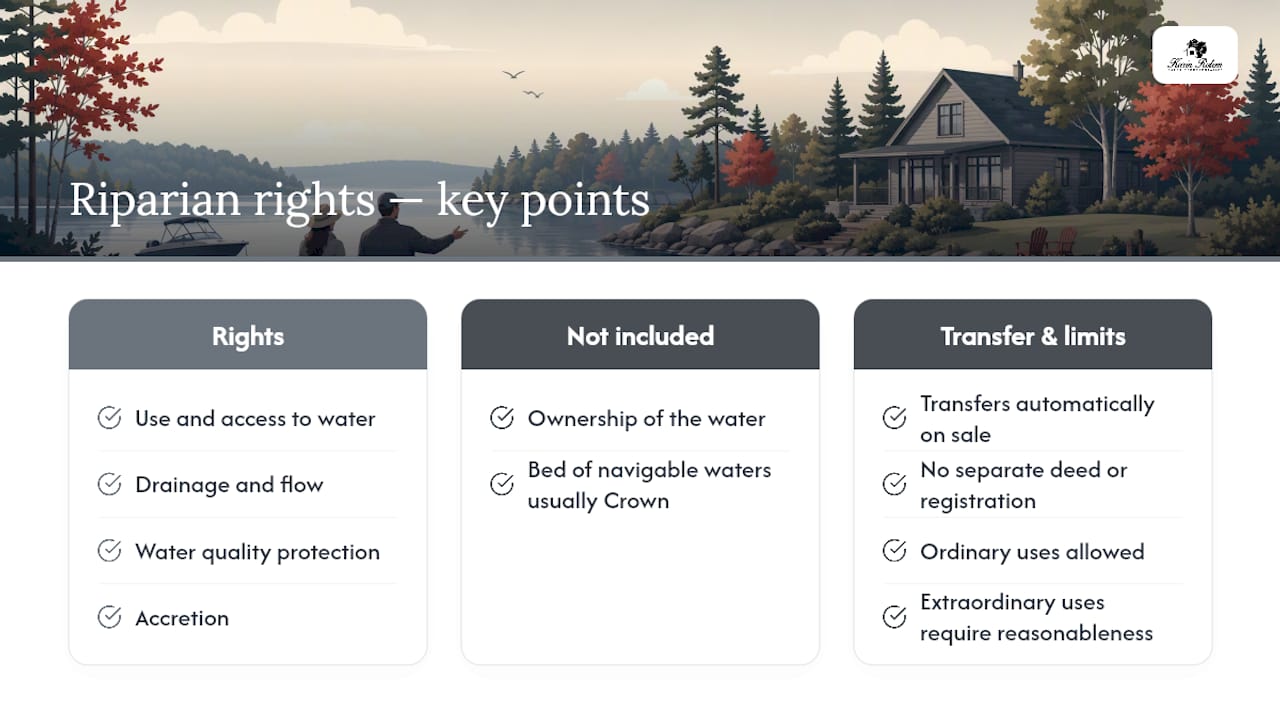
What they don’t give you is ownership of the water itself, or in most cases, the ground underneath it. Ontario guidance is direct on this point: riparian rights cover access, drainage, flow, water quality, and accretion, but the Crown usually holds the bed of navigable waters unless there’s an express grant saying otherwise.
Courts also draw a line between “ordinary” and “extraordinary” uses. Filling a bucket for the garden is ordinary. Diverting a creek to irrigate a commercial farm is extraordinary, and it has to be reasonable in light of every other riparian owner sharing that same watercourse.
Riparian rights exist because land touches water, not because a deed says so. That’s exactly why so many owners misunderstand what they actually own.
Does my property include riparian rights?
You can’t answer this from memory or from what the listing photos suggest. Confirm it with paper.
- Pull the deed and legal description. Look for wording that references a shoreline, water lot, or “more or less to the water’s edge.”
- Review the registered plan and survey. A recent survey shows exactly where your boundary lines fall relative to the water.
- Check for shore road allowances. Many Ontario municipalities hold a strip of land, often 66 feet wide, between private lots and the water. If it’s still unpatented, you don’t own to the shore at all.
- Look for Crown reservations or water lots. Some older patents excluded the shoreline or the bed entirely.
- Confirm easements or rights-of-way on title. Neighbours or the municipality may hold access rights across your frontage.
Buyers routinely assume a waterfront purchase means owning the beach outright, and that assumption causes real problems down the line, according to property law guidance from HGR Graham Partners. A title search paired with a current survey is the only reliable way to know where you stand.
What do riparian rights actually let you do?
Once you’ve confirmed the right exists, here’s what it covers in practice:
- Access: you can reach and use the water from your frontage, and that access generally can’t be blocked by a neighbour or a structure.
- Drainage: you can drain your land into the watercourse, provided you don’t dam, divert, or materially change its natural flow.
- Flow and quantity: you’re entitled to have water reach your property in something close to its natural volume and rate.
- Water quality: you can expect the water to arrive largely undiminished in quality by upstream activity.
- Accretion: land your property gains gradually and naturally, through silt or sediment build up, generally becomes yours.
Ordinary domestic use, drinking water, watering a lawn, watering livestock, is protected almost without question. Extraordinary use, think large-scale irrigation or a commercial water-taking, has to be reasonable and can be challenged by other riparian owners sharing the same watercourse, a distinction that shows up repeatedly in Ontario case law on ordinary versus extraordinary water use.
Every one of these rights is shared. You don’t get to exercise yours in a way that materially harms the equal rights of the owner next door or downstream.
Who can limit what you do on your shoreline?
Owning riparian rights doesn’t mean you can act unilaterally. Several layers of regulation sit on top of the common law, and any one of them can stop a project cold.
- Conservation Authorities regulate development near watercourses and floodplains, and most shoreline work, docks, retaining walls, fill, needs their approval first, a point environmental consultants specializing in riparian issues flag as the most commonly missed step.
- Municipal bylaws often set their own rules on setbacks, tree removal near shorelines, and structure size.
- The Ontario Water Resources Act governs water taking and can require a permit for significant withdrawals.
- The Beds of Navigable Waters Act determines whether you even own the bed you’re proposing to build on.
- DFO steps in federally when a project could affect fish habitat or navigability, and certain dock and shoreline projects require federal review before a shovel goes in the ground.
Pro Tip: Call your Conservation Authority and municipal planning office before you call a contractor. Getting the sequence backwards is the single most common reason waterfront projects get stopped mid-build, and reworking a dock after the fact costs far more than a permit ever would.
What happens when a neighbour blocks access or changes drainage?
Disputes over water are some of the oldest property fights in Ontario, and they tend to follow a predictable pattern.
- Negotiation first. Most disputes resolve without a courtroom once both sides see a survey and understand where rights actually sit.
- Injunctions and damages. Courts have ordered structures removed when they substantially impair a riparian owner’s access to navigable water from any point along their frontage.
- Declaratory relief. A court can simply confirm who holds which right, which often ends the argument on its own.
- Drainage claims are narrower than most owners expect. Ontario guidance is clear that the flow of uncollected surface water onto a neighbouring property is rarely grounds for a successful lawsuit on its own, though downstream owners can protect their own land with berms or grading.
Timing matters enormously here. The Real Property Limitations Act imposes a time limitation period on many land actions, and that clock can start running well before a new owner ever discovers the problem, a risk laid out clearly in analysis of riparian rights and the Real Property Limitations Act. Preserve evidence early: photos, dated correspondence, and witness statements all matter if a dispute drags on.
What should I do before I build or buy?
Treat this as a sequence, not a single phone call.
- If you’re buying: confirm title and survey status, ask the seller for any history of shore-use disputes, and request copies of prior municipal or Conservation Authority permits.
- If you’re building: pre-consult your Conservation Authority, then municipal planning, then DFO if the project touches navigable water or fish habitat.
- Hire a surveyor to establish exact boundaries before anyone applies for a permit.
- Hire a lawyer for title review and to interpret how the statutes apply to your specific parcel.
- Budget realistically. Approvals typically move through surveyor, then Conservation Authority, then municipality, then DFO if applicable, and the full sequence can take weeks to several months depending on the authority’s queue.
Our guide on what deeded waterfront access actually means walks through the same due-diligence sequence in more depth if you’re mid-purchase right now.
How I help clients sort out riparian rights before closing
What I tell my clients buying in Friday Harbour or along Innisfil’s shoreline: don’t assume anything about the water until a survey confirms it. I’ve seen deals stall late because a shore road allowance nobody mentioned turned up in a title search, or because a decades-old survey no longer matched the shoreline after natural accretion.
Here’s what I coordinate on a typical waterfront file:
- Ordering an updated survey before an offer goes firm, not after.
- Arranging a pre-consult with the Conservation Authority when a buyer plans to add a dock or boathouse.
- Connecting clients with a real estate lawyer who specializes in waterfront title before conditions are waived.
I’m not a lawyer, and I won’t pretend to interpret the Beds of Navigable Waters Act for you. My job is coordinating the right people early, so nothing surprises you at closing.
A pattern I see again and again in waterfront deals
What most buyers don’t realize is that the trade-off isn’t really about ownership, it’s about privacy versus obligation. A frontage with public shore road allowance access might feel less private, but it often comes with fewer maintenance headaches than a fully private shoreline carrying erosion or flow responsibilities. I tell clients to walk away when a survey turns up unresolved boundary conflicts with no clear path to resolution. Everything else is usually workable with early due diligence.

Get local help vetting your next waterfront purchase
There’s a difference between reading about riparian rights and having someone walk your specific parcel through the process. That’s where a local agent earns her keep: coordinating the surveyor, flagging the shore road allowance before you’re conditional, and knowing which Conservation Authority contacts actually respond quickly in Innisfil and the Friday Harbour area. I’m not a substitute for your lawyer on statutory interpretation, but I make sure the right professionals are in the loop before you’re locked into a deal you can’t unwind.
If you’re actively looking at waterfront property in the area, start with our Friday Harbour community page to see what’s currently available, or reach out directly and we’ll walk through what due diligence looks like for the specific property you have your eye on.
Sources
- Natural watercourses and drainage disputes
- Ontario
- Department of Fisheries and Oceans Canada
- Beds of Navigable Waters Act, R.S.O. 1990, c. B.4.
- Cottage property issues: know your water rights (HGR Graham Partners LLP)
FAQ
Do I own my shoreline in Ontario?
Not necessarily. Many properties end at a shore road allowance or Crown reservation before the water’s edge, so a survey and title search are the only way to confirm your actual boundary.
Can you deny access to a landlocked property in Canada?
A landlocked property generally has a legal right of access, often through an easement or right-of-way registered on title, but the specifics depend on how that access was originally granted.
Can a neighbour drain water onto your property in Ontario?
Uncollected surface water flowing naturally onto your land is rarely grounds for a lawsuit, though you can take reasonable steps like berms or grading to protect your own property.
Do you own the beach in front of your house in Canada?
Usually not the whole way to the water. The bed of most navigable lakes and rivers stays with the Crown under the Beds of Navigable Waters Act, and shore road allowances often sit between private title and the shoreline itself.