
That is the entire concept in one sentence. Everything else, recapture, the flip rule, the principal residence exemption, is detail that changes how much of your profit lands on that taxable line.
Before you list anything, here is the verdict most sellers need:
- Capital gain exposure: likely if proceeds exceed ACB plus selling costs.
- Recapture exposure: likely if you claimed capital cost allowance (CCA) and your sale price for the building exceeds its undepreciated capital cost (UCC).
- Flip risk: real if you’ve owned the property for less than a year, regardless of your intent.
Three things to do this week if a sale is on the table:
- Pull every purchase document, renovation receipt, and CCA schedule you have.
- Get a broker’s opinion of value so you’re working with a realistic sale price, not a guess.
- Call your accountant before you sign a listing agreement, not after.
Key Takeaways
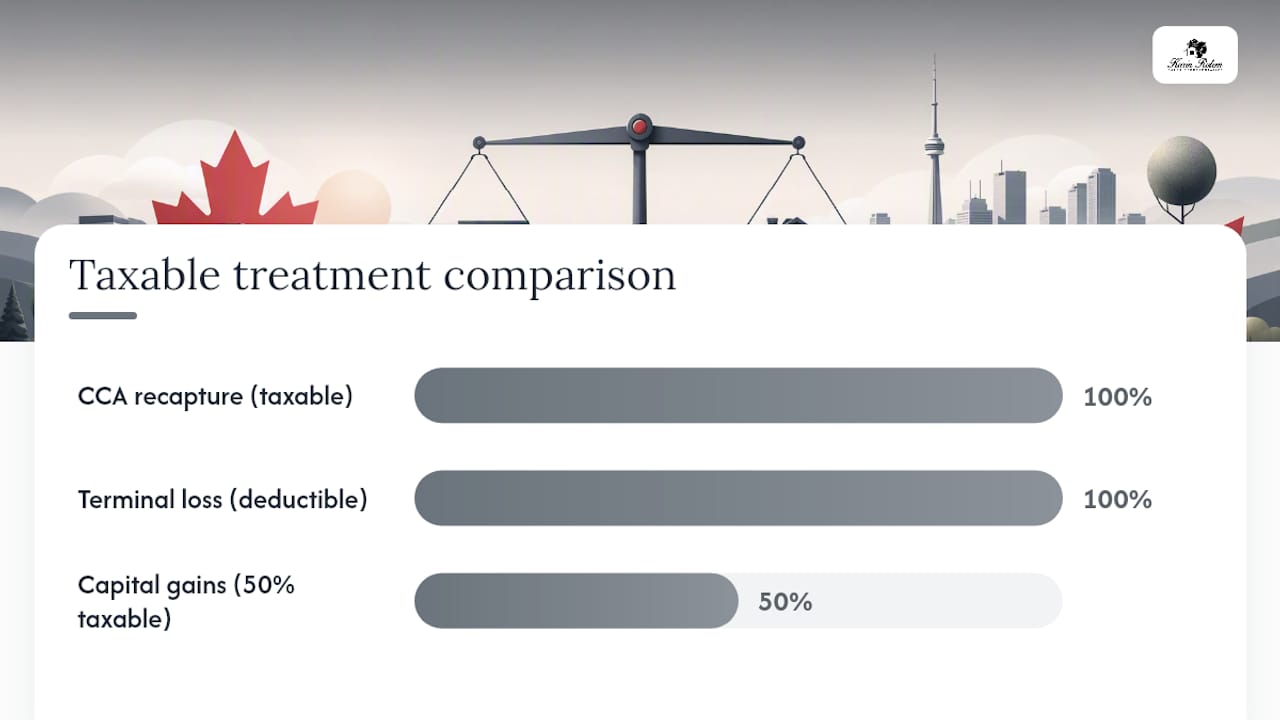
Selling a rental property in Canada means calculating a capital gain (50% taxable) and separately checking for CCA recapture, which is fully taxable as income.
| Point | Details |
|---|---|
| Capital gain formula | Proceeds minus ACB minus selling costs equals your gain; 50% of that is taxable. |
| Recapture is separate | Past CCA claims can trigger fully taxable recapture, reported on Line 9947. |
| Watch the 365-day mark | Ownership for less than a year risks CRA treating profit as business income, not capital gains. |
| Change of use triggers deemed disposition | Converting personal use to rental (or back) can trigger a taxable event under section 45. |
| Work with a local specialist | Karin Rotem’s team pairs local valuation and marketing expertise with tax-aware sale timing for Friday Harbour and Innisfil sellers. |
Official CRA guides and forms to consult next
- Guide T4037: full capital gains calculation rules.
- Form T776: rental income and CCA reporting.
- Line 9947 guidance: recapture reporting specifics.
- Income Tax Act section 45: change-of-use and deemed disposition rules.
How to calculate capital gains on your rental property in Canada
The formula the Canada Revenue Agency uses has three moving parts: proceeds of disposition, minus adjusted cost base (ACB), minus outlays and expenses of the sale. What’s left is your capital gain, or your loss if the number goes negative.
What builds your ACB:
- The original purchase price plus closing costs like legal fees and land transfer tax.
- Capital improvements, a new roof, a renovated kitchen, an added deck, not routine repairs.
- Certain legal and survey costs tied to the acquisition itself.
What counts as outlays and expenses of sale:
- Real estate commissions.
- Legal fees on the sale.
- Marketing or staging costs directly tied to the transaction.
Here’s a worked example. Say you bought a Barrie-area rental for $450,000 five years ago, put $30,000 into a kitchen and bathroom renovation, and sold it for $650,000, paying $32,000 in commission and legal fees.
Proceeds of $650,000 minus ACB of $480,000 minus selling costs of $32,000 leaves a capital gain of $138,000. Under the current standard inclusion rate, $69,000 gets added to your taxable income that year. If you have a typical marginal tax rate, you can expect a proportional tax owed on the gain alone, before recapture is even factored in; see more about Capital Gains Tax – Impact on High-Net-Worth Investors.
What are CCA recapture and terminal loss?
Recapture and terminal loss are the flip sides of the same coin, and they trip up more sellers than the capital gain calculation itself. If you claimed CCA on the building over the years and your sale allocation to the building exceeds its UCC, the difference is recapture, fully taxable as ordinary income, not at the 50% capital gains rate. If UCC exceeds the building’s sale allocation instead, you may have a terminal loss, which is fully deductible against income.
| Scenario | UCC | Building proceeds | Result |
|---|---|---|---|
| Recapture | $200,000 | $260,000 | $60,000 recaptured, taxed as full income |
| Terminal loss | $200,000 | $150,000 | $50,000 deductible loss |
Recapture can make the tax bill on a sale feel much heavier than the capital gain calculation alone would suggest.
- Report recapture on Line 9947 of Form T776.
- The taxable capital gain still flows through Schedule 3 on your T1.
- Both interact, so run the numbers together, not separately.
Which CRA forms do you need to report the sale?
Reporting a rental property sale involves a specific paper trail, and missing a form is one of the more common (and avoidable) errors I see.
- Form T776 (Statement of Real Estate Rentals): reports rental income and CCA up to the year of sale.
- Schedule 3 (Capital Gains or Losses): reports the disposition and calculates your taxable capital gain.
- Guide T4037 (Capital Gains): CRA’s own reference for how the calculation and inclusion rate work.
- Line 9947: where recapture gets reported if you claimed CCA.
- Partnership interests show recapture and gains differently, often via T5013 slip box 151 allocations.
Report the sale in the calendar year the disposition happened, and keep every supporting document for at least six years. If the seller is a non-resident of Canada, separate withholding tax rules apply and need attention well before closing.
How does changing a property’s use affect capital gains?
Moving a property between personal and rental use triggers a deemed disposition at fair market value under section 45 of the Income Tax Act, even though no sale actually happened. That fair market value becomes your new ACB going forward.
- You convert your home to a rental: CRA treats this as if you sold it at fair market value that day.
- You can file a section 45(2) election to defer recognizing that gain, provided conditions are met and the election is filed on time.
- If you later sell, only the growth after the change of use is typically exposed to capital gains tax, since the principal residence exemption can shelter the earlier period.
Say a Toronto couple lived in a home for eight years, then rented it out for four before selling. The gain from those first eight years may be sheltered by the principal residence exemption; the last four years likely are not.
Pro Tip: Get a written valuation dated as close as possible to the day you changed the property’s use. Without it, you and the CRA are both guessing at the fair market value years later.

When does selling a rental property count as business income?
Owned the property less than 365 consecutive days? The CRA’s flipped property rule presumes the profit is business income, not a capital gain, absent a qualifying life event like a job relocation or divorce.
Indicators the CRA looks for beyond the 365-day mark:
- A pattern of frequent property sales.
- Renovations clearly aimed at quick resale rather than long-term rental use.
- Marketing language pitching a fast flip.
The consequence is blunt: business income is 100% taxable, with none of the 50% inclusion benefit that applies to capital gains.
What costs actually reduce your capital gain?
Not every dollar you spend on a rental property lowers your tax bill the same way.
Increases your ACB (reduces the capital gain):
- Capital improvements: new roof, addition, major system replacement.
- Legal fees and land transfer tax on the original purchase.
Deducted against rental income instead (doesn’t touch ACB):
- Repairs and maintenance, painting, minor fixes.
- Property taxes and mortgage interest during the rental period.
Co-owners split both ACB and proceeds according to their ownership percentage, so a vacation rental income split between siblings or spouses needs to match how title is actually held, not an informal understanding.
What I tell my clients before they list a rental property
Recapture catches more sellers off guard than the capital gain itself, mostly because they never modelled it before listing. What I tell my clients considering a sale in the next few years: think hard before maximizing CCA claims annually if you suspect you’ll sell within a decade. Every dollar of CCA you claim now is a dollar of recapture risk later, and claiming CCA is entirely optional.
Before you list:
- Get a broker’s valuation, not just an online estimate.
- Gather every purchase and improvement receipt you can find.
- Model the recapture and capital gain together with an accountant, not in isolation.
In Friday Harbour specifically, demand swings seasonally, and listing during peak interest can shift your net proceeds enough to change whether selling now or holding another year makes more after-tax sense.
A local agent’s perspective on selling rental property in Ontario
What most sellers don’t realize is that a hot market can make holding longer the costlier choice, not the safer one, once recapture is factored in. Selling now versus waiting a year isn’t just a pricing decision, it’s an after-tax proceeds decision. My rule of thumb: run the numbers before you fall in love with a listing date.

Thinking about selling a rental property near Toronto or Innisfil?
There are other ways to approach this: a general accountant, a DIY listing, a generic brokerage. None of them combine local pricing intelligence with tax-aware sale timing the way a dedicated Friday Harbour and Innisfil specialist can. Karin Rotem’s team works alongside your accountant and lawyer rather than replacing them, focusing on the piece we know best: pricing, timing, and positioning your property to the right buyer pool so your after-tax proceeds actually reflect the market.
Our services for sellers include:
- Local market valuation grounded in recent Friday Harbour and Innisfil comparables.
- Help organizing documentation your accountant will need for ACB and CCA calculations.
- Marketing tailored to investors, not just owner-occupiers.
- Coordination with your accountant and lawyer through closing.
If you’re weighing whether to sell this year or hold, book a consultation and review your property options or explore Friday Harbour listings to see what a well-timed exit could look like for you.
Sources
FAQ
How much capital gains tax do I pay on a $300,000 gain?
Half of a large gain gets added to your taxable income at your marginal rate. The tax owed depends on your marginal tax rate, before any recapture.
How much tax do you pay when you sell a rental property in Canada?
You pay tax on 50% of your capital gain at your marginal rate, plus full ordinary tax on any CCA recapture. There’s no single flat rate since the actual bill depends on your total income for the year.
How to avoid capital gains tax when selling a rental property in Canada?
You generally cannot avoid capital gains tax entirely on an investment property, but capital losses from other investments, careful timing of the sale, and a properly filed section 45(2) election on a change of use can all reduce or defer the bill.
How much capital gains tax do I pay on a $100,000 gain?
Half of the gain gets added to your taxable income. The amount of tax depends on your marginal rate and total income for the year.
Does selling a condo, duplex, or commercial rental get taxed differently?
The core capital gains and recapture rules apply the same way regardless of property type; what changes is the CCA class and rate, which affects how much recapture you’ve built up over time.
This article is general information, not a substitute for advice from a qualified financial advisor. Consult a qualified financial professional about your own circumstances before acting on anything here.