
Furnished rental demand in Toronto has firmed up through 2026 after a rocky stretch in 2024 and 2025. Condo leasing hit a record 18,923 transactions in Q2 2026, a 5% jump year over year, while GTA purpose-built vacancy sat at 3.0% in CMHC’s 2025 reading. For landlords, that means well-presented furnished units are leasing faster, but pricing still needs to respect a market that hasn’t fully shaken off its incentive habit.
TL;DR:
- Demand for furnished rentals remains focused in high-turnover neighborhoods like downtown, Yonge and Eglinton, and the Entertainment District, where lease speed and occupancy stay strong.
- Leasing activity increased by 11% in the first half of 2026, with condo vacancy rates at 3.0%, indicating steady absorption despite softer overall market rent growth.
- The busiest leasing period is in Q3, driven by academic year starts, corporate relocations, and family moves, with timing influencing rental incentives.
- Investors should price furnished units against actual tenant payments, focus on presentations that enable move-in ready quality, and target demand in core neighborhoods for best results.
Furnished rental demand Toronto: what the numbers actually show
Start with leasing volume, because it tells the real story before rent figures do. Urbanation logged 34,150 condo leases across the GTHA in the first half of 2026, up 11% from the same period a year earlier, with active condo listings declined notably year over year by the end of Q2. Fewer units sitting on the market alongside more transactions signals genuine absorption, not a fluke quarter.
Asking rents tell a more layered story. Statistics Canada’s Quarterly Rent Statistics put the average asking rent for a two-bedroom apartment in Toronto near $2,660 in Q1 2026, with only modest year-over-year movement. Meanwhile, Rentals recorded Toronto rents climbing month over month, roughly 1.5% in one recent month, while year-over-year declines stayed shallower than in several other major Canadian markets. Put those together and you get a market that bottomed out and is now edging back up, unit by unit.
Vacancy and supply complete the picture. CMHC’s 3.0% purpose-built vacancy rate for 2025 reflects a market still absorbing a wave of international student declines and heavy condo rental competition, according to CMHC’s own commentary. That’s higher than the ultra-tight vacancy Toronto saw before 2023, but it’s not the crisis level some headlines suggested. Purpose-built completions have slowed from their 2023-2024 peak, and the condo investor pipeline, long the backbone of Toronto’s rental supply, has thinned as fewer new projects launch.
The takeaway: demand is concentrated. Well-presented, furnished, and boutique units are absorbing quickly even while average asking rents across the broader unfurnished condo stock stay soft, according to Urbanation’s own analysis. If you’re evaluating a unit on citywide averages alone, you’re missing where the actual competition for tenants is happening.
Why does furnished demand spike in Q3 every year?
Toronto’s furnished rental market runs on a predictable clock, and understanding it is worth more than any single data point in the table above. Three forces converge every summer: the academic year starting in September, corporate relocation cycles tied to fiscal year planning, and family moves timed around school calendars. All three push tenants to search in June, July, and August for a September 1 move-in, which makes Q3 the busiest quarter for furnished leasing by a wide margin.
Different tenant segments show up for different reasons, and their lease lengths vary accordingly:
- Corporate relocations typically want three to twelve month terms while permanent housing gets sorted out.
- Graduate students and visiting academics often need four to eight months tied to a semester or research term.
- Film and television production crews need furnished housing for the length of a shoot, commonly six to sixteen weeks.
- Insurance displacement tenants (people out of a home after fire or water damage) need furnished housing for unpredictable stretches, often two to six months.
- Renovators staying local during a gut renovation usually book three to six months.
Immigration flows and return-to-office mandates add another layer. New permanent residents and skilled-worker arrivals often need furnished housing for their first few months before committing to a lease or purchase, and companies pulling employees back to downtown offices have revived some of the corporate short-term demand that dried up during remote-work years.
Seasonality and incentives move in opposite directions. Landlords who list in late spring for a July move date, positioning ahead of the Q3 rush, land tenants closer to asking rent and with fewer concessions, a pattern confirmed by seasonal market data. List in January, and you’re competing against a glut of empty units and a market where incentives are the norm, not the exception. Our seasonal rental demand guide for Ontario breaks this timing down month by month if you want to plan a launch date.
Face rent versus effective rent: the gap that trips up new landlords
Here’s what most first-time furnished landlords get wrong: they price against the number advertised down the street without asking what that tenant actually pays after concessions. Roughly two-thirds of new buildings were offering incentives in late 2025, according to Urbanation’s tracking, and incentive-adjusted (effective) rents fell more than face rents across that period.
Here’s a simple example. A unit lists at $3,200 a month, the face rent. The building offers one month free on a twelve-month lease. If you’re benchmarking your furnished unit against a competitor’s face rent without checking whether they’re also throwing in free parking, a cleaning credit, or a signing bonus, you’ll misprice your own listing.
A few operational realities shape how furnished units perform against that backdrop:
- Furnished units turn over more often than unfurnished ones because shorter-term tenants cycle through faster, which means cleaning, staging, and inventory checks happen several times a year instead of once.
- Furniture, linens, and small appliances need periodic replacement, and that cost has to be built into your rent, not treated as a surprise.
- Insurance for a furnished unit typically costs more than for an empty one, since the landlord is covering contents as well as the structure.
- Boutique buildings and units with concierge service or premium finishes hold pricing power even when the broader market softens, a pattern documented in luxury rental demand data.
Pro Tip: A furnished unit marketed as genuinely move-in ready, photos, bedding, kitchenware, working Wi-Fi from day one, often avoids the heavy incentive schedule that unfurnished or half-staged units get stuck offering. Tenants paying a furnished premium expect to skip the setup hassle entirely, and if your listing delivers that, you rarely need to compete on discounts.
How should landlords price and prepare a furnished unit right now?
Getting the pricing and presentation right on a furnished unit isn’t complicated, but skipping steps costs you weeks of vacancy. Here’s the order I’d work through it in:
- Price against effective rent, not face rent. Pull three to five comparable furnished listings, ask what incentives they’re actually offering, and price your unit against what tenants really pay.
- Reserve concessions for off-peak months only. If you’re listing in Q3, hold the line on price. If you’re listing in December or January, budget for a modest incentive rather than letting the unit sit empty.
- Invest in professional photography and a written inventory list. Corporate tenants and relocation firms move fast, and a detailed inventory list (furniture, appliances, linens) speeds up their decision and protects you at move-out.
- Offer flexible lease lengths where you can. A unit that can do three, six, or twelve months captures a wider pool of corporate, academic, and insurance-displacement tenants than one locked to a standard annual lease.
- Line up a professional cleaning and turnover schedule before you list. Furnished units change hands more often, and a landlord without a cleaning plan in place will lose weeks between tenants.
- List through corporate housing channels and relocation firms, not just general listing sites. Corporate tenants often search through relocation specialists first, and getting on those radars fills units faster than a general posting ever will.
On the conversion question, furnished makes sense when your unit is in a high-turnover location (downtown core, near hospitals or universities, near production studios) and you can commit to the operational cadence. If you can’t manage frequent turnovers, an unfurnished twelve-month lease with a stable tenant may earn you more in practice, even if the furnished sticker price looks higher on paper. Our guide on furnished rental property features investors need walks through the presentation details that matter most once you’ve made that call.
Pro Tip: Don’t furnish a unit halfway. Tenants paying a premium for furnished housing notice missing kitchen basics or a bare living room faster than any other flaw, and a half-furnished unit often leases slower than one that’s fully unfurnished and priced accordingly.
Which Toronto neighbourhoods see the strongest furnished demand?
Location drives furnished performance more than almost any other variable, and a few pockets of the city consistently outperform the citywide averages.
- Downtown core and the Financial District pull corporate relocations and consulting contractors who need walkable access to major employers.
- The University of Toronto and Yonge and Eglinton corridors draw graduate students, visiting faculty, and hospital staff on rotation.
- King West and the Entertainment District see steady film and production crew demand tied to Toronto’s active production calendar.
- North York and midtown boutique buildings attract longer-staying corporate tenants who want concierge service without downtown’s premium.
One-bedroom and two-bedroom units in newer or well-maintained mid-rise and boutique buildings lease fastest as furnished stock, since they suit both single corporate tenants and small families without the overhead of furnishing a larger unit. Buildings with concierge or amenity packages tend to hold occupancy even when broader rents soften, a trend supported by current luxury rental data. Choosing a location near a hospital, university, or production hub also shortens your expected time between tenants, since demand refills faster in areas with a constant flow of short-term arrivals.
Where is Toronto’s furnished rental market heading?
The near-term trajectory points toward continued tightening rather than a return to the ultra-soft conditions of 2024 and 2025.
A handful of factors will decide how far that tightening goes. Immigration policy remains the biggest lever. Any changes to federal targets or study permit caps ripple directly into vacancy within a couple of quarters, since international students and new permanent residents have historically filled a meaningful share of Toronto’s furnished and short-term stock. Interest rates matter too: if borrowing costs ease further, some investor-owned condos currently sitting empty or listed for sale may return to the rental pool, adding supply back in.
Return-to-office policy is the wildcard worth watching closely. Every major employer that mandates more in-office days brings a fresh wave of corporate relocation and short-term furnished demand with it. On the supply side, purpose-built completions are expected to keep slowing through the back half of 2026, which removes one of the pressure valves that kept vacancy climbing in 2025. Taken together, the market looks set to keep favouring landlords who can offer flexible, well-presented furnished units over those competing purely on unfurnished square footage.
Do licensing rules affect furnished rentals in Toronto?
Toronto’s short-term rental licensing bylaw applies to rentals of less than 28 consecutive days and requires hosts to register with the city, restricting short-term rentals to a principal residence in most cases. That bylaw doesn’t touch the furnished rentals discussed throughout this article: leases of a month or longer, whether three months or twelve, fall under standard Ontario residential tenancy rules, not the short-term rental registration regime.
That distinction matters enormously for anyone weighing furnished leasing as a business model. A landlord offering three-month, six-month, or annual furnished leases operates as a standard residential landlord under the Residential Tenancies Act, with the same notice periods, rent increase guidelines, and Landlord and Tenant Board processes that apply to any unfurnished lease. The furniture itself doesn’t change your legal obligations. Where it does matter is at lease end: a clear inventory list and a condition report protect both landlord and tenant when it comes time to account for furnishings.
If you’re considering shorter stays, under 28 days, you’re stepping into the city’s registered short-term rental framework, which comes with its own compliance requirements and, in many buildings, condo corporation restrictions that prohibit short-term rentals outright regardless of city rules. Always check your building’s declaration and rules before committing to that model. For most investors reading this, sticking to month-plus furnished leases avoids that regulatory layer entirely while still capturing the corporate, academic, and relocation demand covered above.
How does Toronto’s furnished demand compare to other Canadian cities?
Toronto’s furnished rental market behaves differently from Vancouver, Calgary, and Ottawa in a few specific ways worth knowing if you’re weighing where to invest.
Toronto’s asking rents, sitting around $2,660 for a two-bedroom in StatCan’s Q1 2026 release, remain among the highest in the country, but Rentals.ca’s tracking shows Toronto posting smaller year-over-year declines than some other major markets, suggesting the correction that hit rents nationally in 2024 and 2025 has run its course faster here. Vancouver still commands a premium over Toronto on a per-square-foot basis, but its furnished demand skews more heavily toward tech-sector corporate relocations, while Toronto’s demand base is broader: finance, film, healthcare, and academia all contribute meaningfully.
Calgary and Ottawa see far less furnished-specific demand overall, simply because both cities have smaller relocation and film-production sectors pulling short and mid-term tenants. Toronto’s status as Canada’s largest film production hub outside a handful of U.S. cities gives it a furnished demand driver that most other Canadian markets simply don’t have at the same scale. For an investor choosing between markets, Toronto’s combination of deep corporate demand, a large student population, and active production activity makes furnished leasing a more resilient strategy here than in most other Canadian cities.
What lease terms work best for furnished rentals?
Furnished rentals in Toronto typically run shorter and more flexible than the standard twelve-month unfurnished lease, and matching your terms to tenant type matters more than defaulting to one structure.
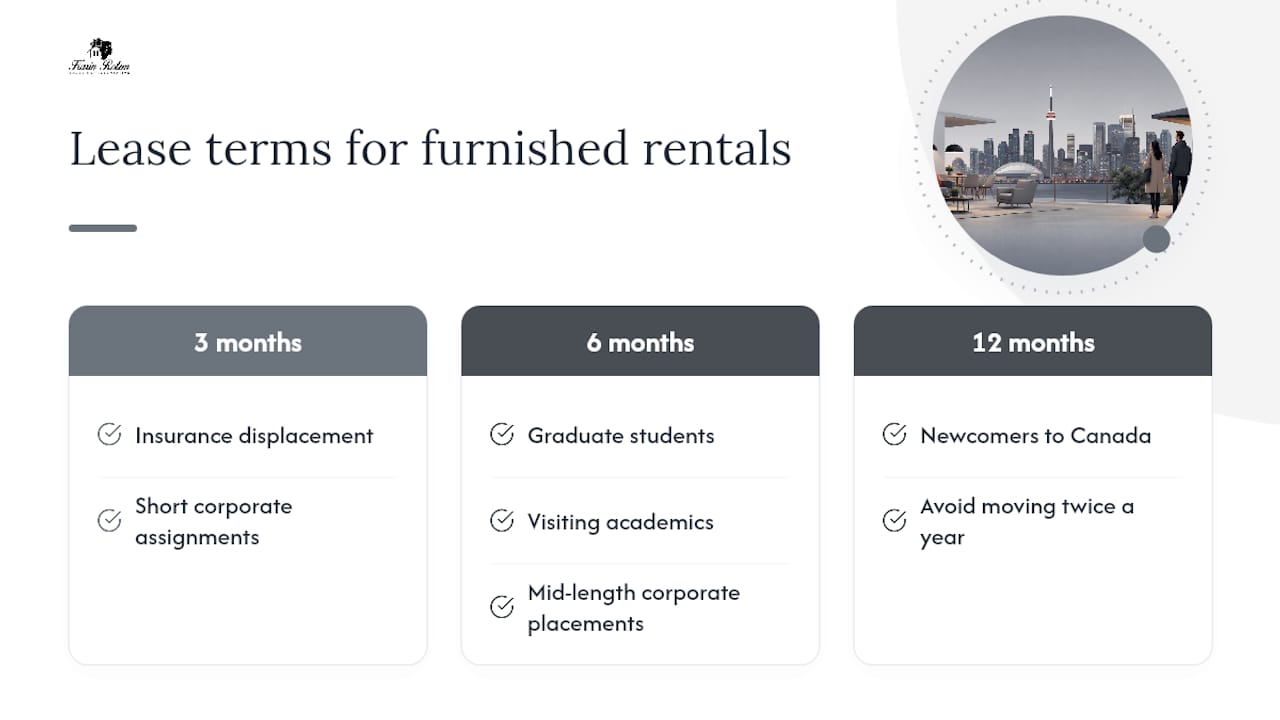
Three-month terms suit insurance displacement tenants and short-term corporate assignments. Six-month terms fit graduate students, visiting academics, and mid-length corporate placements. Twelve-month terms work for tenants who want furnished convenience without the disruption of moving twice in a year, often newcomers to Canada who aren’t ready to commit to buying furniture before they’ve settled permanently.
Flexibility itself has become a competitive advantage. Offering a shorter minimum term at a modest premium, rather than locking every unit into a rigid twelve-month structure, opens your listing to corporate housing and relocation firms that specifically search for that flexibility. Month-to-month renewal clauses after an initial three or six-month term also appeal to tenants uncertain about their long-term plans, and that uncertainty describes a large share of the furnished tenant pool: relocating professionals, students between semesters, and people rebuilding after a home loss.
What amenities matter most in a furnished Toronto rental?
Tenants paying a furnished premium expect the unit to function from the day they walk in, and the amenities that matter most reflect that expectation rather than luxury for its own sake.
Reliable high-speed Wi-Fi ranks as close to non-negotiable, since remote work and video calls are standard for corporate and academic tenants alike. In-suite laundry saves tenants from a task they don’t want to manage during a temporary stay, and a full kitchen with actual cookware, not just appliances, distinguishes a genuinely furnished unit from one that’s furnished in name only. Building amenities matter too: a gym and a workspace or lounge area reduce the need for tenants to seek out a separate gym membership or coworking space during a short stay.
Beyond the checklist basics, thoughtful touches separate the units that lease in days from the ones that sit for weeks. Quality bedding and blackout curtains matter more to tenants than most landlords expect, and a well-stocked linen closet with backups saves awkward mid-stay requests. Secure parking and proximity to transit round out what corporate relocation firms specifically look for when placing employees, since many arrive without a car and need transit access from day one.
What I tell my clients about furnished rentals right now
What I tell my clients weighing a furnished conversion in 2026 is simple: time your launch to Q3, price against effective rent rather than the highest number on the street, and don’t furnish a unit unless you can commit to the turnover cadence it demands. I’ve watched the same pattern play out in Friday Harbour and Innisfil, where seasonal and lifestyle-driven demand rewards owners who present a unit as genuinely move-in ready over those who cut corners on staging.
What most Toronto investors don’t realize is that a furnished unit’s real competition isn’t the building next door, it’s the tenant’s alternative of buying furniture and signing a twelve-month unfurnished lease instead. Your presentation has to make furnished the easier choice. My conservative expectation for 2026 is modest rent growth in well-located, well-presented units and continued softness for anything generic or poorly maintained. If you’re weighing whether a specific property fits that description, browse our current listings or reach out and we’ll walk through whether furnished makes sense for your unit specifically.
— Felix
Where the data in this article comes from
The figures cited throughout come from five primary sources worth bookmarking if you track this market regularly. Urbanation tracks condo leasing volume and pricing across the GTHA on a quarterly basis. CMHC publishes annual vacancy rates and incentive trends for purpose-built rentals. The Toronto Regional Real Estate Board tracks resale and rental listing activity across the GTA. Rentals.ca publishes monthly asking-rent comparisons across major Canadian cities. Statistics Canada’s Quarterly Rent Statistics offer the most consistent national benchmark for average asking rents by unit type and city. For vacancy, check CMHC; for leasing volume, check Urbanation; for month-to-month rent movement, check Rentals.ca.
Sources
- GTHA rental market shows improvement in Q2 | Urbanation
- CMHC rental market reports — major centres
- Rentals
- Statistics Canada — Quarterly rent statistics (daily release)
FAQ
Will rent go down in Toronto in 2026?
Broad asking rents have largely stabilized rather than dropping further, with Rentals.ca recording month-over-month increases in Toronto even as year-over-year comparisons stayed roughly flat to slightly negative. Well-presented furnished units are seeing firmer pricing than the citywide average.
What is the current rental vacancy rate in Toronto?
CMHC reported GTA purpose-built rental vacancy at 3.0% in 2025, up from the ultra-tight rates seen before 2023 but still historically moderate.
Are rental prices dropping in Toronto?
Not broadly, and less than in several other major Canadian markets. Average two-bedroom asking rent stood near $2,660 in Q1 2026 per Statistics Canada, with condo leasing volume up 11% year over year in the first half of 2026.
Where can I find furnished monthly rentals in Ontario?
Corporate housing platforms, relocation firm listings, and dedicated furnished-rental sites carry the bulk of month-plus furnished inventory, alongside boutique property managers who specialize in short and mid-term leasing in Toronto and Innisfil. Building concierge desks in high-demand corridors also field furnished inquiries directly from corporate tenants.
How long are typical furnished rental leases in Toronto?
Furnished leases commonly run three to twelve months, with three and six-month terms most common among corporate, academic, and insurance-displacement tenants, and twelve-month terms favoured by newcomers settling into the city long term.