
Exemptions exist for OINP nominees, protected persons, and spouses of Canadian citizens or permanent residents, and rebates can recover the tax later if you become a permanent resident.
TL;DR:
- The 25% non-resident speculation tax applies to all of Ontario, not just Toronto, and now includes standalone parking and storage units in condo buildings as designated land.
- Exemptions at closing are available for OINP nominees, protected persons, and spouses of Canadian citizens or permanent residents, provided the 60-day occupancy requirement is met.
- NRST also applies to changes in ownership through trusts and partnerships, not just direct property purchases, which can trigger the tax without a sale.
- A foreign national, foreign corporation, or taxable trustee purchasing designated land will owe the tax unless they qualify for an exemption; rebuilding ownership structures after purchase rarely avoids the tax.
- Rebates for eligible buyers, such as permanent residents, require timely application within 180 days of becoming a permanent resident and proof of principal residence, with the deadline starting from the actual residence date, not the PR card arrival.
What is the non-resident speculation tax in Ontario?
The NRST is a land transfer tax add-on, created under Ontario’s Land Transfer Tax Act, aimed at cooling foreign demand in the province’s housing market. Ontario introduced it in April 2017 at a rate that was initially limited to the Greater Golden Horseshoe region.
That changed fast. In March 2022, the province expanded the tax to cover all of Ontario. Then on October 25, 2022, the rate was set at 25%, where it remains today. The most recent update came on March 27, 2024, when Ontario folded standalone parking and storage units into the definition of designated land, closing a gap that condo investors had been using.
What I tell my clients buying in Innisfil or looking at Friday Harbour is this: the NRST is never a standalone bill. It rides on top of Ontario’s regular land transfer tax, and in Toronto it can also stack with the municipal Non-Resident Speculation Tax that the city layered on separately. Three taxes, three sets of paperwork, one closing date. That is where deals get complicated if nobody planned for it in advance, and it is a big reason to understand Ontario’s land transfer tax mechanics before you make an offer.
Who has to pay NRST in Ontario?
NRST catches three types of buyer: foreign nationals, foreign corporations, and taxable trustees. A foreign national is anyone who is not a Canadian citizen or permanent resident under federal immigration law. A foreign corporation is one incorporated outside Canada, or a Canadian corporation controlled, directly or indirectly, by a foreign national or another foreign corporation. A taxable trustee is a trustee of a trust with at least one foreign national or foreign corporation as a beneficiary.
- A single foreign buyer purchasing a $900,000 condo in downtown Toronto pays $225,000 in NRST, on top of provincial and municipal land transfer tax.
- A Canadian numbered company that is majority owned by a non-Canadian shareholder is treated as a foreign corporation, even though it looks like a domestic buyer on paper.
- A family trust with a foreign beneficiary, even a minor grandchild living abroad, can make the whole trust a taxable trustee.
Cassels LLP’s analysis makes a point I repeat constantly: NRST also reaches changes in beneficial ownership through partnership and trust unit transactions, not just straightforward purchases. If you are restructuring ownership of a property you already hold, that transfer can trigger NRST even without a traditional sale.
What property counts as designated land under NRST?
Designated land means residential property containing one to six single family residences. That covers detached houses, semis, town houses, and condo units bought individually. Cottages and vacation homes on qualifying residential land fall under the same rule.
The change that catches buyers off guard is the March 27, 2024 update: standalone parking and storage units in condo buildings are now designated land on their own. An investor buying a parking spot as a separate unit, common in some downtown Toronto buildings, can now owe NRST on that purchase alone.
Zoning does not decide the outcome here. A property zoned commercial but containing a residential unit can still qualify. Farm properties with a seasonal dwelling, mixed-use buildings with a residential component, and assignment sales all need a case-by-case look, ideally before you sign anything.
Which NRST exemptions apply at closing?
Three exemptions can be claimed directly at closing, which matters because they eliminate the NRST bill before you ever pay it, rather than making you wait months for a refund.
- Nominee exemption. You must be nominated under the Ontario Immigrant Nominee Program (OINP) at the time of purchase and provide your nomination certificate to your lawyer for the closing documents.
- Protected person exemption. If you have been granted protected person status (commonly refugee status) under Canadian immigration law, you need proof of that status dated before closing.
- Spousal exemption. If you are purchasing with a spouse who is a Canadian citizen or permanent resident, and you both go on title, the exemption applies to the whole purchase.
Every exemption carries the same string attached: all transferees named on title must certify they will occupy the property as their principal residence within 60 days of registration. Miss that window without a valid reason, and Ontario can reassess the exemption and demand the tax plus interest.
Pro Tip: Gather your OINP certificate, protected person documentation, or marriage certificate well before your closing date lands on your lawyer’s desk. NRST exemption paperwork cannot be assembled the week of closing. I have seen deals stall at the registry office because a client assumed their lawyer already had a document that was still sitting in a drawer at home.
What most buyers don’t realize is that the 60-day occupancy rule is not a formality. Ontario has followed up on it, and the exemption depends on you actually moving in, not just intending to.
How do NRST rebates and refunds work?
If you paid NRST and later become eligible for an exemption, Ontario offers rebates rather than leaving you out of pocket permanently. The one most buyers rely on today is the permanent resident rebate. It requires becoming a permanent resident within four years of the purchase date, then filing the rebate application within 180 days of that permanent residence date. One documentation detail matters more than any other here.
- Use the date on your Confirmation of Permanent Residence, not the date your PR card physically arrives, since the two can be months apart.
- You must occupy the property as your principal residence and typically hold sole title, or title with a spouse, to qualify.
- An industrial use rebate exists for property that ends up used for industrial or commercial purposes rather than residential occupancy, with its own documentation and timing requirements.
- Rebates aimed at foreign students and foreign workers have largely phased out under transitional rules, which means the permanent resident rebate is now the main recovery route for most applicants.
Interest on approved rebates begins accruing 40 business days after the ministry receives a complete application, so incomplete filings quietly cost you money while the clock resets. Applications go through the Ontario Ministry of Finance’s rebate portal, and missing a single required document is the most common reason a filing gets bounced back.
How is NRST calculated and when is it due?
NRST is calculated on the value of the consideration, which usually means the purchase price stated in the agreement of purchase and sale. For new construction, that figure can include upgrades and certain adjustments, so the taxable base is not always the sticker price you first negotiated. Where a property has mixed use, the tax applies only to the portion attributable to residential use, which requires a defensible apportionment at closing.
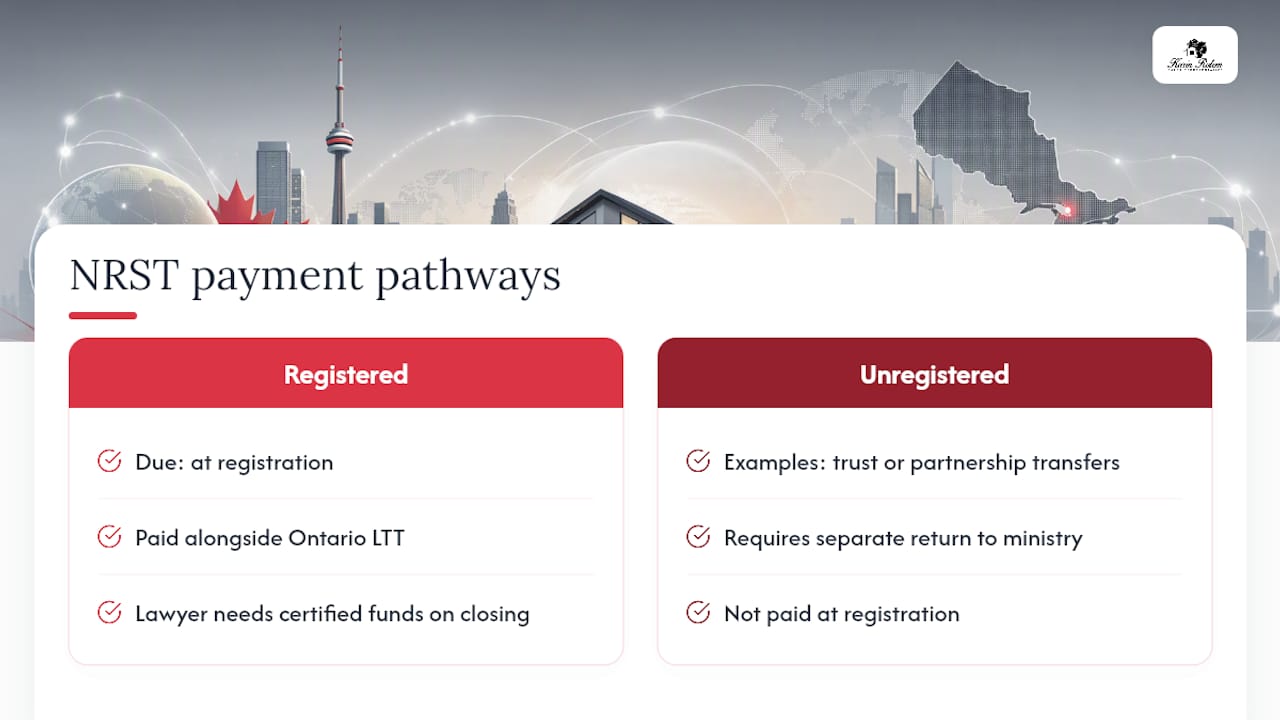
NRST is additional to Ontario’s land transfer tax, calculated separately and paid alongside it, not blended into one combined rate. For registered transfers, the tax is due at registration, meaning your lawyer needs certified funds ready on closing day. Unregistered transfers, such as certain trust or partnership transactions, require a separate return filed directly with the ministry. Get the statement of adjustments wrong on the value of consideration, and you risk an assessment well after you have already moved in.
What happens if you don’t pay or dispute NRST?
Failing to pay NRST at registration exposes you to an assessment for the tax owed, a penalty, and daily-compounded interest that adds up faster than most buyers expect. If you disagree with an assessment, your first step is a formal objection to the ministry, followed by an appeal, and ultimately judicial review if the dispute remains unresolved.
The Yavari v Ontario decision matters here because it confirmed that Ontario’s Minister of Finance retains discretionary relief power under section 20 of the Land Transfer Tax Act in exceptional circumstances, even outside the standard rebate rules. That relief is not guaranteed and is not a substitute for filing on time. If your situation involves a missed deadline, a trust structure, or a corporation with mixed ownership, get a real estate lawyer or tax professional involved before you assume the standard rules will bend in your favour.
My closing-day checklist for non-resident buyers
Here is what I actually walk clients through when NRST is in play, whether they are buying a condo near the waterfront or a family home in Innisfil.
- Before you offer: confirm everyone’s citizenship or permanent resident status, and be honest about who controls any corporation or trust involved. This decides your NRST exposure before you fall in love with a property.
- In the offer: build in conditions that give you time to gather exemption documents, and set a closing date that is not so tight it forces you to rush paperwork.
- At closing: confirm with your lawyer exactly how the transfer will be registered, which exemption documents are being filed, and what your 60-day occupancy plan looks like in practice.
- After closing: calendar your rebate deadlines immediately. If a permanent resident rebate might apply down the road, set a reminder for 180 days after your Confirmation of Permanent Residence date, and keep every document related to occupancy.
Pro Tip: If you are buying through a corporation or family trust, get NRST reviewed before you sign an agreement of purchase and sale, not after. Restructuring ownership after the fact to dodge the tax rarely works and can trigger the tax anyway on the beneficial ownership change itself.
Buyers moving to Ontario from abroad often need financing help too, and non-resident mortgage rules add another layer worth understanding early in the process, alongside real estate SEO services that can assist with targeting and capturing leads for property opportunities.
Where to find official NRST forms and guidance
For the actual paperwork and statutory language, start with the Ontario Ministry of Finance’s NRST page, which lays out the current rate, effective dates, and designated land definitions directly from the source. The rebates and refunds page has the application forms, filing deadlines, and interest rules you will need if you are pursuing a permanent resident rebate.
For the federal side, CMHC’s guidance on the prohibition against purchases by non-Canadians explains a separate restriction that can block a purchase outright, independent of anything Ontario charges. If your situation involves a trust, partnership, or corporate structure, the Cassels LLP analysis is the clearest legal breakdown of how far NRST actually reaches beyond a simple purchase.
Why the standard advice on NRST misses what actually matters
That framing misses where deals actually fall apart. In my experience advising buyers around Toronto and Friday Harbour, the real risk is not the rate itself, since almost every serious buyer already knows it exists. The risk is the paperwork sequencing: exemption documents that arrive too late, occupancy plans nobody wrote down, and ownership structures that quietly convert a Canadian-looking purchase into a foreign one.
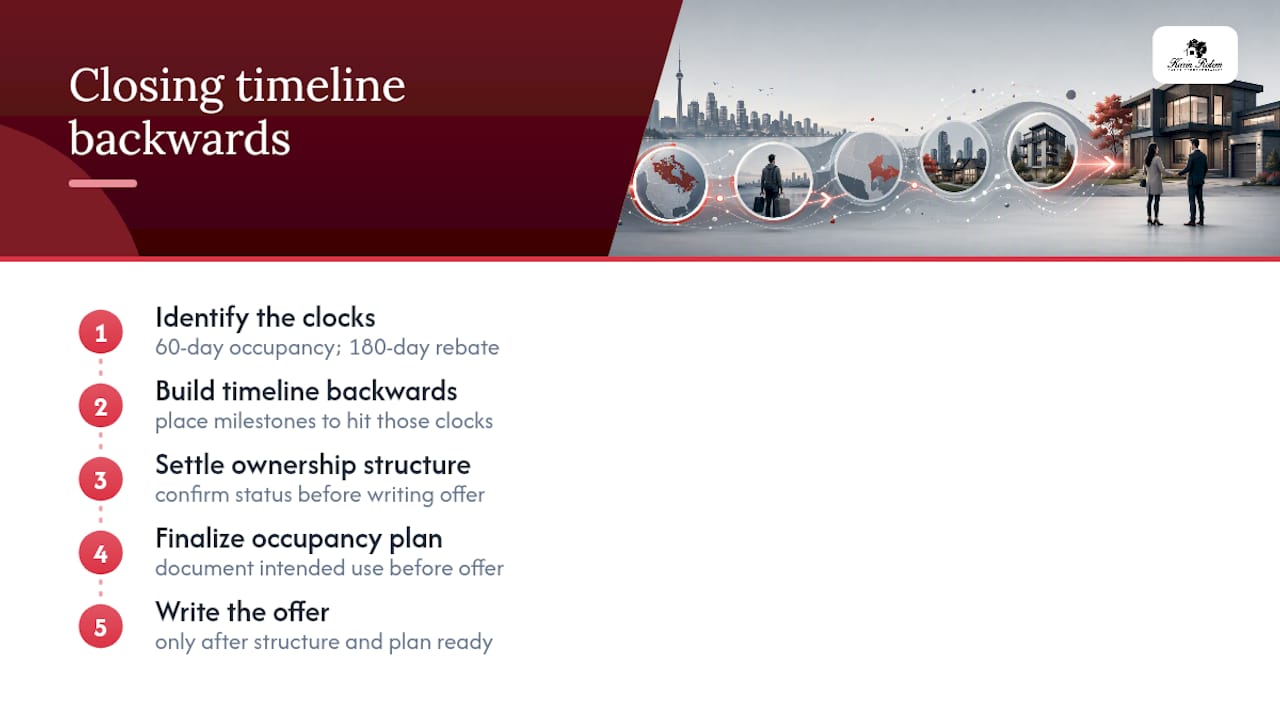
The conventional advice says “check if you’re exempt.” The better advice says build your closing timeline backwards from the 60-day occupancy deadline and the 180-day rebate window, because those two clocks start ticking the moment you close, whether you were paying attention or not. Structure matters more than status.
If you take one thing from this: get your ownership structure and occupancy plan settled before you write an offer, not after you’ve already found the perfect place. That is the difference between a smooth closing and an assessment letter six months later.
— Felix
Sources
- Ontario
- Non-Resident Speculation Tax: Ontario’s 25% Land Transfer Tax Applies More Broadly Than You May Think | Cassels LLP
- CMHC — Prohibition on the Purchase of Residential Property by Non-Canadians Act
FAQ
How much is the non-resident speculation tax in Ontario?
The NRST rate is 25% of the purchase price, in effect since October 25, 2022, and it applies province-wide on top of Ontario’s land transfer tax.
How can you avoid paying NRST?
You cannot avoid NRST if you are a foreign national, foreign corporation, or taxable trustee buying designated land, but you can claim an exemption at closing if you qualify as an OINP nominee, a protected person, or the spouse of a Canadian citizen or permanent resident, provided you meet the 60-day occupancy requirement.
Who is exempt from NRST in Ontario?
Exemptions apply to OINP nominees, protected persons with refugee status, and foreign nationals purchasing jointly with a spouse who is a Canadian citizen or permanent resident, as long as all transferees on title certify occupancy within 60 days of registration.
How much is non-resident income tax compared to NRST?
Non-resident income tax on Canadian rental income or capital gains is a separate federal matter and follows different rates than NRST, which is strictly a one-time provincial land transfer charge on the purchase itself, not an ongoing income tax.
Can a permanent resident get NRST back after paying it?
Yes, if you become a permanent resident within four years of your purchase and file your rebate application within 180 days of that permanent residence date, using your Confirmation of Permanent Residence date as proof.