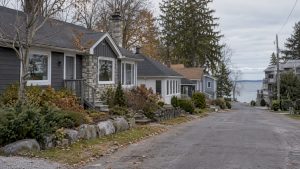
The Innisfil real estate market has shifted toward balanced territory, with months of inventory sitting around 5.3 to 5.5 across Simcoe County and average sale prices moderating rather than climbing. That is a meaningful change from the bidding-war years, and it means buyers finally have room to negotiate while sellers still see steady sales. The full breakdown below explains what that balance looks like by property type and neighbourhood.
TL;DR:
- Innisfil’s housing market has become more balanced with about five and a half months of inventory, giving buyers more negotiating power and slowing price growth.
- Detached homes continue to dominate listings, often making up over 90 percent, leading to higher average prices, while condos have a median price around $445,000 and take longer to sell.
- Rising new listings and increased supply have driven a moderation in prices, especially outside of waterfront and Friday Harbour, which remain influenced by lifestyle and investment demand.
- Buyers should secure financing and conduct proper due diligence early, especially shoreline or septic inspections for waterfront properties, to avoid surprises and strengthen their offers.
- Market statistics vary depending on sources and property types; always verify the timeframe and scope of data before relying on any single reported figure.
Innisfil real estate market snapshot: the numbers that matter right now
Local snapshots put Innisfil’s median sold price somewhere between $683,000 and $842,000, depending on the timeframe and source used, with detached homes typically pulling the average upward since they represent the bulk of active listings. Across Simcoe County, BDAR reported an average sale price near $801,680 alongside rising new listings and active inventory, a combination that signals a calmer market than the frenzy of a few years back.
| Metric | Recent figure | What it tells you |
|---|---|---|
| Average sold price (Simcoe County) | ~$801,680 | Prices are moderating, not spiking |
| Median sold price (Innisfil, aggregate snapshots) | a range depending on source and timeframe | Wide range shows why source and timeframe matter |
| Months of inventory | around five and a half, indicating a balanced to buyer-friendly market | Leaning toward balanced, near a buyer-friendly tilt |
| Condo median sold price | ~$445K | Condos sit well below the detached benchmark |
| Condo days on market | approximately 76 days, longer than detached homes | Condos take noticeably longer to sell than houses |
Detached homes still dominate listing counts, and that share pulls headline averages higher than what a typical condo buyer will actually pay. TRREB’s community reports break out average price, median price, sales counts, and average days on market at the community level, which is the dataset I lean on when a client asks me to justify a number I quote them.
What recent trends tell us about price direction
Short-term headlines can be misleading. One Simcoe flagged a notable price jump in January 2026 reaching over $860,000, a spike driven largely by a shift in the mix of homes that sold that month rather than a genuine market-wide surge. Board data since then points to moderation, not continued acceleration.
Here is what is actually driving activity on the ground:
- Rising active and new listings across Simcoe County give buyers more choice than they had two years ago, which softens upward price pressure.
- Commuter demand from GTA buyers priced out of Toronto keeps a steady floor under detached home values, particularly near Highway 400 corridors.
- Friday Harbour continues to draw a distinct buyer profile: waterfront lifestyle seekers and investors chasing rental income, a segment that behaves differently from the primary-residence market elsewhere in Innisfil.
- Investor activity has cooled slightly compared to peak years, shifting more of current demand toward owner-occupiers.
BDAR itself frames these conditions as a healthier, more balanced environment, one where increased supply gives both sides more time to make a deliberate decision instead of rushing an offer. The one-line takeaway: expect gradual, not dramatic, price movement through the rest of 2026.
Detached, townhouse, and condo: how each segment behaves differently
Innisfil is not one market. It is three, and treating them the same is the fastest way to misprice a listing or overpay on an offer.
- Detached homes carry the highest averages and dominate inventory, often making up more than 90% of active listings in some snapshots, which gives buyers more comparables to work with but also more competition for well-priced properties.
- Condos sold at a median of roughly $445,000 with about 12.3 months of supply and average days on market near 76, a much slower, more buyer-favourable segment than detached homes.
- Waterfront and Friday Harbour properties trade on lifestyle and rental potential as much as square footage, so comparables from inland neighbourhoods rarely apply.
- Townhouses sit between the two, generally faster to sell than condos but with tighter inventory than detached stock.
Rental data adds useful context for condo investors: median rents in recent snapshots run around $2,150 for a one-bedroom and $2,500 for a two-bedroom, numbers worth running against your carrying costs before assuming a condo pencils out as an income property. If you’re weighing a condo purchase, our breakdown of condo economics versus Toronto walks through that math in more detail. Segment-specific due diligence matters too: waterfront buyers need shoreline and septic checks, condo buyers need to read the reserve fund and status certificate closely.
What this means for buyers and sellers this month
Numbers only help if they change what you actually do next.
- Buyers: get your financing pre-approval locked before you start touring, since a balanced market still moves fast on well-priced listings. Pull genuine comparables from the same property type and community, not a county-wide average, and build inspection time into your offer, especially for waterfront properties where shoreline and septic conditions can be expensive surprises.
- Sellers: price to the current data, not to what a neighbour’s home sold for two years ago. A staged marketing approach, list, gauge interest for two to three weeks, then adjust, tends to outperform an aggressive opening price in this kind of market.
- Both sides: build in a realistic negotiation window. With months of inventory sitting near 5.5, neither party should expect an instant close at first ask.
Pro Tip: If you’re selling a detached home with waterfront access, get your septic and shoreline documentation ready before you list. Buyers in this market have the luxury of time, and missing paperwork is the easiest excuse for them to walk.
Sellers weighing timing should also look at seasonal patterns; our guide to listing timing in Innisfil breaks down which months tend to net the strongest offers.
How to verify a market stat before you trust it
Not every number you see online means the same thing. A board figure from BDAR or TRREB reflects actual completed MLS® transactions for a defined period and geography. An aggregator snapshot from a third-party site might pull a 28-day window instead of a trailing 12-month average, which explains why two sites can quote wildly different “average” prices for the same town in the same week.
Before you repeat a headline stat, check four things: the date range it covers, the sample size behind it (a handful of sales skews averages badly), which property types are included, and whether the source links back to a named board or MLS® feed. If a number can’t answer those four questions, treat it as a rough guide, not a fact.

Local perspective: what I tell my clients in Innisfil
What I tell buyers first is simple: get your financing sorted before you fall in love with a listing, especially on Friday Harbour waterfront units where deposit structures and closing timelines differ from a standard resale. What most buyers don’t realize is how much a shoreline or septic inspection can change their offer price, so I push for that due diligence early, not after conditions are waived.
For sellers, I talk pricing windows and audience. A home priced to this month’s data, marketed to both local buyers and the steady stream of Toronto relocators, tends to sell closer to asking than one priced on hope. If you want to see what’s actually moving right now, my current listings give a real-time sense of pace and pricing across Innisfil.
How local jobs and the economy shape Innisfil housing
Innisfil’s housing demand tracks closely with commuter economics. A meaningful share of buyers work in Toronto or Barrie and treat Innisfil as an affordable alternative within driving distance of the GTA via Highway 400, which keeps steady pressure on detached home demand even when broader market sentiment cools.
Local employment growth, particularly in Barrie’s broader labour market and Simcoe County’s logistics and service sectors, supports household formation and first-time buyer activity in Innisfil’s more affordable segments. When regional job growth slows, it tends to show up first in the townhouse and entry-level detached segments, since those buyers have the least financial cushion to absorb rate or income shocks.
Friday Harbour complicates this picture in a useful way. Its buyer pool skews toward lifestyle purchasers and investors rather than commuters chasing affordability, which makes waterfront demand less sensitive to local employment swings and more tied to broader consumer confidence and vacation-property appetite among GTA and out-of-province buyers.
What this means practically: if you’re watching Innisfil for investment timing, keep an eye on GTA employment trends and interest rate direction as much as anything happening locally, since commuter-driven demand is the segment most exposed to those broader forces. Friday Harbour buyers should instead watch discretionary spending trends and vacation-property demand more broadly.
Upcoming development and what it means for prices
New development remains one of the biggest swing factors in Innisfil’s medium-term pricing. Growth along the Highway 400 corridor and continued build-out within Friday Harbour itself both add supply in segments that are currently tight, particularly condos and townhomes.
Friday Harbour’s ongoing expansion, adding new residential phases, marina-adjacent units, and amenity buildings, continues to shape how waterfront inventory behaves. New phases typically launch at prices above resale comparables, which can pull resale values upward once a phase sells out and buyers turn to the existing stock as the more affordable option. That dynamic has played out in waterfront communities across Ontario, and Friday Harbour is no exception.
Beyond Friday Harbour, broader residential development across Innisfil adds density near existing commuter routes, which over time should ease some of the supply pressure that has kept detached home prices elevated relative to inland Simcoe County towns. More supply generally means more negotiating room for buyers, though the timeline for that relief depends heavily on how quickly approved projects actually break ground.
For sellers, nearby development is worth watching closely: a new phase launching nearby can either support your asking price by setting a higher new-build benchmark, or increase competition if it floods your specific segment with comparable inventory. If you’re considering a purchase inside Friday Harbour itself, our full guide to the resort’s real estate market covers what current and upcoming phases mean for value.
Who’s moving to Innisfil and why it matters for demand
Innisfil’s population mix has shifted noticeably over the past several years, and that shift shows up directly in what kind of housing sells fastest. Young families priced out of Toronto and Barrie continue to represent a large share of detached home buyers, drawn by more square footage and yard space for a comparable monthly payment.
At the other end, retirees and near-retirees make up a growing share of buyers in Friday Harbour and other waterfront pockets, often purchasing as a downsize from a larger GTA property or as a second home they plan to convert into a primary residence later. That demographic tends to prioritize turnkey condition and low-maintenance living, which favours condos and newer townhomes over older detached stock needing work.
Investors remain active but more selective than in previous years, increasingly focused on furnished or short-term rental potential in the waterfront segment rather than standard long-term rental units. If that’s your angle, it’s worth understanding what actually makes a rental property investor-ready before you commit to a purchase price.
What this means for demand overall: Innisfil is no longer a single-buyer-type market. Detached inventory serves families, waterfront serves lifestyle buyers and downsizers, and condos increasingly serve both first-time buyers and investors. That diversification is part of why the market has settled into balance rather than swinging hard in one direction.

Mortgage rates and lending conditions for Innisfil buyers
Financing conditions remain the single biggest variable shaping how much house a given income qualifies for in Innisfil right now. Buyers working with a mortgage broker or lender should expect the federal stress test to remain the qualifying hurdle regardless of the contract rate they’re offered, which means pre-approval numbers can shift meaningfully if rates move even modestly between application and closing.
Detached home buyers stretching toward the upper end of Innisfil’s price range should build in a rate buffer when budgeting, since a change of even half a percentage point can meaningfully affect monthly carrying costs on a mortgage in the $600,000 to $800,000 range. Condo buyers financing at the lower end of the market generally have more room to absorb rate movement, but should factor maintenance fees into their qualifying calculations, since lenders count them against affordability.
Waterfront and Friday Harbour purchases sometimes involve different financing structures depending on the property type, whether it’s a freehold home, a condo, or a resort-style unit, so buyers should confirm early with their lender which category their target property falls into. That single conversation, ideally before you start touring, saves the kind of last-minute financing scramble that kills otherwise solid offers.
How Innisfil compares to Barrie and other nearby markets
Innisfil generally trades at a discount to Barrie on a per-square-foot basis for comparable detached homes, though that gap has narrowed as Barrie’s own inventory has loosened. Reports on the broader Barrie market note price softening alongside rising supply, a pattern consistent with what’s happening across Simcoe County rather than something unique to one town.
The practical difference for buyers is usually commute trade-offs versus lot size. Barrie offers slightly shorter commute times into Toronto via GO Transit in some cases, while Innisfil typically offers larger lots and, in Friday Harbour’s case, waterfront access that Barrie’s core neighbourhoods simply don’t have. Buyers comparing the two markets should weigh those lifestyle factors as heavily as the price gap itself, since a $30,000 to $50,000 difference in purchase price can be offset quickly by commute costs or lifestyle value depending on your priorities.
An honest read on Innisfil’s market right now
The conventional advice you’ll hear about Innisfil, that it’s still a hot, undersupplied market riding Toronto overflow, is outdated. The board data tells a different story: rising supply, moderating averages, and months of inventory pushing toward five and a half. That’s not a crash signal. It’s a market finally giving both sides room to think.
Where I think most coverage gets it wrong is treating Innisfil as one market. Detached, condo, and Friday Harbour waterfront behave differently enough that a single headline average misleads more than it informs. A $445,000 condo median and an $800,000-plus detached average are not two data points on the same curve, they’re two different buyer pools with different timelines and different risk factors.
If you take one thing from this, prioritize matching your comparables to your actual segment before you price or offer on anything. The county-wide number is a starting point, not a strategy.
— Felix
How Karin Rotem can help you move on Innisfil’s current market
Karin Rotem is the local specialist for Innisfil and Friday Harbour, not a generalist covering half of Ontario, and that distinction matters when a waterfront deal involves shoreline conditions, septic checks, or condo reserve fund questions that a Toronto-focused agent simply won’t have handled before. Whether you’re buying your first detached home, selling into this more balanced market, or evaluating a waterfront property as an investment, having someone who reads these local numbers weekly changes how confidently you negotiate.
If you’re ready to see what’s actually available, browse our current properties to get a real sense of pricing and inventory across Innisfil today. If Friday Harbour specifically is on your radar, our Friday Harbour community page breaks down current listings and lifestyle details worth understanding before you make an offer. Reach out and we’ll walk through your specific goals together.
This article is general information, not a substitute for advice from a qualified financial advisor. Consult a qualified financial professional about your own circumstances before acting on anything here.
Sources
- BDAR Stats: August 2025
- TRREB community reports — Barrie Q1 2026 (PDF)
- Innisfil home prices surge 22.9 per cent to …
FAQ
How is the housing market in Innisfil right now?
Innisfil has shifted toward a balanced market, with months of inventory around 5.3 to 5.5 and average sale prices moderating rather than climbing, according to BDAR’s regional data.
Is Innisfil a good investment?
Innisfil offers solid fundamentals for investors, particularly in the condo and Friday Harbour waterfront segments, though condo median prices near $445,000 with slower days on market mean investors should model realistic rental yields against carrying costs before buying.
Where is the hottest real estate market in Canada?
Market heat shifts regularly across Canada, but Simcoe County communities including Innisfil have cooled from peak-era bidding wars into steadier, more balanced conditions rather than remaining among the country’s fastest-moving markets.
Are house prices going down in Barrie?
Barrie has seen price softening alongside rising supply, a pattern consistent with the broader moderation happening across Simcoe County, including Innisfil, rather than a sharp or isolated decline.
What’s the difference between average and median home prices in Innisfil?
Average price can be skewed upward by a few high-value detached or waterfront sales, while median price reflects the true midpoint of all transactions, which is why Innisfil’s reported prices range from $683,000 to $842,000 depending on which figure a source quotes.