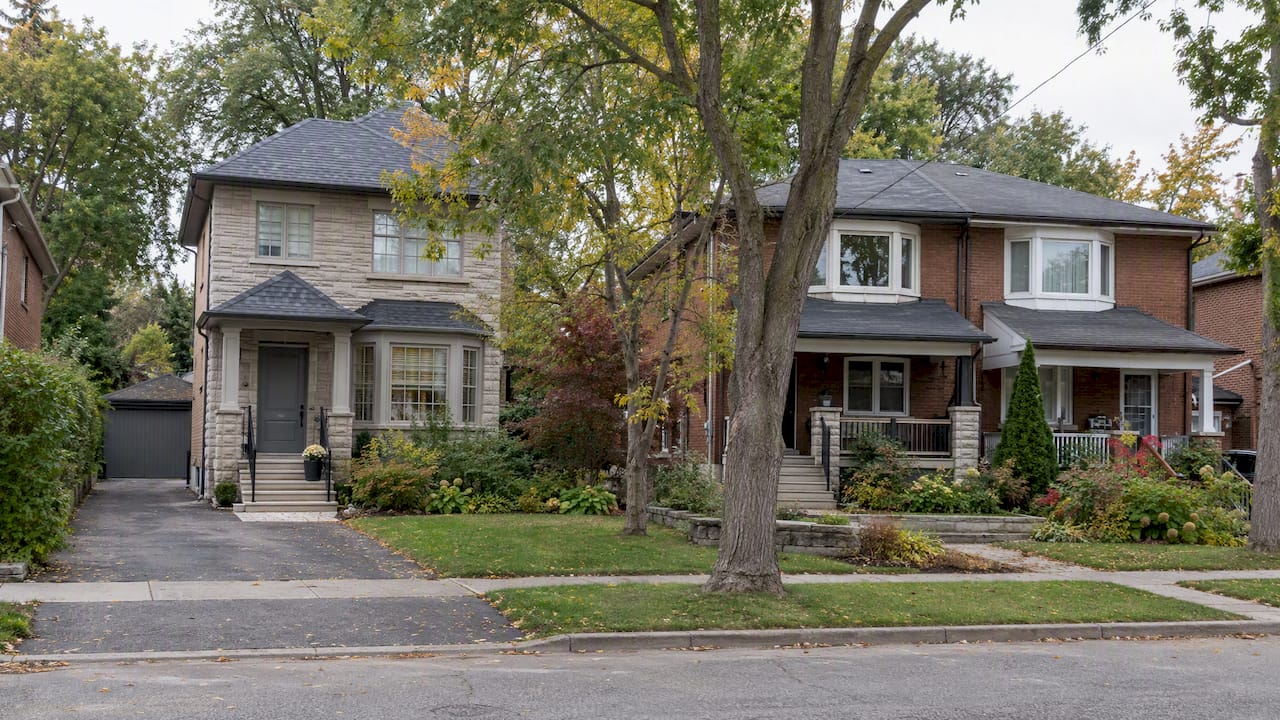
A detached house gives you the most privacy, the most control over the property and usually the highest price. A semi-detached house shares one wall with a neighbour, which usually lowers the purchase price and some running costs, in exchange for a little less privacy and fewer changes you can make on your own. Which one is better depends on how you live, how long you plan to stay and what you want the property to do for you.
I work with buyers and sellers in Toronto and Innisfil, and this question comes up constantly, especially from Toronto families who want more space without stretching their budget. What I tell my clients is simple: do not compare the two on sticker price alone. Compare them on the total cost of owning the home, the risks that come with the structure, and how easily you can sell it later.
TL;DR
- A detached home sits on its own, with no shared walls. A semi-detached home shares one party wall with the house next door.
- Semis generally cost less to buy, but the gap narrows or disappears depending on lot size, location and condition. Always compare actual listings, not averages.
- Insurance, maintenance and renovation freedom all differ. Tell your insurer exactly what you own and how you use it.
- A proper inspection matters for both types. Ontario does not licence home inspectors, so choose carefully.
- Detached tends to suit buyers who need space and privacy. Semis suit buyers who want a house and a yard at a more manageable entry point.
What actually separates the two
The definitions are short, but the consequences are long.
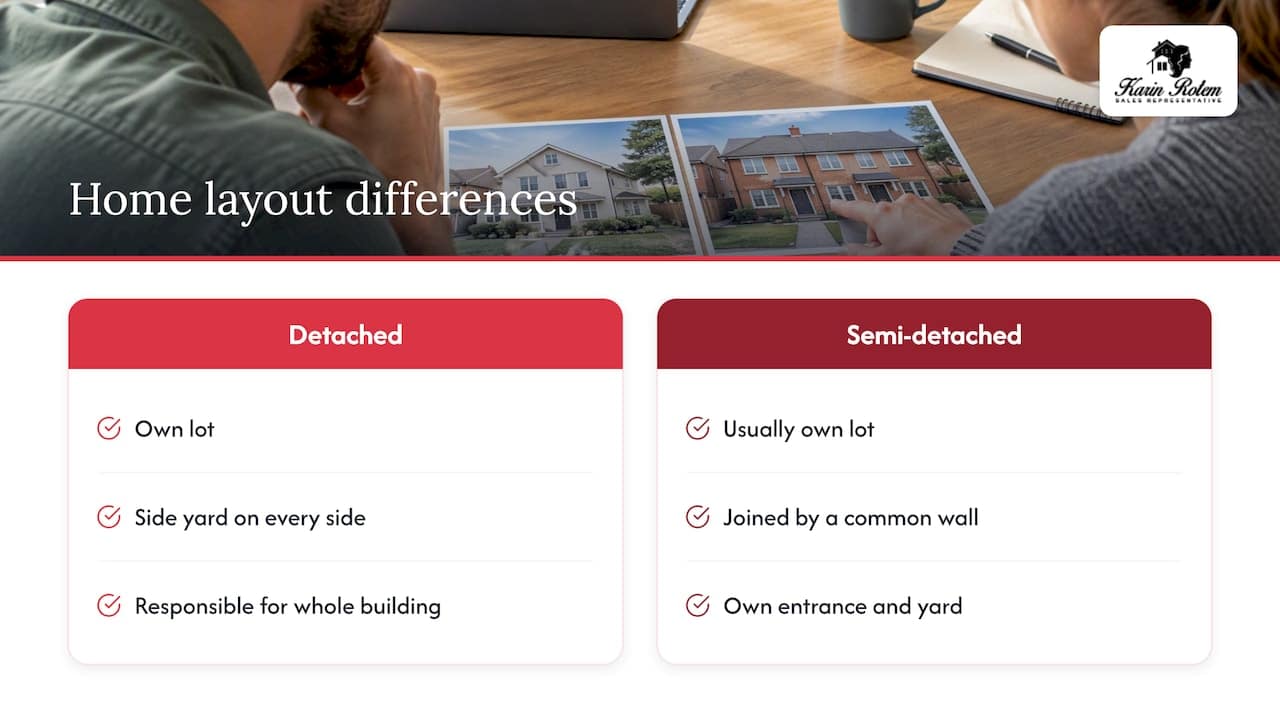
Detached: a freestanding house on its own lot. There is open space, or at least a side yard, on every side. You are responsible for the whole building.
Semi-detached: two homes built as a pair and joined by a common wall, each usually on its own lot. From the street it often looks like one larger building. Each side typically has its own entrance, its own yard and its own mortgage.
One point trips up a lot of buyers. A semi is not a condo or a townhouse in the usual sense. In most of Ontario, you own your half of the building and the land under it, which is called freehold. Some attached homes, though, are held as part of a freehold condominium corporation, which is a structure the Condominium Act, 1998 defines as one where the owners hold their units in fee simple. If a listing mentions a corporation or monthly fees, ask your agent and your lawyer what you are actually buying before you fall in love with the kitchen.
Price: what you pay and what you get for it
Everyone expects the semi to be cheaper, and often it is. You are buying less land, less exterior wall and a shared structure. But I would be misleading you if I said the discount is a fixed percentage. It changes street by street.
What most buyers don’t realize is that a renovated semi on a good street can sell for more than a tired detached house a few blocks over. Condition, lot size, parking, finished basement and location can swamp the style difference. A 25-foot-wide lot with a detached house may not feel that different from a wide semi.
So here is how I suggest you compare:
- Pull three or four recent sales of each type within a few streets of the home you like.
- Compare price per square foot of living space, not just the headline number.
- Note the lot width and whether there is a driveway or garage.
- Look at how long each home took to sell and whether it sold near asking.
That gives you a local answer rather than a general one. In Innisfil and Toronto the pattern is different, so I run this exercise separately for each client. If you are weighing Toronto against Innisfil, our breakdown of how Friday Harbour condo prices compare to Toronto shows how much the location alone can move the numbers.
Your budget is more than the price
The purchase price is one line in a longer list. The Canada Mortgage and Housing Corporation explains that the cost of a home includes more than the price once you add up the other costs of buying. Property taxes, insurance, utilities and repairs all follow you for as long as you own. Run both options through that full list before you decide, because a semi that saves you money up front only wins if its running costs are in line.
Privacy, noise and space
This is where detached homes earn their premium.
In a detached house, your neighbours are a side yard away. You can run a vacuum at 7 a.m., host a loud birthday party or practise the drums in the basement without thinking about who is on the other side of the drywall. You also usually get more room for an addition, a bigger driveway or a detached garage, subject to municipal rules.
In a semi, you share a wall. Well-built party walls are often quieter than people fear, but the quality varies with age and construction. What I tell my clients is to visit at different times: a weekday evening, a Saturday morning. Stand in the room that backs on the party wall and listen. Ask whether the neighbours have kids, a home business or a dog that barks. You are not just buying a house, you are agreeing to a long relationship with one household.
There is a flip side. Many people find a semi cosier and more connected, and a shared wall can make the street feel more neighbourly. For some of my clients, that is a feature.
Maintenance and renovation: who decides what
With a detached home, every decision is yours. Roof, windows, siding, foundation, landscaping: you pay for all of it, and you also choose the timing. That freedom is valuable, and so is the responsibility.
With a semi, the structure is shared in ways that matter:
- The party wall. Any work that touches it, from opening it up to altering a chimney or adding a second storey, needs care and often coordination with the neighbour and the municipality.
- The roofline and exterior. If your neighbour paints their half a different colour or replaces their windows in a different style, it affects how the pair looks. Some buyers do not care. Others care a lot.
- Shared repair situations. Water or fire problems on one side can affect the other. Good neighbours make this easy; bad ones make it painful.
- Basement and foundation. Check the condition at the party wall and how drainage is handled on both lots.
Most buyers focus on the kitchen and forget the less glamorous question: what will the next 15 years of maintenance cost? A semi may have lower exterior upkeep because you are maintaining roughly half the envelope, but only if the neighbour maintains theirs as well.
Insurance: the cost buyers forget
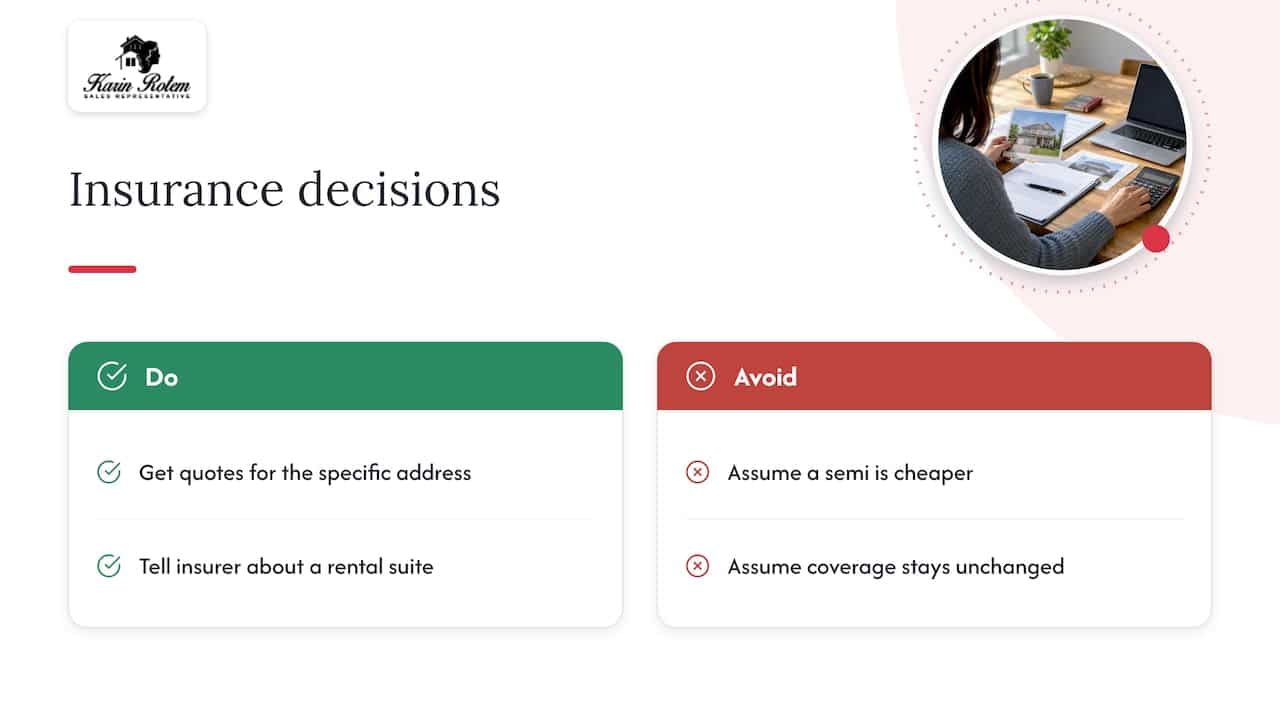
Insurance is not identical for the two types, and it is worth getting quotes before you waive conditions. According to the Financial Consumer Agency of Canada, home insurance is not one-size-fits-all, and your premium reflects the specific home you own. Insurers look at things such as the structure, materials, age of the home and the neighbourhood. Your claims history, your deductible and the replacement value of the home also push the number up or down.
In practice, that means a detached and a semi-detached home with similar sale prices can be priced differently by an insurer, because the shared wall and the building’s risk profile are not the same. I cannot tell you which will be cheaper for your situation, and I would not trust anyone who does without a quote in hand. Ask your broker for quotes on the specific address, before you remove conditions on the purchase.
If you plan to rent out a basement suite, tell your insurer at the start. A secondary suite changes the risk, and your coverage should reflect how the home is really used. Do not assume it stays the same after you add a rental unit. This applies equally to a detached house and to a semi, and failing to disclose it can leave you exposed when you need to make a claim.
Inspection: the same discipline for both
Whatever you choose, do not skip the inspection. The federal Office of Consumer Affairs describes a good inspection as a non-invasive, visual evaluation of the main systems and components of a home, which helps you understand its condition and the repairs it may need before you buy.
Here is the part that surprises people. Ontario has no law requiring home inspectors to be certified or licensed, so, in practice, anyone can offer the service. That makes your choice of inspector a real decision. What I tell my clients:
- Ask whether the inspector belongs to an established professional association.
- Ask about errors-and-omissions insurance.
- Request a sample report and check that it covers the foundation, roof, electrical and plumbing, not just a quick walk-through.
For a semi, ask the inspector to pay special attention to the party wall, the attic at the shared line, and the basement where the two homes meet. For a detached house, the roof, grading and foundation on all four sides deserve extra time.
The report also helps you plan. An older furnace, water heater or set of appliances is not necessarily a reason to walk away, but it is a reason to budget. If the home comes with older appliances, it helps to understand repair-or-replace cost examples per year so that a fridge or dryer failing in year one does not catch you off guard.
If you want to understand how to protect your deposit while you do all this, read our guide on the agent-led home inspection contingency in Ontario. For attached homes held through a condominium structure, the home inspection for condo purchase article covers what is different.
When a status certificate matters
If the semi you like turns out to be part of a condominium corporation, a status certificate becomes essential. It shows the corporation’s financial health, including the reserve fund and any legal claims or planned levy increases. Under Ontario’s regulation, the fee for it is capped, and it is money well spent. Have your lawyer review it. A low monthly fee today can hide an underfunded reserve and a large special assessment tomorrow.
Resale and who your future buyer is
Detached homes usually reach the widest pool of buyers. That generally supports demand and can make them easier to resell, especially for growing families. Semis appeal to a more defined group: first-time buyers moving up from condos, couples who want a yard, downsizers who no longer want a large lot, and investors.
What this means for you is a question about your exit, not just your entry. If you may sell in three to five years, ask yourself who will buy this house from you. A semi in a sought-after neighbourhood close to transit and schools will sell well. A semi on a street with nothing but large detached homes might be a harder sell, or it might be the cheapest way into a great location. Both are true at different times.
If you are already a homeowner and thinking about the sequence, our buy first or sell first checklist for Ontario homeowners will help you plan around the timing risk.
Which type fits which buyer
Here is the honest summary, with the trade-offs left in.
| Your priority | Detached tends to fit | Semi-detached tends to fit |
|---|---|---|
| Maximum privacy and quiet | Yes | Depends on the party wall and the neighbours |
| Lowest purchase price | Rarely | Often, but verify with local sales |
| Control over renovations | Full control, within municipal rules | Shared structure limits some choices |
| Exterior maintenance | All yours | Partly shared in effect, but only if both sides maintain |
| Room to grow a family | Usually more lot and space | Often enough, with a smaller footprint |
| Broadest resale audience | Generally yes | A narrower but active group |
| Income or basement suite | Possible, subject to zoning and insurance | Possible, subject to zoning, party-wall rules and insurance |
If you want the largest yard, a garage and no shared walls, and you can afford it, buy the detached home. If your budget would be stretched to the limit by a detached house, I would rather see you buy a well-located, well-maintained semi than a detached house you can barely afford. A mortgage that leaves breathing room is worth more than a few extra feet of side yard.
Beyond Toronto: how Innisfil and Friday Harbour change the equation
Many of the families I work with are leaving Toronto for a quieter, lifestyle-focused community. For them, the question changes. In Toronto you are often choosing between a detached house you cannot reach and a semi you can. In Innisfil, the same budget may open different options, including detached homes with more land, or a waterfront condo at Friday Harbour that works as a weekend retreat.
If you are considering that move, start with our guide to selling your Toronto home and buying in Innisfil. If you are looking at the waterfront itself, check what to verify before buying waterfront in Innisfil, because shoreline rules and permits can matter more than the style of the house. Our overview of the Innisfil real estate market gives you the local picture.
I will also be direct about something. Friday Harbour is primarily a resort-style community of condos and similar lifestyle properties, and it will not suit every buyer who is searching for a classic detached or semi-detached house. If that is your goal, I will say so, and point you to the areas where those homes are found.
Perspective: what we see in practice
After working with buyers across Toronto and Innisfil, our view is that the detached versus semi-detached debate is rarely about the walls. It is about what the buyer is trying to protect: their budget, their privacy, their time or their investment.
Our team is known for being the number one team at The Harbour and for ranking in the Top 100 worldwide at RE/MAX, but those results come from a habit that applies here too: we ask what the property is for before we ask what it costs. A buyer who wants a quiet family home and a buyer who wants a rental income property can look at the same street and need completely different houses.
We tell clients to test every shortlisted home against three questions. Can I carry this comfortably if rates or my income change? Who will buy it from me? What will it need in the next five years? If a semi passes all three and a detached house does not, the semi wins, and we will tell you so even if the commission would be larger on the other house. The reverse is equally true.
— Felix
Work with a local agent on this decision
If you are comparing a detached house and a semi, the most useful next step is to see real sales and real listings side by side. We can build that comparison for the streets you care about and help you set up listing alerts. Start on our main site, or if the waterfront lifestyle is part of your plan, browse Friday Harbour condos for sale. We will tell you honestly when a property is not the right fit.
FAQ
What is the main difference between a detached and a semi-detached house?
A detached house stands alone with no shared walls. A semi-detached house is joined to its neighbour by one common wall, and each half normally has its own lot and entrance. That shared wall drives most of the differences in price, privacy and renovation freedom.
Is a semi-detached house a good investment?
It can be, particularly in locations with strong rental or first-time buyer demand, because the entry price is often lower. Returns depend on the street, the condition and your costs, so compare recent local sales and get insurance quotes first. If you plan to rent out part of the home, tell your insurer from the start.
Do semi-detached homes cost less to insure?
Not automatically. Insurers price each home on its structure, materials, age, location and your claims history, so two homes at the same price can have different premiums. Ask a broker to quote the specific address before you remove conditions.
Do I need a home inspection for a semi-detached house?
Yes, as with any house. Ontario does not require home inspectors to be licensed, so check their association membership, insurance and a sample report. Ask them to look closely at the party wall, the shared attic line and the basement.
Are semis harder to resell than detached homes?
They usually appeal to a narrower group of buyers, but that group is active in many neighbourhoods. A well-kept semi in a desirable location can sell quickly. The street and the condition matter more than the label.
Sources
- Home insurance, Financial Consumer Agency of Canada
- Home inspections, Office of Consumer Affairs
- O. Reg. 428/19, ontario.ca
- Condominium Act, 1998, ontario.ca
- Estimate the total cost of your home purchase, CMHC
Recommended
- What’s it like living in Aquarius vs. Ferretti Townhomes at Friday Harbour? – Compare before you buy
- What’s the Difference Between Friday Harbour Condos & Townhomes? | Know Before You Buy
- Waterfront property types near Toronto: living or investing
- What Are the Best Floorplans for Resale Value at Friday Harbour? Smart Layouts for Buyers