Landlord insurance is the policy you need once someone other than you lives in your property. It protects the building, your liability as an owner and, in many policies, the rent you lose after an insured loss. It is not required by Ontario law, but your mortgage lender will almost certainly ask for it, and your regular home policy may not respond if you rent the place out without telling your insurer.
I am a real estate agent, not an insurance broker, and I will not quote you a premium. But I sit with investors and second-home buyers in Toronto, Innisfil and Friday Harbour every week, and insurance is the line item that surprises them most. Here is what I tell my clients, and what to bring to a broker.
TL;DR
- Landlord insurance is built for tenant-occupied property. It covers the building, your liability and often lost rent, but not your tenant’s belongings.
- Provincial law does not require it, but most mortgage lenders require landlord-specific coverage.
- Tell your insurer you are renting, and keep that notice in writing. Unreported occupancy can put a claim at risk.
- Condos, seasonal homes, furnished units and short-term rentals each need a different conversation with your broker.
- Budget indicatively, then get quotes. Insurers price on age, location, size, deductible and claims history.
What landlord insurance is, and how it differs from home and tenant insurance
Three policies, three different jobs.
| Policy | Who buys it | What it is built for |
|---|---|---|
| Home insurance | Owner who lives in the home | Owner-occupied house or unit |
| Landlord (rental property) insurance | Owner who rents it to tenants | Tenant-occupied building, landlord liability, eligible rental income, landlord-owned contents |
| Tenant insurance | The renter | The renter’s belongings and personal liability |
That split comes from Westland’s Ontario rental property overview, and Intact makes the same point: landlord insurance does not normally cover tenants’ belongings.
The practical consequence: if a tenant’s laptop, couch and clothes are destroyed in a fire in your building, your policy rebuilds the building. The tenant’s own policy, if they have one, handles their things.
You cannot make a tenant carry insurance by assuming it. Tenants are not required to have tenant insurance under the Residential Tenancies Act or the Condominium Act, but a lease or a condo corporation’s governing documents may require it. If you want it, put it in the lease.
Is landlord insurance required in Ontario?
Not by provincial law. In practice, though, it is rarely optional.
- Your lender. Most mortgage lenders require landlord-specific coverage. If you are financing a rental, expect to show proof of coverage before closing. If you are still working out how much a lender will count your rent toward qualifying, see our guide on how lenders count rental income.
- Your condo corporation. Declarations and rules differ from building to building. Ask for the governing documents and read the insurance and leasing provisions before you buy, not after.
- Your own risk. Even a mortgage-free owner is one slip-and-fall claim away from a very bad year.
What most buyers don’t realize is that the requirement is often written into the commitment letter, not into anything they sign at the insurance counter. Ask your mortgage broker what the lender wants before you shop for a policy, so you do not buy twice.
What a rental property policy typically covers
Wording varies by insurer, so treat this as the common structure and read your own policy.
The building
Building coverage protects the dwelling, and can include detached structures such as a shed, gazebo or garage. Insured perils typically include fire, hail and vandalism, and basic water damage from something like a leaking pipe is a common example. Floods and earthquakes may need add-ons.
Your contents
Landlord-contents coverage is for what you own and supply: appliances, carpets, furniture and maintenance equipment. If you rent furnished, this line matters much more. Our piece on furnished rental property features investors need shows what typically goes into a unit, which is a useful inventory to give your broker.
Liability
Premises liability protects you if you are found liable for damages or injuries that occur on the property. Think of an icy walkway, a failed railing or a guest hurt on the stairs.
Lost rental income
Coverage can include rent you lose when tenants cannot return after a covered loss. Check how long the policy pays and how it defines the trigger. A policy that pays rent only after a covered peril is not the same as one that pays when a tenant simply stops paying.
Exclusions and add-ons to check
This is where a cheap quote and a good quote part ways. Ask your broker to walk you through these specifically:
- Tenant damage. Landlords should look for exclusions for intentional tenant damage, gradual deterioration and ordinary wear and tear. Vandalism and malicious damage by tenants can be an optional endorsement.
- Sewer backup and overland flood. Often optional endorsements. If your property sits low, near a creek or on the waterfront, do not skip this conversation.
- Equipment breakdown. Another optional endorsement worth pricing if you own HVAC, boilers or built-in appliances.
- Vacancy conditions. Policies often limit coverage if a unit sits empty for a stretch. Ask what counts as vacant and for how long.
- Deductibles. Higher deductibles can lower the premium, but increase what you pay out of pocket on a claim.
Ontario’s financial regulator has noted that home insurance products are complex, with wordings and endorsements varying by insurer, and that consumers should understand their coverage and review it regularly. Put a calendar reminder on your renewal and read the changes, not just the price.
Condo, seasonal, furnished and short-term rentals
The type of property changes the answer more than most owners expect.
Condo units
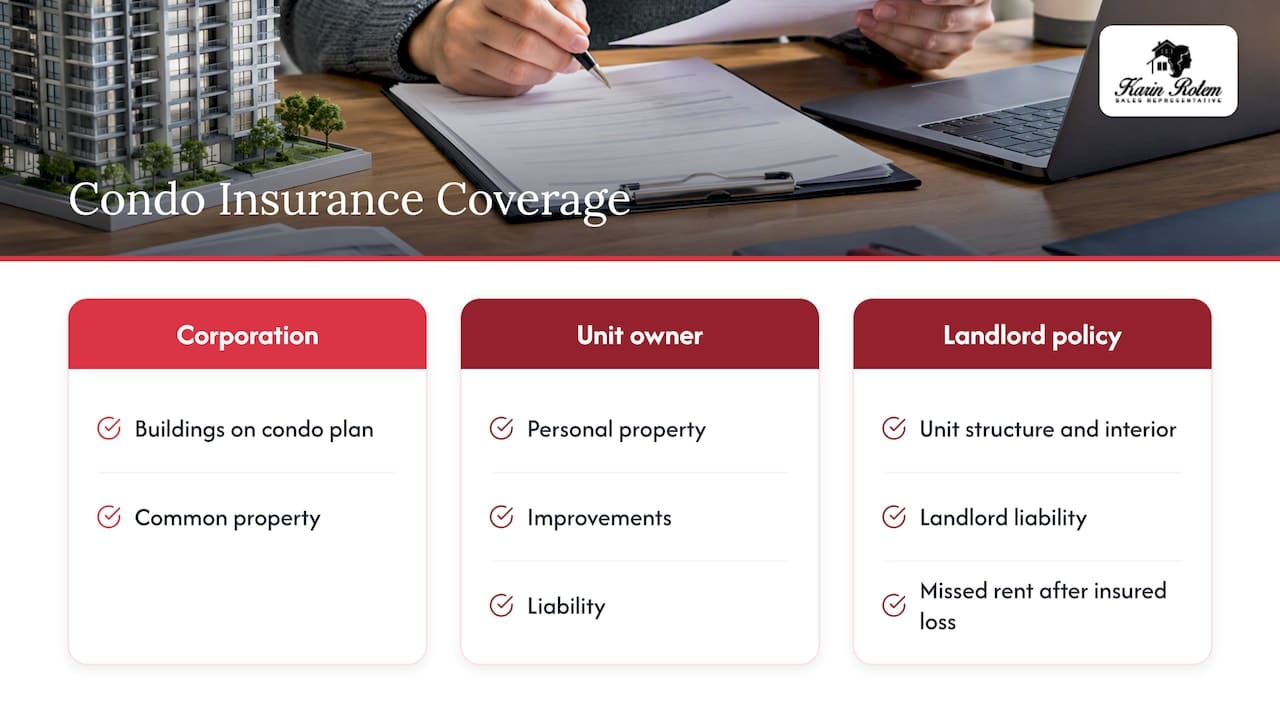
The corporation’s policy typically covers the buildings shown on the condo plan and the common property, while a unit owner’s policy typically covers personal property, improvements and liability. A condo owner who rents the unit out might need landlord condo insurance or rental dwelling insurance, which can cover the unit’s structure and interior, landlord liability and missed rent after an insured loss.
There is a second condo risk that insurance does not neatly solve: special assessments. A shortfall in the building’s reserve fund can land on owners as a bill. Before you buy a rental condo, read about condo special assessments in Ontario and how a reserve fund study signals a building’s health. Ask your broker whether any assessment-related coverage is available on your policy, and what it excludes.
Seasonal and secondary homes
The Insurance Bureau of Canada says seasonal or secondary homes may have coverage limited to named perils, and that whether and how often you rent them must be disclosed. That matters for cottage and resort-community owners who rent a few weeks a year to offset costs. A few weeks of rental is still rental.
Furnished rentals
Furnished means more of your property is inside the unit, so contents limits matter. Photograph and list what you supply, keep receipts, and make sure your landlord-contents limit reflects replacement cost, not what you paid five years ago.
Short-term rentals
If you plan to list on a booking platform, speak to your insurer first. The IBC warns that failing to do so can void coverage. A standard long-term landlord policy may not contemplate a different guest every weekend. Zoning and licensing are a separate gate, so read our overview of Airbnb zoning compliance in Ontario before you commit to a strategy.
Disclosure: the step people skip
Tell your insurer when your living arrangement changes, in writing, and keep a copy. The IBC is blunt on this: failing to fully disclose occupancy may void a home insurance policy, and a tenant-started fire may not be covered if the insurer did not know there was a tenant.
This catches the “accidental landlord” most often: the owner who moves for work and rents out the old home, or the buyer who closes on a condo intending to live in it and then rents it. Move the policy before the tenant moves in, not after.
Bring this to your broker:
- Who will live in the property, and under what kind of lease
- Whether it is furnished, and what you supply
- Whether you will ever rent short-term, even occasionally
- Age of the roof, wiring, plumbing and heating
- Your claims history over the past several years
- The lender’s insurance requirements, if you have a mortgage
What it costs, and what moves the price
I cannot give you a reliable Ontario-wide number, because there is no regulated rate. One broker-side source puts typical annual cost at about $800 to $1,500 and describes the figures as indicative. Another says landlord insurance often costs 15% to 25% more than standard homeowner insurance. Treat both as rough planning figures and replace them with real quotes.
The factors that move your premium:
- Location
- Building size, age and construction
- Coverage limits and deductibles
- Safety features
- Claims history
- Number of rental units
Those factors are listed by KASE, and in my experience the age of the building and the water history dominate the conversation. An older detached house with original plumbing and a finished basement unit will price very differently from a newer condo.
Run the number before you buy
Insurance belongs in your cash-flow math from day one, alongside property tax, condo fees, maintenance and vacancy. Plug a realistic insurance estimate into the mortgage and affordability calculators before you write an offer. A unit that works at one premium and fails at 30% higher is a thin deal.
Tax treatment
Landlords can generally deduct reasonable, current insurance premiums from gross rental income. Two details from the CRA: if only part of a property is rented, only the portion of the premium related to the rented area can be deducted, and under the accrual method, prepaid insurance is deducted in the year or years the coverage relates to. If you run short-term rentals, our guide on T776 steps for short-term rental owners covers the deductions side. Confirm your own situation with an accountant.
Our perspective: insurance is part of the purchase decision
We see insurance treated as paperwork that happens after the offer is accepted. That is backwards. When we help an investor look at a resort-community condo or a waterfront home, we ask about insurance at the same time as we ask about condo fees and rent expectations, because it changes whether the numbers work.
Three habits we recommend to every client who plans to rent:
- Call a broker before you waive conditions. If a property is hard to insure, or insurable only with a steep premium or heavy exclusions, you want to find out while you can still walk away.
- Be honest about your rental plan. A client who says “maybe a few weeks of short-term stays in summer” gets a better, safer policy than one who says nothing and hopes. Ask whether the use is allowed by the condo’s rules and the municipality as well.
- Match the policy to the property type. Waterfront homes raise water and shoreline questions. Furnished units raise contents questions. Condos raise questions about what the corporation insures and what you do. Our guide to waterfront property types near Toronto and the one on erosion control on Ontario waterfront cover why those properties deserve extra care.
And an honest note about fit: if you want a hands-off investment with the least possible paperwork, a single long-term tenant in a standard condo is far simpler to insure than a rotating short-term rental. Resort-style properties can be a great experience and a good hold, but they ask more of you. If you are weighing that, read about whether you can use a Friday Harbour condo as a vacation property and how a condo hotel unit works differently from a standard unit.
— Felix
Buying a rental in Innisfil or Friday Harbour?
If you are looking at an income or vacation property around Innisfil, we can help you test the numbers, including insurance, fees and realistic rent, before you make an offer. Start with Friday Harbour condos for sale, see what is available for rent at The Harbour to benchmark income, or get in touch with our team for guidance tailored to your plan.
A short checklist for the day you arrange coverage
- Confirm the lender’s insurance wording before shopping.
- Tell the insurer in writing that the property is or will be tenant-occupied.
- Ask for quotes with at least two deductible levels and compare the out-of-pocket cost on a claim.
- Ask about sewer backup, overland flood, equipment breakdown and tenant vandalism.
- Ask about vacancy rules and how long lost-rent coverage pays.
- Put tenant insurance in the lease if you want it.
- Keep your policy documents and renewal notices in one folder, and review at each renewal.
- If rent rules affect your plans, read the Ontario rent control guide so your income assumptions are realistic.
FAQ
Do I need landlord insurance if I only rent out a room?
Yes, you should tell your insurer. The IBC advises that failing to disclose occupancy may void a home insurance policy. Your insurer may keep you on a home policy with an endorsement or move you to a different one. Get the answer in writing.
Does landlord insurance cover my tenant’s belongings?
No. Landlord insurance does not normally cover tenants’ belongings. Tenants need their own policy, and you can require it in the lease.
Can I cancel landlord insurance between tenants?
I would not, and I would speak to your broker first. A mortgage lender may require continuous coverage, and a vacant property may still be at risk. Ask what vacancy conditions apply instead of cancelling.
Is landlord insurance tax-deductible?
Generally, yes, as a reasonable current expense against rental income, with the partial-rental and prepaid rules the CRA describes above. Your accountant can confirm how it applies to your return.
What if I rent my condo on a short-term basis?
Call your insurer before you list. Failing to do so can void coverage, and you will also want to check condo rules and municipal zoning.
Sources
- Rental Property Insurance Ontario, Westland Insurance
- CAO Condo Landlords’ Guide
- What is landlord insurance? Intact Insurance
- Landlord insurance for rental properties, Intact Insurance
- Rental property insurance, Co-operators
- Home Insurance Thematic Review Report, FSRAO
- Types of home coverage, Insurance Bureau of Canada
- What Is Condo Insurance, RBC Insurance
- Renting out a room? Insurance Bureau of Canada
- Optimize Landlord Insurance in Ontario, KASE Insurance
- Rental Income, Canada Revenue Agency
- Rental expenses you can deduct, Canada Revenue Agency