If you rent out a cottage, a resort condo or a second home for part of the year, your regular home or seasonal policy probably does not cover that rental unless your insurer has agreed to it in writing. The fix is simple: tell your insurer how often you rent and for how long, then ask for short-term rental coverage, or a separate policy, with liability and lost-income protection included. I’m Karin Rotem, and I see this question come up with nearly every investor and weekend-retreat buyer I work with in Innisfil, Friday Harbour and the GTA.
TL;DR
- Seasonal property can be added to a home policy or insured on its own, but you must disclose use and any rental activity. IBC says so directly.
- Undisclosed rental use can void coverage, so call your insurer before the first guest books.
- Platform protection from a booking site is not a substitute for your own policy.
- Published cost ranges for Canadian hosts vary widely, from about $800 to $1,500 a year for typical hosts, and your quote depends on your property and how you rent.
- Check exclusions (frozen pipes, sewer backup, watercraft, business use) before you sign, not after a claim.
What “seasonal rental insurance” actually means
There is no single product with that name. When people search for it, they usually mean one of three things:
- Seasonal or recreational property insurance for a cottage, cabin, trailer or second home that sits empty part of the year.
- Short-term rental insurance for a property you rent to guests by the night or week, the Airbnb and VRBO style.
- Landlord insurance for a property you rent to a tenant on a longer lease.
The Insurance Bureau of Canada (IBC) explains that seasonal insurance applies to cottages, cabins, trailers and some RVs, and that a seasonal property may be added to a home policy or insured separately. Coverage typically spans the building, detached structures, contents and liability. Where it gets tricky is the rental. IBC’s Ontario guidance adds that how often the property is used and whether it is rented short or long term must be disclosed.
What most buyers don’t realize is that renting for six weekends a summer and renting full-time through a platform are two very different risk profiles to an insurer. You describe yours, and they price it.
Does your current policy cover an Airbnb or cottage rental?
Usually not by default. IBC advises that properties rented for long or short terms face different risks, that owners should contact their insurer first, and that failing to disclose rental use can void coverage.
IBC’s landlord guidance spells out the logic: an ordinary home policy covers your property, your contents and your personal liability, not a tenant’s contents or personal liability. Its example is a tenant who accidentally starts a basement fire while the insurer does not know the tenant exists. Undisclosed occupancy of that kind can put the whole claim at risk.
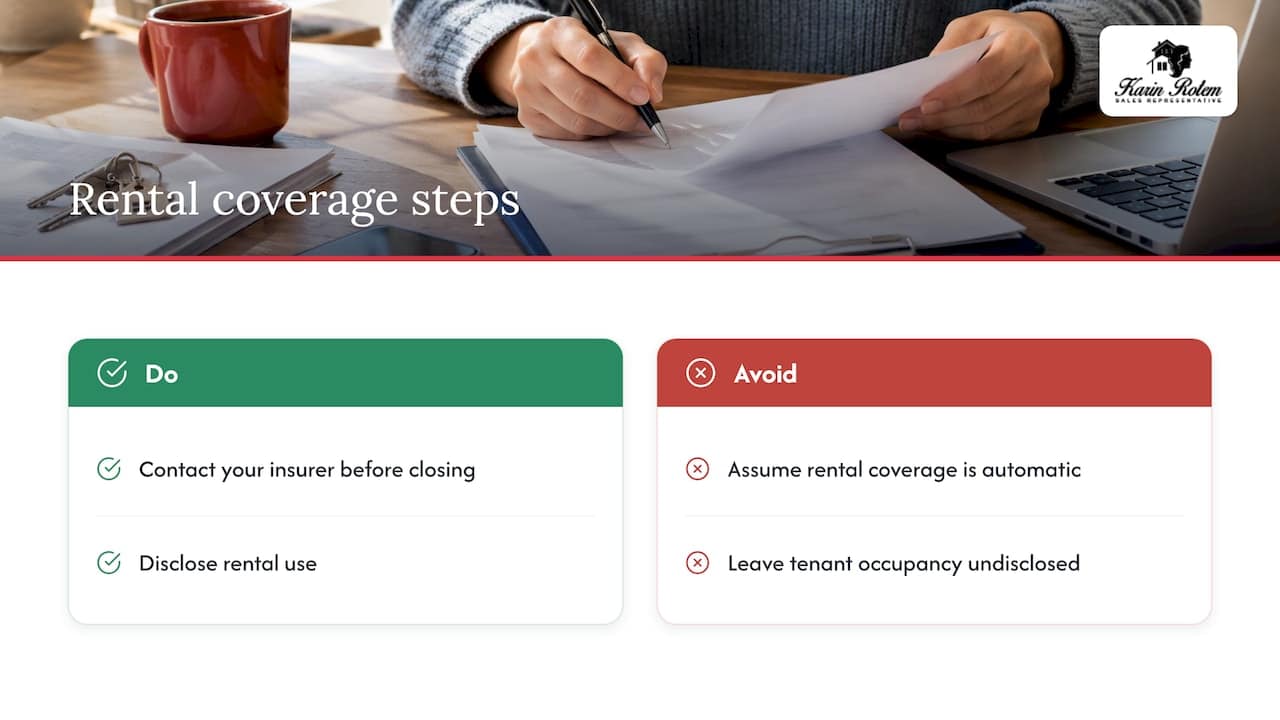
What I tell my clients: the phone call to your insurer or broker is the cheapest step in the whole purchase. Make it before closing, not after your first booking.
What to say on that call
- Whether you rent part of the property or all of it
- How many nights a year, and in which seasons
- Whether guests book through a platform or directly
- Maximum number of guests at a time
- Amenities guests can use: boats, kayaks, hot tub, fire pit, wood stove, dock
- Whether the property is winterized or closed for part of the year
Ask for the answers in writing, or for the endorsement to appear on your declarations page.
Why platform protection is not insurance
Booking platforms advertise host protection, and it can be a useful extra. But it is not the same as a policy you hold. An Ontario broker’s breakdown describes Airbnb’s AirCover as limited, internally administered protection that excludes items such as cash, jewellery, collectibles, vehicles or watercraft, damage to neighbouring property and some lost income. Read the current terms on the platform itself, since they change.
I treat platform protection as a layer on top of insurance, never underneath it.
What good short-term rental coverage includes
Use this checklist when you compare quotes. It reflects what IBC and a published Canadian policy wording flag as the key pieces.
| Coverage | Why it matters for a rental |
|---|---|
| Dwelling and detached structures | Covers the building, plus garages, sheds and docks if listed |
| Contents | Furniture, linens, appliances you supply to guests |
| Commercial or host liability | Guest injuries and property damage claims, including defence costs |
| Guest damage | Accidental or malicious damage by guests |
| Rental income interruption | IBC notes landlord coverage can replace lost rental income after an insured loss |
| Water and sewer backup endorsements | Often excluded on seasonal properties unless added |
| Boats, watercraft, recreation equipment | Usually need their own coverage |
Also check the limits: booking-days per year, guest counts, and the deductible. One Canadian comprehensive home policy, for example, permits renting only for the time shown on the declarations and limits occupancy to two short-term rental groups at once. Wording differs by insurer and province, but it shows that rental coverage is an endorsement with conditions, not something to assume.
Common exclusions on seasonal and rental properties
This is where claims get declined, so read this part twice.
- Sewer backup and outdoor items. IBC Ontario says sewer backup and losses involving fences, freezer food, garden equipment, outdoor plants, trees and shrubs are commonly excluded on secondary or seasonal properties, with optional coverage possibly available.
- Frozen pipes and poor maintenance. IBC also flags frozen pipes, poor maintenance, pests, theft and vandalism as seasonal exclusions to look for in its seasonal property guidance.
- Watercraft and sports equipment. The policy wording cited above excludes certain sports-equipment and watercraft claims, wood-burning appliance claims, and business use during the short-term rental extension.
If your property sits on Lake Simcoe or any waterfront, ask about docks and boats specifically. Our guide to buying on Lake Simcoe waterfront covers shoreline, permits and insurance questions for GTA buyers in more detail. If you close the place for winter, our piece on winterizing an Ontario cottage explains the closing-up decisions that can affect frozen-pipe claims.
What does seasonal or short-term rental insurance cost?
Honest answer: it depends, and published figures come from brokers and managers rather than a regulator, so treat them as ballparks.
- One Canadian broker reports that most Airbnb and VRBO hosts pay roughly $800 to $1,500 a year, with cost driven by location, property type and size, guest numbers, rental frequency, property age and condition, limits, deductibles and claims history.
- Another broker advertises premiums from as low as $25 a month, while stating the actual premium depends on building age, projected income, construction, contents, deductible, location, guests and the coverage you choose.
- A 2019 Whistler vacation-rental manager’s article suggested two to three times a usual homeowner policy, reaching $1,500 to $3,000 for higher-value resort properties.
A resort condo with a modest contents list will price very differently from a lakefront cottage with a dock, a boat and a hot tub. Get at least two quotes from brokers who write short-term rental risks, and give each the same facts so the numbers compare fairly.
A worked example
Say you own a waterfront condo and plan to rent it on weekends from late spring through early fall, with the rest of the year as personal use. The questions that move your premium are: how many nights, how many guests, who maintains it between stays, and whether your condo corporation’s own policy changes what you need to insure. Condo owners should also ask the condo corporation about its rules on short-term rentals, because many buildings restrict them regardless of what an insurer will cover.
Condo owners: two policies, two sets of rules
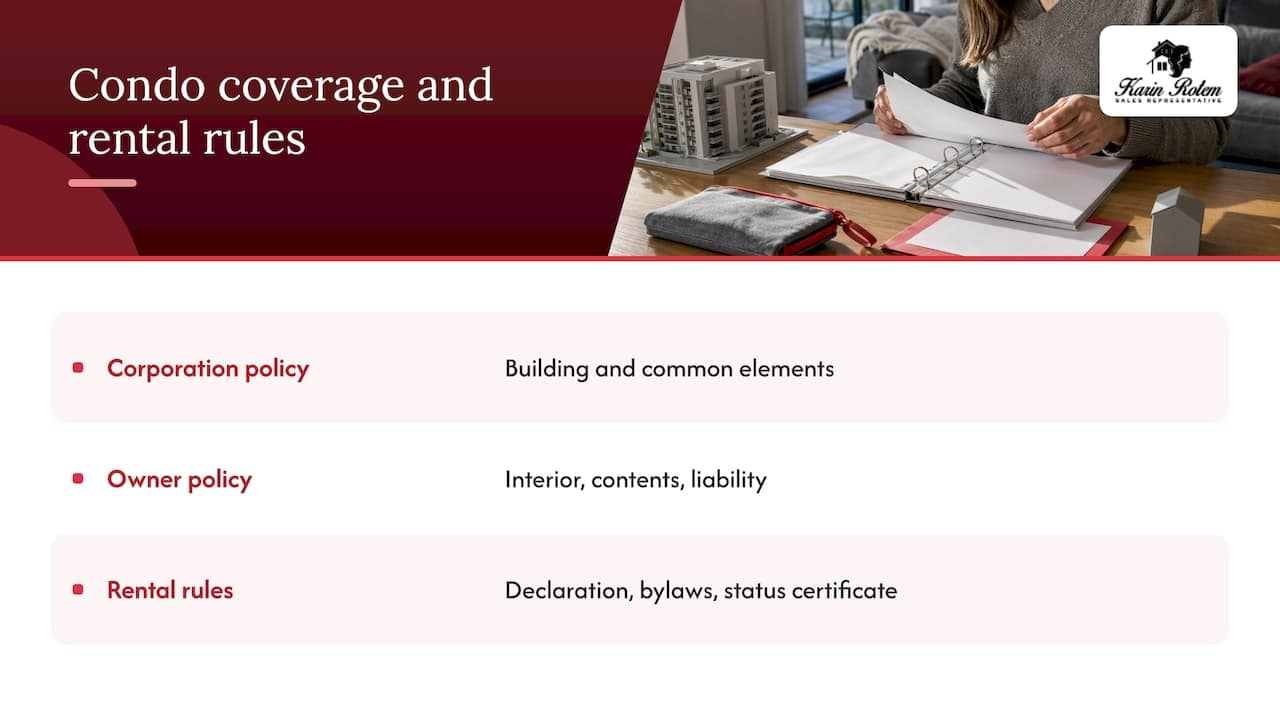
In a condo, the corporation insures the building and common elements through its own policy, and you insure your unit’s interior, contents and liability. Reading the declaration, bylaws and status certificate before you buy is something I walk every condo buyer through, because the rental rules there can decide whether your investment plan works at all. In resort communities this matters even more, since rental programs and restrictions vary building by building.
Refinancing a rental property: how insurance fits in
If you plan to pull equity from a rental later, lenders will look at your insurance and your rental use. A few points from published sources:
- CMHC’s homeowner refinance premium schedule applies to owner-occupied properties with one to four units, so don’t treat it as a rule for a non-owner-occupied investment property.
- Lender terms can restrict short-term rental outright. One lender’s 2025 refinance-plus-improvements program, for instance, requires a statutory declaration that an added suite will not be used for short-term rental.
- A 2026 renewal guide says a straight renewal generally avoids a new stress test, while a refinance triggers qualification again, with lenders typically capping uninsured investment-property loan-to-value around 80%, subject to lender rules.
The practical point: keep your insurance and your mortgage story consistent. If your lender believes the property is a long-term rental and your insurer believes it is a family cottage, someone will eventually be surprised. For how lenders treat the income itself, see our guide to the rental income mortgage in Canada.
Your pre-launch checklist
- Confirm the property is legal to rent short term where it sits. Our walkthrough on setting up a short-term rental in Ontario legally covers licensing and municipal rules.
- Call your insurer or a broker and disclose the rental plan in full.
- Get short-term rental coverage added in writing, or buy a standalone policy.
- Ask about sewer backup, water damage, watercraft and amenity endorsements.
- Confirm liability limits and whether lost rental income is included.
- Check your lender’s terms and your condo corporation’s rules.
- Plan for tax at the same time: our guide to T776 deductions for short-term rental owners shows how insurance premiums and other costs fit into your return.
- Diarize an annual review. Your rental frequency, guest counts and property value change, and so should your coverage.
If you are comparing this against a longer-term lease, our landlord insurance guide for Ontario covers that side.
Our perspective on insuring a waterfront rental
We work every day with buyers who fall in love with a Friday Harbour or Innisfil property and then ask, almost as an afterthought, whether they can rent it out. Our answer is always the same: decide your insurance and rental plan before you make an offer, not after closing.
What most buyers don’t realize is that insurance shapes your numbers. A premium, a deductible and an exclusion for watercraft or sewer backup are real line items in your return, and they belong in the same spreadsheet as your mortgage and condo fees. When we help investors compare properties, we ask about intended rental nights, guest counts and amenities up front, because those answers steer the quote.
Our approach is practical and decision-focused: we help you understand what a property offers and whether it fits your goals, including whether a particular building’s rental rules suit your plan. Our team’s focus on Friday Harbour and Innisfil means we can point you to the right questions for resort-style communities, and then to the insurance and legal professionals who answer them for your specific property.
Felix
Looking at a rental-friendly property in Friday Harbour or Innisfil?
If you are weighing a vacation home or income property, we can help you shortlist places that match your plan and walk you through what to ask before you buy. Start with the current Friday Harbour condos for sale, or look at The Harbour rental listings to see how rental stock looks today. You can also contact our team for tailored guidance on buying, selling or leasing.
FAQ
Do I need special insurance to rent out my cottage?
Usually yes, or at least a written endorsement. IBC says seasonal property can be added to a home policy or insured separately, and that rental use must be disclosed. Ask your insurer exactly what rental activity your policy permits.
Does Airbnb insurance in Canada replace my own policy?
No. Platform protection has limits and exclusions, and an Ontario broker describes it as limited and internally administered. Keep your own coverage, with liability and rental-income protection, in place.
What should Ontario short-term rental owners check first?
Check dwelling and contents coverage, commercial liability, guest damage, rental-income interruption, booking-day and guest-count limits, and the deductible. Then ask about endorsements for water, sewer backup, boats and amenities.
Can I refinance a property I rent short term?
Often yes, but lenders set their own rules and some restrict short-term rental use. A refinance also means qualifying again, unlike a straight renewal. Speak with a mortgage professional before you commit to a rental plan.
Sources
- IBC: What to Know About Seasonal Property Insurance
- IBC Ontario: Types of home coverage
- IBC: Renting out a room? What you need to know about insurance
- Comprehensive Home Insurance Policy wording
- Airbnb and Short-Term Rental Insurance Ontario
- Short-Term Rental Insurance for Airbnb and VRBO Hosts
- Short Term Rental Insurance
- The Ins and Outs of Vacation Rental Insurance for Owners
- CMHC: Mortgage Loan Insurance Premium Information
- Refinance Plus Improvements program terms
- Investment Property Mortgage Renewal Canada