Development charges are a one-time fee the Town of Innisfil collects from whoever builds new housing, to help pay for the roads, water and sewer, and other services that growth requires. If you are buying a resale home or condo, you do not pay them at closing. If you are buying new, they are already part of what the builder spends, and that can shape the price you are quoted. Here is how they work, what the 2026 numbers look like, and what I tell my clients to ask before they sign on a new build in Innisfil or Friday Harbour.
TL;DR
- Development charges are levied on new development, not on resale purchases. The developer normally pays them before the building permit is issued.
- Innisfil’s April 1, 2026 town-wide charge is $61,915 for a detached or semi-detached home and $27,646 for a bachelor or one-bedroom apartment, with area charges added where services exist.
- The cost can be reflected in what a builder charges for a new home, so it is worth understanding before you compare a new build with a resale.
- Exemptions and reductions exist for affordable units, non-profit housing and some rental housing. Rates are indexed each April.
- Ask for the total purchase cost in writing, including anything the builder adds on closing, rather than trying to isolate the development charge.
What development charges are, in plain terms
When a new subdivision or condo building goes up, the town needs bigger pipes, wider roads, more fire and library capacity. Ontario lets municipalities collect a charge from new development to cover those growth-related capital costs. Ontario’s guide to municipal development charges explains that a municipality must pass a by-law supported by a background study before it can impose them.
The same guide lists the services that can be funded this way, including water, wastewater, stormwater, highways, transit, waste diversion, policing, fire, ambulance, libraries, parks and recreation, public health and childcare. The provincial law behind it is the Development Charges Act, 1997, which allows a by-law to charge for the increased capital cost of services that development creates.
Innisfil states the purpose the same way: the Town’s development charges page describes the charges as a main source of funding for growth-related infrastructure such as roads, water and sewer. Innisfil has grown quickly and has large planned growth areas, so these charges carry real weight in the local budget.
Innisfil’s 2026 rates
The Town publishes rate pamphlets that take effect each April 1. The figures below come from the April 1, 2026 pamphlet for lands that are not part of the Innisfil Developers Allocation Group agreement. They are the published town-wide totals per unit for that period.
| Dwelling type | Town-wide charge (April 1, 2026) |
|---|---|
| Detached or semi-detached home | $61,915 |
| Row home or other multiple | $49,684 |
| Apartment, two or more bedrooms | $36,861 |
| Bachelor or one-bedroom apartment | $27,646 |
For a detached home, that $61,915 is made up of $33,455 for general services and $28,460 for roads and related services.
Then come area charges. These are added on top, but only where the service is actually available to the land. For a detached or semi-detached home the area totals in the same pamphlet run from $35,877 in Cookstown to $63,925 in Innisfil Central. Location inside the municipality therefore changes the bill considerably.
One more wrinkle: the Town’s rate pamphlets distinguish developments covered by the Innisfil Developers Allocation Group agreement. According to the Town’s charges page, those lands contribute only to Phase 3 of the proposed wastewater-treatment infrastructure, so their pamphlet looks different.
A separate industry catalogue, the BILD GTA and Simcoe development charges catalogue for October 2026, lists Innisfil’s latest available totals as $140,815 per single-detached unit and $82,948 per two-bedroom apartment, both in Innisfil Central. That compilation reflects data current as of mid-2026 and counts charges differently from the Town’s pamphlet, so compare like with like when you see two different numbers quoted.
How the rates move
Innisfil indexes its rates every April 1, using the latest twelve-month change in Statistics Canada’s Building Construction Price Index, according to the Town. So the figures above are the published rates for the April 2026 period. The next pamphlet will replace them, and the by-laws themselves can be amended. The April 2026 pamphlet cites by-law 096-23 as amended, together with several companion by-laws. If you need an exact figure for a specific lot, use the Town’s current pamphlet and by-law rather than a number in an article, including this one.
Who pays, and when
The charge is imposed on development. In practice the developer, or the person responsible for the development approval, pays it. Innisfil’s site-plan guidance says the Building Department calculates the amount, and payment is due before the building permit is issued.
The Development Charges Act sets special timing for some categories. Certain rental and institutional development can pay in equal annual instalments, while other specified types are payable in full on the earlier of occupancy authorization or first occupancy. The statutory category of the project decides which applies.
There is also a protection against rate shock for builders. Under Ontario’s current framework, the rate is frozen at the site-plan or zoning application and stays frozen for 18 months after approval. That matters for you as a buyer of a pre-construction unit: the charge built into a project may reflect the rate when the application was made, not the rate on the day you sign.
What this means if you are buying
Here is what most buyers don’t realize: you rarely see a line called “development charge” on a purchase. It is a cost of building the home, and the sources do not give a fixed rule for how much of it reaches the buyer. What they do establish is that the charge can be reflected in the cost of building and potentially the price of a newly built home. There is no mandatory direct charge to someone buying a resale property.
So what does that mean for each type of reader?
Resale buyer. If you are buying an existing home in Innisfil, or a resale condo, no development charge is collected from you on that sale. Your closing costs are the usual ones: land transfer tax, legal fees, and adjustments. Our guide to buying a house in Innisfil walks through those costs and the steps.
New-build buyer. Your agreement of purchase and sale should state what is included in the price and what is added on closing. Some builders list levies and adjustments separately. Read that section line by line, and have your lawyer review it.
Investor. Whatever a builder’s cost structure, your return is calculated on what you actually pay, plus carrying costs such as condo fees and property tax. Development charges matter to you mostly as one of the reasons new inventory is priced as it is. For the yield side, see our look at Innisfil cap rates for investors.
Toronto buyer relocating. Compare the all-in monthly cost, not the sticker. Property taxes and fees differ a lot from Toronto, which is why we put together a Toronto versus Innisfil cost of living guide and a breakdown of Innisfil property taxes.
A worked example
Say a builder is delivering a row of townhomes in Innisfil. Using the Town’s April 1, 2026 town-wide figure for a row or other multiple, the charge is $49,684 per unit before any area charges that apply to the location. The builder pays that before the permit, alongside land, construction and financing costs, and sets prices with all of it in mind.
Now compare a two-bedroom apartment in a mid-rise. The town-wide charge for that type is $36,861, and a bachelor or one-bedroom is $27,646. Smaller units carry smaller charges, one reason the per-unit cost differs between building types.
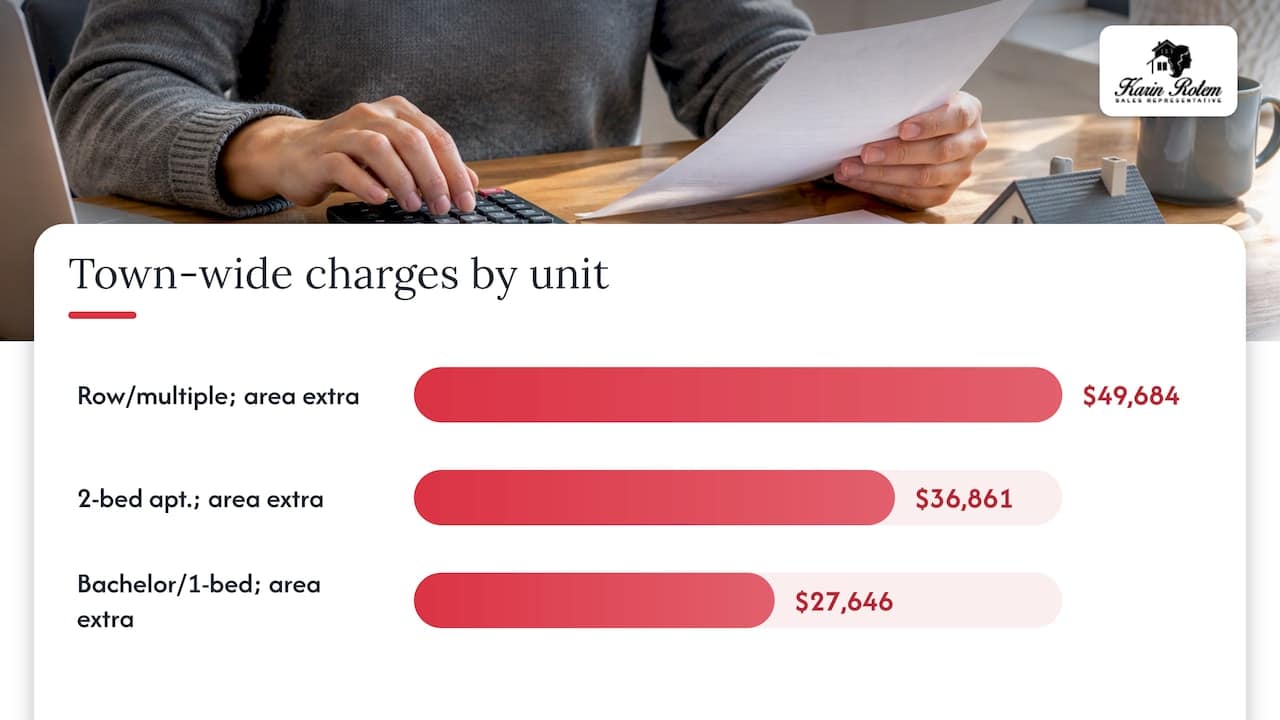
These are illustrations of how the published rates scale, not a prediction of any builder’s price. The reason I walk clients through them is simple: when you compare a new townhome to a resale one down the street, part of the gap can be the cost of bringing new housing to the ground.
Exemptions and reductions
Not every new unit carries the full charge. Innisfil’s April 2026 pamphlet lists as exempt or not chargeable:
- qualifying affordable and attainable units
- non-profit housing
- inclusionary-zoning units
- long-term-care development
- specified additional dwelling units in existing homes or rental buildings
- other statutory categories the pamphlet names
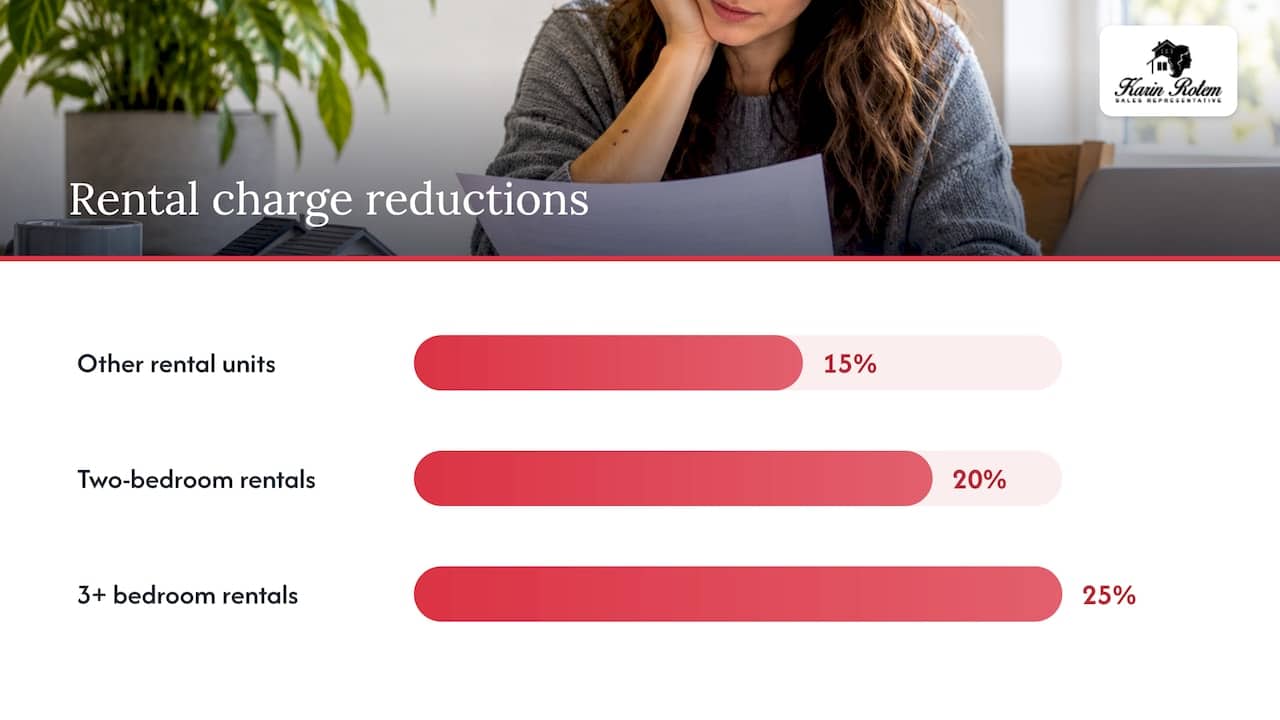
Rental housing receives bedroom-based reductions: 15% for other units, 20% for two-bedroom units and 25% for units with three or more bedrooms.
Provincially, the guide states that non-profit housing is exempt, and that qualifying affordable residential units have been exempt since June 1, 2024. Those units must meet the affordability tests and a 25-year affordability agreement requirement. It also notes multi-year payment deferrals for certain developments, including rental housing and institutional development, with the timing set out in the Act.
For most buyers of market-priced homes and condos, none of these apply. They matter more to people building a secondary suite, or investors considering purpose-built rental. If you are planning an additional dwelling unit on a property you own, confirm the category with the Town’s Building Department before you budget.
Questions to ask before you buy new
This is the checklist I use with clients looking at new construction in Innisfil:
- What is the full price, and what is added on closing? Ask for the complete list of adjustments and levies in writing.
- Where is the project? Area charges differ across Innisfil, from the Cookstown figure to the Innisfil Central figure.
- When was the application made? The rate freeze can mean the project’s cost basis is older than today’s pamphlet.
- What are the ongoing costs? Condo fees, reserve fund contributions and property taxes shape your monthly budget more than a one-time builder cost. Our page on Innisfil property tax rates shows what to budget.
- What is planned nearby? Growth areas and new files change the neighbourhood you are buying into. We track them in new developments in Innisfil.
Sellers: why this still matters to you
If you own a home in Innisfil and are thinking of selling, development charges are not a cost on your sale. They matter indirectly. New homes nearby are priced with these charges in mind, and buyers comparing your home to new construction will weigh that. Pricing against both resale and new competition is part of how a listing sells in a reasonable time, and we cover it in pricing a home in Innisfil.
Our perspective
What we tell our clients is that development charges are a builder’s cost and a town’s funding tool, not a surprise bill waiting at your closing. The useful question is never “what is the charge?” It is “what is my all-in cost, and does this home fit what I want it to do for me?”
Friday Harbour and Innisfil attract buyers with very different goals: a weekend retreat on the water, a family leaving Toronto for a quieter pace, an investor weighing a resort-style rental. Our team is built around those goals. We are known as a top-performing team at The Harbour, and our approach is high-touch and client-first: we read the agreement with you, compare new and resale on the same footing, and negotiate on the terms that matter to your budget.
When you work with us, you get one advisor who knows the local market, the communities and the paperwork, and who keeps the focus on your decision rather than on jargon.
Felix
Talk to us about your Innisfil purchase
If you are weighing a new build against a resale, or comparing waterfront options, we can lay the numbers side by side with you. Start with the current Friday Harbour condos for sale, look at what a Friday Harbour listing offers, or contact us through Karin Rotem Real Estate for tailored guidance on buying, selling or leasing in Innisfil and the Toronto area.
FAQ
Do I pay development charges when I buy a resale home in Innisfil?
No. The charge is imposed on development and is generally paid by the developer before the building permit is issued. The sources do not establish a direct charge to a resale buyer. Your closing costs on a resale are the usual ones, such as land transfer tax and legal fees.
Do development charges raise the price of a new home?
They can be reflected in the cost of building, and potentially in the price of a newly built home. How much reaches the buyer depends on the builder and the market, and it is not published as a fixed pass-through. Ask for the full price and closing adjustments in writing.
How often do Innisfil’s development charge rates change?
The Town indexes its rates each April 1, using the latest twelve-month change in Statistics Canada’s Building Construction Price Index. By-laws can also be amended, so check the Town’s current rate pamphlet for the figure that applies to a specific project.
When did development charges start in Ontario?
They are governed by the Development Charges Act, 1997, which lets municipalities pass by-laws to recover the capital cost of services needed because of development. The Act lists eligible services and requires a background study before a by-law is passed.
Are any new homes exempt?
Yes, some categories are. Innisfil’s April 2026 pamphlet lists qualifying affordable and attainable units, non-profit housing and certain additional dwelling units, among others. Rental housing receives bedroom-based reductions of 15%, 20% or 25%.
Sources
- Development Charges, Town of Innisfil
- Town of Innisfil development charges pamphlet, April 1, 2026
- Municipal development and community benefits charges, and parkland, Ontario.ca
- Development Charges Act, 1997, Ontario.ca
- BILD GTA and Simcoe development charges catalogue, October 2026