
Decluttering before selling means removing enough of your belongings that a buyer sees the house, not your life in it. Start with storage spaces, sort every room into four piles, clear counters and closets to about half full, and get the donation pickups booked early. Done well, it costs you a few weekends and very little money, and it shapes every photo and showing that follows. This is the plan I walk sellers through in Toronto, Innisfil and Friday Harbour.
TL;DR
- Start in the basement, garage and storage areas. They hold most of what leaves the house and carry the least emotional weight.
- Sort into four piles in every room: keep, sell, give away, toss. Add one dated “undecided” box for hard calls.
- Aim for half-full closets and cabinets, clear floors and nearly empty counters. Pack family photos first.
- Book donation pickups before you start. A fixed pickup date forces decisions.
- Plan on two to four weeks for a typical three-bedroom home, longer if you are also downsizing.
Why decluttering pays before anything else
Buyers walk through a home in minutes and judge it mostly by how much space they see. Crowded rooms read as small rooms, and overfull closets read as not enough storage. Neither problem costs you anything to fix, which is why decluttering sits at the top of nearly every pre-listing checklist.
It also comes before photography. Listing photos are the first showing, and clutter that you stop noticing after years shows up immediately on camera. If you are planning photos, our notes on listing photography for home sellers and on why staging lifts sale price both assume the decluttering is already done.
What most sellers don’t realize is that decluttering is also the first step of your move. Everything you remove now is something you don’t pay to pack, move or store later.
How long it really takes
The honest answer depends on the house and on how much time you have each day.
- A typical three-bedroom home: one Toronto-area moving guide suggests two to four weeks of steady work, roughly an hour or two a day, with donation pickups booked early and one room tackled per weekend.
- A fast sprint: a two-week schedule works if you commit: entry and living areas first, then kitchen and pantry, closets and linens, bathrooms and laundry, and finally garage, storage and the donation drop-off.
- A full downsize: if you are leaving a large family home for something smaller, an eight to twelve week staged process is a realistic frame, with sorting first, selling and donating next, and staging last.
What I tell my clients: count back from your listing date, not forward from today. If photos are on a Thursday, the garage has to be empty the weekend before.
Where to start: storage first, living rooms last
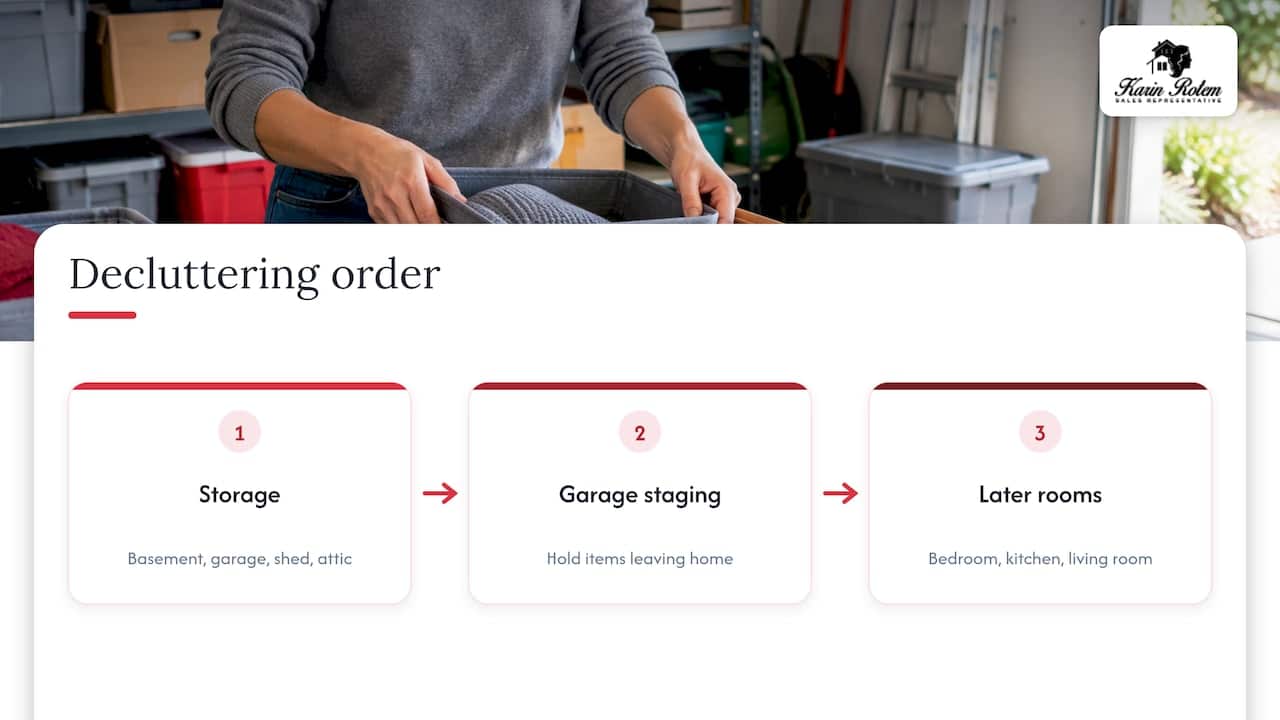
Most people begin with the living room because it is visible. It is the wrong place to start. Storage spaces such as the basement, garage, shed and attic hold most of what will leave the house, and the decisions are easy because nobody is emotionally attached to a box of old cables. One Toronto guide puts it as start in the basement and finish in the living room, and that matches how I see it work.
There is a second benefit. A cleared garage can act as a staging area for items on their way out, so donation piles don’t take over the rooms you are trying to keep presentable. Leave the main bedroom and kitchen for last, once you have built up sorting stamina.
The four-pile method
In every room, sort each item into one of four piles and don’t go back to reopen decisions:
- Keep: it fits your next home and you actually use it.
- Sell: it has real resale value and you list it early, not the week before closing.
- Give away: it is clean, complete and in good shape.
- Toss or recycle: it is broken, worn out or nobody would take it.
Two refinements help. A single “undecided” box with a date on it keeps hard calls from stalling the whole room. And if you haven’t touched something in the past year, it probably doesn’t make the cut.
Important papers and keepsakes deserve their own calm time. Don’t sort them in a rush at the end of a long day.
Room by room: what buyers should see
| Room | Target when buyers walk through |
|---|---|
| Entry | Clear floor, a few coats at most, no piles of shoes |
| Living room | Floors clear along the walls, only the main seating and one table |
| Kitchen | Counters nearly bare, cabinets and pantry about half full |
| Bedrooms | One bed per bedroom, half-full closets, bare surfaces |
| Bathrooms | Daily products out of sight, fresh towels only |
| Laundry, garage, basement | Floor visible, shelves tidy, mechanicals reachable |
The half-full benchmark for cabinets and pantry is a good test, with one soft touch such as a plant or a bowl of fruit left on the counter. Closets work the same way: half full tells a buyer there is room for their things.
If you are still living in the house
You don’t need to rent furniture or buy new throw pillows. Keep one bed per bedroom, a table and a couch, and move the rest out. Clear floors along the walls and an empty counter do more than decorative extras.
Keep access in mind, too. A home inspector will need to reach the electrical panel, water heater, foundation walls and attic hatch, so don’t leave boxes stacked in front of them.
Depersonalizing: photos and collections
A CREA survey of mostly Canadian REALTORS® found that 79% said removing family photos mattered more than removing trinkets. The reasoning is simple: buyers need to picture their own family on the stairs. Pack photos, diplomas, kids’ art on the fridge and personal collections first, because that is quick and has the biggest effect.
What to do with the stuff
The pile that leaves your house needs a destination and a date. This is where most declutters stall: bags sit in the garage for three weeks because nobody booked a pickup.
Storage for items you are keeping
If you are keeping items that don’t fit the staged look, such as seasonal gear or extra furniture, line up storage before you start, not after the boxes are packed. Label by room in your next home so you are not re-sorting after the move.
Donating in Toronto and the GTA
- Habitat for Humanity ReStore: the GTA ReStores take furniture, appliances, kitchens, flooring, windows, doors and tools. In-home pickup is $150 for up to three items, $300 for four to seven and $450 for more than eight, curbside pickup is free for condo and apartment loading-bay pickups, and donors receive a charitable tax receipt for the assessed value.
- Families in need: United Chesed’s Item Redistribution Program matches furniture, appliances, electronics and medical equipment (not mattresses or clothing) with families, and most items are spoken for within a week of the listing email.
- Other GTA options: a Toronto donation roundup lists Furniture Bank, the Salvation Army and JRCC Furniture Depot, among others. Check each one’s current pickup terms before you plan around them.
- Paint, batteries and electronics: these usually go to municipal or EPRA depots rather than the curb, so check your municipality’s rules.
If you are selling in Innisfil, check what your local transfer station and municipality accept before the final haul, since rules differ from Toronto’s.
A cleaner house is the last step
Once shelves and floors are empty, you can clean properly. Wipe down cabinets, inside closets and baseboards while there is nothing in the way. If you prefer gentler products, there is a practical guide to reducing toxins with your cleaning routine that fits well at this stage.
A four-week schedule you can copy
- Week 1: Book donation pickups and any storage. Clear the garage, basement and attic. List sellable items.
- Week 2: Closets, linens and bathrooms. Pack seasonal items and family photos.
- Week 3: Kitchen, pantry and bedrooms. Clear counters and surfaces. Empty the undecided box.
- Week 4: Final pickups, deep clean, then look at the house the way a stranger would. Walk through again in the evening light, when clutter shows most.
If you also have minor repairs to do, schedule them alongside the later weeks. Our guide on what to fix before listing fits an eight-week window, and decluttering is its natural first phase.
Special situations
Waterfront and resort-style homes
In a waterfront home, buyers look past you to the view. Window sills, decks and docks should be clear so the water is the focal point. Outdoor furniture, bikes, water toys and storage bins are the clutter that most often sneaks into photos, so clear them as carefully as you clear the inside. We cover the outdoor side in waterfront home staging before photos.

Downsizing to a condo
If you are moving from a house into a condo, treat the declutter as the first pass of your downsize. Measure the new space and decide what fits before you sort. Our piece on downsizing to a condo in Toronto walks through it.
Selling in Toronto and buying in Innisfil
A lot of the families I work with are selling a Toronto home and moving north. Timing matters here: your declutter should be finished before your listing goes live, and your packing should already be half done. Both are covered in the Toronto to Innisfil relocation checklist.
Perspective
What I tell my clients is that decluttering isn’t about making a home look empty. It’s about removing everything that competes with the home itself. In Friday Harbour and along the Innisfil shoreline, that competition is usually the view: a buyer should walk in and see the water, not a crowded balcony or a packed hall closet.
We ask sellers to do the hard sorting early, then walk the house with them before photos and again before the first showing. Our team’s approach is built around that kind of hands-on guidance. We work with sellers on preparation, pricing and marketing, and we are recognized as the number one team at The Harbour and among the Top 100 worldwide at RE/MAX.
The sellers who do best are the ones who treat the declutter as the first marketing decision, not a chore before the real work begins.
Felix
Ready to prepare your home for the market?
If you are planning to sell in Innisfil, Friday Harbour or Toronto, we can walk through your home with you and tell you what to clear, what to keep and when to list. You’ll find us at Karin Rotem Real Estate, and if you are curious about what is selling at the waterfront, start with our Friday Harbour condos for sale.
FAQ
What is the fastest way to declutter a house before selling?
Run a focused two-week sprint, starting with the garage, basement and storage areas and finishing with the main living spaces. Book donation pickups before you begin so that you have a hard stop. Then sort every room into keep, sell, give away and toss piles without revisiting decisions.
Should I stage the home or just clear it out?
For most sellers, clearing comes first and does most of the work. You don’t need to buy pillows or rent furniture. If you are still living there, keep a bed in each bedroom, a table and a couch, and clear the floors and counters. If you want more on staging after that, see our staging guide for sellers.
How much should I remove from closets and kitchen cabinets?
Aim for about half full. That shows buyers there is spare storage. Keep kitchen counters nearly bare, with perhaps one small decorative item.
What should I do with items I can’t decide on?
Put them in one box, write a date on it, and move it to storage or the garage. If you haven’t needed anything in it by that date, donate it unopened or let it go. Papers and keepsakes should get their own quiet time apart from the schedule.
Sources
- Fall Declutter Guide: Organizing Tips to Sell Homes Faster
- Clearing Out a House Before Selling
- Decluttering Tips for Putting Your Home on the Market
- Moving in Toronto in 2026
- CREA Café: Survey on getting sellers ready to list
- Donate – Habitat ReStore GTA
- Item Redistribution Program – United Chesed
- 7 places to donate your used furniture in Toronto
- How to Reduce Toxins at Home: A Practical Cleaning Guide