
Short answer: use a comparative market analysis (CMA) to set or test a listing price, and order a formal appraisal when a lender, lawyer, trustee, or the Canada Revenue Agency needs a defensible number. A CMA is a pricing opinion built from recent sales data. An appraisal is a regulated, documented valuation that holds up under scrutiny. Many transactions use both, and that’s by design, not redundancy.
TL;DR:
- A CMA is a quick, informal pricing opinion created by a real estate agent using recent sales and active listings, not suitable for legal or financing purposes.
- A formal appraisal is a regulated, technically detailed valuation prepared by an AIC-designated appraiser, often required for mortgages, estate, or legal disputes.
- Appraisers follow CUSPAP standards, conduct interior inspections, and reconcile multiple valuation approaches, making their reports broadly accepted by lenders and courts.
- Costs for a CMA are usually free and delivered within days, while an appraisal involves fees depending on scope and can take from several days to weeks.
- When in doubt, clarify what the relying party needs, as a CMA often suffices for listing, but a formal appraisal is necessary for mortgage approval, estate, or legal requirements.
CMA vs appraisal: what actually differs between them
The two tools answer different questions, prepared by different people, held to different standards. That’s the whole story in one sentence, but the details matter once money or legal exposure is on the line.
A CMA is built by your real estate agent using recent nearby sales, active competing listings, and their read on local demand. It’s fast, usually free, and designed to answer one question: what should this house be listed or offered at right now? An appraisal is prepared by a designated professional following the Canadian Uniform Standards of Professional Appraisal Practice, and it’s built to survive a lender’s underwriting desk, a courtroom, or a CRA audit.
Here’s how the two stack up on the points that matter most:
- Prepared by: a licensed Realtor (CMA) versus an AIC-designated appraiser (formal appraisal)
- Purpose: guiding a listing or offer price versus producing a value third parties will rely on
- Standards: informal, agent-dependent methodology versus CUSPAP-compliant, documented methodology
- Inspection depth: desktop and drive-by comparison of comparable properties versus a full interior inspection with documented, reconciled adjustments
- Acceptance: rarely accepted by lenders, courts, or the CRA versus the standard those institutions require
- Cost and turnaround: typically free, delivered within a day or two versus a paid report, often taking several days to two weeks depending on scope
That last line is where most people get tripped up. A CMA feels authoritative because it comes with real numbers and a confident agent behind it. But confidence isn’t the same as defensibility, and that gap only shows up when someone downstream, a bank, a judge, a tax auditor, asks how the number was actually produced.
Who prepares each report, and why the credentials matter
A CMA can be prepared by any licensed real estate agent, and quality varies with experience, honesty, and how carefully comps were chosen. There’s no governing body certifying CMA methodology in Canada, which is precisely why it isn’t accepted for legal or financing purposes.
A formal appraisal is a different animal entirely. It’s prepared by a member of the Appraisal Institute of Canada, holding one of two core designations:
- AACI™ (Accredited Appraiser Canadian Institute): the senior designation, typically used for complex residential, commercial, and specialized properties
- CRA™ (Canadian Residential Appraiser): focused specifically on residential property valuation
Both designations require accredited education, supervised experience, and ongoing compliance with CUSPAP. Public Services and Procurement Canada aligns its own valuation guidelines with AIC and OEAQ standards, which tells you how deeply embedded these credentials are in institutional and government property valuation.
Statistic callout: The AIC is the professional body that actually issues AACI™ and CRA™ designations and sets the appraisal methodologies lenders and institutions rely on across the country. That single fact explains why a bank will accept an appraisal without blinking and reject a CMA outright, even a very good one.
How each method actually reaches a number
The mechanics behind these two documents diverge more than most people expect.
- CMA construction: your agent pulls recently sold comparables, checks active competing listings, and adjusts informally for differences like square footage, renovations, or lot size. Much of this relies on local market feel rather than a fixed formula, since a comparative market analysis is fundamentally a data-informed opinion, not a certified calculation.
- Appraisal methodology: appraisers choose from three recognized approaches, direct comparison (similar to a CMA but far more rigorous), cost approach (land value plus depreciated replacement cost), and income approach (used for rental or investment properties).
- Reconciliation: where a CMA stops at a suggested price range, an appraisal reconciles multiple approaches into one supported figure, backed by a full interior inspection and documented adjustments.
Subjectivity is fine when you’re deciding whether to list at $849,000 or $859,000. It’s not fine when a lender needs to know the collateral behind a mortgage is actually worth what’s being borrowed against it.
When a CMA is enough, and when you need an appraisal
Most listing decisions don’t need a formal appraisal. If you’re pricing a home to sell, testing an offer strategy, or doing a quick gut check on value, a CMA covers it, especially if you get input from more than one agent to triangulate a realistic price.
An appraisal becomes necessary, not optional, in these situations:
- Mortgage underwriting or refinancing, where the lender orders and requires it
- Estate settlements, divorce proceedings, or CRA matters involving capital gains
- Legal disputes, expropriation cases, or highly unusual properties with no clean comparables
Pro Tip: Before assuming a CMA will do, ask the party actually relying on the number, your lender, lawyer, or trustee, what they require. Guessing wrong here costs more time than just asking upfront.
If you’re navigating a refinance or mortgage portability situation, understanding how portability works helps you anticipate when a lender will insist on their own appraisal regardless of what you already have.
What each option costs and how long it takes
Budgeting for these two documents looks nothing alike.
A CMA is typically free when it’s part of an agent’s listing service, since it’s essentially a sales and pricing tool baked into the relationship. An appraisal is a paid, standalone service, and the fee depends heavily on scope.
- Desktop appraisal: fastest and cheapest, no interior access, used for lower-risk lending scenarios
- Drive-by appraisal: exterior-only inspection, moderate cost, moderate turnaround
- Full appraisal with interior inspection: highest cost, most thorough, typically required for higher-value or higher-risk lending decisions
Statistic callout: AIC guidance for mortgage professionals confirms that lenders, not borrowers, decide the appraisal scope based on their own risk assessment, which is why two people refinancing similar homes can end up with very different bills and timelines.
Turnaround for a full appraisal often runs anywhere from a few days to two weeks depending on the appraiser’s schedule and how complex the property is. Who pays varies by scenario. In a purchase, it’s usually the buyer through the lender; in an estate or legal matter, it’s often the party requesting the report.
When your CMA and appraisal don’t match, here’s what to do
Disagreement between a CMA and an appraisal isn’t a red flag by itself, it usually just means the two documents were built with different assumptions.
- Compare effective dates. A CMA from three months ago in a shifting market will disagree with a current appraisal simply because the market moved.
- Check the comps and scope. An appraiser’s interior inspection may have surfaced condition issues your agent’s exterior-based comps never accounted for.
- Ask for reconciliation. A good appraiser can walk you through exactly why their number lands where it does, approach by approach.
- Get a second opinion when it matters. If a lender, lawyer, or trustee is relying on the figure and something feels off, a second appraisal or an expert review resolves it faster than arguing over the first one.
Used together, the two reports actually strengthen each other: the CMA informs your negotiating position, while the appraisal, as practitioner guidance confirms, gives you documented proof that holds up if anyone challenges the number later.
What I tell my clients when this question comes up
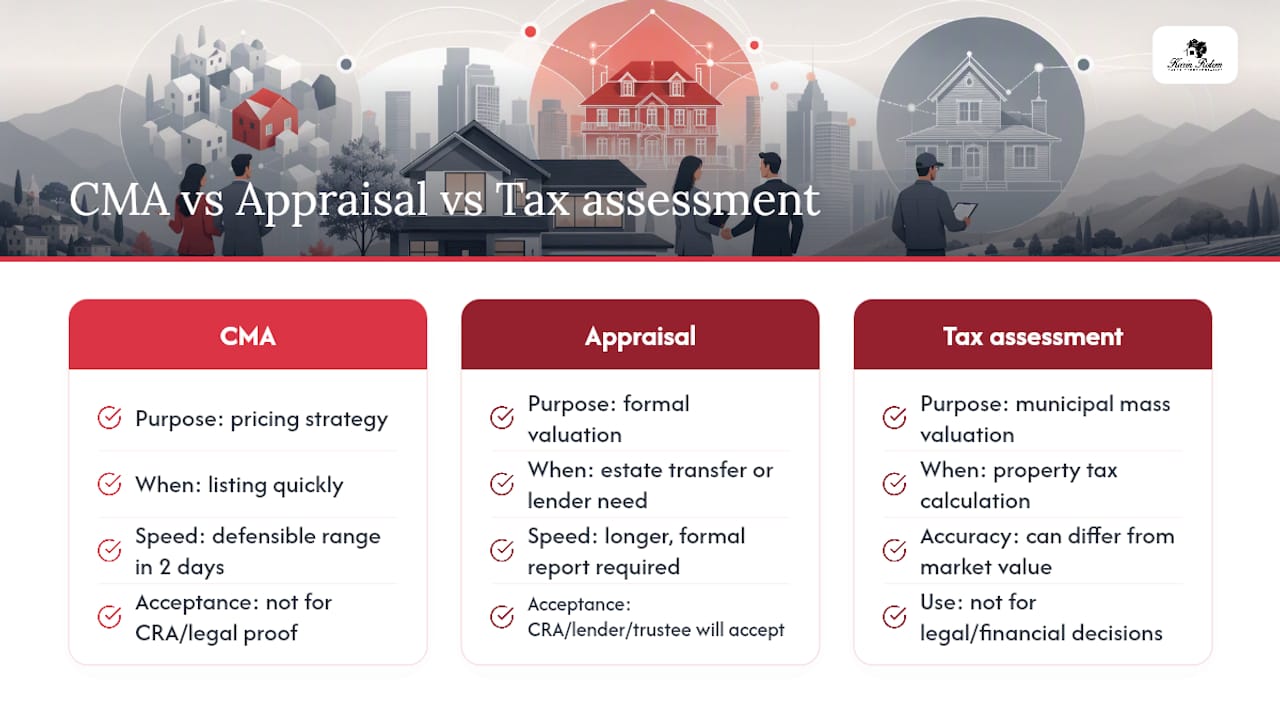
What I tell my clients is that a CMA and an appraisal aren’t competing tools, they’re built for different rooms in the house, so to speak. I had a seller in Innisfil last year who wanted her home listed the week she called. A CMA was all she needed, and we had a defensible price range within two days. Compare that to a client going through an estate transfer at Friday Harbour, where the trustee needed a document CRA would accept without question. A CMA wouldn’t have cut it there, full stop.
What most buyers don’t realize is that a municipal tax assessment is not the same as either document. MoneySense has pointed out that assessed values are mass-valuation tools that can differ substantially from real market value, which means leaning on your property tax notice for a legal or financial decision is a mistake I see more often than I’d like. When a client needs something beyond pricing strategy, I coordinate directly with AIC-designated appraisers so the paperwork matches exactly what the lender, lawyer, or trustee actually requires.
— Felix
How our team helps you get the right valuation, not just any valuation
We provide practical guidance to help you understand which report you need. When listing a home, a CMA can be prepared using recent comparables relevant to your specific local market. If your situation calls for a formal appraisal, such as for refinancing, estate matters, or legal disputes, a referral to a qualified AIC-designated appraiser is recommended to obtain a credible appraisal report.
When you reach out, expect a straightforward conversation: what you’re trying to accomplish, what the relying party actually requires, and a clear next step from there, whether that’s a CMA on your property or a referral to get a proper appraisal moving. If you’re weighing a sale or purchase in the Friday Harbour community, start by exploring current listings on the water or reach out through our main site to get a market-specific answer instead of a generic one.
Sources
- A Realtor Letter vs. A Certified Appraisal: What Estate Lawyers Need to Explain to Clients
- What appraisers do – Appraisal Institute of Canada
- PSPC valuation guidelines for appraisal reporting
- Home appraisal vs. tax assessment: What every Canadian property owner needs to know – MoneySense
FAQ
What is a CMA valuation?
A CMA valuation is a real estate agent’s data-informed opinion of a property’s likely market value, based on recent nearby sales and active competing listings. It’s used to set listing prices and guide offer strategy, not for legal or lender purposes.
Is market value usually higher than appraised value?
Not reliably, market value and appraised value often land close together, though they can diverge when a market is moving quickly or when comparable sales data is thin. An appraisal’s documented methodology tends to be more conservative than a CMA built during a fast-rising market.
What is a CMA used for in real estate?
A CMA is used to help sellers set an initial listing price and help buyers judge whether an asking price is reasonable before making an offer. It’s a pricing tool, not a substitute for a formal appraisal when a lender, court, or the CRA needs a defensible value.
How is a CMA different from a home appraisal for a mortgage?
A CMA is prepared free by your agent and reflects a pricing opinion; a mortgage appraisal is a paid, CUSPAP-compliant report from an AIC-designated appraiser that your lender requires before approving financing. Lenders will not accept a CMA in place of an appraisal.
Can I use a CMA instead of an appraisal for an estate or legal matter?
No, estate settlements, CRA matters, and legal disputes generally require a formal appraisal because it documents methodology, assumptions, and effective date in a way a CMA does not. Ask the lawyer or trustee involved what they specifically require before assuming a CMA will suffice.