Deeded waterfront access is a recorded property right that gives your land the legal entitlement to use a specifically described strip or parcel of land leading to or bordering water. It is registered on title, which means it travels with the property when it sells and binds future owners. What it does not do is give you ownership of the shoreline itself or the lakebed beyond what the deed expressly states — in Ontario, that bed often remains with the Crown. The single most important step when you see “deeded access” on a listing: pull the land registry or land titles record and have a lawyer read the actual grant wording before you make an offer.
Ontario lawyers flag this consistently: buyers treat “water access” as a casual phrase when it is a precise legal term. Whether that access lets you launch a boat, build a dock, or simply walk to the shore depends entirely on what the registered document says.
What does deeded waterfront access mean, legally?
The formal term you will see on Ontario title records is an appurtenant easement or a deeded access parcel. Understanding the difference between these two concepts is the foundation of everything else.

An easement appurtenant is tied to the land itself, not to the person who owns it. When the property sells, the easement transfers automatically to the new owner. An easement in gross, by contrast, is personal — it belongs to a specific individual or utility provider and does not necessarily follow the land on resale. For a waterfront buyer, appurtenant is the word you want to see.
A typical deeded access grant contains several specific components:
- Legal description of the access strip or parcel: the deed will reference a plan number, lot and concession, or a reference plan (e.g., “Part 1, Plan 51R-XXXXX”) that physically locates the access on the ground.
- Permitted uses: the grant spells out what you can do — pedestrian access, boat launching, mooring, carrying gear. Uses not listed are generally not permitted.
- Exclusivity clause: the grant states whether the right is exclusive to your property or shared with neighbouring lots.
- Maintenance obligations: who cuts the grass on the access strip, repairs the path, or maintains a dock (if one is permitted) is often specified.
- Restrictions: phrases like “for pedestrian access only” or “no buildings or structures without the written consent of the servient owner” limit what you can build or store.
Unless the grant expressly permits structures, storage, or exclusive occupation, simple access does not automatically allow a dock, boathouse, parking area, or permanent mooring. That distinction catches buyers off guard more often than any other aspect of deeded access.
What types of deeded waterfront access appear on Canadian titles?
Not every listing that says “water access” carries the same legal weight. Here are the main forms you will encounter:
- Deeded access parcel: a separate lot (often a narrow strip) registered in the name of a group of properties or a homeowners’ association. Ownership of the parcel is shared, and your right to use it flows from that shared ownership. This is common in older Ontario cottage subdivisions.
- Appurtenant easement: a right registered against the servient property (the land you cross) and in favour of your property (the dominant tenement). It runs with your title automatically on sale.
- Right-of-way: a specific type of easement that permits passage over another’s land. Every right-of-way is an easement, but not every easement is a right-of-way — the scope of use depends entirely on the original grant wording.
- Licence: a personal, non-registered permission granted by the neighbouring landowner. Licences are revocable and do not bind future owners of the servient land. If the neighbour sells, the new owner can terminate it.
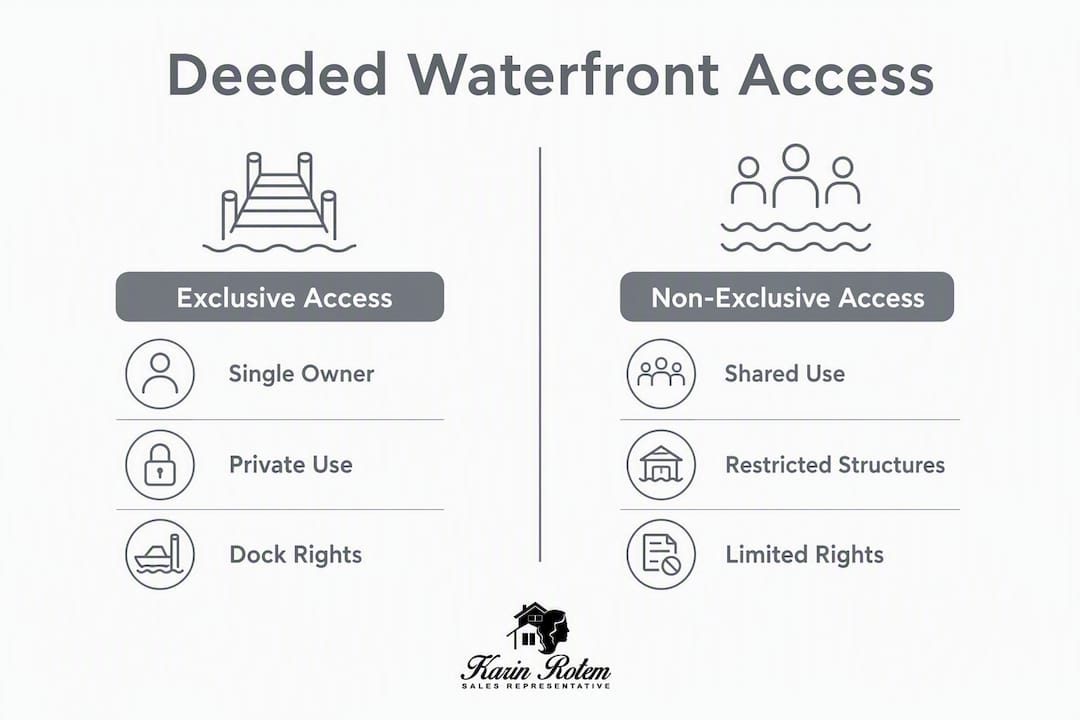
Exclusive vs. non-exclusive is a critical distinction. An exclusive grant means only your property (and possibly a defined group) can use the access. A non-exclusive grant means the servient owner retains the right to use the same strip and may grant similar rights to others. Exclusivity is expressed on title with language like “exclusive right of way for the benefit of Part 2, Plan 51R-XXXXX.”
Red flag: if a seller describes access as “traditional” or “by agreement with the neighbour,” that is almost certainly an unregistered licence. Unregistered promises offer no protection to a buyer — if it is not on title, it lacks the same legal force as a registered right.
How does deeded access appear on title, and why does registration matter?
In Ontario, property rights are recorded in one of two systems: the older Land Registry system (based on deeds) or the more modern Land Titles system (based on a guaranteed parcel register). Most Ontario properties have been converted to Land Titles, where the parcel register is the authoritative record of all interests affecting the land.
When you or your lawyer pulls a title search, a registered easement or deeded access parcel appears as an instrument on the parcel register, with a registration number and a reference to the document that created it. That document — the grant or transfer — contains the full legal description and permitted uses. Your lawyer needs to read that document, not just note that an easement exists.
A practical title-search checklist for deeded access:
- Confirm the word “appurtenant” appears, linking the right to your specific property.
- Identify the registration number and retrieve the original grant document.
- Check for any conditions, maintenance clauses, or restrictions registered against the easement.
- Look for a reference plan that physically locates the access strip on the ground.
- Confirm no subsequent instrument has modified or extinguished the right.
A survey or real property report is the physical complement to the title search. It shows you where the access strip actually sits on the ground, its dimensions, and whether it crosses a road allowance or another private property. Discrepancies between the survey and the title description are a serious red flag that needs legal resolution before closing.
Most Ontario easements are express easements created by written agreement and registered on the servient property’s title — registration is what makes them enforceable against future owners. An oral promise or a handshake deal with the current neighbour protects no one once the property changes hands.
What rights does deeded waterfront access give you — and what are the limits?
Typical rights a deeded access grant permits:
- Walking to and from the water along the described strip
- Launching a canoe, kayak, or small boat from the access point
- Carrying gear, life jackets, and equipment across the strip
- Mooring a boat temporarily at the water’s edge (if the grant says so)
- Shared use of any dock or launching ramp that is part of the deeded parcel
Common limitations buyers should expect:
- No permanent structures (docks, boathouses, sheds) unless the grant expressly allows them
- No storage of boats, trailers, or equipment on the access strip overnight or seasonally
- No parking on or adjacent to the strip unless specified
- Seasonal or timed use restrictions (e.g., May 1 to October 31 only)
- Shared use with other dominant tenements, meaning the strip can be busy on summer weekends
Beyond the deed itself, municipal and conservation authority rules overlay additional restrictions on what you can do at the shoreline. Even if your deed says nothing about docks, the municipality or a conservation authority may prohibit or regulate them independently. Provincial shoreline protections, species-at-risk habitat rules, and federal navigable-waters requirements can all apply simultaneously.
One more limit that surprises buyers: title to the waterbed of a navigable lake often remains with the Crown in right of Ontario unless there is an express grant to the contrary. Your access right ends at the high-water mark. Public navigation rights may also apply, meaning other boaters can pass through the water adjacent to your access point regardless of your deed.

Can you build a dock on deeded waterfront access in Canada?
The short answer is: usually not automatically, and often not without multiple approvals. A deeded right of access implies the right to enter and traverse — it does not permit occupancy or structures unless the grant specifically says so.
Here is the step-by-step process I walk my clients through:
- Read the grant wording first. Look for language permitting “structures,” “docks,” “boathouses,” or “occupation of the shore lands.” If those words are absent, you do not have an automatic right to build.
- Check servient owner consent clauses. Some grants require written consent from the owner of the land you cross before any structure is erected. Identify who that is and whether they are cooperative.
- Consult the municipality. Municipal waterfront bylaws govern dock size, setbacks, and materials. In Muskoka Lakes, for example, the Township has specific building permit requirements for docks that apply regardless of what your deed says.
- Contact the local conservation authority. Conservation authorities regulate shoreline alterations under provincial legislation. A permit is typically required for any work within the regulated area adjacent to water.
- Check federal requirements. Under the Navigation Protection Act, construction of works in a listed navigable waterway requires a Notice of Work submitted to Transport Canada’s Navigation Protection Program before construction begins.
- Confirm insurance and financing implications. Lenders and insurers may treat a dock on deeded access differently from a dock on owned waterfront, and some will require additional documentation or endorsements.
What is typically allowed without a permit: a temporary floating dock that is removed seasonally and has less than 15 m² in contact with the lakebed may not require Ministry of Natural Resources and Forestry (MNRF) occupational authority under Ontario Regulation 239/13, though a municipal building permit may still apply. A fixed crib dock almost always requires both municipal and conservation authority approval.
Pro Tip: Even when your deed clearly permits a dock, get the municipal and conservation authority approvals confirmed in writing before closing. A deed provision is not a building permit, and discovering a regulatory barrier after you own the property is an expensive lesson.
How deeded access compares with easements, rights-of-way, and licences
| Legal Interest | What It Is | Transfers on Sale? | Who Bears the Burden? | Scope of Use |
|---|---|---|---|---|
| Deeded access parcel | Separate lot owned (often jointly) for access purposes | Yes, with the benefiting property | All parcel owners share maintenance | As per shared ownership agreement |
| Appurtenant easement | Registered right over servient land in favour of dominant land | Yes, automatically | Servient landowner | As defined in the grant document |
| Right-of-way | Easement permitting passage over another’s land | Yes, automatically | Servient landowner | Passage only, unless grant says more |
| Licence | Personal, unregistered permission | No — revocable by grantor or new owner | None (no registered burden) | As agreed, but unenforceable against future owners |
The label matters to mortgage lenders and insurers. A registered appurtenant easement or deeded parcel is a bankable, insurable interest. A licence is neither. Water-rights considerations in property transactions follow similar principles across North American jurisdictions, as explored in property deal analysis from comparable markets.
Practical buyer checklist: the exact steps I recommend
When a listing claims deeded waterfront access, here is the ordered process I use with every client:
- Preliminary screening (before the offer): ask the listing agent for the instrument number and the name of the plan that creates the access. If they cannot produce it, treat the access as unconfirmed.
- Request the title abstract: your lawyer pulls the full parcel register and retrieves the original grant document. Budget one to two weeks for a thorough review.
- Full title search: confirm the right is appurtenant, registered, and not subject to any modifying instruments. Check the servient property’s title as well to confirm the burden is registered there.
- Order a survey or real property report: confirm the physical location, dimensions, and condition of the access strip. Typical turnaround is two to four weeks; budget accordingly.
- Verify municipal and conservation permits: contact the local planning department and conservation authority to confirm what structures, if any, are permitted at the access point.
- Check insurance and financing: speak with your mortgage broker and insurer about how the access is classified. Non-standard access can affect loan-to-value ratios and coverage terms.
- Add a condition to the offer: if access is central to the property’s value, include a condition making the offer conditional on satisfactory title review and confirmation of access rights. This is standard practice and protects you.
- Negotiate clarifications or an indemnity at closing: if the grant wording is ambiguous, ask the seller to register a clarifying instrument or provide a title indemnity before funds are released.
What I tell my clients: the red flags that make me recommend walking away include an unregistered access, a servient owner who is actively disputing use, missing survey documentation, and municipal records that contradict the seller’s description of permitted use. Any one of these alone warrants a serious conversation; two or more together usually means the risk outweighs the price.
Understanding what your lawyer does at closing is worth reading before you get to that stage — title review for deeded access is one of the most consequential parts of the closing process.
Pro Tip: If the deed is ambiguous about dock rights and the seller insists the right exists, ask them to register a clarifying amendment before closing — not after. Once you own the property, the cost and effort of resolving ambiguity falls entirely on you.
If access is contested or the deed is unclear: what to do
Start with documentation. Preserve every piece of paper: the original grant, any correspondence with the servient owner, historic photos of use, and any municipal records. Do not make unilateral changes to the access strip while a dispute is live — doing so can prejudice your legal position.
Your lawyer’s first move is typically to request clarification or a statutory declaration from the seller confirming the scope of use. If the seller cannot or will not provide that, an indemnity from the seller (or title insurance covering the specific risk) is the next line of defence.
Escalation options, in order of cost and complexity:
- Negotiation: direct discussion between lawyers, often resolves ambiguity quickly and cheaply.
- Mediation: a neutral mediator helps parties reach a binding settlement; faster and less expensive than court.
- Registered caveat or declaratory action: your lawyer registers a caveat to protect your interest while a court determines the scope of the right.
- Court proceedings: a judge interprets the grant and issues a declaratory order. This is the most expensive route, often taking one to three years and costing tens of thousands of dollars.
Red flags that signal a costly dispute ahead: inconsistent historic use (neighbours have blocked access periodically), unregistered promises from the seller, a missing or outdated survey, active objections from the servient owner, and municipal records that do not align with the seller’s claims.
Pro Tip: Title insurance can cover specific, identified access risks — but only if the risk is disclosed to the insurer before closing. Ask your lawyer to flag the access issue to the title insurer explicitly; a generic policy may not respond to a known, undisclosed risk.
Typical costs and timeline for confirming deeded waterfront access
Costs vary by province, complexity, and whether a dispute arises. For Ontario buyers, here are realistic ranges:
Legal fees and title search: a lawyer’s review of a deeded access situation, including retrieval and analysis of the grant document and a title opinion, typically runs $1,500–$3,500 for a straightforward file. Complex or disputed access can push that figure significantly higher.
Survey or real property report: a boundary survey or real property report in Ontario generally costs $2,000–$5,000 depending on lot size, terrain, and the surveyor’s workload. Rural and cottage-country properties at the higher end of that range are common.
Registration fees: registering a clarifying instrument or an amended easement in Ontario’s Land Titles system carries a provincial registration fee (currently based on the value of the instrument); your lawyer will confirm the current schedule.
Municipal and conservation authority permits: dock and shoreline alteration permits vary by municipality. In Muskoka Lakes Township, building permit fees for docks are set by the municipal fee schedule and depend on the value of construction. Conservation authority permits for shoreline work typically take four to twelve weeks for review, longer if an environmental assessment is triggered.
Mortgage and insurance implications: lenders may require a title insurance policy or an enhanced survey endorsement when access is non-standard. Title insurance premiums for a residential purchase in Ontario typically run $200–$400, though a specific access endorsement may add to that cost.
Ontario’s luxury waterfront market has seen strong demand, which means access rights that are clearly registered and permit-ready command a meaningful price premium at resale. Buyers who skip the due diligence often discover the gap between what they paid and what the access is actually worth.
Key takeaways
Deeded waterfront access is a registered property right that grants defined use of a shoreline strip — not ownership of the water or the bed — and its value depends entirely on what the grant document actually says.
| Point | Details |
|---|---|
| Registration is everything | Only a registered appurtenant easement or deeded parcel is enforceable against future owners; unregistered promises are not. |
| Scope controls use | The grant document defines permitted uses; docks, storage, and structures require express permission in the deed and regulatory approval. |
| Permits are separate from the deed | Municipal, conservation authority, and federal approvals are required for shoreline structures regardless of what the deed allows. |
| Due diligence has a cost | Budget $1,500–$5,000+ for legal review and survey before closing; disputes cost far more. |
| Karinrotem guides buyers through it | The team vets access rights, connects buyers with specialist lawyers and surveyors, and negotiates deed clarifications before closing. |
What I tell my clients about deeded waterfront access
Deeded access is one of those listing features that sounds better than it sometimes is — and occasionally is better than buyers realise. The difference is always in the document.
What I see most often in Ontario cottage communities, including Friday Harbour-adjacent areas around Innisfil and the Muskoka corridor, is a shared access strip registered decades ago when a subdivision was created. The strip is real, the right is registered, and seasonal use works fine for most buyers. The problem arises when a buyer assumes that strip also gives them the right to install a private dock, park a trailer, or store a boat over winter. Those uses require explicit grant language, and that language is rarely there.
My simple decision rule with clients: if the title clearly grants the use you need, the survey confirms the physical access, and the municipality confirms what structures are permitted, the access is a genuine asset. Price it accordingly and proceed. If any one of those three pieces is missing or ambiguous, I recommend making the offer conditional on resolution — or asking the seller to remedy the gap before closing. Walking away is always on the table when the seller cannot or will not clarify.
The resale angle matters too. Easements that improve practical access to a private lake can add meaningful value to a property. A clearly registered, permit-ready access right is something the next buyer’s lawyer will confirm quickly and the next buyer’s lender will accept without hesitation. An ambiguous or unregistered access creates friction at every future sale.
Local agents who work waterfront properties regularly know which access strips in a given community have a history of disputes and which ones have been quietly used without issue for thirty years. That local knowledge is not in any title search — it comes from being in the market.
How Karinrotem’s team helps buyers evaluate deeded waterfront access
Waterfront due diligence is one of the most detail-intensive parts of any cottage or lakefront purchase, and it is exactly where having the right team around you makes a measurable difference. What I do for clients who are considering a property with deeded access: I vet the listing language before they spend time on a showing, connect them with specialist real estate lawyers and accredited land surveyors who work in the specific municipality, and stay involved through the permit-check and negotiation stages so nothing falls through the cracks.
For buyers looking at Friday Harbour and the Innisfil waterfront, I have direct familiarity with the access structures common to that community and the local regulatory environment. That means faster answers and fewer surprises. If you are ready to look at properties or want a second set of eyes on a listing that claims deeded access, reach out directly — the conversation is always worth having before the offer goes in.
Authoritative sources and next places to read
These are the primary resources I point clients to when they want to go deeper on deeded waterfront access in Canada:
- Ontario Land Registry / Land Titles (Teranet): search parcel registers and retrieve registered instruments at OnLand. This is the authoritative source for confirming whether an easement is registered and retrieving the original grant document.
- Township of Muskoka Lakes — Building Permit Requirements for Docks: the Township publishes a detailed guide covering crib docks, floating docks, MNRF requirements, and the Navigation Protection Program. Essential reading before any dock project.
- Local conservation authority: find your authority through Conservation Ontario. Each authority publishes its regulated area maps and permit application requirements online.
- Transport Canada — Navigation Protection Program: for works on listed navigable waterways, the Notice of Work process and guidance material are at tc.canada.ca.
- FDT Law — Who Owns the Waterfront at Your Cottage? A clear explanation of Crown ownership of waterbeds and the high-water-mark rule in Ontario.
- Insight Law Firm — Easements in Ontario: a practical guide to how easements are created, registered, and enforced under Ontario law.
- HGRGP — Cottage Property Issues: Know Your Water Rights: an Ontario lawyer’s overview of the transaction risks buyers face with water access.
- Karinrotem: for local agent guidance, listing vetting, and introductions to specialist lawyers and surveyors, contact the team directly.
FAQ
What does “waterfront deeded” mean on a listing?
“Waterfront deeded” typically means the property has a registered legal right — either a deeded access parcel or an appurtenant easement — that entitles it to use a defined strip of land leading to the water. It does not mean the property owns the shoreline or lakebed outright.
Can you build a dock on deeded lake access?
Not automatically. A deeded right of access permits entry and passage; it does not permit structures unless the grant expressly says so. You also need municipal building permits and, in most cases, conservation authority approval before any dock construction begins.
What is the difference between an easement and deeded access?
Deeded access is often created through an easement registered on title. The key distinction is between an appurtenant easement (tied to the land, transfers on sale) and a licence (personal, unregistered, revocable). A right-of-way is a specific type of easement that permits passage; its scope depends on the original grant wording.
Who pays for a deed of easement?
Costs are negotiated between the parties. In a purchase transaction, the buyer typically pays for the lawyer’s title review and the survey confirming the access. If a new easement is being created or an existing one is being clarified, legal drafting and registration fees are usually split or assigned by agreement — your lawyer will advise on what is standard in your specific transaction.
Does deeded waterfront access affect property value?
Yes. A clearly registered, permit-ready access right that improves practical use of a private lake tends to add value at resale. Ambiguous or unregistered access can create friction with future buyers’ lenders and lawyers, which can suppress offers or complicate a sale.