
Timing is one of the most consequential decisions a seller makes, shaping buyer demand, sale price, and how long your property sits on the market. In Ontario and the Greater Toronto Area, the impact of timing in property sales is measurable and well-documented. Spring peaks, winter lulls, and shifting inventory levels all create real differences in outcomes. But timing is not a magic lever you pull in isolation. The sellers who get the best results combine market awareness with strong preparation and realistic pricing. This article breaks down what the data shows and what I tell my clients about making timing work for them.
Why timing matters in real estate selling: the Ontario market picture
Real estate market timing is the practice of listing a property when buyer demand, inventory conditions, and pricing potential align in your favour. In Ontario, that alignment follows a recognizable seasonal pattern, though it is never perfectly predictable.
Median house prices in Toronto peak in May, with february and april also delivering strong results. That pattern reflects a simple reality: buyers who want to move before the school year ends flood the market in spring, creating competition among purchasers and upward pressure on prices. More competing offers mean sellers hold more negotiating power.

The typical selling timeline in Ontario runs 120–150 days from listing to closing. That includes 30–60 days to receive and accept an offer, plus another 60–90 days to close. Sellers who understand this timeline plan their listing launch accordingly, rather than reacting to the market after the fact.
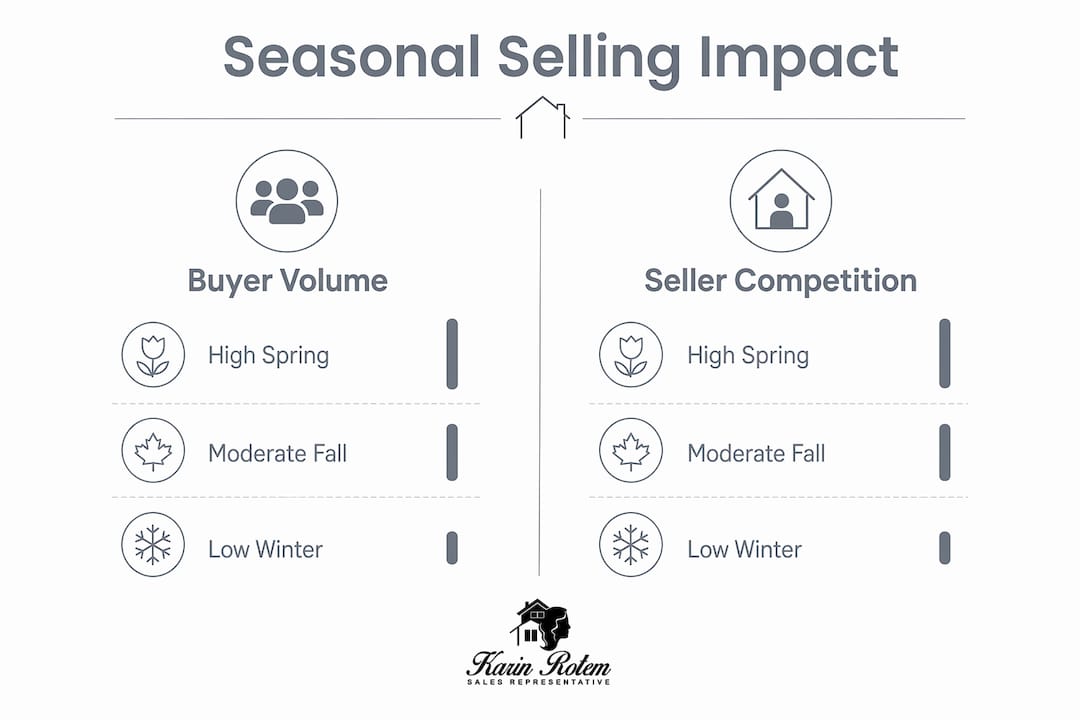
| Season | Buyer volume | Competition for sellers | Typical price pressure |
|---|---|---|---|
| Spring (march to may) | Highest | High | Upward |
| Summer (june to august) | Moderate | Moderate | Stable |
| Fall (september to november) | Moderate, serious | Lower | Stable to slight upward |
| Winter (december to february) | Lowest | Minimal | Neutral to slight downward |
What this table tells you is that spring is not automatically the best season for every seller. It is the busiest, which means more competition from other listings too.
What are the seasonal dynamics that actually affect your sale?
Spring draws the largest buyer pool, but it also draws the most listings. Your property competes against more inventory in march and april than at almost any other time of year. Sellers who list early in the spring window, before inventory builds, often capture the strongest demand.
Fall buyers tend to be more serious because they face real deadlines. A family that missed the spring window needs to be settled before the holidays. A professional relocating for a january start date cannot wait. Fewer listings in september and october mean your property gets more attention per buyer. The trade-off is a smaller overall buyer pool.
Winter is the quietest season, but well-prepared sellers face minimal competition and connect with genuinely motivated buyers. Relocating professionals and buyers with firm deadlines are active in december and january regardless of the weather. A well-staged, correctly priced home in winter can outperform expectations precisely because so few others are listed.
One factor worth watching in 2026 is the FIFA World Cup, with matches hosted across North America including Toronto. Major events like this shift buyer attention and can compress or extend active buying windows in the weeks surrounding them. Sellers in the GTA should factor that into their listing calendar.
Pro Tip: Monitor months of inventory rather than waiting for price changes. Inventory levels shift before prices do, giving you an earlier signal that the market is heating up or cooling down.
Does pricing strategy matter more than the season you list in?
Pricing accuracy drives buyer attention and faster sales more reliably than the month you choose to list. A correctly priced home in november will outperform an overpriced home in april. That is a truth most sellers resist, but the data supports it consistently.
Overpricing is the most common and costly mistake I see. A home that sits on the market for 30 or 40 days starts to carry a stigma. Buyers assume something is wrong. Price reductions that follow attract lower offers than the original list price would have generated. The right listing price strategy is not about anchoring high and negotiating down. It is about generating early momentum.
Property readiness compounds the effect of good pricing. Homes that are clean, decluttered, professionally photographed, and staged consistently attract more showings and stronger offers. The first days on market are the highest-traffic window you will ever have for that listing. Wasting that window with a cluttered presentation or an aspirational price is a recoverable mistake, but it costs you time and money.
- Price at or slightly below comparable sales to generate multiple offers
- Complete repairs and cosmetic updates before listing, not after
- Hire a professional photographer and, where budget allows, a stager
- Launch on a Thursday or Friday to capture weekend showing traffic
- Resist the urge to test the market at a higher price “just to see”
Pro Tip: The first week on market is your most powerful selling window. A well-priced, well-presented home listed on a Thursday generates showing momentum heading into the weekend, when most buyers are actively touring properties.
Why does personal timing often outweigh market timing?
Trying to time the absolute market bottom is usually counterproductive. By the time a market peak or trough is confirmed in the data, the best buyers and the best properties have already moved. Sellers who wait for perfect conditions often wait too long and face a market that has shifted against them.
Most sellers I work with are not selling because the market is perfect. They are selling because life has changed. A job relocation, a growing family, a divorce, a retirement, or a parent who needs care. These are the real drivers of timing decisions, and they are legitimate. Trying to override a genuine life need in pursuit of a market peak rarely ends well.
Exit structure and tax planning usually yield better outcomes than trying to forecast perfect market timing. A seller who understands their capital gains position, their next purchase timeline, and their carrying costs will make a better decision than one who is simply watching price charts.
Buyer sentiment shifts faster than affordability, driven by bond yields, central bank signals, and media coverage of rate expectations. A seller who waits for “the right rate environment” may find that buyer confidence has already moved in a direction they did not anticipate. The market does not wait for anyone to feel ready.
The honest answer to “when should I sell?” is: when you are financially prepared, your home is ready, and your personal circumstances support the move. Those three factors, aligned together, produce better outcomes than any seasonal calendar.
How can sellers use timing strategically in 2026?
Timing works best as one input in a broader plan, not as the plan itself. Here is how to use it well.
-
Start preparation early. Listing preparation beginning well before seasonal peaks allows you to take advantage of increased buyer demand as soon as the market opens. If you want to list in march, start your repairs and staging in january.
-
Track inventory, not just prices. Market inventory is the leading indicator, moving before prices and telling you whether buyer leverage is growing or shrinking. When months of inventory drops below two or three months in your area, conditions favour sellers.
-
Choose your season based on your property type. Waterfront and lifestyle properties near Friday Harbour often see strong demand in late spring and early summer, when buyers are thinking about the season ahead. Understanding local waterfront market trends gives you an edge that broad GTA data cannot.
-
Use fall and winter strategically. If spring is not possible for you, fall is a strong alternative. Price sharply, present well, and you will find serious buyers. Winter requires the sharpest pricing but offers the least competition.
-
Plan your listing launch like a product launch. Set a firm date, complete all preparation before that date, and go to market with professional photos, a strong description, and a clear pricing rationale. A rushed listing loses the first-week advantage.
Pro Tip: Buyer confidence reacts to rate signals faster than actual rate changes. Watch Bank of Canada announcements and bond yield movements in the weeks before your planned listing date. A positive rate signal can meaningfully increase showing traffic.
Key takeaways
Timing shapes real estate outcomes, but it works best when combined with accurate pricing, strong preparation, and a clear understanding of your personal goals.
| Point | Details |
|---|---|
| Spring peaks, but competition rises too | Listing early in the spring window captures demand before inventory builds. |
| Fall and winter offer real opportunities | Serious buyers and low competition reward well-prepared sellers in quieter seasons. |
| Pricing accuracy outperforms season selection | A correctly priced home in any season outperforms an overpriced home in peak season. |
| Personal timing is a legitimate driver | Life events and financial readiness matter more than chasing a market peak. |
| Inventory is the best leading indicator | Months of inventory shifts before prices, giving sellers an earlier signal to act. |
What I have learned about timing after years in this market
Here is my honest view: sellers who obsess over timing usually underinvest in preparation. They spend months watching the market and then rush the listing when they decide the moment is right. That is backwards.
What I tell my clients is this. The market will always have a spring peak and a winter lull. Those patterns are real and worth understanding. But the sellers I have seen get truly exceptional results are the ones who spent three months getting their home ready and then listed at a fair price. Season mattered less than execution.
Local nuances matter more than broad GTA averages. A Friday Harbour condo does not follow the same seasonal curve as a detached home in Scarborough. Waterfront and lifestyle properties respond to buyer psychology around seasons and recreation, not just school calendars and rate cycles. Knowing your specific market is worth more than any general timing rule.
The sellers who come to me saying “I want to wait until the market is better” are often the ones who wait too long and sell in a worse position than they would have six months earlier. Sometimes the best timing is simply when you are ready to move forward with a solid plan.
— Karin Rotem
Thinking about selling? Here is how Karinrotem can help
Karinrotem works with sellers across Toronto, Innisfil, and the Friday Harbour community to build listing plans that account for both market conditions and personal goals. Whether you are considering a spring launch or evaluating whether fall makes more sense for your property, the team brings local data and honest guidance to every conversation. Browse current available listings to see how properties are positioned and priced in today’s market. If you want a direct conversation about your specific situation, reach out to Karinrotem for a no-pressure consultation on timing, pricing, and preparation.
FAQ
When is the best time to sell a house in Ontario?
Spring (march to may) is the peak selling season in Ontario, with median prices typically highest in may. Sellers who list early in the spring window capture the strongest buyer demand before inventory builds.
How long does it take to sell a home in Ontario?
The typical timeline runs 120–150 days from listing to closing, including 30–60 days to receive an offer and 60–90 days to close. Planning your listing date with this timeline in mind helps you align your sale with your move date.
Is it worth selling in winter in the GTA?
Winter brings fewer buyers, but those who are active tend to be highly motivated and facing real deadlines. Well-prepared sellers with accurate pricing can achieve strong results in winter due to minimal competition from other listings.
Does timing or pricing matter more for a successful sale?
Pricing accuracy has a greater impact on sale success than the month you list. A correctly priced, well-presented home will outperform an overpriced home in any season, including peak spring.
How do I know when market conditions favour sellers?
Watch months of inventory rather than waiting for price changes. When inventory drops below two to three months in your local market, conditions are shifting in favour of sellers, often before price data confirms it.