
Ontario’s luxury waterfront real estate market is defined by sharp segmentation, where pricing power and demand vary dramatically by lake, shoreline quality, and property condition. The luxury waterfront market trends Ontario investors are tracking in 2026 tell two very different stories: a fast-moving, near-asking-price segment for premium quality properties, and a patient buyer’s market for everything else. Understanding which story applies to the property you’re eyeing is the difference between a smart acquisition and an expensive mistake. Muskoka’s marquee lakes, Georgian Bay Township, and resort communities like Friday Harbour each operate by their own rules, and knowing those rules is the foundation of any sound strategy.
How is the luxury waterfront market segmented across ontario?
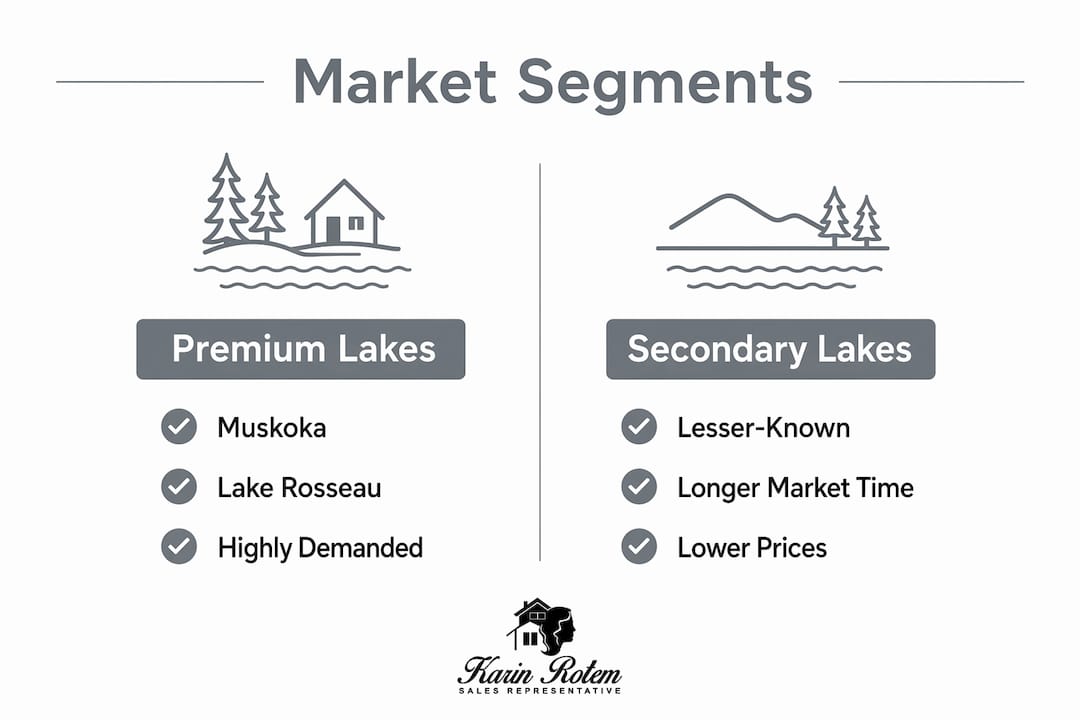
Ontario’s luxury waterfront market does not move as one. It operates as a collection of distinct micro-markets, each shaped by lake reputation, shoreline quality, and local municipal conditions.
The main segments worth knowing are:
- Muskoka’s Big Lakes (Lake Muskoka, Lake Rosseau, Lake Joseph, and Lake Muskoka): The prestige tier. Deep-waterfront median prices on these four premier lakes rose approximately 19% year-to-date in May 2026, reaching roughly $3.3 million. That kind of price movement reflects genuine scarcity and sustained demand from high-net-worth buyers.
- Secondary Muskoka municipalities (Bracebridge, Gravenhurst, Huntsville, Lake of Bays): Active and recovering. Benchmark prices rose month-over-month by 4.24%–6.31% in May 2026 across these areas. These markets offer more entry points than the Big Lakes, with meaningful price momentum.
- Georgian Bay Township: A contrasting story. Inventory sits at 23.3 months with a median of 65 days on market. That is a buyer’s market by any measure, and it signals negotiation room for patient purchasers.
- Resort communities (Friday Harbour, Deerhurst): Lifestyle-driven purchases with amenity-rich offerings that attract a different buyer profile entirely.
Shoreline quality is the single biggest driver of value within any segment. Properties with hard, deep, south-facing waterfront on a reputable lake command premiums that no amount of interior renovation can replicate. Condition matters too. Turnkey properties on quality shorelines sell fast and close to list. Properties needing work on secondary lakes sit longer and invite offers.
Pro Tip: When comparing properties across different municipalities, always check the shoreline classification, not just the lake name. Two properties on the same lake can have vastly different values based on water depth, dock access, and exposure.

What are the current pricing trends and negotiation dynamics?
Ontario’s luxury waterfront pricing in 2026 is correcting from COVID-era peaks, but the correction is uneven. That unevenness is where opportunity lives.
Here is what the data shows right now:
- Q1 2026 showed a soft start. Muskoka recorded 22 waterfront sales in Q1 2026, down 12% from Q1 2025. Days on market rose by 32 days, and the sale-to-list ratio dropped to 94%. That is a meaningful shift toward buyer leverage across the broader market.
- Spring 2026 reversed the trend at the quality end. Gravenhurst properties sold at 97.1% of list price with a median of just 12.5 days on market. Muskoka Lakes properties moved at 95.2% of list within 16 days. These numbers reflect genuine demand, not wishful pricing.
- Overpriced listings are stalling. Sale-to-list ratios of 93–95% are common for listings that have not adjusted from 2021 and 2022 price expectations. Buyers are disciplined. They are walking away from properties that are not priced to reflect current conditions.
- Royal LePage forecasts a modest 2% increase in Ontario’s median recreational property prices for 2026. That is not a boom, but it is a floor. Structural scarcity of buildable waterfront land supports pricing even when demand softens.
- Negotiation discounts of 3%–7% are realistic on properties sitting beyond 60 days. Use days on market and months of inventory as your primary negotiation signals, not the list price alone.
What I tell my clients is this: the sale-to-list ratio tells you whether a seller is living in 2021 or 2026. If a property has been sitting for 90 days at the same price, the seller has not accepted current market reality yet. That is your opening.
Stat to know: Months of inventory in Muskoka rose to 17.5 in Q1 2026. Anything above 6 months is a buyer’s market. At 17.5, buyers hold significant leverage on properties that are not in the premium quality tier.
How do investor considerations and regulations shape purchases?
The investor calculus for Ontario luxury waterfront has shifted materially in the past two years. Short-term rental income is no longer the reliable underwriting assumption it once was.
Key factors every investor needs to weigh:
- STR licence caps and waiting periods in Muskoka have reduced the attractiveness of short-term rental income strategies. Regulations including summer breaks and licence caps mean that projecting strong Airbnb-style returns requires careful due diligence before purchase, not after.
- Buyer motivation has shifted. Most luxury waterfront buyers in 2026 are purchasing for personal vacation use, not rental income. That shift changes the underwriting model entirely. If you are buying for income, you need to verify STR eligibility before making an offer, not during closing.
- Long-term holding remains compelling. Structural scarcity of buildable waterfront supply means that well-located properties hold value through economic cycles. The 2025 waterfront price dip of 5% year-over-year to $809,900 for Ontario recreational properties was a correction, not a collapse.
- Resort communities offer a different model. Friday Harbour and similar communities operate under their own rental frameworks, which can differ significantly from municipal STR rules. Understanding income property types at Ontario resorts is critical before committing capital.
Pro Tip: Before making any offer on a waterfront property you intend to rent, confirm the municipal STR licence status and any waiting list position. Buying a property assuming rental income and then discovering a licence cap applies is a costly error.
If you want to understand the full legal framework, the guide on setting up a short-term rental in Ontario covers the current regulatory landscape in detail.
What tools and strategies help buyers succeed in this market?
Succeeding in Ontario’s luxury waterfront market requires more than a budget and a wish list. It requires a clear framework for reading market signals and selecting the right asset.
Read the right metrics
Month-to-month median prices are unreliable in luxury waterfront markets because transaction volumes are small. A single sale can swing the median by hundreds of thousands of dollars. Use rolling 12-month baselines, days on market, and sale-to-list ratios as your primary decision tools. These metrics are harder to distort.
Seasonal timing matters too. Q1 waterfront results consistently underperform annual averages due to low winter activity. Spring data is far more predictive of true market conditions.
Compare market segments before committing
| Market Segment | Typical Days on Market | Sale-to-List Ratio | Investment Implication |
|---|---|---|---|
| Muskoka Big Lakes (premier) | 12–16 days | 95%–97% | Low negotiation room; buy on quality |
| Muskoka secondary municipalities | 30–60 days | 93%–95% | Moderate leverage on overpriced listings |
| Georgian Bay Township | 65+ days | Below 93% | Strong negotiation room; verify demand drivers |
| Friday Harbour and resort communities | Varies by unit type | Varies | Amenity premium; confirm rental framework |
Prepare financing before you search
Luxury waterfront financing moves differently than urban residential. Lenders assess waterfront properties with additional scrutiny around seasonal access, well and septic systems, and structural condition. Having financing pre-arranged and a clear buyer criteria document ready before you begin viewing properties saves weeks and prevents losing quality listings to faster buyers.
Pro Tip: Work with a local agent who specialises in waterfront transactions, not a generalist. The value of local waterfront expertise shows up most clearly in micro-market knowledge and offer strategy, not just property access.
Key takeaways
Ontario’s luxury waterfront market in 2026 rewards buyers who understand micro-market segmentation, read the right metrics, and price their offers against current conditions rather than COVID-era peaks.
| Point | Details |
|---|---|
| Market is bifurcated | Premium quality properties sell fast and near asking; broader inventory invites negotiation. |
| Pricing corrections are real but uneven | Sale-to-list ratios of 93%–97% vary sharply by municipality and property quality. |
| STR regulations change the investor model | Confirm licence eligibility before purchase; personal use is now the dominant buyer motivation. |
| Use rolling metrics, not monthly medians | Days on market and 12-month baselines are more reliable than single-month price swings. |
| Scarcity supports long-term value | Buildable waterfront supply is structurally limited, which underpins pricing through soft demand cycles. |
What i’ve learned advising luxury waterfront clients in 2026
The most consistent pattern I see right now is buyers who arrive with 2021 expectations meeting sellers who still have 2021 price hopes. Neither side is entirely wrong, but the market has moved on.
What actually works in 2026 is coming in with a clear, data-backed offer that references days on market and comparable sale-to-list ratios. Sellers respond to evidence, not emotion. When I show a client that a property has been sitting for 95 days in a market where quality properties sell in 16, they understand the negotiation position immediately.
What most buyers don’t realise is that the best waterfront properties rarely need negotiation. Gravenhurst properties selling at 97.1% of list in 12.5 days are not waiting for a low-ball offer. If you find a genuinely premium property at a fair price, move quickly and cleanly. Save your negotiation energy for the properties that have earned it through extended market time.
The other shift I’m watching closely is buyer motivation. Clients who came to me three years ago asking about rental income projections are now asking about personal enjoyment, family use, and long-term appreciation. That is a healthier foundation for a purchase decision, and it aligns better with what waterfront ownership actually delivers.
— Felix
Explore luxury waterfront properties with Karinrotem
Karinrotem specialises in luxury waterfront real estate across Toronto and Innisfil, with deep expertise in Friday Harbour, one of Ontario’s most sought-after resort communities. Whether you are looking for a primary residence, a weekend retreat, or a property with income potential, the team brings the local knowledge and negotiation experience to help you make a confident decision. Friday Harbour offers a distinctive combination of luxury waterfront living and resort-grade amenities that sets it apart from traditional cottage country options. Browse the latest Friday Harbour listings or reach out directly to discuss your goals and get a personalised market assessment.
FAQ
What is luxury waterfront real estate in ontario?
Luxury waterfront real estate in Ontario refers to high-end properties on premium lakes or shorelines, typically priced above $1.5 million, with quality frontage, deep water access, and superior condition or amenities.
Which ontario regions have the strongest waterfront demand?
Muskoka’s Big Lakes (Lake Rosseau, Lake Joseph, Lake Muskoka, and Lake Muskoka) show the strongest demand, with median prices reaching approximately $3.3 million and properties selling within 12–16 days in spring 2026.
Is 2026 a good time to buy luxury waterfront property in ontario?
Yes, for buyers with clear criteria and financing ready. Broader inventory and extended days on market in secondary segments offer negotiation leverage, while Royal LePage forecasts a modest 2% price increase for 2026.
How do STR regulations affect waterfront investment in ontario?
Muskoka’s short-term rental regulations, including licence caps and waiting periods, have reduced rental income viability. Investors should confirm STR licence eligibility before purchase and factor personal use into their holding strategy.
How should investors interpret waterfront pricing data?
Monthly median prices are unreliable in luxury waterfront markets due to low transaction volumes. Use rolling 12-month baselines, days on market, and sale-to-list ratios for a more accurate picture of market conditions.