
Ontario land transfer tax (LTT) is a provincial tax paid by the buyer every time a property changes hands in Ontario, calculated on the purchase price using a graduated tiered rate system. What most buyers don’t realise is that this tax can add thousands of dollars to their closing costs, and in Toronto, a second municipal tax layers on top. Understanding how Ontario land transfer fees work before you make an offer is the difference between a smooth closing and a last-minute cash scramble. This guide covers the 2026 rates, Toronto’s additional tax, first-time buyer rebates, and exactly when the money leaves your account.
What is land transfer tax in Ontario?
Ontario land transfer tax is a one-time provincial tax triggered when a buyer registers a property transfer at the Land Registry Office. The buyer pays it. The seller does not. The tax applies to residential, commercial, and multi-residential properties, and the amount owed depends entirely on the purchase price.

The tax is not an annual charge like property tax. You pay it once, at closing, and never again for that transaction. That distinction matters because many buyers confuse the two and underestimate their closing costs as a result.
Toronto buyers face an additional layer. The City of Toronto charges its own Municipal Land Transfer Tax (MLTT) on top of the provincial amount. Buyers purchasing outside Toronto pay only the provincial tax. That geographic difference has a significant impact on your total closing budget.
How to calculate land transfer tax in Ontario
Ontario LTT uses a graduated marginal rate structure, exactly like income tax brackets. Each portion of the purchase price is taxed at the rate assigned to that bracket, not the full price at the highest rate.
The 2026 Ontario provincial LTT brackets for residential properties are:
| Purchase price portion | Tax rate |
|---|---|
| First $55,000 | 0.5% |
| $55,000.01 to $250,000 | 1.0% |
| $250,000.01 to $400,000 | 1.5% |
| $400,000.01 to $2,000,000 | 2.0% |
| Above $2,000,000 (one or two family homes) | 2.5% |
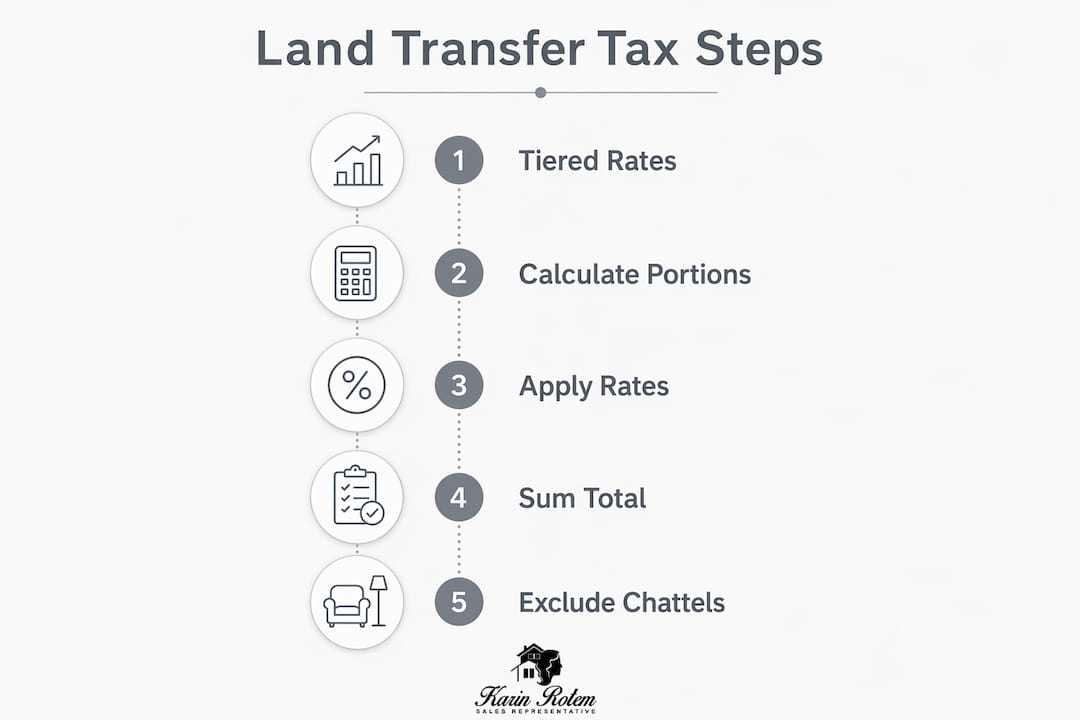
The 2.5% top bracket applies only to residential properties with one or two single-family residences. Commercial and multi-residential properties above $2,000,000 are capped at 2.0%. That distinction matters if you are buying a small investment property or a mixed-use building.
For a $900,000 home, the calculation works like this: $275 on the first $55,000, plus $1,950 on the next $195,000, plus $2,250 on the next $150,000, plus $10,000 on the remaining $500,000. Total provincial LTT: $14,475. That is a meaningful closing cost that deserves a line in your budget from day one.
Pro Tip: Appliances, furniture, and other chattels listed separately in your purchase agreement are excluded from taxable value, which can reduce the LTT you owe. Ask your lawyer to itemise chattels clearly in the contract.
Does Toronto charge an extra land transfer tax?
Toronto buyers pay the provincial LTT plus the Toronto Municipal Land Transfer Tax (MLTT). The MLTT mirrors provincial rates up to $2,000,000, then adds luxury brackets that climb steeply for high-value properties.
Toronto MLTT luxury brackets above $2,000,000 rise progressively: 3.5%, 4.5%, 5.5%, 6.5%, and up to 7.5% for properties over $20,000,000. For most residential buyers, the combined provincial and Toronto MLTT roughly doubles the total land transfer tax bill compared to buying in Mississauga, Vaughan, or Innisfil.
| Purchase price | Ontario provincial LTT | Toronto MLTT | Combined total |
|---|---|---|---|
| $600,000 | $8,475 | $8,475 | $16,950 |
| $900,000 | $14,475 | $14,475 | $28,950 |
| $1,500,000 | $24,475 | $24,475 | $48,950 |
Toronto buyers face a ‘double tax’ scenario that dramatically increases closing costs compared to buyers in surrounding GTA municipalities. Municipalities outside Toronto do not have the authority to levy their own land transfer tax under current Ontario legislation. That is why the same $900,000 home costs roughly $14,000 more to close in Toronto than in Barrie or Innisfil.
Pro Tip: If you are comparing properties in Toronto versus the 905 region, use the closing cost calculators on Karinrotem’s website to model the combined LTT impact before you commit to a neighbourhood.
Who qualifies for land transfer tax exemptions in Ontario?
Ontario offers a first-time home buyer rebate that reduces or eliminates provincial LTT for eligible buyers. Toronto offers a separate rebate on the MLTT. These two rebates can save a first-time buyer a significant amount at closing.
Key eligibility rules and rebate amounts:
- The Ontario provincial rebate covers up to $4,000 of LTT, which fully offsets the tax on homes priced up to approximately $368,000.
- The Toronto MLTT rebate covers up to $4,475 for eligible first-time buyers purchasing within city limits.
- Neither you nor your spouse or common-law partner can have previously owned a home anywhere in the world. This rule catches many buyers off guard.
- You must be a Canadian citizen or permanent resident and at least 18 years old.
- You must occupy the home as your principal residence within nine months of closing.
Strict eligibility rules govern both rebates, and a prior ownership by a spouse disqualifies the entire claim, not just the spouse’s portion. Professional advice is not optional here. A lawyer who misses this detail costs you thousands.
Other exemptions exist for certain transfers between family members, divorcing spouses, and farm properties, but these are narrow and fact-specific. If you think you may qualify for any exemption beyond the first-time buyer rebate, confirm it with a real estate lawyer before closing.
When and how is land transfer tax paid?
LTT is due at closing, not when you sign the offer or the agreement of purchase and sale. Many buyers assume the tax is paid earlier in the process. That assumption can create a serious cash flow problem if you have not set the funds aside.
The payment process works in four steps:
- Your real estate lawyer calculates the exact LTT owing based on the final purchase price registered on the Transfer/Deed.
- The lawyer collects the funds from you as part of your closing costs, typically a few days before the closing date.
- LTT is remitted electronically through the Teraview system at the time of registration with the Land Registry Office.
- The transfer cannot be registered without full LTT payment, making it a hard requirement, not a soft deadline.
LTT is collected at closing by the buyer’s lawyer and remitted electronically. The timing is critical. If your funds are tied up in a wire transfer or a delayed mortgage disbursement, the registration cannot proceed. What I tell my clients is to have closing funds confirmed and accessible at least three business days before the closing date.
Pro Tip: Ask your lawyer for a full closing cost breakdown at least two weeks before closing. LTT is often the largest single line item, and knowing the exact number early prevents last-minute surprises.
Common misconceptions about Ontario land transfer tax
A few persistent misunderstandings about LTT cost buyers money or create unnecessary stress. Clearing them up early makes the whole process easier.
- LTT is not annual. It is a one-time tax paid at closing. Your annual property tax bill is a completely separate obligation.
- Chattels are not subject to LTT. Appliances, window coverings, and furniture itemised separately in the purchase agreement reduce the taxable purchase price. A $20,000 chattel allocation on a $900,000 purchase saves a meaningful amount.
- Toronto’s double tax is not widely understood. Buyers relocating from outside Ontario often budget for one land transfer tax and discover the Toronto MLTT only when they receive their lawyer’s closing statement.
- The first-time buyer rebate is not automatic. You must apply for it through your lawyer at closing. Missing the application means losing the rebate entirely.
- LTT applies to the full purchase price, not the mortgage amount. If you put $200,000 down on a $900,000 home, LTT is calculated on $900,000, not $700,000.
Expert guidance from lawyers and realtors helps buyers budget properly and understand the complex rules, especially in Toronto. The buyers who avoid surprises are the ones who ask questions early, not after the offer is signed.
Key takeaways
Ontario land transfer tax is a tiered, one-time provincial tax paid by the buyer at closing, with Toronto buyers owing a second municipal tax on top, making professional guidance and early budgeting non-negotiable.
| Point | Details |
|---|---|
| Tiered provincial rates | Ontario LTT ranges from 0.5% to 2.5% based on purchase price brackets. |
| Toronto double tax | Toronto buyers pay both provincial LTT and the MLTT, roughly doubling the total. |
| First-time buyer rebates | Ontario offers up to $4,000 and Toronto up to $4,475 for eligible first-time buyers. |
| Payment at closing | LTT is due at registration, collected by your lawyer, and cannot be deferred. |
| Chattels reduce taxable value | Itemising appliances and furniture separately in the agreement lowers the LTT calculation. |
What I’ve learned from watching buyers get blindsided by LTT
The clients who handle closing costs best are the ones who treated LTT as a fixed line item from the moment they set their budget, not an afterthought. The ones who struggled were almost always buyers who focused entirely on the purchase price and mortgage payment, then received a lawyer’s statement two weeks before closing showing $28,000 in land transfer taxes they had not fully accounted for.
What surprises me most is how often the Toronto MLTT catches experienced buyers off guard. I have worked with clients who owned property in other provinces, understood the concept of land transfer tax, and still did not realise Toronto charges its own version on top. The cost difference between Toronto and Innisfil is not just about purchase price. It shows up directly in closing costs.
The first-time buyer rebate is another area where I see money left on the table. The eligibility rules are strict, and a prior home ownership by a spouse disqualifies the claim entirely. I always tell clients to confirm rebate eligibility with their lawyer before the offer is finalised, not after. Once the deal closes without the application, the rebate is gone.
My honest advice: build LTT into your budget the same day you set your maximum purchase price. Use a calculator, confirm the number with your lawyer early, and if you are buying in Toronto, model both taxes together. The buyers who do this sleep better on closing day.
— Felix
Buying in Ontario? Karinrotem can help you plan for every closing cost
Understanding Ontario land transfer fees is one piece of a larger financial picture. Karinrotem’s team works with buyers across Toronto and Innisfil, including Friday Harbour, and we factor LTT, MLTT, and all closing costs into every purchase plan from the start. Whether you are a first-time buyer assessing rebate eligibility or an investor comparing properties across the GTA, having the right guidance makes the numbers clear before you commit. Browse our current Ontario listings and reach out to discuss how closing costs fit into your specific budget and goals.
FAQ
What is land transfer tax in Ontario?
Ontario land transfer tax is a one-time provincial tax paid by the buyer when a property is purchased and registered at the Land Registry Office. The rate is tiered, ranging from 0.5% to 2.5% based on the purchase price.
Do Toronto buyers pay more land transfer tax?
Yes. Toronto buyers pay both the provincial LTT and the Toronto Municipal Land Transfer Tax, which mirrors provincial rates up to $2,000,000 and adds luxury brackets up to 7.5% above that threshold.
How do first-time buyers get a land transfer tax rebate in Ontario?
First-time buyers can claim a provincial rebate of up to $4,000 and a Toronto MLTT rebate of up to $4,475 through their lawyer at closing. Neither the buyer nor their spouse can have previously owned a home anywhere in the world to qualify.
When exactly is land transfer tax paid?
LTT is paid at closing, when your lawyer registers the Transfer/Deed with the Land Registry Office. The transfer cannot be registered without full payment, so funds must be available before the closing date.
Can I reduce the amount of land transfer tax I owe?
Yes. Chattels such as appliances and furniture listed separately in the purchase agreement are excluded from the taxable purchase price, which lowers the LTT calculation. A real estate lawyer can structure the agreement to reflect this accurately.