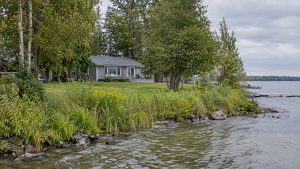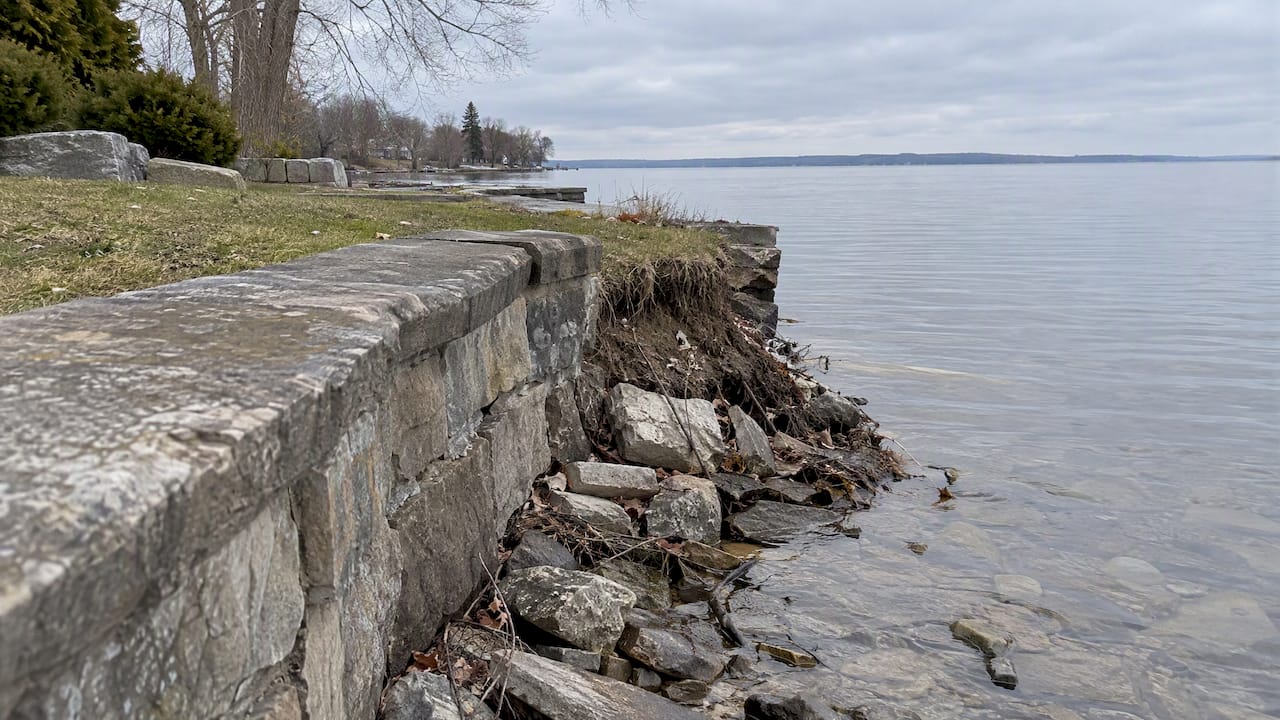
If you own or want to buy waterfront in Ontario, erosion control is not a landscaping detail. It decides what you may build, what you may repair, who has to approve it and what a buyer will pay you later. On Lake Simcoe and around Innisfil, you will usually deal with three layers at once: the province, the conservation authority and the Town. Below is how I walk my clients through it, and where I tell them to slow down.
TL;DR
- Repairing or replacing an existing erosion control structure can be done without a Public Lands Act work permit if you follow set rules, but you must register first. A new or expanded structure needs a permit.
- On Lake Simcoe, the Lake Simcoe Region Conservation Authority (LSRCA) regulates shoreline work, and the Town of Innisfil adds its own permit system. One approval does not replace the other.
- Conservation authorities favour natural shorelines over concrete, steel and gabions, so an old hard wall can become a cost for the next owner.
- Before you offer on waterfront, ask what is on the shore, whether it was approved and what it will cost to maintain.
Why erosion control matters more on the water
Shorelines move. The LSRCA puts it plainly: flooding, erosion and slope failures are naturally occurring processes that become a hazard when people and buildings are in their path. A lot that looks stable in July can look different after a stormy spring with high water.
Parks Canada has pointed to climate-driven changes such as more frequent, severe storms and high-water levels in its shoreline remediation work. What I tell my clients is simple: treat erosion control as ongoing management, not a one-time construction job. A wall built ten years ago still needs inspection, and the rules around it may have changed since.
There is also a second erosion problem that buyers rarely hear about. Researchers working on Huron County lake-level assessments describe how wave energy can be reduced by structures at the water’s edge, while surface water and groundwater keep eroding a bluff from the top down. That is why the better projects protect the toe and also stabilize the slope, often with planted terraces of willow, red-osier dogwood and poplar cuttings.
Who regulates shoreline work
Most buyers assume one office signs off. In practice there are several, and each looks at something different.
| Layer | What it covers | What to check |
|---|---|---|
| Province (Public Lands Act) | Work on shore lands, including below the high-water mark | Registration for maintenance of existing structures, a work permit for new or expanded ones |
| Conservation authority | Development and site alteration in regulated areas | A permit before building, filling or altering the shoreline |
| Municipality (Innisfil) | Zoning and the Community Planning Permit System | Waterfront zoning requirements and a local permit |
| Federal (where it applies) | Federal lands and waterbodies | Separate approvals, for example on Parks Canada waters |
The province: shore lands and the Public Lands Act
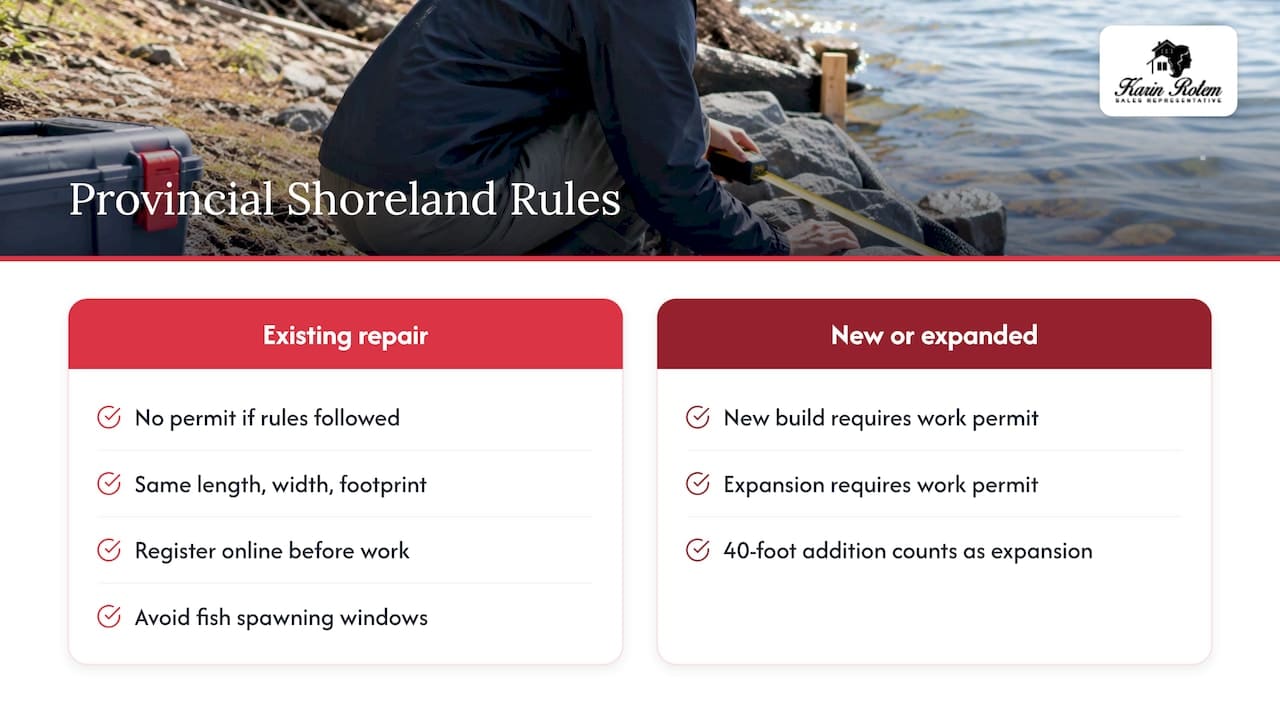
In Ontario, the beds of most water bodies are Crown land, and the Ministry manages shore lands under the Public Lands Act. On the province’s page for existing erosion control structures, you may not need a work permit to maintain, repair or replace one if you follow every listed rule. Those rules include keeping the same length, width and footprint, and avoiding work during fish spawning windows. You still have to register the activity online before you start. Failing to register or to meet the rules can lead to charges and fines.
If you want to build a new structure or expand an existing one, the same page says you will need a work permit. That is the line most owners cross without realizing it. Adding forty feet of wall “to match” the neighbour’s is an expansion, not a repair.
The province also publishes a general page on Crown land and shore land work permits, which is the starting point when your project falls outside the repair exemption.
The conservation authority: LSRCA on Lake Simcoe
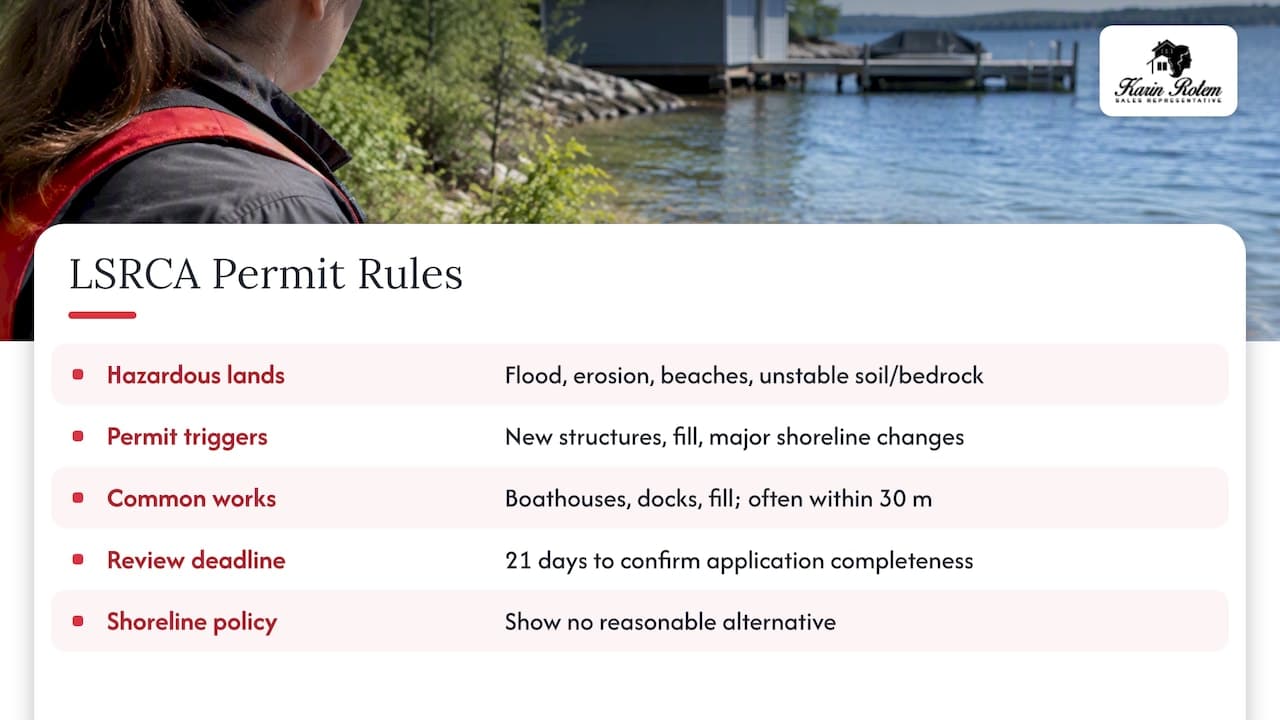
For Innisfil and the rest of the Lake Simcoe watershed, the LSRCA is the body that matters most. Under Ontario Regulation 41/24, conservation authorities regulate development in hazardous lands, which the regulation describes as land that could be unsafe because of flooding, erosion, dynamic beaches or unstable soil or bedrock. The LSRCA’s planning and permits page says you need a permit before constructing new structures, placing fill or significantly altering the shoreline. Works such as boathouses, docks and fill near the water, especially within 30 metres, are the usual triggers. It also recommends a pre-submission consultation, and that is advice I second. A geotechnical report or drainage plan may be requested, and the authority has 21 days to tell you whether your application is complete.
The philosophy matters as much as the paperwork. The LSRCA’s implementation guidelines state that shoreline alterations are not permitted except under specific policies, and that an applicant must show there is no reasonable alternative. In plain terms, the default answer to a new wall is no, unless you can show why a natural approach will not work.
The Town of Innisfil: zoning and the CPPS
A conservation permit does not grant municipal permission, and the reverse is also true. Innisfil’s Community Planning Permit System covers building a new structure, adding to a building, boathouse or dock, and site alterations such as grading, fill, vegetation removal and shoreline work. The Town’s zoning by-law also includes specific regulations for residential waterfront properties with frontage on Lake Simcoe.
What most buyers don’t realize is that these systems are separate queues. You can have the LSRCA’s blessing and still be missing a Town permit. For the full picture on that side, see our guide to CPPS and Parks Canada permits for Innisfil waterfront.
Hard wall or natural shoreline?
This is the question I get most from owners with an ageing wall. Conservation authorities generally discourage or prohibit shoreline hardening such as concrete, sheet steel, railway ties and gabion baskets, and prefer bioengineering, native vegetation and natural contours. The LSRCA’s stated goal is to keep natural shorelines wherever possible so that future restoration is minimized.
Ontario examples show the direction. A shoreline naturalization project on the Detroit River used native plantings and a riparian buffer to stabilize the bank and improve fish habitat, and the University of Windsor’s write-up reports a cost of $62,000 in 1997 to 1998. Treat that figure as a historical data point, not a quote for today. Costs depend on frontage, slope, access and the reports required, and I would never give you a number without a site visit and a contractor’s estimate.
How the options compare
| Approach | Typical regulatory view | Buyer’s concern |
|---|---|---|
| Native planting and riparian buffer | Favoured | Needs time to establish, little structural protection on a steep, active bank |
| Bioengineering (live stakes, terraces, bio-logs) | Favoured, often the only type allowed for new development | Needs design and monitoring |
| Natural stone or boulders | Case by case, depends on location and design | Confirm it was approved |
| Concrete, sheet steel, ties, gabions | Discouraged or prohibited | Ongoing maintenance, possible pressure to replace |
The last row is where I slow clients down. If you are buying a home with an old hard wall, remember that repairs are allowed under the provincial rules only within the same footprint, and anything bigger is a new project judged by today’s standards. That can mean a wall that is expensive to keep and hard to expand.
What I check before a client offers on waterfront
Here is the order I follow. It is the same whether the buyer is a Toronto family looking for a weekend place or an investor.
- Walk the shore, not just the house. Look for leaning or cracked walls, exposed roots, slumping, bare soil and debris lines that show where water reaches.
- Ask what is there and who approved it. Request permits, registrations and any LSRCA correspondence. An unapproved structure is the seller’s history, but it can become your problem.
- Confirm what you actually own. Shore lands, road allowances and riparian rights change what you may touch. Our guide to riparian rights in Ontario explains what waterfront owners can and cannot do.
- Check the setback and the regulated area. A distance such as 30 metres does not prove a lot is buildable, as we explain in Ontario waterfront setbacks.
- Make your offer conditional where it helps. Depending on the property, that can mean a review of permits, a shoreline inspection or a conversation with the conservation authority. Your lawyer and agent should set the wording together.
- Budget for upkeep. Ask for the age of any structure and a realistic maintenance outlook before you price your offer.
Our checklist on five pre-offer checks when buying waterfront in Ontario covers shore and septic together, and I recommend reading it alongside this one. For Lake Simcoe specifically, see market cues, shoreline, permits and insurance for GTA buyers.
Don’t forget the building itself
Erosion is only one way water affects a property. Salt, spray and wind wear down fixings and exterior materials too. Lake Simcoe is fresh water, so the exposure is not the same as on a sea coast, but the principle of checking the envelope still applies. This UK article on coastal roof materials and how salt exposes poor fixings is written for British homes, so don’t take its details as Ontario standards. It is still a useful illustration of why exposed waterfront homes deserve a closer look at roofing and fasteners during your inspection.
Protect your neighbours, and yourself
The province warns that even when you have the right to repair an existing structure, you must make sure the work does not affect neighbouring properties. A common problem is a change in sediment movement or debris build-up. You can be held legally responsible for damage caused by your project, so talk to your neighbours before work starts. I would add a practical point: a shared shoreline often means a shared problem, and a coordinated approach usually costs less than two owners doing separate repairs.
Selling a waterfront home with a shoreline structure
If you are selling, expect the buyer’s lawyer and inspector to ask about the shore. What I tell my sellers is to gather the paperwork before listing: permits, registrations, contractor invoices and photos of any past repairs. A clean file shortens negotiations. A missing one invites a price cut or a condition that delays closing. If you suspect a past repair was done without registration, deal with it before you list, not after you have an accepted offer. Our guide to selling an Ontario waterfront home without permit delays goes through that process.
Docks and boathouses raise related questions. See dock permits on Lake Simcoe and Ontario boathouse permits if those apply to your property.
Our perspective on shoreline risk
We work with buyers, sellers and investors around Innisfil, Toronto and the Friday Harbour community, and we see the same pattern. Buyers fall for the view and the dock, then discover that the shoreline is the part of the purchase with the most unknowns. We don’t think that should scare you off. It should change the order of your questions.
First, we ask what you want from the property. A weekend retreat you will use for ten years has a different risk tolerance from an income property you plan to hold and resell. Second, we ask what the shoreline is made of and who signed off on it. Third, we ask whether the property is a good fit at all. Sometimes the honest advice is that a particular lot carries more shoreline responsibility than the buyer wants, and a condo in a managed resort community is the better match. Friday Harbour is a good example of how different that ownership experience can be, which is why many of our clients compare both options before deciding.
We are not engineers or lawyers, and we say so. What we do is spot the questions, bring in the right professionals early and negotiate with the facts in hand.
— Felix
If you’re looking at Lake Simcoe or Friday Harbour
If you are weighing a shoreline home against a resort-style condo, we can show you both sides with current listings. Browse Friday Harbour condos for sale or get in touch through our main site and tell us what you want from the water. We will tell you honestly whether a property fits your goals, including when it doesn’t.
FAQ
Do I need a permit to repair my existing shoreline wall in Ontario?
Not necessarily a Public Lands Act work permit. The province says you may not need one if you follow its rules, such as keeping the same footprint and avoiding fish spawning periods. You must still register the activity online first, and you may still need conservation authority or municipal approvals, so confirm before you begin.
Can I build a new seawall on Lake Simcoe?
It is difficult. A new or expanded structure needs a provincial work permit, and the LSRCA’s guidelines say shoreline alterations are generally not permitted unless you meet specific policies, including showing there is no reasonable alternative. Plan on a pre-submission consultation and expect natural approaches to be favoured.
Does a conservation authority permit cover the Town of Innisfil’s requirements?
No. The Town’s Community Planning Permit System and zoning rules are separate from the conservation authority’s regulation. Check both early, because approval from one does not give you approval from the other.
Should I worry about an old concrete or steel wall when buying?
It is worth a closer look. Hard structures are generally discouraged by conservation authorities, repairs are limited to the existing footprint, and replacement may be judged against current preferences. Ask for permits and the structure’s age, and get a professional opinion on condition before you remove conditions.
Sources
- Maintain, repair or replace erosion control structures on shore lands, ontario.ca
- Crown land and shore land work permits, ontario.ca
- O. Reg. 41/24, ontario.ca
- Planning and Permits, Lake Simcoe Region Conservation Authority
- LSRCA Regulation Implementation Guidelines
- Community Planning Permit System, Town of Innisfil
- Town of Innisfil Comprehensive Zoning By-law 080-13
- Huron County Extreme Lake Levels Integrated Assessment, Phase I Report
- Dean Construction site naturalization, University of Windsor GLIER
- Coastal roof materials for UK homes