
If you own a home or condo in Innisfil, your property tax is the assessed value of the property multiplied by the Town’s residential rate, which the Town lists as 1.239628% for 2026. The bill arrives twice a year, and the Town charges a 1.25% monthly penalty on late payments. I’m Karin Rotem, and I help buyers and sellers in Innisfil and Friday Harbour every week. Below I walk through how the bill is built, what changed in 2026, and how to budget for it before you make an offer.
TL;DR
- The 2026 residential tax rate in Innisfil is 1.239628%, applied to the value MPAC assigns to your property. A $600,000 assessment works out to roughly $7,438 a year.
- Bills come in two installments. In 2026 they were due June 29 and September 28, and a 1.25% penalty is added each month to unpaid amounts.
- The 2026 budget raised the blended tax bill by 4.2% for the average household, about $222.99 more than 2025.
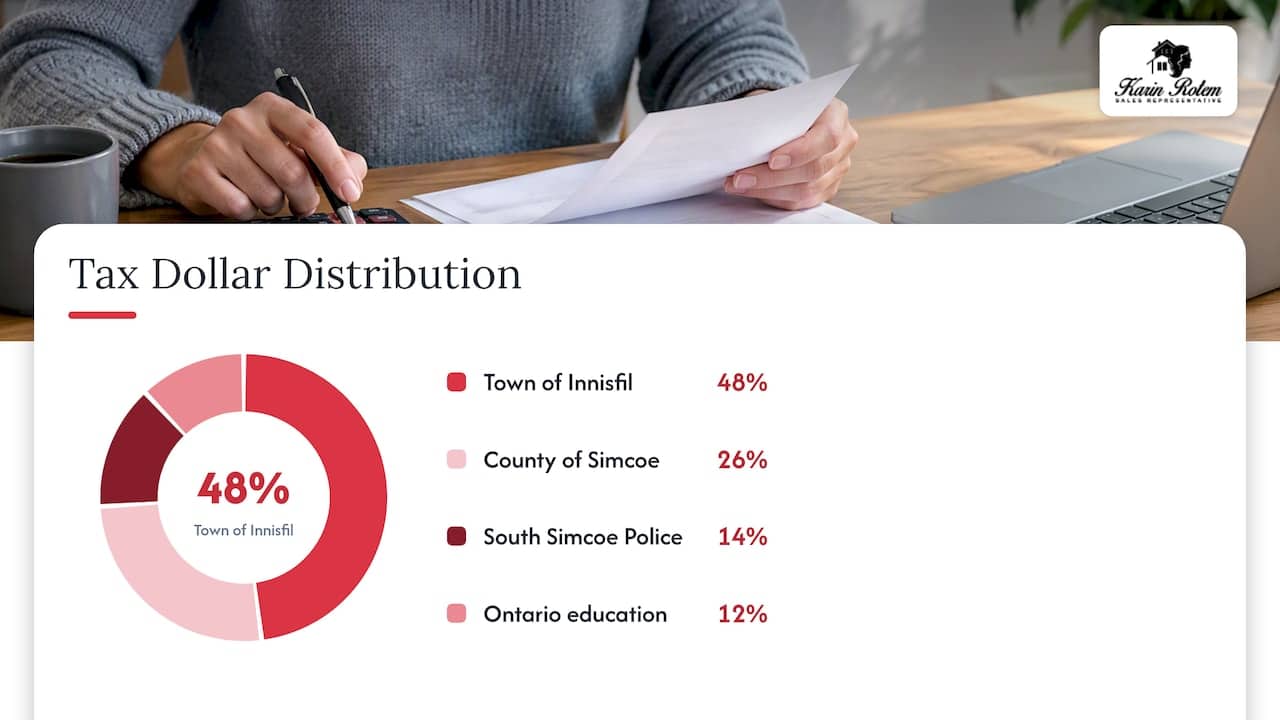
- Only about 48 cents of each tax dollar stays with the Town. Police, the County of Simcoe and education take the rest.
- Friday Harbour condos are taxed on the same basis as any Innisfil home. Budget for tax and condo fees together.
How the Innisfil property tax bill is calculated
The formula is simple. Your bill equals your property’s assessed value multiplied by the tax rate for its class. The Town of Innisfil states that Residential, Multi-Residential and Farmland Development II properties share one rate of 1.239628% in 2026.
Here is what that looks like at a few assessment levels. These are my own calculations from the published rate, not Town figures, so treat them as estimates.
| Assessed value | Estimated 2026 annual tax | Per month (÷12) |
|---|---|---|
| $446,363 (Town’s average household) | about $5,533 | about $461 |
| $600,000 | about $7,438 | about $620 |
| $800,000 | about $9,917 | about $826 |
| $1,000,000 | about $12,396 | about $1,033 |
The $446,363 figure is the assessment the Town uses for its average household in the budget announcement. Your own number will depend on the property. Always ask for the actual current bill on any listing you are serious about, because sellers and listing agents can supply it.
Assessed value is not the price you pay
What most buyers don’t realize is that the number on the tax bill is not your purchase price. The Municipal Property Assessment Corporation (MPAC) sets the assessment, not the Town. MPAC assesses and classifies every property in Innisfil based on its use.
That creates a gap in two situations:
- You bought recently at a high price. The assessment may sit well below what you paid, so your first bills can look low. They won’t necessarily stay that way when MPAC catches up.
- You bought a new build or newly completed unit. Assessment can lag, and what you see on the seller’s bill may not reflect your own.
What I tell my clients: when you run the numbers, test your budget with a tax estimate based on the purchase price, then treat the seller’s current bill as the optimistic case. If you can live with the higher figure, you are covered either way.
Innisfil property tax due dates and late penalties
The Town issues bills twice a year, and each bill is due in two installments. For 2026, the first installment was due June 29 and the second September 28. Both have passed as I write this in October 2026. The Town publishes the dates for the next cycle on its property tax page, so check there before you plan your 2027 cash flow.
The penalty is firm. If a payment isn’t received by the due date, the Town adds 1.25% per month on the unpaid balance, charged on the first business day of each month until the arrears are paid. On a $3,000 installment that is $37.50 for the first month alone, and it keeps recurring.
Pay early, not on the deadline
The deadline is when the Town receives the money, not when you click send. The Town notes that online banking is not instantaneous, so allow at least 2 to 3 business days. If you pay by credit card through a third-party provider, there is a convenience fee and the Town advises allowing at least 5 business days. Neither works for a last-minute payment.
Two habits I suggest:
- Set a reminder for one week before each due date.
- Have your roll number handy. You need it for online banking and for setting up eBilling.
If you buy mid-year, check the bill is in your name
New homeowners sometimes get a tax bill from the Town before MPAC’s first assessment notice reaches them. MPAC mails property assessment notices in November. If nothing has arrived, confirm your roll number through the Town’s services rather than assuming it is on its way. Your lawyer will handle tax adjustments on closing, but the account setup after closing is yours to confirm.
Why the 2026 bill went up 4.2%
If you saw the headlines about a 5.5% increase, that was the earlier plan. Council adopted a revised budget on January 14, 2026, with a blended property tax increase of 4.2% for the average household. That is about $222.99 more per year than the 2025 bill.
The blended figure combines four pieces:
| Component | 2026 change |
|---|---|
| Town services | 1.31% |
| Police services | 10.83% |
| County of Simcoe services | 3.5% |
| Education | 0% |
Police is the largest driver, and it is not something the Town controls directly. Local reporting on the budget also noted that council drew on a property tax stabilization reserve to soften the impact, so you should expect the Town to keep balancing user fees, taxes and reserves in future years. I can’t predict future rates, and I would be wary of anyone who claims to. What you can do is budget for increases rather than a flat bill.
Where your tax dollar actually goes
The Town of Innisfil collects the money, but it keeps only part of it. According to the Town, roughly 48% of each dollar stays with the municipality. The rest goes to the South Simcoe Police Service (14%), the County of Simcoe (26%) and the Province of Ontario for education (12%), as described on the Town’s website.
Why does this matter to a buyer? When someone says “Innisfil taxes are too high,” they are often reacting to the Town’s share. In fact, a large part of the bill is set by partners. County budgets, for example, flow straight through: Simcoe County’s 2026 budget carried a 3.5% tax increase on its portion, as the Town’s own summary shows.
Innisfil versus Toronto: what changes in your budget
Many of my clients are Toronto professionals comparing a city home with a waterfront place in Innisfil. A tax rate by itself won’t settle that comparison, because the price of the property, commute, insurance, condo fees and lifestyle all move at the same time. I cover that full picture in our Toronto vs. Innisfil cost of living guide.
For property tax specifically, compare in this order:
- Get the actual current tax bill for each property you are considering.
- Estimate a bill at the purchase price using each municipality’s current rate.
- Add monthly condo fees if it is a condo, and utilities if they are not included.
- Compare the total monthly carrying cost, not the tax line alone.
If you are moving from Toronto, the relocation checklist walks through what to organize before and after closing, and our piece on selling your Toronto home and buying in Innisfil covers the sequencing.
Friday Harbour property taxes
Friday Harbour is one of the most searched topics I get asked about. The short answer is that the tax logic is the same as anywhere else in the Town. The Town sets the rate, MPAC sets the assessment, and your bill follows from your unit’s value. Because Friday Harbour is a waterfront resort community, assessments tend to be higher than for inland condos, so the dollar amount tends to be higher too.
What’s different is the full ownership cost. A condo buyer pays:
- Municipal property tax, as above.
- Monthly maintenance (condo) fees, which cover shared amenities and the building’s operating costs.
- A contribution to the reserve fund, which is built into those fees.
- Utilities and insurance, depending on the building and your unit.
I’ve written a dedicated guide on property taxes for Friday Harbour condos that goes through annual costs in more detail. Before you offer on a unit, ask your agent for the status certificate. It shows the fees, reserve fund health and any special assessments, which matters as much as the tax line.
Taxes and investment returns
If you are buying at Friday Harbour as an investment, taxes are one input into your yield, not an afterthought. High carrying costs against rental income can compress returns, and I look at that honestly in our piece on cap rates in Innisfil. Cap rates there sit in the low single digits at Friday Harbour, so a tax or fee surprise can change the picture quickly. If you’re thinking about rentals, also read about short-term rental income properties and using a Friday Harbour condo as a vacation property.
What if you think your assessment is wrong?
You don’t need to hire an appraiser first. MPAC runs a free online tool, AboutMyProperty, and the Town points owners to it. Using it, you can compare your assessment with up to 100 similar properties in your neighbourhood. If the comparison suggests an error, you can then file a Request for Reconsideration with MPAC.
A caution from experience: a lower assessment feels good, but a wrong one in your favour may get corrected later. Challenge it when the facts support it, not as a routine tactic.
Credits, rebates and tax treatment for owners
The Ontario Energy and Property Tax Credit (OEPTC) can help eligible low- to moderate-income residents. For 2026 the maximum is $1,307 for non-seniors and $1,488 for seniors, including a property tax component of $1,017 and $1,198 respectively. Eligibility depends on 2025 residency and principal residence status. You apply by filing your income tax return and completing Form ON-BEN. Whether you qualify depends on your income, so speak to an accountant or check with the Canada Revenue Agency.
Cottages and second homes
If your Innisfil property is a weekend retreat, note that you cannot claim the OEPTC for a second residence if you have already claimed it for your principal residence, per the same CRA guidance. This surprises some Toronto buyers who assume every property carries a credit.
Income properties
For rental owners, the CRA lets you deduct property taxes for the period the property was available for rent. That covers rental income reporting only. I’m a real estate agent, not an accountant, so confirm the details of your own situation, including rental losses and personal use, with a tax professional before you buy.
Our perspective: budget the whole month, not the tax line
We work in Innisfil and Friday Harbour every day, and the same pattern repeats. Buyers fixate on one cost, usually the tax rate, and then get surprised by another. A buyer who has priced the tax, condo fees and insurance together rarely regrets the purchase.
Our view is practical:
- Run the high-case number. Estimate tax at your purchase price and add a cushion for increases. Council has moved the rate up in recent budgets, and the 2026 adopted increase is 4.2%.
- Ask what you are actually buying. A waterfront condo and a detached home on a lot have very different cost structures, even at the same price.
- Know when Innisfil isn’t the right fit. If your goal is the lowest possible carrying cost, or you need a daily commute without tradeoffs, we will tell you so, and we’ll show you where the numbers point instead. Our drive time guide for commuters is a good reality check.
- Sellers should care too. Buyers read your tax bill closely. When we price a home, we expect to explain the carrying cost, which is part of pricing a home in Innisfil to sell.
We aren’t here to make property taxes sound trivial or scary. They are a known, calculable cost, and with the right inputs they stop being a source of stress.
— Felix
Planning a purchase or sale in Innisfil or Friday Harbour?
If you are weighing a condo, a home or an income property, we can give you the tax, fee and market picture for the specific listings you like, not generic averages. Browse Friday Harbour condos for sale or The Harbour listings for sale, or contact us through karinrotem.com and tell us your goal. For a broader view of where prices stand, start with our Innisfil real estate market overview and our look at Innisfil waterfront prices.
FAQ
When are Innisfil property taxes due?
The Town bills twice a year, with two installments. In 2026 the due dates were June 29 and September 28. Check the Town’s property tax page for the next schedule, since dates can change from year to year.
What is the Innisfil property tax rate?
For 2026 the residential rate is 1.239628%, applied to your MPAC assessment. Multiply your assessed value by 0.01239628 for a rough annual figure, then confirm against your bill.
What happens if I pay my Innisfil property tax late?
The Town adds a 1.25% penalty each month on the unpaid balance, charged on the first business day of the month. Because online banking can take 2 to 3 business days to arrive, pay at least a week early. If you’ve missed a payment, contact the Town’s tax office at 705-436-3710 or inquiry@innisfil.ca.
Are Friday Harbour property taxes different from the rest of Innisfil?
The rate is the same Town rate. What differs is the assessed value of your unit, and the added monthly condo fees that come with ownership. Ask for a unit’s current tax bill and its status certificate before making an offer.
Can I dispute my property assessment?
Yes. Start with MPAC’s free AboutMyProperty tool to compare your assessment with similar homes, and file a Request for Reconsideration if it looks inaccurate. The Town can’t change the assessment, as MPAC sets it.
Sources
- Property Taxes, Town of Innisfil
- Property Taxes (billing and late payments), Town of Innisfil
- Property Assessments, Town of Innisfil
- Innisfil Council adopts 2026 Town Budget
- Budgets, Town of Innisfil
- Town of Innisfil
- Ontario Energy and Property Tax Credit Questions and Answers, Canada Revenue Agency
- Rental Income, Canada Revenue Agency