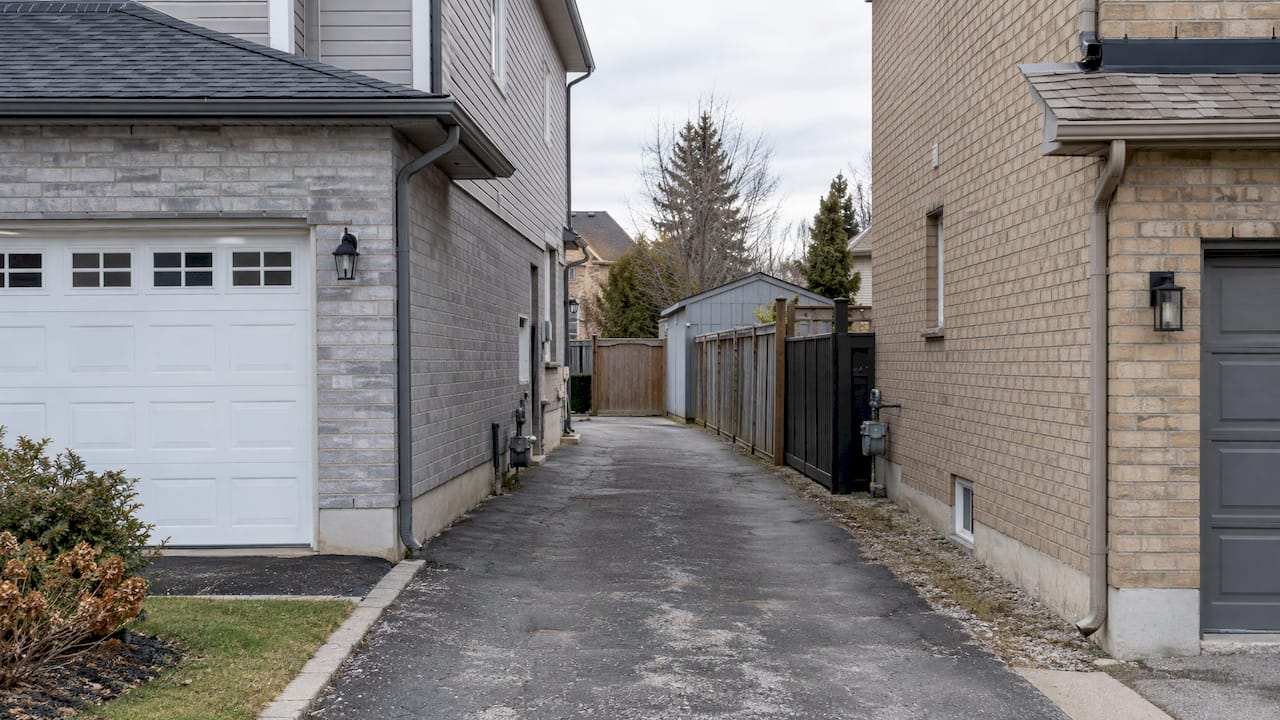
A right-of-way easement is a legal right for someone else to pass over a defined part of your land, usually to reach their own property or a road. You still own the land. But you can’t build on that strip, block it or use it in ways that interfere with the holder’s right. In Ontario, the right is normally written on title, so you can find it before you make an offer.
What I tell my clients is simple: an easement is not automatically a deal-breaker, but you should know exactly what it says before you remove conditions. Here is how I walk buyers through it.
TL;DR
- A right of way is one type of easement: the right to pass over another owner’s land. Every right of way is an easement, but not every easement is a right of way.
- The wording of the registered document controls who can use the strip, for what purpose and how far the right extends.
- Check the parcel register, the instrument itself and a survey before you waive conditions. Ask your real estate lawyer to explain the wording.
- Shared driveways are the most common everyday example, and maintenance and access disputes are the most common problem.
- Releasing a registered easement takes a specific registered document and usually the agreement of the other party.
What a right-of-way easement actually is
An easement is a right to use part of someone else’s land for a limited purpose without owning it. Boardwalk Law lists the usual Ontario examples: a shared driveway between neighbouring homes, access to a landlocked or rear property, utility access for hydro and water, and access roads serving commercial properties.
A right of way is the passage version. In a 2017 Ontario Superior Court decision, it is described as a common positive easement that lets the owner of one parcel pass over a defined part of a neighbouring parcel to get to or leave their own property.
Two points surprise buyers.
You still own the land. Treadstone Law explains that an easement does not transfer ownership. You own every inch of your lot, but you can’t use the burdened area in a way that unreasonably interferes with the holder’s rights.
It affects what you can do. According to Ever Law Group, an easement can limit construction plans, landscaping, fencing, parking, access routes and future redevelopment. That’s why I raise it at the offer stage, not at closing.
Right of way, access easement and other easements
People search “access easement vs right of way” because the terms overlap. In practice, an access easement and a right of way usually describe the same thing: a right to get across land. Insight Law Firm puts the relationship plainly: every right of way is an easement, but other easements cover utilities, drainage, support for shared walls, parking and access to services.
| Type | What it allows | Typical Ontario example |
|---|---|---|
| Right of way / access easement | Passing over a defined strip to reach a property or road | Shared driveway, rear-lot access |
| Utility easement | Installing and maintaining services | Hydro, water or gas lines |
| Drainage easement | Water to flow across or be carried over land | Rear-lot swale or pipe |
| Support or shared-wall easement | Structural support between buildings | Semi-detached or townhouse walls |
| Parking easement | A defined parking use | Lane or shared lot |
One more distinction is worth knowing. Rights of way are often used to refer to easements, but an academic review of Canadian easement law notes that a right of way contracted to a particular individual may be a licence rather than an easement. A licence is personal permission, and it doesn’t run with the land the way an easement does.
Public versus private rights of way
Ever Law Group also separates public rights of way, such as municipal road allowances, sidewalks or pathways controlled by a municipality, from private ones between neighbouring owners. Private rights of way are governed by the easement agreement registered on title. This article is mostly about the private kind, because that’s the one that shows up in a purchase.
Dominant and servient owners, in plain words
These two terms come up in every easement discussion. The dominant owner is the one who benefits: the parcel that gets the right to cross. The servient owner is the one whose land is crossed.
Ontario’s land registration guidance says an easement is a right annexed to land that lets the dominant owner impose restrictions on the servient owner as to its use. It exists for the benefit of the dominant land. The two parcels must be owned by different parties, or by the same party in a different capacity.
When you buy a home with a shared driveway, you may be one, the other or both, depending on the layout. Ask which one you are. It changes who maintains what and who needs whose consent.
There’s a Canadian exception. Alberta’s land titles guidance notes that statutory utility rights of way can resemble easements but may not need a separate benefiting parcel. Utilities, municipalities or the Crown can hold them. If you’re buying outside Ontario, the rules differ by province.
How a right of way is created, and how far it reaches
An easement may be created by grant, reservation, operation of law, statute, or section 15(1) of the Conveyancing and Law of Property Act. The most common route for a buyer is an express grant: a document, registered on title, that says who may cross where.
The wording matters more than anything else. The Superior Court has said that the creating document, read in light of the circumstances when it was made, controls the nature and extent of an express easement, including ancillary rights such as reasonable entry and repair.
A right of way is not unlimited use
Insight Law Firm notes that a right of way for pedestrian access does not let you drive a car over the same path, and a right for one vehicle does not give you the right to park or store materials, because courts read the original grant strictly. In Barbour v. Bailey, the Court of Appeal limited an easement to non-vehicular passage because the evidence showed 20 years of foot use but not 20 years of vehicle use.
Can a neighbour earn one just by using your land?
Sometimes, but less often than people think. ZSM Law explains that Ontario’s Real Property Limitations Act deals with claims to a way enjoyed without interruption for twenty years, and use with the owner’s permission generally doesn’t support a claim. It also explains that under section 51 of the Land Titles Act, no adverse right can be acquired by possession or prescription over Land Titles land. So a neighbour generally can’t earn a new right of way over Land Titles land by years of use. Older properties and unconverted parcels can be different, which is one more reason to have a lawyer review the title.
Finding a right of way before you make an offer
In Ontario, easements and rights of way are registered on title under the Land Titles Act or, for properties not yet converted, under the Registry Act. Once registered, an easement appears against the servient title and may also be noted on the dominant title.
This is the order I suggest:
- Ask for the parcel register early. Teranet describes the parcel register as listing the PIN, owners, type of ownership, easements, transfer history, mortgages and liens. Easements are right there in the list.
- Read the actual instrument, not just the line item. The register will say an easement exists. The document says what it permits, and where.
- Get a survey or reference plan. Insight Law Firm notes that a surveyor’s plan can show the physical footprint of the easement. I cover why this matters in Ontario property surveys and what title insurance can’t settle.
- Have your real estate lawyer review it. Boardwalk Law notes a lawyer can examine the registered documents and clarify which part of the property is affected, who may use it, what use is permitted and whether there are restrictions or obligations.
- Walk the property with the document in hand. If the plan shows a strip along the side yard and a fence sits in the middle of it, you want to know before closing.
The register is the starting point, not the whole answer
ZSM Law points out that section 44(1) of the Land Titles Act says registered land is, unless the register says otherwise, subject to rights of way, watercourses and other easements. In plain terms, an easement that never made it onto the register can in some cases still bind the land. A thorough title search also looks beyond the register at things like unpaid taxes, utility arrears and work orders.
Lenders and title insurers treat easements as part of the risk on title. Ask your lawyer how your lender sees the one on your property.
Shared driveways: where right-of-way questions get practical
Most buyers don’t meet a right of way in a courtroom. They meet it at a shared driveway between semi-detached or freehold townhouses. According to Korman’s, the registered owner keeps ownership of the affected area, and the parties who benefit need that owner’s consent before making changes to it.
The disputes I hear about are predictable. Ever Law Group lists blocked access routes, fence placement, maintenance disagreements, unauthorized expansion of use, and parking or obstruction. These can get expensive and personal if nobody deals with them early.
Treadstone Law gives the rule of thumb both sides need: the document controls. If a neighbour uses more of your property than the easement allows, that may be trespass. But you can’t simply block a valid right of way either.
What most buyers don’t realize is that the paper often says nothing about who pays to repave. Before you buy, ask the seller:
- Who plows and repairs the shared section today, and is it written down anywhere?
- Is there a shared-use or maintenance agreement registered on title?
- Do you park on the strip, and does the document allow it?
- Have there been any complaints? Sellers have disclosure duties, which I cover in Ontario seller disclosure requirements.
A buyer who hears “we’ve never had a problem” should still read the document. Good relations between neighbours don’t bind the next owners.
Waterfront and lifestyle properties
Many of my clients buy near the water, in Innisfil, around Lake Simcoe and at Friday Harbour. Ever Law Group’s definition of a right of way includes access to a waterfront area, so shoreline paths, lane access and shared boat or beach access are all worth asking about. A condo or lot near the lake may also have utility and servicing easements. Read each one.
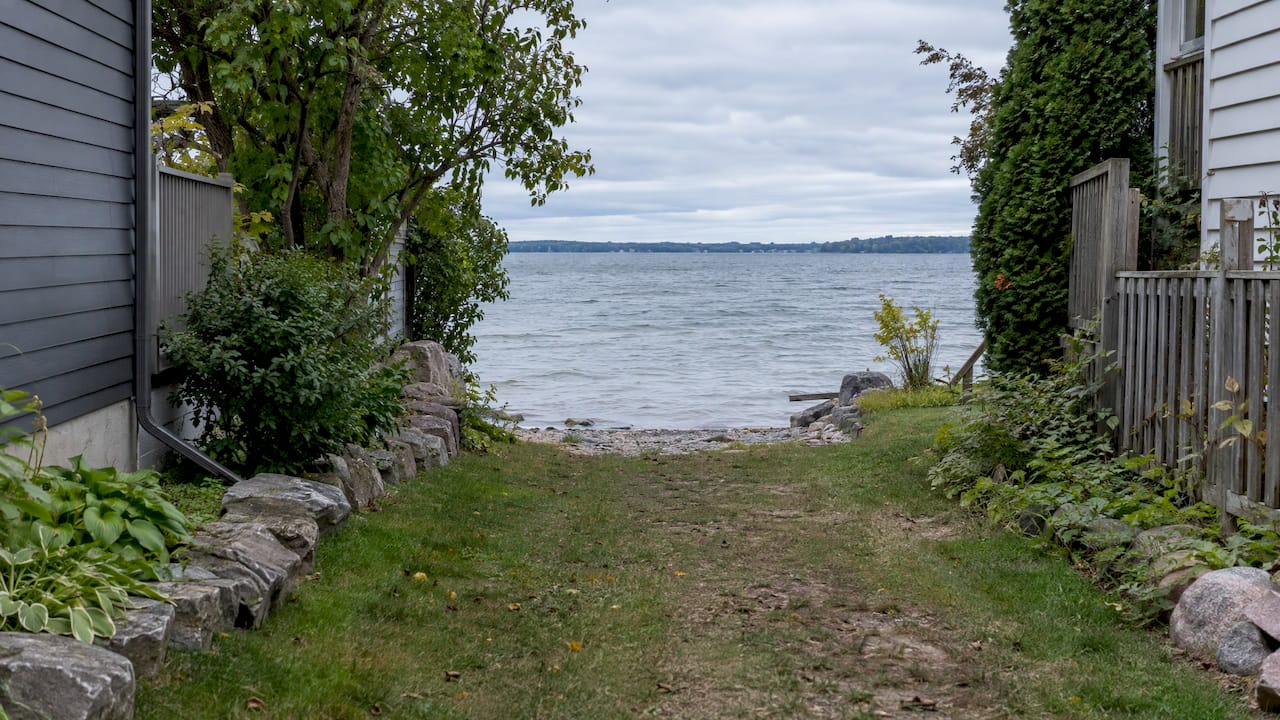
For the water side of the picture, see five pre-offer checks when buying waterfront in Ontario and riparian rights in Ontario. Easements and riparian rights are different things, and a waterfront buyer should understand both.
Changing or removing a right of way
People also ask how to get an easement removed. Honest answer: it’s usually not quick, and you usually can’t do it alone.
For a registered easement, Ontario’s land registration guidance says the Transfer, Release and Abandonment (TREL) is the principal document used to release it. It’s registered on both the servient and dominant lands, except for an easement in gross, which is registered only against the servient land. A TREL can release the whole easement or part of it, as to land or purpose.
The same bulletin says TREL can’t be used for unregistered easements, such as prescriptive ones, because they aren’t in the electronic registry system.
There are two more points to know:
- Planning Act approval. Ontario’s registration guidance says creating and removing many easements is subject to Planning Act approval. The land registration system doesn’t monitor this, and compliance is the registrant’s responsibility. Exceptions include court orders, expropriation, temporary easements under 21 years and easements over an entire existing parcel.
- Land transfer tax. Ontario’s Ministry of Finance says the grant of an easement or right of way is a taxable conveyance when registered, and tax is payable on any consideration. If you negotiate a new easement, budget for it. For the general picture, see my Ontario land transfer tax guide and what closing costs include in Ontario.
If you want to change an easement, the practical path is a negotiated agreement with the other owner, drafted and registered by a real estate lawyer. Disputes that don’t resolve may need a lawyer and sometimes the court. I’m not a lawyer, and I’ll always tell clients when a question belongs with one.
Our perspective on easements when buying
Easements are one of the most misunderstood items in a purchase. Buyers see the word on a title search and worry, or they see a neighbour’s driveway and assume it’s fine. Neither reaction is a plan.
We approach it the way we approach every transaction: find out what the document says, look at how the property is actually used, and then ask whether it fits what you want from the home. A right of way along a side lot may never affect you. The same strip across the spot where you planned a pool or a garage suite will.
For waterfront and resort-style properties, that diligence matters even more, because shared access, services and lifestyle features are part of the appeal. Our team works with buyers, sellers and investors across Toronto, Innisfil and Friday Harbour, and we bring your lawyer into the conversation early. We’d rather tell you a property isn’t the right fit than see you discover that after closing.
Felix
If you’re looking in Innisfil or Friday Harbour
If you’re weighing a condo or home near the water and want help reading the title and plan alongside your lawyer, my team can walk you through current listings. Start with Friday Harbour condos for sale or get in touch through the main site and tell me what you’re looking for.
FAQ
What is a right of way in Ontario?
It’s a legal right for one party to pass over another person’s land to reach a road, laneway, driveway, waterfront area or another property. Private rights of way are usually registered on title and governed by the wording of the easement agreement. Public ones, such as municipal road allowances and sidewalks, are controlled by a municipality or other authority.
What is the difference between an access easement and a right of way?
In everyday use, they usually mean the same thing: a right to cross land to get somewhere. A right of way is a type of easement, and other easements cover things like utilities, drainage and shared-wall support. What matters for you is the exact wording of the registered document.
What are the rules of a shared driveway?
The registered document sets them. It defines the permitted area, the purpose and sometimes conditions of use. The registered owner keeps ownership of the strip, and those who benefit generally need the owner’s consent to change it. You can’t block a valid right of way, and a neighbour can’t use more than the easement allows.
How do you get an easement removed from your property?
For a registered easement, a Transfer, Release and Abandonment is the principal document, and it usually needs the other owner’s agreement. Planning Act approval may also apply. Unregistered easements can’t be released with that document, so speak to a real estate lawyer first.
Sources
- Terence Berg and Matilda Berg v. Marilyn Susan Marks, 2017 (Ontario Superior Court)
- Armstrong v. 571609 Ontario Inc., 2026 ONSC 3831
- Barbour v. Bailey, 2016 ONCA 98
- Land Titles Act, R.S.O. 1990, c. L.5
- Ontario Land Registration Bulletin 2005-02: Easements and Release of Easements
- Ontario Land Registration Bulletin 2022-08: Releasing and Deleting Easements
- Ontario Guide to the Application of the Land Transfer Tax Act
- Service Alberta Land Titles Manual: Easements
- Easements, Errors, and Energy Projects (University of New Brunswick Law Journal)
- Teranet: The Value of a Parcel Register
- Insight Law Firm: Easement vs. Right-of-Way
- Insight Law Firm: Real Estate Title Search in Ontario
- Ever Law Group: Easements and Rights-of-Way in Ontario
- ZSM Law: Easements, Mutual Driveways, and Rights of Way
- Treadstone Law: Easements on Ontario Property
- Boardwalk Law: Easement on Property in Ontario
- Korman’s: Easement vs. Right-of-Way