
In a bidding war, the offer most likely to close, fast, certain, and simple, wins more often than the highest noisy bid. Sellers pick certainty over drama every time. The buyers who win consistently line up four levers before they ever submit: a firm mortgage pre-approval, a deposit that signals seriousness, conditions trimmed to the bone, and a closing date that fits the seller’s life, not just their own.
TL;DR:
- A firm mortgage pre-approval, a sizable deposit, and shortened condition timelines signal certainty and lower perceived risk, often outweighing a higher bid.
- Comps within 500 meters and the past 90 days should anchor your offer price, safeguarding against appraisal gaps and unrealistic guessing.
- Shortening financing or inspection conditions is more effective than increasing your bid, as it demonstrates reliability and reduces seller hesitation.
- Pre-emptive or bully offers can prevent bidding wars but risk revealing your hand early and triggering higher listing thresholds.
- Understanding the seller’s motivation, like a need for fast closure or flexible timing, allows tailoring your offer to their specific problem, increasing its appeal.
Bidding war strategies that actually move the needle before you offer
You have a narrow window, usually 24 to 72 hours, between finding out a property is going to multiple offers and having to submit yours. What you do in that window matters more than anything you say in the offer letter. Here’s the short list I walk every client through before they let their agent submit anything:
- Get firm mortgage pre-approval, not a soft pre-qualification, and confirm your lender will underwrite that specific property.
- Decide your deposit size now and know exactly how you’ll deliver it (certified cheque, bank draft, or wire) on short notice.
- Plan your condition timelines: 3 to 5 business days is standard for financing and inspection, or arrange a pre-offer inspection if you’re waiving that condition.
- Draft a short irrevocable period and pick a closing date that actually works for the seller’s move.
- If escalation clauses are permitted in your area, understand exactly how far you’re willing to go, and know that they carry appraisal risk.
What most buyers don’t realize is that half this list has nothing to do with price. Sellers and their agents are reading your offer for risk, not just dollars, and every one of these levers either lowers that risk or raises it.
Primary strategies: price levers and non-price levers explained
Price is only one lever, and often not the most persuasive one. The buyers who consistently win multiple-offer situations understand that sellers are solving for three things: how much money lands in their pocket, how sure they are the deal will close, and how little hassle it takes to get there.
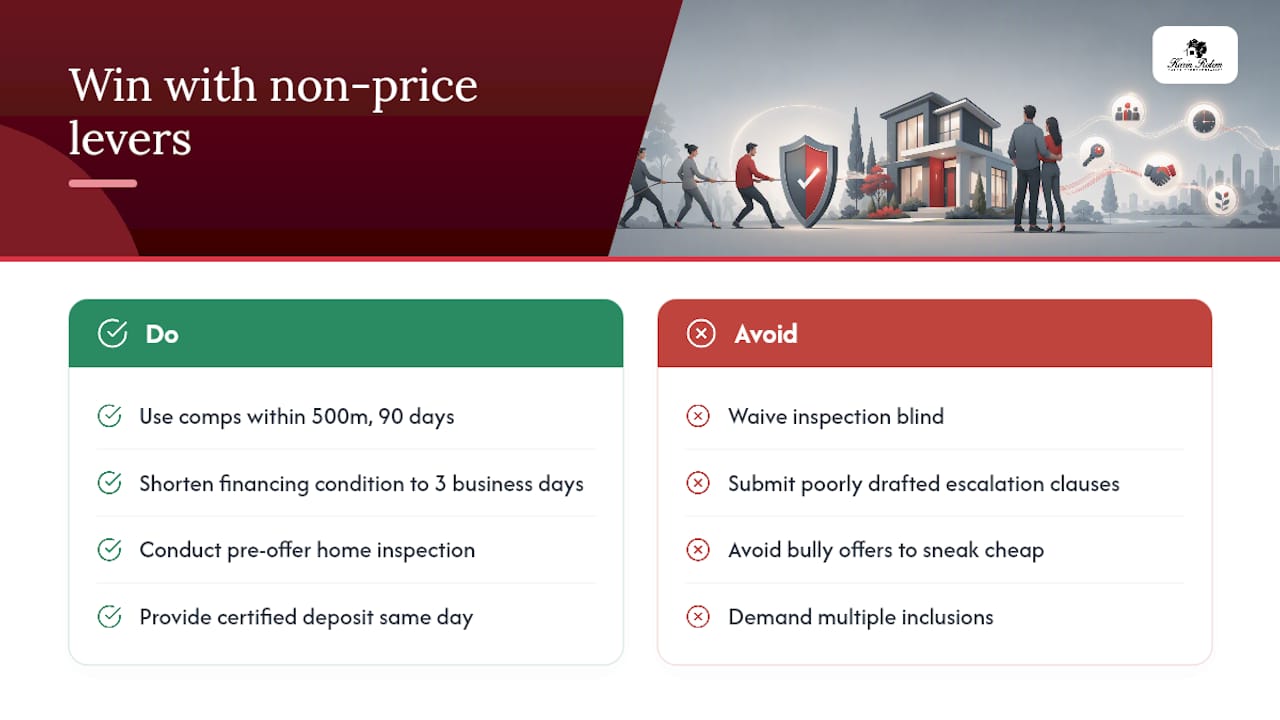
Setting price with real comps. A serious offer starts with sales within roughly 500 metres of the property and from the last 90 days, not city-wide averages from six months ago. That radius and window keep your number grounded in what’s actually happening on that street right now, which also protects you against appraisal risk later. If comps support $850,000 and the bidding is pushing past $900,000, you’re not competing anymore, you’re guessing.
A bigger deposit doesn’t buy you a lower price, but it does buy you credibility with a seller who has been burned before by a deal that fell through.
Conditions. This is where most bidding wars are actually won or lost. A financing condition tightened to 3 business days instead of 5 tells the seller you already know your lender will move fast. A status certificate review condition on a condo can often be shortened if your lawyer pre-reviews a sample certificate from the same building. Waiving the home inspection condition is the biggest lever of all, and it should only happen after a pre-offer inspection, never blind.
Escalation clauses. These let your offer automatically beat a competing bid by a set increment up to a cap. They can work, but they need careful structure: a clear maximum, a clearly stated step amount, and language that complies with your provincial and brokerage rules, because poorly drafted escalation clauses create disputes over what triggered them.
Bully offers. A pre-emptive or “bully” offer, submitted before the scheduled offer date, can end a bidding war before it starts. The catch: you’re showing your hand early, and a well-run listing agent can use your bully offer to set a new floor for everyone else who was planning to wait. Bully offers make sense when you love the property enough to pay a fair premium for certainty, not when you’re hoping to sneak in cheap.
Non-price terms that matter. A closing date matched to the seller’s own move, a certified deposit ready to deliver same day, and simple, unconditional inclusions (no asking for the sauna, the shed, and the patio furniture) all reduce friction. Sellers remember the clean offer, not just the highest one.
Pro Tip: If you’re torn between raising your price and shortening your financing condition, shorten the condition first. A tighter timeline costs you nothing extra and often reads as stronger than an extra $5,000.
Concrete prep: lenders, inspections and comps you should have in hand
Winning bidding wars starts weeks before you find “the one.” Here’s what should already be sitting in your file:
- Firm mortgage pre-approval, not a soft pre-qualification. A pre-approval from your lender should include a rate hold, a confirmed maximum purchase price, and ideally a lender who has already reviewed your income and credit documents, not just run a quick estimate. That distinction can be the difference between a financing condition that removes cleanly in 3 days and one that stalls at day 4 while your lender asks for more paperwork.
- A pre-offer inspection booked and paid for, if you’re even considering waiving the inspection condition. It typically costs a few hundred dollars and gives you a written record of the roof, furnace, electrical, and foundation before you commit to buying blind.
- Comparable sales pulled within 500 metres and the last 90 days. Ask your agent for this specifically. Comps from three streets over or six months ago will mislead you on price and leave you exposed if the appraisal comes in short.
- Deposit logistics confirmed. Know which account the funds are coming from, how fast your bank can issue a certified cheque or bank draft, and whether you need 24 hours’ notice.
The 2024 CMHC mortgage consumer survey found that a large share of recent buyers relied heavily on their mortgage broker or lender through the process, and rated that relationship as one of the most valuable parts of getting their offer accepted. That tracks with what I see on the ground: buyers with a lender who answers the phone on a Saturday afternoon consistently move faster than buyers whose broker takes two days to reply.
If you’re watching for new listings the moment they hit the market, tools built for rapid listing exposure and alerts can shave hours off your response time, and hours matter when a hot property is scheduled to go to offers within a week of listing.
How to draft the strongest, clearest offer
A winning offer reads like a solution to the seller’s problem, not a negotiation opener.
A few drafting details make a measurable difference:
- Keep condition windows tight but real: 3 to 5 business days for financing, and the same range for a status certificate review on a condo, rather than the default 10.
- State that financing is confirmed with a named lender without disclosing your actual approved limit or personal financial details. The seller doesn’t need your ceiling, just your certainty.
- If you use an escalation clause, cap it at a clear dollar maximum, state the increment precisely (say, $2,500 over the next-highest bid), and confirm the wording with your agent against provincial guidance before you submit.
- Set your irrevocable period short, often 24 to 48 hours in a hot multiple-offer scenario, which pressures the seller to decide quickly rather than shopping your offer around.
- Have your deposit ready to deliver same day or next business day, not “sometime this week.”
None of this requires you to pay more. It requires you to remove every reason a seller’s lawyer or agent might flag your offer as risky.
Avoiding appraisal shortfalls and buyer’s remorse
When you bid above recent comps, you’re taking on appraisal risk: the lender’s appraiser may value the home lower than your offer, leaving a gap your mortgage won’t cover. Before you bid past comparable sales, know exactly how much cash you could bring to close that gap, and whether you actually want to.
Set a walk-away number before the offer date, not during it. Write it down. The moment bidding passes that number, you’re no longer buying a home, you’re buying regret with better landscaping.
A conditional offer, even a tight one, protects you far better than a risky no-condition bid on a property with any age or complexity to it.
Pro Tip: Write your walk-away number on a sticky note and hand it to your agent before the offer deadline. Emotion tends to win in the room; a number written down beforehand tends to win the negotiation.
What I tell my clients: short real-world examples and checklist
I’ve watched a buyer lose a bidding war by $15,000 to an offer with a shorter financing condition and a certified deposit ready same day. Price wasn’t the deciding factor, certainty was. On another deal, a buyer who offered $10,000 less than the top bid still won because their closing date matched the seller’s own move into a new build almost perfectly.
Here’s the 10-point check I run through with buyers in the 24 hours before they submit:
- Lender confirms firm approval for this specific address, not a generic pre-approval.
- Deposit funds are accessible and deliverable same day.
- Condition windows are set (3 to 5 business days) or a pre-offer inspection is already booked.
- Comps within 500 metres and 90 days support the number you’re about to write.
- Closing date is checked against the seller’s stated timeline.
- Irrevocable period is short and deliberate.
- Escalation clause, if used, has a hard cap you’ve written down.
- Walk-away price is set and shared with your agent in advance.
- Inclusions list is simple and doesn’t ask for extras.
- You’ve read our guide to handling multiple offers for local context on what sellers are actually weighing.
Psychological tactics to influence seller decisions
Sellers, and their agents, are pattern-matching against every offer they’ve ever seen fall apart. Your job is to look like the offer that won’t.
A personal letter to the seller can help in some markets, but it’s a soft tactic and it cuts both ways: it can build goodwill, or it can accidentally reveal financial desperation (“we love this home so much, please pick us”). Use restraint. Let your terms do the emotional work instead of your words.
Timing sends its own signal. Submitting early, well before the stated offer deadline, with a short irrevacable period, tells the seller you’re confident and decisive. Waiting until the last hour to submit, then padding the irrevocable to give yourself room to think, reads as hesitation, and hesitant buyers get passed over even when their price is competitive.
Simplicity itself is persuasive. A one-page offer with clean terms feels less risky to a seller’s lawyer than a five-page document full of clauses and exceptions, even when the underlying price is identical. What most buyers don’t realize is that the listing agent is often the one recommending which offer to accept, and agents recommend the offer that gives them the fewest headaches to explain to their client.
Understanding seller motivations and tailoring offers
Every seller is solving a different problem, and the buyer who identifies that problem usually wins the deal. Some sellers need to close fast because they’ve already bought their next home. Others need a longer closing because they’re waiting on a new build. Some just want the highest number because they’re moving out of the province and don’t care about anything else.
Ask your agent to find out, directly if possible, what the seller actually needs. A flexible closing date costs you nothing and can outweigh several thousand dollars in price if it solves the seller’s real problem. I’ve seen sellers accept a lower offer purely because the closing date lined up with their own purchase, saving them a bridge loan.
Estate sales, relocations, and downsizing situations each carry their own pressure points. An estate sale often prioritizes a clean, uncomplicated transaction over a marginal price gain, since the executors want the file closed. A relocating seller usually cares intensely about the closing date and very little about small price differences. Tailoring your offer to the seller’s actual motivation, rather than assuming price is the only variable, is one of the most underused strategies for competitive bidding.

Effective communication and negotiation techniques during bidding wars
Speed and clarity beat cleverness in a multiple-offer negotiation. When your agent calls the listing agent to ask questions before the offer deadline, that call itself is a negotiation technique: it signals seriousness and often surfaces information (the seller’s preferred closing date, whether they’ll consider a bully offer) that shapes your entire strategy.
Ask direct questions rather than fishing for hints. “Is the seller open to a pre-emptive offer?” gets a cleaner answer than a vague conversation about interest level. If the listing agent says no bully offers will be considered, respect that and focus your energy on making your scheduled offer the cleanest one in the pile.
Avoid escalating emotionally through your agent. A negotiation technique I always emphasize: never let your agent relay urgency or desperation to the other side, even when you feel it. “We really want this one” is information the other side can use against you. Calm, specific, term-based communication (what you’re offering, when, and how) reads as strength. Vague enthusiasm reads as leverage for the other side.
Using agents strategically in bidding wars
Your agent’s job in a bidding war goes well past writing the offer. A good agent calls the listing agent before the deadline to ask the questions that shape your strategy: how many offers are expected, whether the seller has a preferred closing date, and whether pre-emptive offers are even on the table.
Same-day showings matter more than people expect. In fast-moving markets, teams that can show a property the same day it lists consistently get their buyers in front of properties before the crowd builds, which gives you more time to prepare a strong offer instead of scrambling on offer night.
Your agent should also be pulling comps in real time, not from a stale report, and pushing back if you’re tempted to bid past what the numbers support. A good agent tells you when to stop, not just how to win. That’s a harder conversation than most buyers expect, and it’s exactly the conversation that protects you from the appraisal gap six weeks later.
Legal considerations and disclosures in bidding wars
Multiple-offer rules vary by province, and the details matter more than most buyers assume. In Ontario, for example, sellers are not required to disclose the number or value of competing offers, though recent legislative changes have opened the door to optional “open offer” processes in some situations. Ask your agent which process applies to the specific listing before you assume you know how the bidding will run.
Escalation clauses carry their own legal wrinkle: they must be worded carefully enough that both your offer and any competing bid can be fairly compared, and provincial real estate regulators have specifically flagged clauses that create ambiguity about what triggered the increase. If your clause isn’t airtight, it can be challenged or simply ignored by a cautious listing agent.
Deposit disclosure and delivery timing are also legal, not just logistical, matters; your lawyer should confirm exactly when and how the deposit needs to be delivered to satisfy the agreement of purchase and sale. And any material facts about the property that come up during your pre-offer inspection need to be handled through your own lawyer, not casually mentioned to the listing agent, to protect your negotiating position.
Author perspective: when walking away is the smarter win
What I tell my clients most often isn’t about winning. It’s about discipline. Overpaying by $30,000 to win a bidding war doesn’t feel like a loss in the moment, but it often becomes one at renewal time or resale. Sometimes losing the bidding war is the best outcome you didn’t recognize yet, because the wrong home at the wrong price follows you for years after the excitement fades.
— Felix
How Karin Rotem’s team helps buyers in competitive markets
A strong real estate team is built for moments like these: same-day coverage on new listings, negotiation strategy that goes beyond price, and offer packaging designed around what a specific seller actually needs, not a generic template. We pull tight comparables, coordinate lender timelines, and help clients decide, calmly, where their walk-away line sits before the pressure hits.
If you’re actively competing for a home in Toronto, Innisfil, or the Friday Harbour community, the fastest way to get useful guidance is a short call, not a form. We’ll talk through your pre-approval status, your target neighbourhoods, and what recent comparable sales in your price range actually look like. Start at Karinrotem to book a conversation, and if waterfront or vacation properties are part of your search, our Friday Harbour listings page is a good place to see what’s currently available.
Sources
- Canada
- CMHC — Mortgage consumer trends 2019 to today (2024)
- AgentsPublish — How to win in multiple offers without overpaying
FAQ
Which is the best bidding strategy?
There’s no single best strategy, but the most consistently effective one combines firm mortgage pre-approval, a strong certified deposit, tight condition timelines, and a closing date tailored to the seller’s needs. Buyers who lead with certainty rather than the highest raw number tend to win more often without overpaying.
How do I start a bidding war for my home as a seller?
Setting an intentionally attractive list price based on recent comparable sales, then holding a set offer date, is the standard approach sellers and their agents use to create competitive bidding. That’s a seller-side tactic, but understanding it helps buyers recognize when a low list price signals an engineered multiple-offer situation rather than an undervalued property.
What is the best way to win a bidding war without overpaying?
The strongest approach is to strengthen your non-price terms, deposit size, condition timelines, closing flexibility, before you touch the price. A pre-offer inspection lets you safely shorten or waive the inspection condition, which often does more to win the deal than a higher bid.
What is the hardest month to sell a house?
This varies by local market conditions and inventory levels rather than a fixed calendar rule, and it shifts year to year based on interest rates and buyer demand. Ask a local agent about current listing volume and buyer traffic for your specific area and price range rather than relying on a generic seasonal rule.
Should I use an escalation clause in a bidding war?
An escalation clause can work, but only when it’s capped at a clear maximum and worded to comply with your provincial and brokerage guidelines. Poorly structured clauses risk confusion or rejection, so confirm the exact wording with your agent before including one in your offer.