If your short-term rental isn’t licensed where it’s located, the Canada Revenue Agency can deny your expense deductions and tax you on gross rental revenue instead of net profit. This has applied since the 2024 tax year, with a narrow exception for owners who became compliant by December 31, 2024. Check your municipal licence status and your GST/HST registration threshold before you file anything else.
TL;DR:
- Non-compliance with municipal or provincial licensing rules in Canada disallows expense deductions, leading to taxation on gross rental revenue starting in 2024.
- A temporary relief applies only if the property became compliant by December 31, 2024; from 2025 onward, each day of operation is judged individually.
- To avoid denial, owners must verify exact municipal zoning, registration requirements, and license coverage for the entire tax year before filing.
- The non-compliant expense portion is calculated using the formula A times B divided by C, where B is the number of non-compliant days and C is total rental days.
- Register for GST/HST once your taxable supplies exceed $30,000 in a rolling 12-month period, and keep detailed records to support compliance review or audits.
What changed with short term rental taxes in Canada
The federal government amended the Income Tax Act so that expenses tied to a non-compliant short-term rental are no longer deductible, starting with the 2024 tax year. “Non-compliant” means the property violated a municipal or provincial licensing, registration, or permit requirement at any point during the year.
There was one break: if you brought your property into compliance by December 31, 2024, the CRA treats it as compliant for the entire 2024 tax year. That relief applied only to 2024. For 2025 and beyond, a property is judged compliant or not for each day it operated, with no grace period.
Owners most at risk are the ones who assumed a business licence application or a “pending” municipal review counted as compliance. It doesn’t. Hosts in cities with caps, principal-residence requirements, or outright bans on short-term rentals (parts of Toronto and several Ontario municipalities among them) face the sharpest exposure, since a single unresolved bylaw issue can wipe out a year’s worth of deductions.
Is my rental short-term, and is it compliant?
The CRA defines a short-term rental as a residential property rented for less than 90 consecutive days at a time. A non-compliant short-term rental is one operating in a municipality or province where it fails to meet the applicable licensing, permit, or registration rules for that specific address, even if the host has a licence for a different property or an expired one for the same unit.
To classify your property correctly, work through this before you touch your tax return:
- Confirm the municipal zoning bylaw for the property’s exact address, not the general city rule.
- Check whether the province (Ontario doesn’t run a blanket provincial licence, but some municipalities do) requires separate registration.
- Verify your licence covers the entire tax year, not just the month you applied.
- Don’t assume platform tax collection substitutes for your own licence. CRA guidance is explicit that a platform remitting GST/HST on your behalf has nothing to do with municipal compliance.
Our guide on Airbnb zoning compliance in Ontario breaks down municipality-by-municipality rules if you’re unsure where your property stands.
How to calculate the non-compliant amount on Form T776
The CRA formula for the non-compliant portion of your expenses is A × B ÷ C, where A is the short-term rental portion of your total expenses, B is the number of days the property was non-compliant, and C is the total number of days it operated as a short-term rental.
Here’s the sequence for Form T776:
- Calculate total rental expenses for the property, then isolate the portion attributable to short-term use.
- Complete Chart A to determine the non-compliant amount of expenses, entering it on line 9365.
- Complete Chart B for capital cost allowance (CCA), since the denial extends to the CCA portion tied to non-compliant days, entering that figure on line 9366.
- Subtract both non-compliant amounts from your gross short-term rental income to arrive at line 9367, your allowable net amount.
A simplified example, modelled on CRA’s own worked scenarios: say your total short-term rental expenses for the year are $12,000 (A), the unit was non-compliant for 60 days (B) out of 240 total short-term rental days ©. The non-compliant amount is $12,000 × 60 ÷ 240 = $3,000. That $3,000 becomes non-deductible, and the CCA claim for those same 60 days follows the identical proration onto line 9366.
| Variable | What it represents | Example value |
|---|---|---|
| A | Total short-term rental expenses | $12,000 |
| B | Days non-compliant | 60 |
| C | Total short-term rental days | 240 |
| Result (A × B ÷ C) | Non-compliant amount (line 9365) | $3,000 |
GST/HST rules every short-term rental host needs to know
You must register for GST/HST once your taxable supplies exceed $30,000 CAD over any rolling 12-month period. The timing matters: if you cross $30,000 within a single calendar quarter, you’re required to register immediately and start charging tax on the booking that pushed you over. Cross it gradually across four consecutive quarters instead, and you have until the start of the month after the quarter you exceeded it.
Quick reference for GST/HST rates:
- GST only (most provinces): 5%
- Ontario HST: 13%
- Nova Scotia HST: 14%
- New Brunswick, Newfoundland and Labrador, Prince Edward Island HST: 15%
Place-of-supply rules tie the rate to where the property sits, not where your booking platform is headquartered. Since July 2021, some platforms collect and remit GST/HST on behalf of unregistered hosts, but that arrangement doesn’t excuse you from registering once you’re above threshold, and it has no bearing on municipal licensing.
Voluntary registration below the threshold has a real upside: you can claim input tax credits on renovations, furniture, and platform fees. The trade-off is that registration also changes how a future sale or change in use gets taxed, sometimes triggering GST/HST you wouldn’t otherwise owe.
What the CRA can review, and for how long
Under section 67.7 of the Income Tax Act, the CRA holds the authority to reassess a non-compliant short-term rental deduction denial for any taxation year, without the usual three-year limitation. That’s a meaningful departure from how most personal tax reassessments work, and it means a licensing gap from several years back can still surface in an audit today.
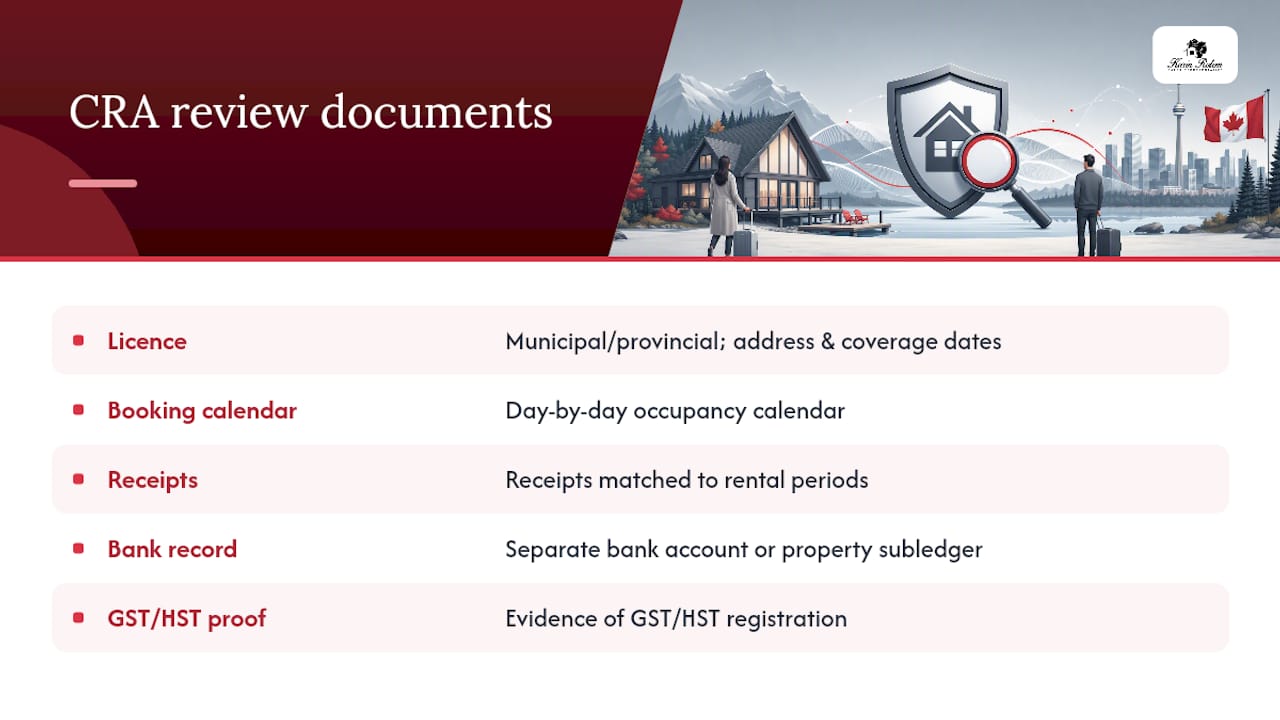
What the CRA typically wants to see: your municipal or provincial licence (with the exact address and coverage dates), a day-by-day booking calendar, receipts tied to specific rental periods, a separate bank account or clean subledger for the property, and proof of any GST/HST registration.
Pro Tip: Set up one folder per property per year, sorted by month, containing your licence renewal confirmation, booking platform statements, and a running calendar of occupied nights. If the CRA calls in three years, you want to spend ten minutes pulling records, not a weekend reconstructing them.
Our short-term rental income property checklist walks through a fuller version of this filing system if you own more than one unit.
Switching to long-term rental? Watch the GST/HST trap
Converting a short-term rental to a long-term residential lease counts as a change in use for tax purposes, and it can trigger GST/HST on the property’s fair market value at the moment of conversion, particularly if you were registered and claiming input tax credits. Long-term residential rent is generally GST/HST exempt, so the CRA treats the switch as if you sold the commercial-use portion of the property to yourself.
This is where owners get blindsided. A property that appreciated significantly since purchase can generate a large, immediate GST/HST liability precisely at the moment you thought you were simplifying your life by dropping the short-term hosting workload.
Before converting, model the fair-market-value assumption, calculate any input tax credit recapture, and compare it against the reduced income and effort of long-term tenancy. Talk to an accountant who has actually run these change-in-use numbers before you give notice to your booking platform.
Your step-by-step compliance checklist
- Verify municipal and provincial licensing for the exact property address, not the neighbourhood or the building.
- Reconcile every booking against Form T776, then calculate the short-term rental portion of your total expenses.
- Confirm your GST/HST registration status and register immediately if you’ve crossed the $30,000 threshold.
- Keep platform correspondence, especially any notice about tax collection on your behalf.
- Maintain a day-by-day rental calendar showing occupied and vacant nights for the full year.
- Retain licences, permits, and receipts for at least six years given the CRA’s indefinite reassessment power under section 67.7.
Our guide to setting up a short-term rental legally in Ontario covers the province-specific licensing steps in more depth if you’re still in the application stage.
Provincial and municipal tax variations beyond compliance
Ontario doesn’t run a single provincial short-term rental licence. Instead, individual municipalities set their own rules, and the tax consequences ride on top of whatever licensing regime applies locally. Toronto requires a short-term rental registration and limits hosting to a principal residence in most cases. Innisfil and other municipalities near Friday Harbour have their own zoning and business licence requirements that differ from Toronto’s, and getting them wrong triggers the same federal deduction denial regardless of which city you’re in.
Municipal accommodation taxes (sometimes called MAT) add another layer. Many Ontario municipalities charge a percentage on top of the nightly rate, collected either by the host or increasingly by the platform itself. That’s separate from GST/HST and separate from income tax. Missing a municipal accommodation tax remittance won’t affect your federal deduction, but it can result in municipal penalties and, in some cases, licence suspension, which then cascades into a federal compliance problem the following year.
Quebec runs its own provincial classification and tax regime for tourist accommodation, distinct from Ontario’s municipal-only approach. British Columbia introduced provincewide restrictions on short-term rentals in many communities, layered on top of municipal bylaws. If you own property in more than one province, don’t assume a compliance approach that works in one jurisdiction transfers to another. Each province and often each municipality within it treats licensing, registration, and accommodation tax differently, and the federal deduction-denial rule cares about all of them equally.
How rental income shifts your tax bracket
Short-term rental income gets added to your other income and taxed at your marginal rate, the rate that applies to your next dollar earned, not your average rate across all income. A host earning $70,000 from employment who adds $25,000 in net short-term rental income doesn’t just pay tax on that $25,000 at one flat rate. Instead, portions of it get taxed progressively as they push through Canada’s federal brackets, then again through whichever provincial brackets apply.
This matters more than most owners realize when they’re deciding how much to charge or how many nights to book. A property that looks profitable at a lower income level can push a host into a higher bracket once combined with employment or other business income, meaning the effective tax rate on that last chunk of rental profit is higher than the rate on the first chunk.
It also matters for the deduction-denial rule specifically. If your rental is non-compliant and your expenses get denied, you’re not just losing deductions, you’re being taxed on gross revenue that then stacks on top of your other income at your marginal rate. That’s a materially worse outcome than losing a deduction on a compliant property, where at least your net income (after legitimate expenses) is what gets added to your bracket calculation.
If you’re weighing whether a short-term rental income property makes sense given your overall tax picture, our page on what qualifies as a short-term rental income property is a useful starting point before you run the bracket math with an accountant.
Does rental income affect other credits and benefits?
Adding short-term rental income to your return increases your net income, and net income is the figure the CRA uses to test eligibility for a number of income-tested benefits. The Canada Child Benefit, GST/HST credit, and Old Age Security clawback thresholds all key off net income, so a profitable rental year can reduce or eliminate benefits you were previously receiving.
This catches part-time and retired hosts off guard more than full-time investors. A retiree renting out a lake property near Friday Harbour for a few months a year might not think of themselves as running a business, but if that income pushes their net income past the Old Age Security recovery threshold, they’ll see a clawback the following tax year that has nothing to do with the rental’s actual profitability.
The deduction-denial rule compounds this risk specifically. A non-compliant property that gets taxed on gross revenue instead of net income inflates your reported income further, which can trigger benefit reductions you wouldn’t have faced had the same property been properly licensed and taxed on net profit. It’s another reason licensing compliance isn’t just an income tax issue. It ripples into every benefit calculation that uses net income as its test.
Filing deadlines and forms for short-term rental taxes
Individual short-term rental owners file rental income on Form T776 as part of their personal T1 return, due April 30 for most filers, or June 15 if you or your spouse is self-employed (though any balance owing is still due April 30). If your rental activity is structured through a corporation, the corporate filing deadline follows the corporation’s own fiscal year end, typically six months after that date.
GST/HST filing deadlines depend on your assigned reporting period, which the CRA sets based on your revenue. Most small short-term rental operators file annually, with the return and payment due three months after their fiscal year end. Larger operators or those who choose more frequent filing may be on a quarterly or monthly schedule instead.
Keep Form T776, Chart A, and Chart B together as one package for each property you own, since the CRA’s worked examples in the T4036 guide show multiple properties handled on separate schedules within the same return. Missing the April 30 deadline (or June 15 with the self-employment extension) triggers late-filing penalties in addition to any interest on the tax owing, so don’t wait on a licence renewal to hold up your entire return. File based on your actual compliance status for the year and amend later if your municipal licensing situation changes.
Penalties for non-compliant short-term rental reporting
Beyond the deduction denial itself, which effectively taxes you on gross revenue, the CRA applies standard late-filing and gross-negligence penalties on top when a return understates income or overstates deductions the taxpayer knew or should have known were disallowed. A late-filing penalty starts at 5% of the balance owing plus 1% per month, up to twelve months, and gross-negligence penalties can reach 50% of the understated tax when the CRA determines the error was knowing or reckless.
Because section 67.7 removes the normal three-year reassessment limit for these specific denials, a host who claimed deductions on a non-compliant property in 2024 could still face a reassessment, interest, and penalties well beyond the point where a typical tax matter would have closed. Interest compounds daily on any balance owing from the original filing date, not from the date of reassessment, which means older non-compliant years carry substantially higher total cost by the time the CRA catches up to them.
Municipal penalties run separately and add another cost layer. Operating without a required licence can draw fines directly from the municipality, sometimes escalating for repeat violations, and in some jurisdictions can result in an order to cease short-term rental operations at the address entirely. That municipal shutdown then locks in your federal non-compliance for every remaining day in the tax year, compounding the deduction denial you’re already facing.
What I tell clients weighing a short-term rental purchase
What I tell my clients before they buy a rental property near Friday Harbour: the licence check comes before the offer, not after closing. I’ve watched buyers fall for a strong nightly rate and skip the municipal zoning call entirely. What most buyers don’t realize is that yield and regulatory risk trade off directly, and a tax advisor should confirm the numbers before you’re the one explaining a denied deduction to the CRA.
— Felix
Buying with tax compliance built in from day one
Some real estate teams offer to assist buyers in vetting a property’s rental-use status before financial commitment, by reviewing municipal zoning, permit history, and any flagged compliance issues, and coordinating with accountants or tax advisors to help ensure numbers hold up under current federal rules.
If you’re looking at income property near Friday Harbour, bring your target budget, your expected occupancy assumptions, and any licence documentation the current owner has on file. We’ll walk the zoning and compliance angle with you before you write an offer, not after. Browse our current Friday Harbour listings or reach out through Karinrotem to set up a conversation about what a compliant, tax-smart purchase actually looks like in this market.
FAQ
How much tax will I pay on my Airbnb income?
Short-term rental income is added to your other income and taxed at your marginal rate, the same bracket structure that applies to employment income. If your property is non-compliant with local licensing, expense deductions are denied and you’re taxed on gross revenue instead of net profit, which raises the effective tax significantly.
Do I have to report rental income to the CRA?
Yes, all short-term rental income must be reported on your T1 return using Form T776, regardless of whether the property is licensed. Reporting requirements apply even in years the CRA denies your related deductions for non-compliance.
How much tax do I pay on rental income in Canada?
There’s no flat rental tax rate. Net rental income (income minus allowable deductions) is taxed at your personal marginal rate, and GST/HST may also apply if you’ve crossed the $30,000 registration threshold for taxable supplies.
How much capital gains do I pay on $100,000?
Capital gains tax depends on your inclusion rate and marginal tax bracket, not a flat percentage, and calculating it for a rental property also requires accounting for any CCA recapture claimed over the ownership period. Our guide on capital gains on rental property in Canada walks through how the calculation works for a property sale.
What counts as a non-compliant short-term rental?
A short-term rental (under 90 consecutive days) is non-compliant if it fails to meet the municipal or provincial licensing, registration, or permit rules for its specific address at any point during the tax year. Platform-collected tax does not count as compliance with these local requirements.