
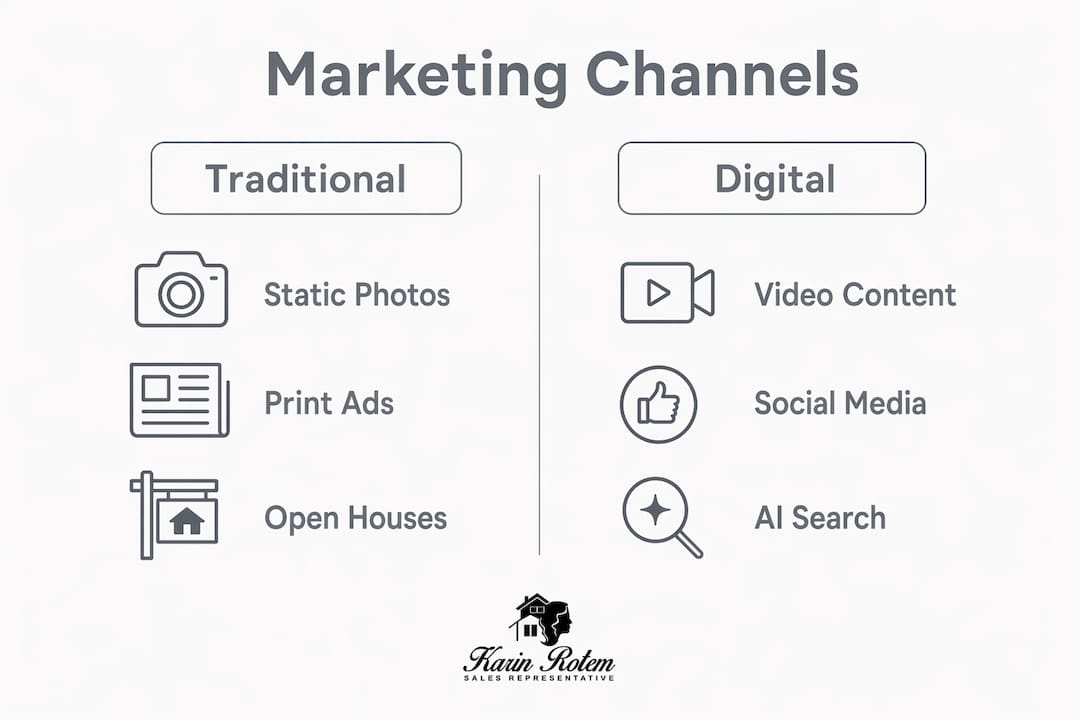
Digital marketing in real estate is defined as the use of online channels, including video, social media, search engines, and AI-powered platforms, to attract qualified buyers and convert property inquiries into sales. The role of digital marketing in home sales has shifted from optional to foundational. 97% of homebuyers now use the internet during their property search, which means your listing’s online presence determines whether buyers find you or your competition. At Karinrotem, we have seen this shift play out directly in markets like Toronto, Innisfil, and Friday Harbour, where the right digital strategy separates a listing that lingers from one that sells in days.
How does video content transform home listings and buyer engagement?
Video is the single most powerful tool in real estate digital marketing today. Listings with video receive 403% more inquiries than those without, according to NAR research. That figure is not a marginal improvement. It represents a fundamental change in how buyers engage with properties before ever stepping through the door.

Virtual tours amplify this effect further. Matterport and Zillow research shows that virtual tours increase engagement by 87% and reduce time-to-sale by 20%. For a waterfront property in Friday Harbour or a family home in Innisfil, a 3D walkthrough lets out-of-town buyers experience the space before committing to a showing. That pre-qualification saves everyone time and brings more serious buyers to the table.
What separates high-performing video content from generic listing footage is authenticity and a recognisable format. Formats that consistently outperform standard walkthroughs include:
- Speed tours: 60-second property overviews set to music, designed for social media feeds
- Hide-and-seek videos: an agent “discovers” the home’s best features as if seeing them for the first time, creating a narrative arc
- Branded video series: recurring formats tied to a specific neighbourhood or property type, building audience loyalty over time
- Behind-the-scenes content: showing the preparation process, staging decisions, or neighbourhood context
Pro Tip: Resist the urge to over-produce. Buyers respond to genuine enthusiasm and clear visuals far more than cinematic perfection. A well-lit iPhone video with honest commentary often outperforms a polished production that feels scripted.
Here is how the main content formats compare in terms of buyer impact:
| Format | Engagement lift | Effect on time-to-sale | Best use case |
|---|---|---|---|
| Static photos | Baseline | Baseline | All listings |
| Video walkthrough | Up to 403% more inquiries | Moderate reduction | Urban and suburban homes |
| 3D virtual tour | 87% engagement increase | 20% reduction | Luxury, waterfront, out-of-town buyers |
| Social media short-form | High reach, lower intent | Awareness stage | New listings, open houses |
The impact of online marketing on home sales is most visible in the video category, where the gap between agents who use it and those who do not continues to widen every year.
Why does responsiveness determine whether digital leads convert?
Generating interest online is only half the equation. What happens in the hours after a buyer submits an inquiry determines whether that interest becomes a sale. Only 41% of real estate teams respond immediately to after-hours inquiries, according to a 2026 NAHB survey of over 700 real estate professionals. That gap is a direct revenue loss for the majority of agents.
The urgency is real. 78% of local real estate searches lead to a phone call, email, or in-person visit within 24 hours. A buyer who searches for a Friday Harbour condo at 9 p.m. on a Thursday and receives no response until Monday morning has almost certainly moved on. Responsiveness quality now rivals pricing as a factor in buyer decision-making.
Here is a practical system for improving follow-up speed and consistency:
- Set a response SLA. Commit to a maximum response time of 30 minutes during business hours and 2 hours after hours. Document it and hold your team to it.
- Automate the first touch. Use a CRM like Follow Up Boss or LionDesk to send an immediate acknowledgement message the moment a lead submits a form. This buys goodwill while you prepare a personal response.
- Handle missed calls deliberately. Set up a missed-call text-back sequence so that any unanswered call triggers an automatic SMS within 60 seconds.
- Use AI voice assistants for after-hours coverage. Tools like Structurely or Ylopo’s AI assistant can qualify leads, answer common questions, and book showings around the clock without requiring a human on call.
- Review your lead routing weekly. Leads that sit in a shared inbox or get assigned to the wrong team member are a structural problem, not a motivation problem. Fix the system, not the person.
Pro Tip: Sign up for listing email alerts on your own market to experience the buyer’s perspective firsthand. You will quickly identify where your follow-up process has gaps.
Operational responsiveness is now as important as the quality of the listing itself. The digital marketing strategies for selling homes that generate the highest close rates are always paired with fast, consistent follow-up systems.
How does AI search visibility affect agent discovery and buyer trust?
AI-powered search tools including ChatGPT, Perplexity, and Google’s AI Overviews are changing how buyers find agents. Only 8.4% of agents appear in AI-generated search results for high-intent queries, and the top 1% of those agents capture 47% of all citations. The implication is stark: most agents are effectively invisible to a growing segment of buyers who start their search with an AI tool rather than a traditional search engine.
Third-party validation is the deciding factor. 71% of buyers will not contact an agent without some form of third-party confirmation of credibility, and AI models strongly favour agents with distributed reviews across multiple platforms. Agents cited on four or more review platforms are significantly more likely to surface in AI search results than those with reviews concentrated on a single site like Google or Realtor.ca.
Building AI search presence requires a deliberate identity strategy:
- Distribute reviews across platforms. Collect reviews on Google Business Profile, Realtor.ca, Zillow, RateMyAgent, and Facebook. Each platform is a separate signal that AI models use to verify your credibility.
- Optimise your Google Business Profile. Google Business Profile drives 33% of all local real estate clicks, making it the highest-leverage local SEO asset available at no cost.
- Publish original local content. Neighbourhood guides, market updates, and community spotlights give AI models the localised, authoritative content they need to recommend you accurately.
- Maintain consistent NAP data. Your name, address, and phone number must match exactly across every platform. Inconsistencies confuse AI models and suppress your visibility.
| AI presence strategy | Expected impact |
|---|---|
| Reviews on 4+ platforms | Higher likelihood of AI citation |
| Optimised Google Business Profile | 33% of local real estate clicks |
| Original neighbourhood content | Improved AI grounding and recommendation accuracy |
| Consistent NAP across platforms | Reduced suppression in local AI results |
The role of online reviews in real estate client acquisition has grown from a nice-to-have into a structural requirement for appearing in the channels where buyers now begin their search.
Which digital marketing channels deliver the best results for home sellers?
Not every channel deserves equal investment. Understanding where buyers actually spend their attention, and where leads convert, is what separates a focused digital strategy from a scattered one.
Property portals like Realtor.ca and Zillow remain the highest-intent discovery channels. Buyers on these platforms are actively searching, which means the quality of your listing content, photos, video, and description, determines whether they click or scroll past. Social media platforms including Instagram, Facebook, and TikTok serve a different purpose: they build awareness and emotional connection before a buyer is ready to search formally.
Mobile optimisation is no longer optional. 71% of buyers use mobile devices during their property search, which means every listing page, email, and landing page must load quickly and display cleanly on a phone screen. A listing that looks stunning on a desktop but breaks on mobile loses buyers before they read a single word.
Long-form content consistently outperforms short posts for driving qualified traffic. A detailed neighbourhood guide for Friday Harbour or a market update for Innisfil attracts buyers who are researching seriously, not just browsing. These readers convert at a higher rate because they arrive with context and intent.
Combining organic and paid strategies produces the strongest overall return. SEO generates leads at $14 per lead compared to $42 per lead for paid advertising, but the two channels together yield a 3.1x return on investment. Running Google Ads to capture immediate demand while building organic content for long-term visibility is the most cost-effective approach for most sellers and agents.
The five most effective digital marketing tactics for home sellers in 2026 are:
- Professional video and 3D virtual tours on every listing, distributed across portals and social media
- Google Business Profile optimisation with regular posts, photos, and review responses
- Targeted social media advertising on Facebook and Instagram using postal code and demographic targeting
- Email marketing to warm leads with new listing alerts and neighbourhood market updates
- Long-form local content including neighbourhood guides, school district summaries, and lifestyle features
Key takeaways
Effective digital marketing in real estate requires video content, fast lead follow-up, and distributed AI search presence working together to convert buyer interest into closed sales.
| Point | Details |
|---|---|
| Video drives inquiries | Listings with video receive 403% more inquiries than photo-only listings. |
| Responsiveness converts leads | Only 41% of teams respond immediately after hours, creating a significant competitive gap. |
| AI visibility requires distribution | Agents on four or more review platforms are far more likely to appear in AI search results. |
| Combined SEO and paid ads | Integrating organic and paid strategies produces a 3.1x return on investment. |
| Mobile-first content matters | 71% of buyers search on mobile, making optimised content a baseline requirement. |
What I have learned about authenticity versus technology in digital marketing
Here is my honest view after years of marketing properties in Toronto, Innisfil, and Friday Harbour: the agents who obsess over production quality often underperform the agents who obsess over connection.
I have watched sellers invest heavily in drone footage and cinematic edits for properties that sat on the market, while a genuine 90-second walkthrough filmed on a phone generated multiple offers in a weekend. The difference was not the equipment. It was the story being told and whether it made a buyer feel something.
That said, technology is not the problem. The problem is using technology as a substitute for a clear brand voice. What I tell my clients is this: before you decide on a video format or a social media platform, decide what you want buyers to feel when they encounter your listing. Warmth? Excitement? Confidence? Every content decision flows from that answer.
I am also cautious about chasing every new trend. Not every property benefits from a TikTok-style speed tour. A waterfront estate in Friday Harbour deserves a different tone than a downtown Toronto condo. The best digital strategy is the one that matches the property’s personality to the right buyer’s expectations, not the one that follows the latest algorithm.
Transparency matters more than polish. Buyers who arrive at a showing with accurate expectations, set by honest video content and clear descriptions, are far more likely to make an offer than buyers who feel misled by over-edited imagery.
— Karin Rotem
How Karinrotem uses digital marketing to sell your home
At Karinrotem, every listing we bring to market is supported by a full digital marketing plan, including professional video tours, 3D virtual walkthroughs, targeted social media advertising, and a dedicated follow-up system that responds to buyer inquiries within minutes, not days. We have built our reputation in Toronto, Innisfil, and Friday Harbour by combining local market knowledge with the kind of online presence that puts your property in front of the right buyers at the right moment. If you are ready to see what a data-driven marketing approach looks like in practice, explore our current property listings or browse our sold listings to see the results for yourself. We would love to build a tailored plan for your home.
FAQ
How does digital marketing increase home sale prices?
Digital marketing increases exposure to a larger pool of qualified buyers, which creates competitive conditions that support stronger offers. Video listings and virtual tours attract more serious inquiries, reducing days on market and improving negotiating position.
What is the most effective digital marketing tool for selling a home?
Video content is the most effective single tool, with listings receiving 403% more inquiries than those without video, according to NAR research. Combined with a 3D virtual tour, video significantly reduces time-to-sale and attracts out-of-town buyers.
Why does responsiveness matter in real estate digital marketing?
78% of local real estate searches lead to contact within 24 hours, meaning buyers expect near-immediate responses. Agents who follow up within 30 minutes of an inquiry convert leads at a significantly higher rate than those who respond the next day.
How can agents improve their visibility in AI search results?
Agents should collect reviews on four or more platforms including Google, Realtor.ca, and RateMyAgent, and publish original local content regularly. Consistent name, address, and phone data across all platforms is also required for AI models to surface an agent accurately.
Is social media or SEO more important for selling homes?
Both serve different stages of the buyer journey and work best together. SEO captures high-intent buyers actively searching, while social media builds awareness and emotional connection earlier in the decision process. Combining the two produces a 3.1x return on investment compared to either channel alone.