
Anti-money laundering in Canadian real estate is the system of legal and regulatory requirements designed to detect, deter, and report illicit financial activity in property transactions. Governed by the Proceeds of Crime (Money Laundering) and Terrorist Financing Act (PCMLTFA) and enforced by the Financial Transactions and Reports Analysis Centre of Canada (FINTRAC), these obligations apply to real estate brokers, developers, mortgage lenders, and, as of October 2025, title insurers. Between $45 billion and $113 billion is laundered annually through the Canadian economy, with $5.3 billion flowing through British Columbia real estate alone in 2022. That scale makes AML compliance not just a legal formality but a genuine market integrity issue for every professional involved in a Canadian property transaction.
What is anti-money laundering in Canadian real estate?
Anti-money laundering (AML) in real estate refers to the set of obligations under the PCMLTFA that require reporting entities to verify client identities, monitor transactions, maintain records, and file reports with FINTRAC when suspicious or large-cash activity is detected. The term “reporting entity” covers a broad range of professionals: real estate brokers and salespersons, developers selling directly to the public, mortgage lenders and brokers, and, following the October 2024 and October 2025 regulatory expansions, mortgage administrators and title insurers as well.
The core purpose of these rules is to prevent property transactions from being used to “clean” money derived from criminal activity. Criminals favour real estate because high transaction values allow large sums to move in a single deal, and complex ownership structures can obscure the true source of funds. For buyers and sellers in markets like Toronto, Innisfil, and Friday Harbour, this means your real estate professional is legally required to ask detailed questions about your identity and the source of your funds. That is not intrusive; it is the law.

Non-compliance carries serious consequences. FINTRAC has issued 24 administrative monetary penalties averaging $110,000 to real estate brokers between 2020 and November 2025, with a single maximum penalty reaching approximately $282,000. Reputational damage and loss of licence are additional risks that no brokerage can afford to ignore.
What are the core AML obligations for real estate professionals?
Every reporting entity in the real estate sector must meet four foundational obligations under the PCMLTFA. Understanding each one is the starting point for building a compliant practice.
- Know Your Client (KYC) and beneficial ownership verification. You must confirm the identity of every client using government-issued photo identification and, where a corporation or trust is involved, identify the individuals who ultimately own or control the entity. Beneficial ownership verification is the single most common failure point attracting FINTRAC scrutiny, particularly when numbered companies or trusts are involved.
- Large Cash Transaction Reports (LCTRs). Any receipt of $10,000 or more in cash within a 24-hour period must be reported to FINTRAC within 15 business days. This threshold applies regardless of whether the transaction appears suspicious.
- Suspicious Transaction Reports (STRs). When there are reasonable grounds to suspect that a transaction is related to money laundering or terrorist financing, an STR must be filed with FINTRAC. Filing an STR alone does not satisfy FINTRAC’s expectations; a documented compliance programme is still required.
- Recordkeeping. Client identification records, transaction records, and beneficial ownership information must be retained for a minimum of five years and made available to FINTRAC upon request.
- Mandatory AML compliance programme. Every reporting entity must maintain a written compliance programme that includes a designated compliance officer, written policies and procedures, a risk assessment, an ongoing training plan, and an independent prescribed review conducted at least every two years.
Pro Tip: Do not treat your compliance programme as a one-time document. FINTRAC expects it to evolve as your client base and transaction types change. A generic checklist downloaded from the internet will not survive an examination.
How does money laundering occur in Canadian real estate?
Real estate laundering commonly uses numbered companies, third-party nominees, all-cash purchases, and layered trust arrangements that are deliberately designed to complicate detection. Understanding how these schemes work is what allows a diligent professional to spot them before a transaction closes.
The most common technique is the use of a nominee buyer. A criminal places a property in the name of a trusted associate or a numbered company, with the actual funds originating from illicit sources. The property is then resold, often quickly, converting dirty money into a capital gain that appears entirely legitimate. Rapid resale at or near market value is itself a red flag, particularly when the buyer shows little interest in the property’s condition or rental income potential.
Sanctions evasion is now integrated into AML monitoring obligations. Real estate professionals must watch for listed individuals attempting to acquire property through proxy buyers or complex ownership chains designed to circumvent Canadian sanctions regimes. This is not a theoretical risk. It is an active enforcement priority for Global Affairs Canada and FINTRAC.
Common red flags to watch for during due diligence include:
- Clients who are reluctant to provide identification or beneficial ownership information
- All-cash purchases with no apparent financing, particularly at or above asking price
- Transactions involving multiple layers of corporations or trusts with no clear business rationale
- Buyers who have never visited the property or show no interest in its physical condition
- Rapid resale within months of purchase, especially at a loss or minimal gain
- Instructions to pay proceeds to a third party unrelated to the transaction
Pro Tip: What I tell my clients is that a legitimate buyer has nothing to fear from thorough due diligence. If a counterparty resists basic identity verification, that resistance is itself a red flag worth documenting.
What are the consequences of non-compliance and how is enforcement evolving?
“The AML environment in Canadian real estate is shifting toward an enforcement-led regime with dramatically increased penalties as a deterrent.” — Lexology, 2026
The enforcement picture has changed materially in 2026. Under the proposed Strong Borders Act and Bill C-12, maximum penalties may rise to $20 million, representing an increase of up to 40 times current levels. That is not a hypothetical deterrent. It is a signal that regulators view the existing penalty structure as insufficient to change behaviour in a high-value sector.
FINTRAC has also eliminated the pre-issuance correction window. Previously, a brokerage under examination had an opportunity to correct deficiencies before a penalty was finalised. That window no longer exists, which makes proactive internal reviews far more urgent than they were even two years ago.
The most common compliance failures identified in FINTRAC enforcement actions fall into three categories:
| Failure type | Consequence |
|---|---|
| Missing or inadequate risk assessment | Automatic penalty trigger; no defence without documentation |
| Absent or outdated prescribed review | Signals systemic non-compliance; increases penalty severity |
| Incomplete KYC and beneficial ownership records | Direct link to money laundering risk; highest scrutiny category |
63% of penalised brokers lacked adequate risk assessment documentation. That single statistic tells you where most brokerages are failing and where your compliance effort should be concentrated first.
How should real estate professionals build an effective AML compliance programme?
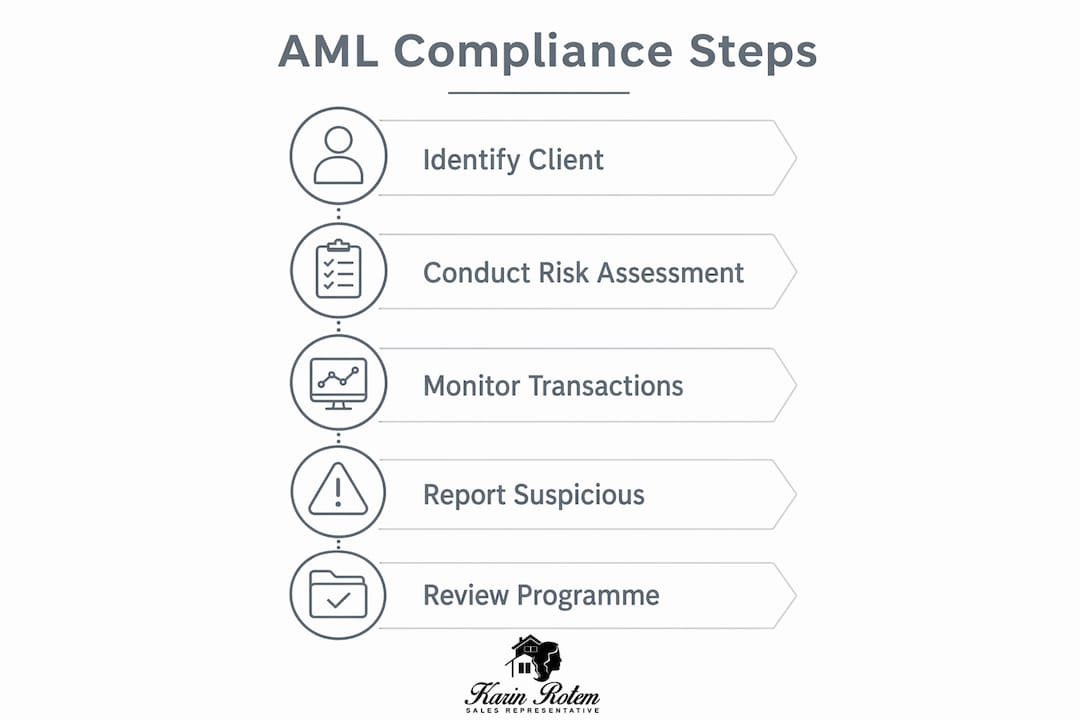
A documented, brokerage-specific AML compliance programme is not optional. Here is how to build one that will hold up under FINTRAC examination.
- Appoint a compliance officer. This individual must have the authority and knowledge to implement and oversee the programme. In a smaller brokerage, this is often the broker of record, but the role must be formally designated in writing.
- Write policies and procedures specific to your practice. Risk assessments must reflect your actual client profile, transaction types, and geographic markets. A brokerage specialising in pre-construction condos in Toronto faces different risks than one focused on rural recreational properties in Innisfil.
- Conduct and document a formal risk assessment. Identify your high-risk client categories, transaction types, and delivery channels. Review and update this assessment whenever your business model changes materially.
- Implement a client onboarding process. Collect government-issued photo ID at the outset of every relationship. For corporations and trusts, obtain and verify beneficial ownership information before the transaction proceeds. Proper beneficial ownership verification prevents money laundering risk from escalating undetected.
- Train your staff regularly. Training must be ongoing, not a one-time orientation. Document every training session, including dates, attendees, and content covered. FINTRAC will ask for this documentation.
- Commission an independent prescribed review every two years. Independent prescribed reviews are among the highest-leverage compliance activities and one of the most common deficiencies found in audited brokerages. The reviewer must be independent of the compliance function being assessed.
- Use technology to support monitoring. Transaction monitoring software and identity verification platforms can flag anomalies that manual review would miss, particularly in high-volume offices.
Pro Tip: Do not wait for a FINTRAC examination to discover gaps. Schedule your prescribed review proactively, treat the findings as a management tool, and update your programme before the next cycle begins.
What recent regulatory changes affect AML compliance in Canadian real estate?
The regulatory perimeter has expanded significantly since 2024, and more changes are on the way. Here is what you need to know for 2026.
- Title insurers as reporting entities (October 1, 2025). Title insurance companies are now subject to the full range of PCMLTFA obligations, including KYC, recordkeeping, and STR filing. This closes a significant gap that was previously exploited in complex transactions.
- Mortgage sector expansion (October 2024). Mortgage lenders, brokers, and administrators have been reporting entities since October 2024, meaning the compliance chain now covers virtually every professional involved in a residential or commercial transaction.
- Listed Property and Equipment Property Reports (LPEPR). A new reporting regime for high-value property and equipment transactions is being phased in, targeting sectors where large assets can be used to move illicit funds.
- Universal enrolment under Bill C-12. Proposed provisions would require all reporting entities to formally enrol with FINTRAC, creating a centralised registry and closing the gap for entities that currently operate outside the examination cycle.
- British Columbia’s Bill 29 and the Cullen Commission findings. BC’s legislative reforms, informed by the Cullen Commission’s findings on money laundering in BC real estate, continue to influence national policy direction. The foreign buyer rules in Ontario are one downstream expression of this national conversation about ownership transparency.
The direction of travel is clear: more entities, more reporting, and significantly higher penalties for those who do not comply.
Key takeaways
AML compliance in Canadian real estate is a mandatory, documented, and actively enforced legal obligation that covers identity verification, transaction reporting, and programme maintenance under the PCMLTFA and FINTRAC.
| Point | Details |
|---|---|
| Regulatory framework | PCMLTFA and FINTRAC govern all AML obligations for Canadian real estate professionals. |
| Expanded reporting entities | Title insurers (Oct 2025) and mortgage sector participants (Oct 2024) are now fully subject to AML rules. |
| Enforcement is intensifying | Penalties may reach $20 million under proposed legislation; FINTRAC has removed the pre-issuance correction window. |
| Most common failure | 63% of penalised brokers lacked adequate risk assessment documentation. |
| Compliance programme essentials | Written policies, KYC procedures, risk assessment, staff training, and biennial independent reviews are all required. |
What I’ve learned about AML compliance in the markets I serve
Working with buyers and sellers across Toronto, Innisfil, and Friday Harbour, I see a consistent pattern: most clients understand that AML questions are coming, but very few understand why the questions are as detailed as they are. What most buyers don’t realise is that the obligation sits with the real estate professional, not the client. If I cannot verify your identity and the source of your funds, I cannot represent you. That is not a preference. It is the law.
What I find more concerning is the number of investors, particularly those purchasing through corporations or family trusts, who arrive at a transaction without having thought through the beneficial ownership question at all. They have a numbered company. They have a lawyer. They assume the paperwork is in order. It often is not, at least not in the form FINTRAC requires. I always recommend that investor clients speak with a compliance-aware real estate lawyer before the offer stage, not after.
The regulatory environment is only going to get more demanding. The shift toward an enforcement-led posture means that brokerages and professionals who have been coasting on minimal compliance programmes are running out of time. I would rather have an uncomfortable conversation with a client about documentation now than watch a transaction unravel under FINTRAC scrutiny later. Proactive compliance is not a burden. It is how you protect your clients, your licence, and your reputation.
For investors considering non-resident property purchases in Ontario, the AML layer adds another dimension of due diligence that should be factored in from the very beginning of the process.
— Karin Rotem
Work with a team that understands compliance-aware real estate
Buying or selling property in Toronto, Innisfil, or Friday Harbour means working within one of Canada’s most closely watched real estate markets. At Karinrotem, we guide every client through the identity verification and documentation process clearly and without surprises, so your transaction moves forward with confidence. Whether you are a first-time buyer, a seasoned investor, or a non-resident exploring waterfront opportunities, our team combines deep local expertise with a thorough understanding of current AML obligations. Browse our available properties or explore Friday Harbour luxury listings to start your search with a team that takes compliance as seriously as you do.
FAQ
What is AML in Canadian real estate?
AML (anti-money laundering) in Canadian real estate refers to the legal obligations under the PCMLTFA requiring real estate professionals to verify client identities, report large cash transactions and suspicious activity, and maintain documented compliance programmes overseen by FINTRAC.
Who is required to comply with AML regulations in Canada?
Real estate brokers, salespersons, developers selling directly to the public, mortgage lenders, mortgage brokers, mortgage administrators, and title insurers are all reporting entities subject to PCMLTFA obligations in Canada.
What happens if a real estate professional fails to comply with AML rules?
FINTRAC can issue administrative monetary penalties averaging $110,000 per case, with a recorded maximum of approximately $282,000. Proposed legislation under the Strong Borders Act could raise maximum penalties to $20 million.
What is a suspicious transaction report in real estate?
A Suspicious Transaction Report (STR) is a mandatory filing with FINTRAC when a real estate professional has reasonable grounds to suspect that a transaction is connected to money laundering or terrorist financing. Filing an STR does not replace the requirement for a full compliance programme.
How often must a real estate brokerage conduct a prescribed review?
An independent prescribed review of the AML compliance programme must be conducted at least every two years. This review must be performed by someone independent of the compliance function and the findings must be documented and acted upon.