
Ontario investors are increasingly eyeing furnished rental properties as a way to earn meaningfully more than standard long-term leases allow. But choosing the right furnished rental property features investors can actually rely on requires more than picking nice furniture and posting on a listing site. Regulatory requirements, tenant expectations, operational realities, and tax planning all intersect in ways that catch many buyers off guard. This article walks you through the key criteria, must-have features, income comparisons, and tax considerations so you can invest with confidence in lifestyle-driven markets like Friday Harbour and Innisfil.
Key Takeaways
| Point | Details |
|---|---|
| Income premium from furnishing | Furnished mid-term rentals can earn 20-50% more monthly income than unfurnished long-term leases. |
| Operational features matter | Smart home tech, dedicated workspaces, and high-speed internet drive tenant satisfaction and justify higher rents. |
| Tax impacts | Furniture investments are Class 8 assets eligible for 20% annual depreciation, but claiming CCA should be strategic. |
| Regulatory advantage | Mid-term rentals avoid short-term rental restrictions, allowing investment properties to earn premium income legally. |
| Location shapes demand | Lifestyle-driven markets like Friday Harbour require tailored furnishings and amenities to attract stable, higher-paying tenants. |
Key criteria to evaluate furnished rental properties for investors
Having a clear framework matters before you spend a dollar on furnishings or commit to a property. The furnished rental investment tips that actually move the needle start with understanding who your tenants will be and what they expect.
Tenant profile shapes everything. Mid-term furnished rentals typically attract three core groups: corporate employees on extended contracts, healthcare professionals filling temporary hospital placements, and relocating families needing a stable base while their permanent home closes or is prepared. Each group has different needs, but all share one priority: a move-in ready space with zero friction.
Income premiums are real and significant. Mid-term rentals can achieve 30 to 50% higher monthly yields than traditional long-term rentals in the GTA. That gap closes somewhat in smaller markets but remains compelling even in communities like Innisfil when the property is well positioned.
Here are the core criteria to assess before buying:
- Zoning and licensing requirements: Mid-term rentals (stays over 30 days) generally avoid the licensing and principal residence rules that apply to short-term rentals. Confirm your municipality’s position and review short-term rental regulations in Ontario before finalising your strategy.
- Turnover frequency and operational load: Weekly turnover on short-term rentals creates significant cleaning, restocking, and communication costs. Mid-term tenants reduce that burden considerably.
- Property management availability: If you are not managing the unit yourself, confirm that local property managers have experience with furnished mid-term rentals specifically. The skill set differs from traditional long-term management.
- Building rules and condo corporation bylaws: Some condominium buildings in Friday Harbour and Innisfil restrict short-term rentals. Mid-term furnished rentals often fall outside those restrictions, but always verify with the status certificate.
Essential furnishings and operational features that attract high-paying tenants
With your evaluation criteria set, let’s look at the specific features of furnished rentals that command premium rents from quality tenants.
The difference between a furnished unit that sits vacant and one that books consistently comes down to operational quality. Successful furnished rentals require operational consistency and features like smart locks and high-speed internet, which are baseline expectations for business travellers and professionals, not optional extras.
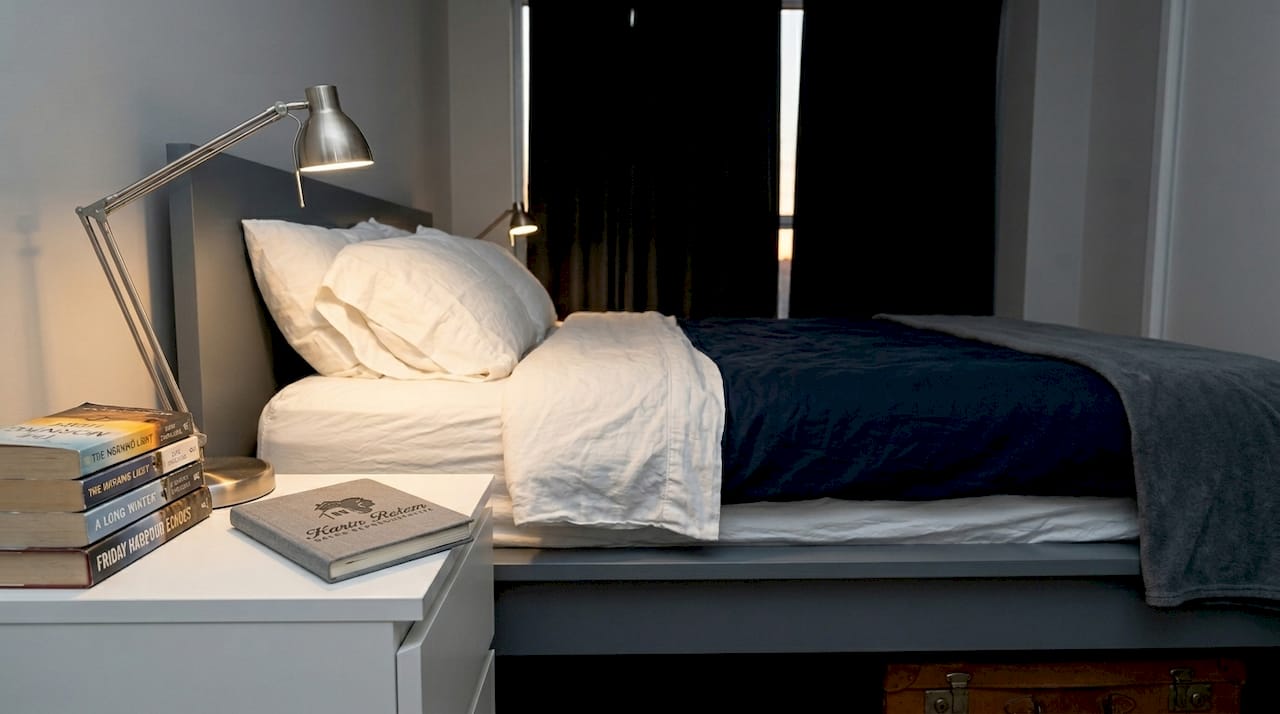
Bedroom quality: Memory foam or hybrid mattresses, quality linen (at minimum 400 thread count), and blackout curtains are non-negotiable. A poor sleep experience generates negative reviews and tenant complaints that directly affect your occupancy rate.
Dedicated workspace: Reliable Wi-Fi at 100 Mbps or faster and a proper desk with adequate lighting are critical for the remote worker and corporate tenant segments. A kitchen table does not qualify.
Smart home technology: Keyless entry systems, programmable thermostats, and contactless self check-in allow you to manage the property remotely and reduce your dependency on being physically present for every arrival.
Here is a full list of the features that justify premium pricing in Friday Harbour rental amenities and similar lifestyle communities:
- Memory foam mattress and quality bedding
- Blackout curtains in every bedroom
- Dedicated workspace with ergonomic chair and strong Wi-Fi
- Smart lock and programmable thermostat
- In-suite washer and dryer
- Fully equipped kitchen including cookware, utensils, coffee maker, and toaster
- Streaming TV services (Netflix, etc.) already set up
- Welcome guide with local recommendations
Pro Tip: Stock the kitchen as though a competent home cook will use it for three months. Tenants staying 30 to 90 days will notice immediately if the pans are thin or the knives are dull. A one-time investment of $300 to $400 in quality cookware pays for itself in better reviews and repeat bookings.
Comparison table of rental income and operational demands for furnished vs unfurnished options
To clarify the trade-offs, here is a direct comparison of the investor-friendly rental properties approach against standard unfurnished leasing in Ontario markets.
| Factor | Furnished (mid-term) | Unfurnished (long-term) |
|---|---|---|
| Monthly income premium | 15 to 40% higher | Baseline |
| Typical lease length | 1 to 6 months | 12 months |
| Tenant turnover frequency | Moderate (3 to 6x per year) | Low (1x per year) |
| Cleaning and maintenance costs | Higher, but recoverable through rent | Lower |
| Licensing requirements (Ontario) | None for 30+ day stays | None |
| Tenant profile | Corporate, healthcare, relocating families | General renters |
| Operational complexity | Moderate (smart tech reduces load) | Low |
| Furnishing capital required | $8,000 to $20,000+ depending on size | None |
| Vacancy risk | Lower with strong positioning | Low |
Key takeaways from this comparison:
- The income premium on furnished rentals is real, but it requires an upfront furnishing investment and ongoing operational attention.
- Mid-term furnished rentals occupy a useful middle ground: better income than long-term leases, far less regulatory exposure than short-term rentals.
- Investors comparing Innisfil and Toronto condo rentals often find that Innisfil offers lower acquisition costs with comparable or stronger rental yields once lifestyle amenities factor in.
Capital cost allowance and tax considerations for furnishing investments
Understanding what to look for in rentals from a tax perspective can meaningfully improve your net return. The furnishing investment you make is not just a cost; it is a deductible asset when structured correctly.
The Canada Revenue Agency classifies furniture and appliances as Class 8 assets. Furniture and appliances are Class 8 assets with a 20% annual Capital Cost Allowance (CCA) rate, meaning you depreciate them at 20% per year on a declining balance. CCA is optional and must be used strategically to avoid recapture tax.
Here is what that means in practice:
- Items under $2,500: These can often be expensed fully in the year of purchase rather than depreciated over time. A set of kitchen appliances at $1,800 is gone from your taxable income in year one.
- Larger investments: A full furnishing package at $15,000 would be depreciated at 20% per year. In year one (with the half-year rule), you could claim roughly $1,500.
- CCA is optional: You do not have to claim it every year. If you had a low-income year or expect higher income later, deferring CCA preserves future deductions.
- Recapture risk: When you sell the property, any CCA previously claimed may be “recaptured” as income if the asset’s value exceeds the undepreciated capital cost. This is a real consideration for investors who plan to exit in the short term.
Pro Tip: Track every furnishing purchase with receipts and note whether items are below or above $2,500. This simple habit at purchase time saves your accountant hours and prevents you from missing immediate deductions. Review the tax implications of rental furnishing with a qualified accountant before your first filing.
What I tell clients is this: furnishing your rental is not just an expense; it is a tax-advantaged investment in your income stream. The key is matching your CCA strategy to your personal tax situation each year.
How location and market niche influence furnished rental features and income potential
Location does not just affect what price you can charge. It shapes the entire furnishing strategy, tenant expectation, and operational approach required to succeed. This is especially true in lifestyle-driven communities.
Furnished rentals in lifestyle-driven markets require operational and comfort features as competitive differentiators and can command premium pricing. In places like Friday Harbour and Innisfil, the surrounding lifestyle amenities, marina access, golf, and waterfront settings become part of your rental’s value proposition.
A furnished unit in Friday Harbour is not competing with a downtown Toronto condo. It is offering something fundamentally different: space, nature, and a genuine change of scenery. Tenants will pay for that difference, but only if the unit itself matches the quality of the surroundings.
The tenant demographics in lifestyle communities include:
- Travelling professionals and executives who want a retreat from urban density during a multi-month contract
- Relocating families who need a comfortable, stable home while their permanent residence is being arranged
- Healthcare workers from nearby Barrie and surrounding areas on rotating placement contracts
- Digital nomads and remote workers who can work from anywhere and actively choose lifestyle locations
Your furnishing choices should reflect these groups. Friday Harbour community benefits like the marina, dining, and outdoor recreation make outdoor-ready amenities, such as bike storage, kayak access, and quality outdoor seating on the balcony, meaningful differentiators.
Top pro tips for maximising furnished rental returns in Ontario lifestyle markets
With location context clear, here are the rental property features for investors that translate directly into higher occupancy and stronger income.
- Offer modest discounts for stays of 60 days or more. A 10% reduction for a 90-day stay still outperforms monthly short-term rates and locks in revenue with far less turnover effort.
- Bundle utilities and internet into the rent. Tenants in the professional and corporate segment strongly prefer all-inclusive pricing. It simplifies their expense reporting and reduces friction at the decision point.
- Invest in smart home technology. A smart lock, video doorbell, and programmable thermostat cost roughly $400 to $600 total and allow fully contactless check-in. This is not a luxury; it is expected.
- Refresh furnishings every three to four years. Worn furniture signals neglect. Consistent small upgrades maintain your property’s competitive positioning and allow you to justify rate increases.
- Use corporate and relocation platforms for tenant sourcing. General listing sites attract a wide mix of tenants. Platforms focused on corporate housing and relocation attract the higher-paying, lower-risk profiles that suit mid-term rentals. Mid-term rentals offer premium income and less volatility than short-term rentals with operational simplicity that suits regulated Ontario markets.
Pro Tip: Search the premium rental strategies at Friday Harbour to understand what the competitive bar looks like locally before setting your rate. Pricing too low out of caution leaves money on the table; pricing above the local competitive range without matching quality leads to vacancies.
Why a strategic furnished rental approach beats chasing short-term rentals in regulated Ontario markets
Here is my honest perspective after working with investors across Toronto and Innisfil for years. Most buyers come to me excited about short-term rental income figures they saw online. The numbers look extraordinary. What those figures rarely show is the full picture: licensing requirements, principal residence rules, municipal accommodation taxes, and condo corporation restrictions that can make short-term rentals unworkable before you even list your first booking.
Mid-term rentals bypass onerous short-term rental regulations and still achieve 20 to 50% higher income than long-term leases without the licensing complications. That is a compelling combination, and it is what I recommend to most furnished rental investors in this market right now.
There is also a deeper point worth making. A well-run furnished rental is a hybrid of housing and hospitality. The investors who treat it purely as a passive investment and underinvest in operational quality consistently underperform compared to those who approach it as a product. Your tenant’s comfort, your check-in process, your response time when something breaks: these operational elements drive reviews, referrals, and occupancy more than your furniture brand ever will.
The short-term rental legal challenges in Ontario are real and growing. Municipalities are tightening rules regularly. Mid-term furnished rentals provide a legally clear, income-strong, and operationally manageable path that short-term rentals simply cannot match in most Ontario communities today.
Discover investment opportunities in furnished rental properties with Karin Rotem
If this article has given you a clearer picture of what furnished rental investments require and what they can deliver, the next step is finding the right property in the right community. Our team specialises in exactly that. We work with investors across Friday Harbour and Innisfil to identify investing in Friday Harbour opportunities that align with your income goals, lifestyle preferences, and compliance requirements. Whether you are exploring your first furnished rental or expanding an existing portfolio, we can help you evaluate available furnished rental properties with the market knowledge and practical guidance you need. Reach out to the Karin Rotem Real Estate team today to start a conversation about your investment goals.
Frequently asked questions
What rental income premium can I expect from furnished rentals in Ontario?
Furnished rentals in markets like the GTA can generate 30 to 50% higher monthly income than equivalent unfurnished units, with mid-term stays over 30 days typically delivering the most consistent premiums.
Are there specific tax benefits when furnishing a rental property?
Furniture and appliances are Class 8 assets with a 20% annual Capital Cost Allowance rate, but claiming it is optional and should align with your long-term tax strategy to avoid recapture liabilities when you eventually sell.
What tenant types typically rent furnished properties in lifestyle communities like Friday Harbour?
Mid-term furnished rentals attract corporate travellers, healthcare professionals on placement contracts, relocating families, and digital nomads who need stable, move-in ready housing for 30 days or more.
Do I need a short-term rental licence to operate a furnished rental over 30 days?
No. Rentals longer than 30 days are typically classified as mid-term and do not require short-term rental licences, principal residence compliance, or municipal accommodation taxes in most Ontario municipalities.
What furnishing features do tenants value most in lifestyle rental communities?
Tenants prioritise quality beds, blackout curtains, dedicated workspaces, reliable high-speed internet, smart locks for contactless access, and fully equipped kitchens for comfortable mid-term living.
Recommended
- Can I Rent Out My Friday Harbour Condo? | What Buyers Need to Know – Karin Rotem Real Estate Agent
- What’s Included in the Package? What Amenities Are Included in Friday Harbour Rental Properties? – Karin Rotem Real Estate Agent
- Our Properties – Karin Rotem Real Estate Agent
- Types of Accommodations Available for Rent at Friday Harbour – Karin Rotem Real Estate Agent