The residential property tax rate in Innisfil for 2026 is 1.239628%, according to the Town of Innisfil. You multiply that rate by your home’s MPAC assessed value to estimate your annual bill. On a $500,000 assessment, that comes to about $6,198 a year, split among the Town, Simcoe County, South Simcoe Police and provincial education.
I’m Karin Rotem, and I work with buyers and sellers in Innisfil and Friday Harbour every week. Property tax is one of the first costs clients ask about, usually right after the price. Below is the rate, what it’s made of, how to estimate your own bill, and what I tell clients to watch for. For a shorter companion piece, see our page on Innisfil property taxes, due dates and what to budget.
TL;DR
- The 2026 residential rate in Innisfil is 1.239628%, applied to your MPAC assessed value, not to the price you paid.
- A rough guide: $400,000 of assessed value is about $4,959 a year, $500,000 is about $6,198 and $700,000 is about $8,677.
- Only about half of each tax dollar stays with the Town. The rest goes to Simcoe County, South Simcoe Police and education.
- Taxes are billed in two final instalments, and late payments carry a 1.25% penalty and monthly interest.
- Friday Harbour condos pay the same Town rate as everyone else. What differs is the assessed value, plus condo fees, which are a separate cost.
The 2026 Innisfil residential tax rate
The Town’s property tax page states that the 2026 residential rate is 1.239628%. That is a combined figure. It is not a rate the Town alone sets, and that is the first thing most buyers don’t realize. When you see “Innisfil’s tax rate”, you are looking at four different bodies’ charges added together.
The rate is expressed as a percentage of assessed value. So 1.239628% means about $12.40 of tax for every $1,000 of assessed value. Compared with Toronto, where the rate is lower but home values are higher, the arithmetic can land closer together than people expect. I go through that in our Toronto vs. Innisfil cost of living guide.
What makes up the rate
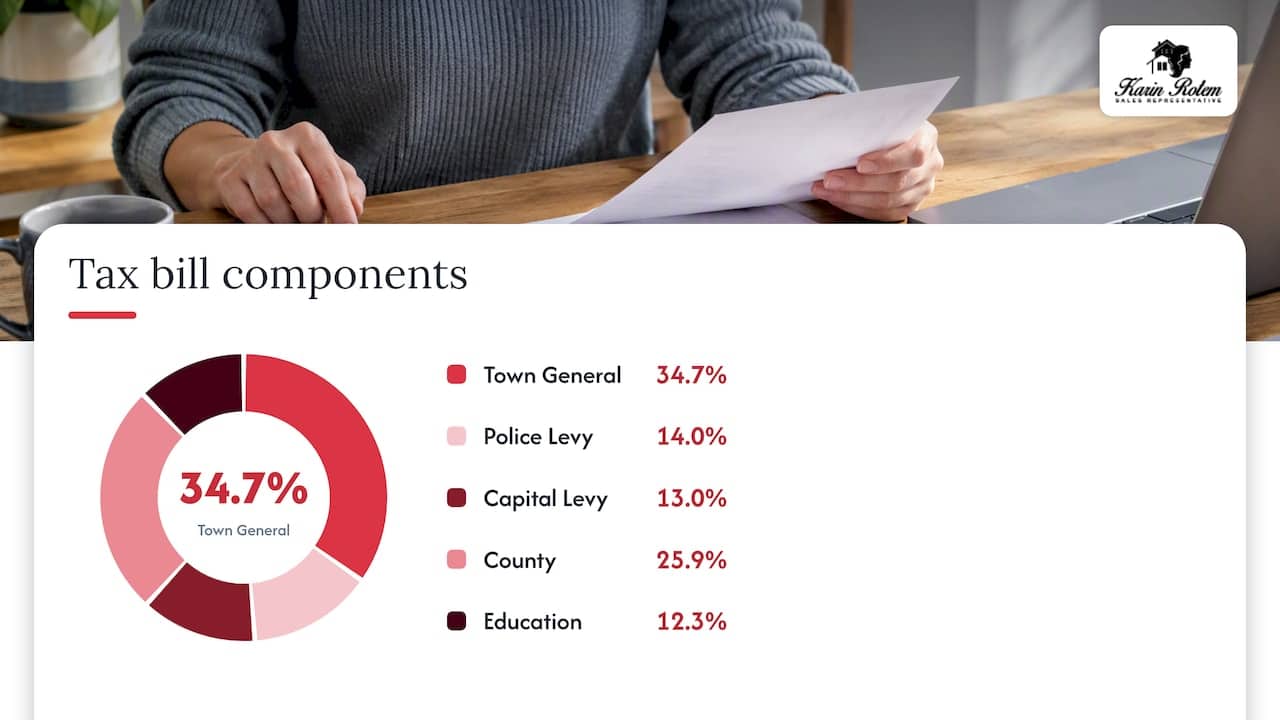
The breakdown comes from By-law No. 029-26, the Town’s 2026 estimates and tax rates. Here are the five components and what each one represents as a share of the total.
| Component | 2026 rate | Share of your bill |
|---|---|---|
| Town General Levy | 0.430394% | about 34.7% |
| Police Levy (South Simcoe Police) | 0.173963% | about 14.0% |
| Capital Levy (Town) | 0.161038% | about 13.0% |
| County of Simcoe | 0.321233% | about 25.9% |
| Education (provincial) | 0.153000% | about 12.3% |
| Total residential rate | 1.239628% | 100% |
The percentage shares are my own arithmetic from the by-law’s rates. The education rate is set by the province: the Minister of Finance establishes it under Ontario Regulation 400/98 of the Education Act, as ontario.ca explains. The Town has no say in that piece.
What I tell my clients: if you want to understand why your bill moves from year to year, look at the Town General and Capital levies. Those are the pieces Council decides. The County, Police and education lines move for reasons set elsewhere.
How to estimate your own bill
The method is simple, as the Town’s page confirms: take your current MPAC assessment and multiply it by the residential rate.
- Find your assessed value on your last tax bill or your MPAC assessment notice.
- Multiply it by 0.01239628 (that is, 1.239628%).
- The result is your estimated annual tax before any special charges.
- Divide by two if you want to see roughly what each final instalment will be. Your actual bill may include interim billing, so confirm with the Town.
Worked examples
These are straight multiplications at the 2026 rate. They are estimates, not quotes.
| Assessed value | Estimated annual tax | Roughly per month |
|---|---|---|
| $400,000 | $4,958.51 | $413 |
| $500,000 | $6,198.14 | $517 |
| $600,000 | $7,437.77 | $620 |
| $700,000 | $8,677.40 | $723 |
| $900,000 | $11,156.65 | $930 |
A scenario I see often: a Toronto couple selling a $1.1 million semi and moving to a $750,000 home in Innisfil. They assume their tax bill will fall sharply. Often it does, but not always by as much as they hope, because Innisfil’s rate is higher than Toronto’s. Always run the number on the actual assessment of the home you’re considering, not a rule of thumb. If you are weighing that move, our guide to selling your Toronto home and buying in Innisfil covers the full cost picture.
Assessed value is not what you paid
This is where buyers get caught. Your tax is based on the value MPAC assigns, and that can differ significantly from market value, as WOWA’s Innisfil property tax overview points out. Two practical consequences follow.
- Resale homes: the assessment may be older and lower than today’s price. The bill you see on the seller’s statement may not be the bill you’ll pay after the next reassessment or any change on the property.
- New builds and new condos: the assessment may be phased in or updated once the unit is complete and registered. A first-year bill can look different from later years.
What most buyers don’t realize is that the seller’s current tax figure on a listing is a starting point, not a promise. I always ask my buyers to budget on the purchase price multiplied by the current rate as a conservative figure, then compare it with the real assessment. If you’d like to check an assessment before you make an offer, ask me and I’ll pull it up with you.
Local charges that can appear on the bill
The standard levies are not the whole story for every property. By-law 029-26 authorizes the collection of special charges from benefiting properties alongside regular taxes. Examples named in the by-law include levies under the Tile Drainage Act or the Drainage Act. These mostly matter if you are buying a rural or agricultural parcel, or a lot that benefits from a municipal drain.
Before you buy, ask your lawyer to confirm on the tax certificate whether any special charges, arrears or local improvement amounts are attached to the property. A condo buyer in Friday Harbour will rarely meet these. A buyer looking at acreage on the edge of town might.
The by-law also notes that taxpayers can ask in writing to receive bills electronically or at a different mailing address. That matters if you are a Toronto owner with a second home here: send the direction to the Town Treasurer so the bill doesn’t sit unseen at a cottage address.
When taxes are due and what happens if you’re late
For 2026, final bills were due in two instalments, on June 29 and September 28, per the Town’s property tax page. The pattern is what matters for your planning: two final instalments, one around the end of June and one around the end of September. Check the Town’s page for the current year’s exact dates, since they shift.
The penalty structure in the by-law is strict:
- A 1.25% penalty applies on the first day of the month after an instalment due date.
- Interest of 1.25% is then added on the first day of each calendar month on unpaid taxes.
That compounds quickly on a $6,000 bill. The Town offers several payment methods, including pre-authorized payment plans. For most of my clients, I recommend the pre-authorized plan. It removes the risk of a missed date, which is the most avoidable cost of owning here. If you are buying mid-year, your lawyer will adjust the taxes between you and the seller on closing, so you don’t pay for the seller’s months.
Where your tax dollar goes
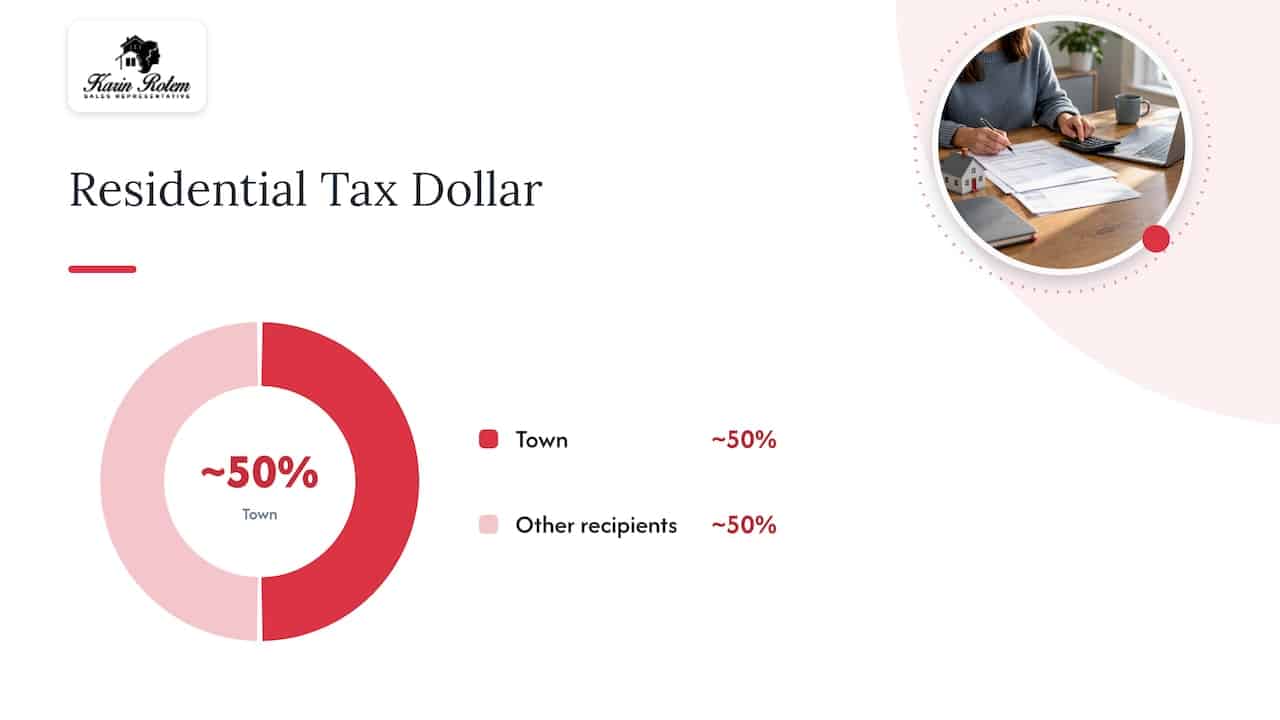
Only about half of each residential tax dollar stays with the Town to pay for local services, according to the Town’s budget page. The rest goes to the County of Simcoe, South Simcoe Police and provincial education. County services include waste collection, paramedics and social services.
The Town’s share covers day-to-day operations and capital work. The proposed 2025/2026 budget lists road rehabilitation, park development and stormwater projects in its capital plan, and describes balancing demand for services from rapid growth against tax affordability.
On the trend, the Town’s approved two-year budget projected an increase of 5.5 per cent in 2025 and 2026. Treat that as direction rather than a promise for the years ahead. Growth is real here, and I’d budget for gradual increases rather than assuming a flat bill. Our look at new developments in Innisfil shows how much building is coming, which is part of why the Town talks about capital needs.
Property tax for Friday Harbour condos
Buyers often ask whether a resort community carries a special tax. It doesn’t. A Friday Harbour condo owner pays the same Innisfil residential rate, applied to the unit’s assessed value. Because waterfront resort units tend to be valued higher than inland condos, the dollar amount is usually higher, but the rate is not different.
Here is a realistic way to budget, and it’s what I walk clients through:
- Start with the purchase price as a proxy for assessed value.
- Multiply by 1.239628% to get a yearly tax estimate.
- Add monthly condo fees, which are separate and set by the corporation. Ask for the status certificate, which shows the fees, the reserve fund and any planned special assessments.
- If you plan to rent the unit short-term, factor in the costs and rules that apply to rental use. Our page on short-term rental income properties explains the basics.
A $600,000 unit would be around $7,438 a year in tax at the 2026 rate, before condo fees. That’s an estimate on a round number. Your actual assessment is what counts, and for brand-new units it can differ from the price on the agreement of purchase and sale.
Honest guidance: if you are comparing a Friday Harbour condo with a Toronto condo, don’t compare tax alone. Compare tax plus condo fees plus how often you will use the place. A weekend owner and a full-time resident weigh those costs very differently. Our article on how Friday Harbour condo prices compare to Toronto sets this out in more detail.
Our perspective
We don’t think of property tax as a number to be afraid of. We think of it as a line item that should be on the page before you fall in love with a home. In our experience with Innisfil and Friday Harbour buyers, the surprises rarely come from the rate itself. They come from three places: an assessment that is out of date, a condo fee nobody priced in, and a Toronto owner who assumed the bill would be much smaller.
Our approach is to put the full carrying cost in front of you early: tax at the current rate on the likely assessed value, condo fees if there are any, insurance, utilities, and the cost of owning a second property if that’s what you’re buying. If the numbers don’t fit your goals, we’ll tell you. A waterfront condo is a wonderful lifestyle purchase, but it is not the right fit for every budget or every investor, and we would rather you walk away informed than close on something that strains you.
For sellers, taxes matter too. Buyers will look at your tax bill, and a clear picture helps you price with confidence. Our guide on pricing a home in Innisfil shows how closing costs and pricing fit together.
— Felix
Planning your purchase or sale
If you’re looking at Friday Harbour, we can show you what comparable units are listed for and work out the likely tax and carrying cost for each, before you book a single showing. Browse Friday Harbour condos for sale or The Harbour listings for sale, or contact our team to talk through your numbers. If you are renting first, there is also a page for The Harbour rentals.
For a broader view of where the market stands, see our Innisfil real estate market page, and if you are considering family life here, living in Innisfil covers commuting and daily costs.
FAQ
What is the property tax rate in Innisfil?
The 2026 residential rate is 1.239628%. It combines the Town’s levies, Simcoe County, South Simcoe Police and the provincial education rate. You apply it to your MPAC assessed value.
How much are property taxes on a $500,000 home in Innisfil?
At the 2026 rate, a $500,000 assessed value gives an estimated $6,198.14 a year, or about $517 a month. Your bill may differ if special charges apply or your assessment is not $500,000. Your tax certificate will show the exact figures.
Do Friday Harbour condos pay a different tax rate?
No. They pay the same Innisfil residential rate as other homes. The dollar amount depends on each unit’s assessed value. Condo fees are a separate cost, so ask for the status certificate before you buy.
What happens if I pay my Innisfil property tax late?
The Town adds a 1.25% penalty on the first day of the month after the due date, then 1.25% interest on the first day of each month the amount stays unpaid. A pre-authorized payment plan is the simplest way to avoid this.
Where does my Innisfil property tax go?
About half stays with the Town for local services and capital projects. The rest goes to Simcoe County services, South Simcoe Police and provincial education.
Sources
- Property Taxes, Town of Innisfil
- By-law No. 029-26, 2026 Estimates and Tax Rates
- Property tax, ontario.ca
- Innisfil Property Tax 2026, WOWA.ca
- Budgets, Town of Innisfil
- Proposed 2025/2026 Budget, Town of Innisfil
- Property taxes in Innisfil to climb 5.5 per cent in 2025 and 2026