
You can buy a second home in Canada with as little as 5% down, but only if the property qualifies as an owner-occupied second home and you meet the lender’s rules. If you plan to rent it out as an investment, expect a much larger down payment, and the lender will also look closely at your income and your existing mortgage. Here is how the numbers work, what I tell my clients before they start shopping, and where buyers get caught.
TL;DR
- The federal minimum is 5% on the first $500,000 and 10% on the portion up to $1.5 million. At $1.5 million or more it is 20%.
- CMHC insures eligible owner-occupied second homes from 5% down. The home must be in Canada, under $1.5 million, and usable year-round.
- Pure investment and rental-pool properties do not qualify for the vacation-home programs, so plan on a conventional mortgage with a larger down payment.
- A $300,000 second property needs $15,000 down at the minimum. A $600,000 one needs $35,000.
- Budget for closing costs, the stress test and taxes on top of the down payment.
The rule: how much down payment a second home needs
There is no special “second home” minimum in federal rules. The same minimum down payment scale applies to any home purchase in Canada:
| Purchase price | Minimum down payment |
|---|---|
| Up to $500,000 | 5% of the price |
| $500,000 to $1.5 million | 5% of the first $500,000, plus 10% of the portion above $500,000 |
| $1.5 million or more | 20% of the price |
What most buyers don’t realize is that the “20% for a second property” line you see everywhere is not a law. It is what lenders usually ask for when the property is a rental or when you don’t qualify for insurance. Whether you land at 5% or 20% depends on how you will use the home, not on the fact that it is your second.
Worked examples: $300,000, $600,000 and $1.2 million
People often ask what a $300,000 second property requires. At the minimum, it is 5%, or $15,000. The math for higher prices uses the two-tier scale:
| Price | Calculation | Minimum down |
|---|---|---|
| $300,000 | 5% x $300,000 | $15,000 |
| $500,000 | 5% x $500,000 | $25,000 |
| $600,000 | $25,000 + 10% x $100,000 | $35,000 |
| $900,000 | $25,000 + 10% x $400,000 | $65,000 |
| $1,200,000 | $25,000 + 10% x $700,000 | $95,000 |
These are minimums for an insured, owner-occupied purchase. If your lender asks for more, or if the property is a rental, the number rises. Also, the down payment must come from your own resources and be documented. If you are pulling funds from several accounts, read our guide to the 90-day paper trail for deposits and down payments before you move money around.
When 5% down works: the owner-occupied second home
CMHC offers insured financing for owner-occupied second homes with 5% down on the first $500,000 and 10% on the remainder. The conditions are specific:
- The property is in Canada.
- It is valued below $1.5 million.
- It is suitable and available for year-round occupancy.
- It has year-round vehicular access.
That last pair trips up cottage buyers. A seasonal cabin at the end of a water-access road or a three-season dwelling without proper heating and insulation will not fit. A winterized condo or townhouse in a resort-style community usually fits much better, which is one reason many Toronto professionals look at places like Friday Harbour in Innisfil for a weekend base.
Sagen, another mortgage insurer, runs its own vacation and secondary homes program, with its own eligibility list. Each insurer has its own rules, so your lender or mortgage broker will tell you which insurer your file fits.
If you want to check a property against the insured-mortgage rules before you make an offer, a CMHC insurance calculator is a quick way to see the premium and the numbers at different down payments.
When you need more: rentals and investment properties
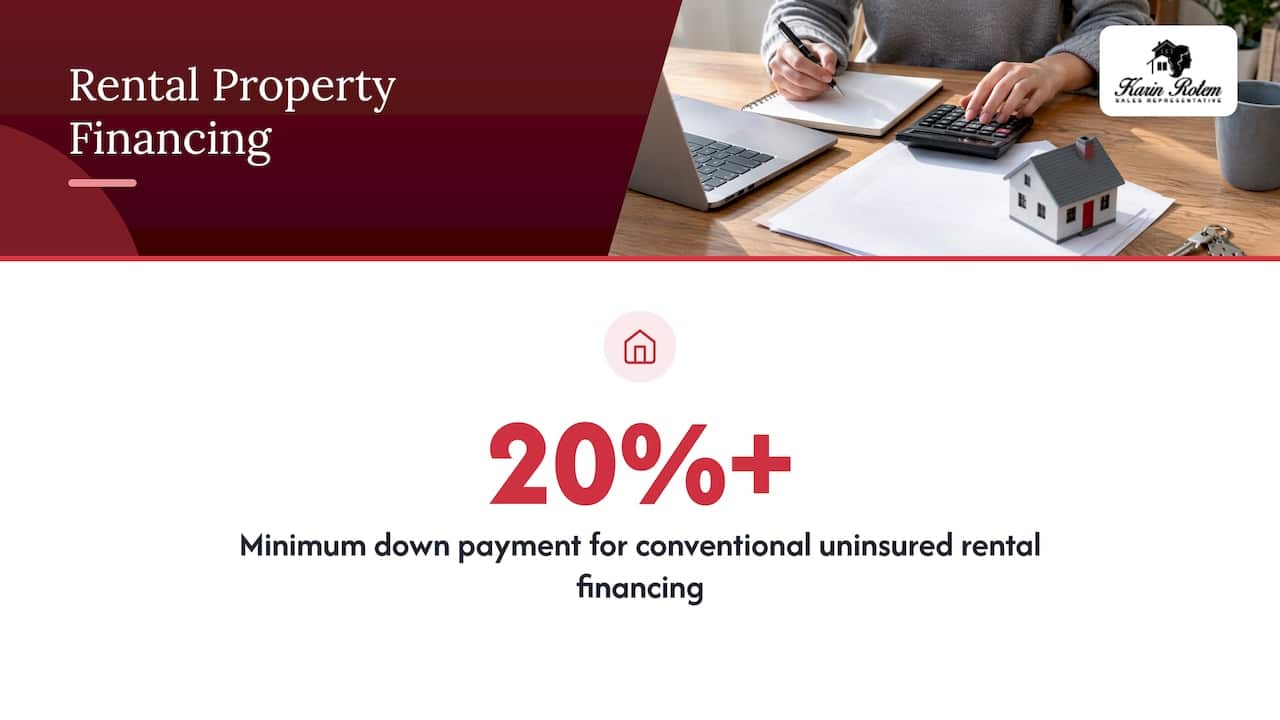
If the main purpose is income, the rules change. Sagen states that investment properties and rental-pool properties are not eligible for its vacation and secondary homes programs. In practice that pushes you to a conventional, uninsured mortgage, which in Canada means putting down 20% or more.
This matters for resort condos. Many buyers at Friday Harbour want to offset carrying costs with short-term rental income. Before you decide how you will use the unit, understand that how you use it shapes how you finance it. What I tell my clients is to settle on the real plan first: personal use with the occasional rental is a different conversation with a lender than a unit you intend to rent most of the year.
If rental income is part of how you hope to qualify, see how lenders treat it in our guide to rental income and your mortgage. Lenders typically count only a portion of projected rent, so don’t build your budget on the full amount.
Where the down payment money can come from
Lenders want to know where your funds originate. Common sources include savings, the sale of another property, an RRSP withdrawal, or a documented gift from an immediate family member. If you are selling a Toronto home to fund the second purchase, timing matters. We walk through that in our guide to selling your Toronto home and buying in Innisfil.
A few practical points:
- Keep large deposits in your account for the period your lender asks for, and keep statements.
- Avoid moving money between accounts without a record.
- Ask your lender early whether a gift letter is required and how they want it worded.
- If you are buying from outside Canada, non-resident mortgage options are different, and the down payment is usually larger.
Qualifying: the stress test and your existing mortgage
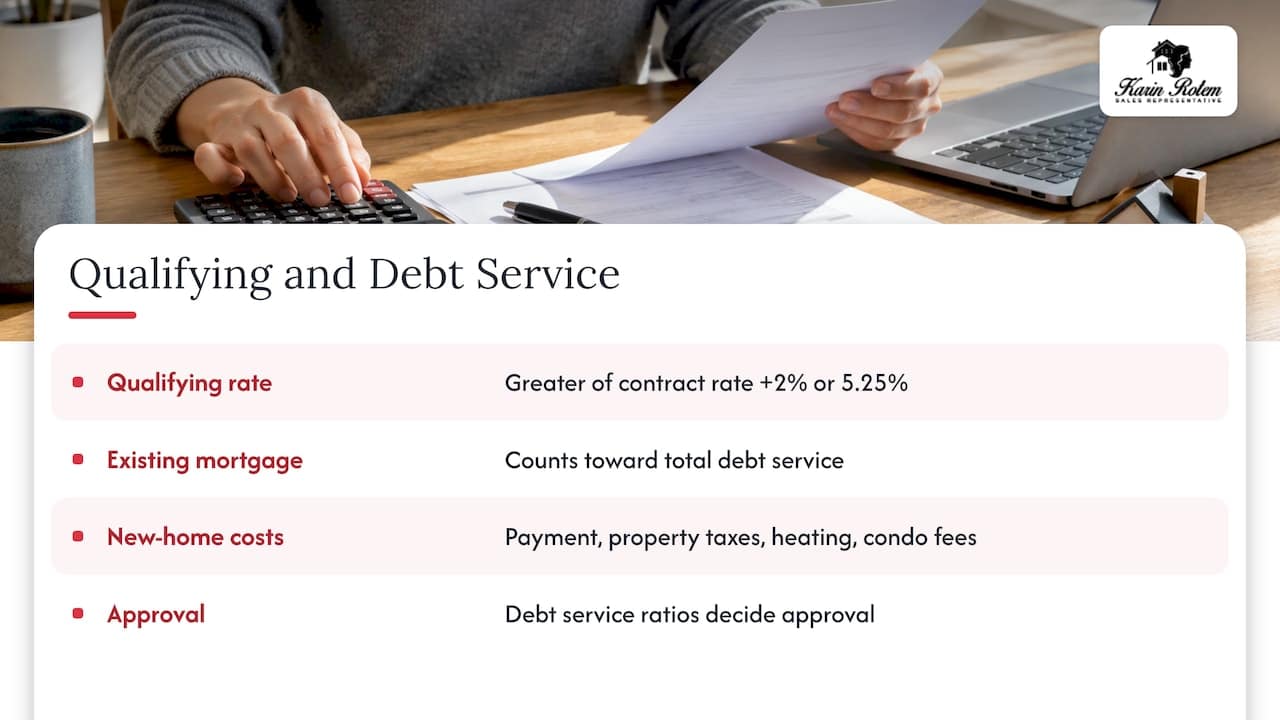
The down payment is only the first gate. For uninsured mortgages at federally regulated lenders, the minimum qualifying rate is the greater of your contract rate plus 2% or 5.25%. In plain terms, you must show you can carry the payment at a rate meaningfully higher than the one you will actually pay.
With a second property, the lender adds the new payment, property taxes, heating and condo fees to what you already carry on your first home. Your total debt service ratios are what decide the approval, not your down payment alone. A strong down payment with a heavy existing mortgage can still fall short.
Condo fees deserve attention in particular. They count toward your qualifying calculation, and they cover things like the reserve fund contribution, building insurance and shared amenities. Before you buy, ask for the status certificate and read the reserve fund study. A well-funded reserve is a good sign, and it is the best protection against a surprise special assessment.
25 or 30 years: amortization on a second home
Amortization is how long your mortgage takes to pay off if you keep making regular payments. CMHC states that its second-home mortgages have a 25-year maximum amortization, although some buyers may qualify for 30 years through CMHC Home Start.
The trade-off is simple:
| 25 years | 30 years | |
|---|---|---|
| Monthly payment | Higher | Lower |
| Total interest over the life of the loan | Lower | Higher |
| Effect on qualifying | Tighter | Easier |
A longer amortization lowers the monthly payment, which can help you qualify and keep cash flow comfortable. A shorter one saves interest. If you expect to make lump-sum payments or increase your payments later, a longer amortization with prepayments gives you flexibility. Ask your lender which options apply to your property and your file.
Taxes to review before you buy
Taxes are where second-home buyers most often get surprised after closing. Here are the main items to review with your accountant:
- GST/HST on new builds and rentals. The CRA explains that if you buy a vacation property primarily for personal use (more than 50%), you are not eligible to claim input tax credits for the GST/HST paid on the purchase. The same publication covers your GST/HST responsibilities if you rent the property short-term.
- Capital gains. A second home does not get the principal residence exemption in the way your main home does. Government of Canada announcements in 2024 introduced a $250,000 annual threshold for individuals to benefit from the one-half inclusion rate on capital gains. Rules can change, so confirm the current treatment with your accountant. We cover the details in capital gains on rental property in Canada.
- Short-term rental income. If you rent the home, you report the income and may deduct expenses. See our steps for short-term rental taxes in Canada.
- Underused Housing Tax. The CRA notes that vacation properties in eligible areas, or properties that are seasonally inaccessible, may be exempt. This applies mainly to affected owners, such as non-residents, so check whether it concerns you.
Perspective: how we guide second-home buyers
What I see most often is buyers deciding on the home first and the financing second. We reverse that. Before we tour a single unit, we help you decide how you will use the property, how much you want to put down, and what monthly number keeps the purchase enjoyable rather than stressful.
At Friday Harbour and across Innisfil, much of our work is with Toronto professionals who want a waterfront weekend base, and with investors who want a resort-style rental. The two groups need different financing, and we say so up front. Our job is to match the property to your goal, and to tell you honestly if a particular unit does not fit.
We negotiate hard for our clients, and we make sure the numbers on the page, from the down payment to the condo fees, are the numbers you can live with. Then we connect you with trusted lenders so your approval is in place before you make an offer.
Felix
Costs beyond the down payment
A down payment is not the whole cash requirement. Set aside funds for:
- Ontario land transfer tax (and Toronto’s municipal land transfer tax if you buy in the city)
- Legal fees and title insurance
- Mortgage default insurance premium, if your down payment is under 20%
- Home inspection or, for a condo, a status certificate review
- Furnishing, if the home is meant to be move-in ready
We recommend building a simple budget with your lender and lawyer before you write an offer, so closing day holds no surprises.
Looking at Friday Harbour or Innisfil?
If a waterfront or resort-style second home is on your list, we can show you what is on the market and what it takes to finance it. Browse Friday Harbour condos for sale or see current prices and what you get. To talk through your down payment and your plan, get in touch through karinrotem.com. If you are still weighing the idea, our piece on the benefits of owning a second home in Ontario is a good next read.
FAQ
Can I buy a second home with 5% down in Canada?
Yes, if it is an owner-occupied second home that meets the insurer’s rules. CMHC requires the property to be in Canada, valued below $1.5 million, and suitable for year-round occupancy. Rental and investment properties do not qualify for these programs.
How much down payment do I need for a $300,000 second property?
At the minimum, 5%, which is $15,000, provided the property qualifies for insured financing. If it is a rental or the lender requires a conventional mortgage, expect to put down 20%, which is $60,000.
Is a 20% down payment required for a vacation home?
Not by federal rules. Twenty per cent is what lenders generally ask for on rentals and uninsured mortgages. A winterized vacation home you will use personally may qualify for insurance with less down.
Should I choose a 25-year or 30-year amortization?
A 25-year amortization costs less interest overall, while 30 years gives a lower monthly payment. CMHC second-home mortgages have a 25-year maximum, with 30 years possible for some buyers through CMHC Home Start. Your lender can tell you which applies to your file.
Sources
- How much you need for a down payment, Canada.ca
- Flexible Financing for Second Homes with CMHC Insurance
- Vacation/Secondary Homes, Sagen
- Minimum qualifying rate for uninsured mortgages, OSFI
- The GST/HST and the Purchase, Use and Sale of Vacation Properties, CRA
- Government of Canada delivering tax fairness for every generation
- Exemption for Qualifying Occupancy, Canada.ca