
Stepping into a luxury condo purchase in Ontario without understanding what you’re actually paying for is one of the most common and costly mistakes I see buyers make. When clients ask me about luxury condo amenities explained Ontario, they usually think they know what to expect: a gym, maybe a rooftop. The reality is far more layered. Amenities define your daily experience, shape your monthly costs, and directly influence resale value. This guide breaks down what luxury amenities actually include, what they cost you through fees, how to assess which ones matter for your lifestyle, and what to watch for before you sign anything.
Key takeaways
| Point | Details |
|---|---|
| Luxury versus standard amenities | High-end buildings offer concierge, wellness suites, and private terraces that standard condos simply do not include. |
| Fees cover all amenities equally | You pay for every common element through condo fees, whether you use the amenity or not. |
| Access is not always universal | Rooftop decks and exclusive lounges may be restricted to specific unit owners per the building declaration. |
| Amenities affect resale value | Well-maintained, desirable amenities increase property demand and support long-term investment returns. |
| Review the declaration early | Confirming amenity access rights in the condominium declaration should happen before you make an offer. |
Luxury versus standard condo amenities in Ontario
Most buyers walk into this conversation thinking the difference between a luxury and a standard condo is just about finishes. Quartz countertops versus laminate. It goes much deeper than that.
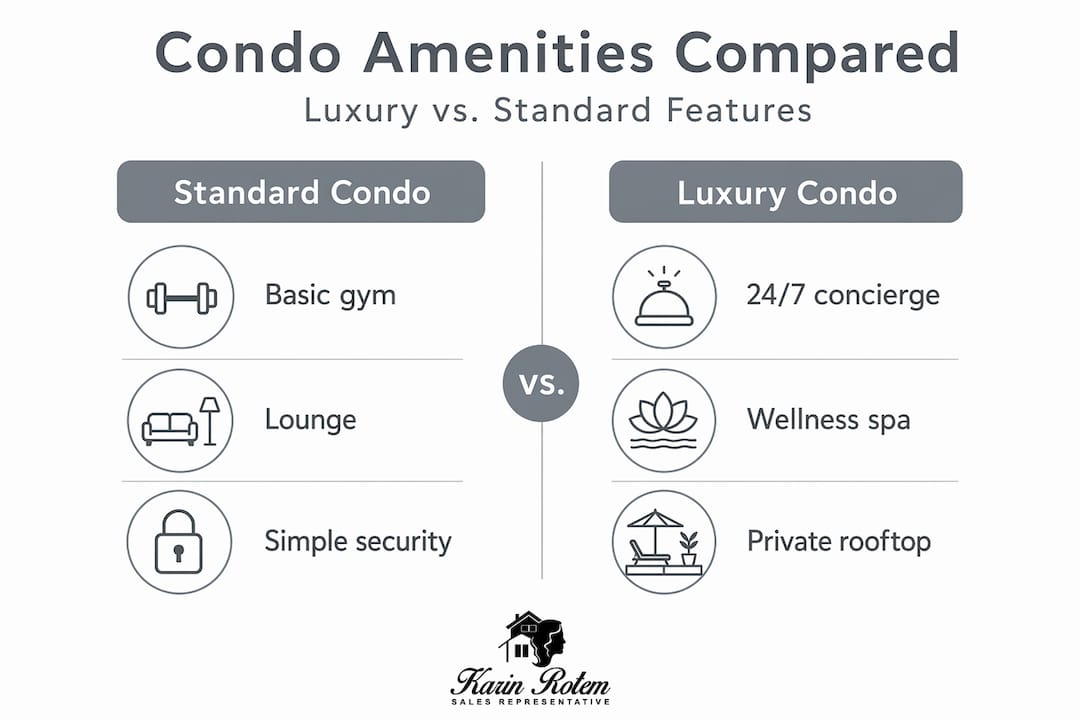
Standard condos typically offer basic fitness rooms, communal lounges, and surface-level security. Luxury buildings layer in a completely different tier of services and infrastructure. Think 24/7 concierge staffed by trained hospitality professionals, state-of-the-art fitness studios with dedicated yoga and spin rooms, rooftop terraces with panoramic views and summer kitchen setups, private event spaces you can book for gatherings, and co-working lounges with private meeting rooms.

The design environment matters too. Luxury condo lobbies are built to feel like boutique hotel entrances. The quality of materials, lighting, and spatial flow signals to residents and guests alike that they are somewhere considered and intentional. This extends to common corridor finishes, elevator interiors, and amenity-level layouts.
Here is a clear breakdown of where the two tiers diverge:
| Feature | Standard condo | Luxury condo |
|---|---|---|
| Concierge | Part-time or none | 24/7 trained concierge |
| Fitness facilities | Basic gym equipment | Full fitness studio, yoga, sauna |
| Outdoor spaces | Ground-level garden | Rooftop terrace with views |
| Work and social spaces | Shared lounge | Private meeting rooms, co-working |
| Security | Basic key fob entry | Multi-layer security, smart access |
| Building technology | Standard systems | Smart-home integration, advanced HVAC |
| Pet amenities | None or basic | Dog wash stations, pet lounge |
Some Ontario luxury suites, particularly in central Ottawa, reach price points around $1,000,000, where features like Caesarstone countertops and smart-home technology are standard, not upgrades.
Pro Tip: When comparing buildings, ask for the amenity floor plan specifically. A building that lists “rooftop terrace” might mean 400 square feet with four chairs. A genuine luxury building will have a fully landscaped, programmed rooftop with seasonal events and maintained furnishings.
Location also shapes what developers include. Waterfront communities like Friday Harbour in Innisfil offer resort-style programming with marinas, restaurants, and golf access built into the broader development. Urban Toronto towers compete on tech-forward features and walkability. Understanding waterfront versus urban living options helps clarify which amenity packages genuinely fit your goals.
Popular amenities and their real-world value
What I tell my clients is that amenities should save you time, improve your wellbeing, or replace costs you would otherwise pay elsewhere. If they do none of those things for you personally, you are paying for them regardless.
Here are the amenities I see add the most genuine value for Ontario buyers:
- 24/7 concierge. The role has shifted dramatically. Concierge now coordinates everything from dry-cleaning pickup and dinner reservations to parcel management and trusted trades referrals. For busy professionals, this is not a perk. It is a genuine time-saver. Learn more about what concierge actually does in a luxury community context.
- Fitness and wellness suites. Full studios with personal training booking, infrared saunas, steam rooms, and even cold-plunge pools are showing up in Ontario’s top buildings. For anyone who currently pays for a gym membership and physiotherapy appointments separately, the math often works in the building’s favour.
- Rooftop terraces and outdoor spaces. A properly designed rooftop terrace extends your living space by several hundred square feet, effectively increasing the usable area of your unit without adding to your square footage cost.
- Co-working lounges and private meeting rooms. Post-pandemic demand made these non-negotiable in new luxury builds. The best ones include bookable private offices, broadcast-quality video call setups, and printer access.
- Smart security systems. Multi-factor building access, facial recognition entry, and real-time surveillance monitoring protect both your physical safety and the value of your investment.
- Pet-friendly amenities. Dog wash stations and dedicated pet relief areas are increasingly common in luxury Ontario buildings, reflecting the reality that a large portion of condo buyers own pets.
Developers like Devron and Dorsay are also incorporating advanced humidification systems, dedicated water treatment, and leak detection technology in their Toronto builds, appealing specifically to health-conscious buyers who want sustainability baked into the building itself.
Pro Tip: Ask the property manager for the amenity booking log from the past three months. A rooftop terrace booked every weekend tells you residents actually use it. One with no bookings tells you something is wrong, whether the rules, the condition, or the programming.
Financial considerations: fees, value, and risk
Here is where most buyers get surprised. Monthly condo fees in a luxury building cover far more than most people expect, and refusing to understand the fee structure before buying is a real financial risk.
Amenities are legally common elements, which means maintenance costs are permanently distributed through condo fees. You pay for the pool whether you swim or not. You pay for the concierge whether you speak to them or not. This is not a flaw in the system. It is how condo ownership works. But buyers who go in unaware often feel blindsided.
What are you actually getting for those fees? Let’s put it in concrete terms:
| Cost outside the building | Typical monthly cost | Included in luxury condo fees |
|---|---|---|
| Gym membership | $50 to $150 per month | Yes |
| Concierge services | $500+ per month if private | Yes |
| Building insurance (structure) | Varies, significant | Yes |
| Reserve fund contributions | Unpredictable if renting | Included |
| Exterior maintenance | Owner’s responsibility in freehold | Included |
The risks buyers overlook are special assessments. If a building’s reserve fund is underfunded and a major system fails (roof, elevator, parking structure), the shortfall gets divided among unit owners as a lump-sum charge. This is completely legal and not uncommon in older Ontario buildings.
What most buyers don’t realise is that a higher condo fee in a well-managed luxury building is often safer than a lower fee in a building with an inadequate reserve fund. The condo fee breakdown at Friday Harbour is a useful real-world benchmark for understanding what comprehensive fees look like versus stripped-down alternatives. Similarly, understanding what is included in monthly costs before buying protects you from budgeting surprises later.
Always request the status certificate before purchasing. It includes the reserve fund study, current financials, and any pending litigation. Your lawyer will review it, but you should read the reserve fund section yourself.
Evaluating amenities: lifestyle fit and investment goals
Not every buyer should be paying for every amenity package. The key question to ask yourself is straightforward: which of these amenities will I actually use at least twice a week?
Here is a practical process I walk my clients through before they commit to a building:
- List your current monthly services. Gym, dog walker, co-working space, security monitoring. Add up the costs. Then compare that to what the condo fee covers and calculate your net cost difference.
- Check the condominium declaration for amenity access. Exclusive-use elements like rooftop decks may be restricted to penthouse owners. Confirm in writing which amenities your specific unit tier can access before making an offer.
- Research local market demand. In Toronto, co-working lounges and fitness studios drive resale demand. In Innisfil’s Friday Harbour, resort amenities like marina access and restaurant proximity are what buyers pay a premium for. Knowing how Friday Harbour compares to other Ontario communities helps you benchmark what you should expect to pay and what you are getting.
- Ask about amenity maintenance history. Has the pool been closed for repairs in the last two years? Is the gym equipment being replaced on a regular cycle? These details reveal how well the building actually manages what it promises.
- Talk to current residents. Not the sales team. Walk through the lobby and ask someone in the elevator what they think. Resident satisfaction is the most honest signal of how well the building delivers on its amenity promises.
- Consider your investment horizon. If you plan to rent the unit or sell within five years, desirable amenities are a genuine value driver. Buyers and renters in Ontario’s major markets consistently prioritise buildings with full amenity packages when comparing similar price points.
Practical logistics of luxury condo living
There are real-world details about luxury condo life that don’t show up in the brochures. Understanding them before you move in prevents frustration.
- Moving logistics. High-rise move-ins require advance booking of the service elevator, and many buildings also require movers to provide a certificate of insurance before they can access the freight elevator. Failing to arrange this can mean delayed move-in dates and extra costs.
- Amenity booking systems. Most luxury buildings require advance booking for private event spaces, guest suites, and sports courts. Popular slots during weekends fill up quickly. Knowing the booking rules before you buy tells you whether the amenity is genuinely accessible or whether you will always be waiting for a spot.
- Access restrictions by unit type. Not every resident has access to every amenity. Some buildings designate certain facilities as staff-only or exclusive to specific owners. This matters most with rooftop terraces, private dining rooms, and premium parking allocations.
- Building management quality. A luxury amenity package in a poorly managed building is worth very little. Look for buildings with professional property management firms, responsive maintenance systems, and active condo boards that publish meeting minutes.
The quality of the management operation behind the amenities matters as much as the amenities themselves. I have seen clients fall in love with a gym and a view, only to find out six months in that the concierge is understaffed and the rooftop is closed half the season due to deferred maintenance.
My honest take on what actually matters
In my experience advising buyers across Ontario, the amenity that buyers consistently overlook, and later wish they had paid more attention to, is building management. Not the wine cellar. Not the golf simulator.
I have seen luxury condo amenities explained Ontario-wide, and the buildings that hold their value and keep residents happy are the ones where the management team is professional, the reserve fund is healthy, and the condo board is engaged. A rooftop terrace that is beautifully designed but closed for nine months due to insurance disputes is not a luxury feature. It is a liability.
What most buyers also overlook is that the concierge service tells you everything about the culture of the building. A well-run concierge operation builds genuine community, anticipates resident needs, and keeps the experience consistent year-round. A concierge desk that is understaffed or undertrained is a sign of broader management issues.
My advice: prioritise the fee structure, the reserve fund, and the management quality above the amenity list. Then choose the building whose amenity package fits how you actually live, not how you imagine you might live.
— Karin Rotem
Find your ideal luxury condo with Karinrotem
If you are ready to move from research to reality, Karinrotem’s team specialises in helping Ontario buyers find properties where the amenities, fees, and lifestyle truly align. We work primarily across Toronto and the Innisfil area, with deep expertise in Friday Harbour’s luxury waterfront community. Whether you are comparing buildings, reviewing a status certificate, or trying to decide whether a specific fee structure makes sense for your budget, we are here to help you think it through. Browse our current property listings to see what is available right now, and reach out directly to book a conversation with Karin.
FAQ
What are luxury condo amenities in Ontario?
Luxury condo amenities in Ontario include 24/7 concierge, state-of-the-art fitness studios, rooftop terraces, private event spaces, co-working lounges, and advanced security systems that standard condos do not typically offer.
Do condo fees always cover amenities?
Yes. Amenities are legally classified as common elements, so maintenance costs are distributed through monthly condo fees regardless of whether individual residents use them.
Can all residents access every amenity?
Not always. Exclusive-use amenities like rooftop terraces may be restricted to specific unit owners per the condominium declaration, so buyers must confirm access rights before purchasing.
How do luxury amenities affect resale value?
Desirable, well-maintained amenities increase a building’s market appeal and support higher resale prices, particularly in competitive Ontario markets where buyers prioritise lifestyle features.
What should I check before buying a luxury condo in Ontario?
Request the status certificate to review the reserve fund, check the condominium declaration for amenity access restrictions, and speak with current residents about their day-to-day experience with building management and amenity availability.